Unit 1 · Topic 1.6 · about 30 minutes · 7 parts · 12 scored checks, 2 of them multiple choice, plus 2 from earlier lessons
AP Biology 1.6: Nucleic Acids
Unit 1: 8 to 11% of the multiple-choice section
What you'll be able to do
- Describe the structure of DNA and RNA, from the parts of a nucleotide to antiparallel strands and base pairing, and how that structure lets them carry biological information.
Key vocabulary
| Term | What it means | The exam trap |
|---|---|---|
| Nucleotide | The monomer of a nucleic acid: a five-carbon sugar, a phosphate and a nitrogenous base. | Questions name a nucleotide's three parts in different orders, so check each part rather than matching a memorized phrase. |
| Nitrogenous base | The part of a nucleotide that varies: adenine, thymine, guanine, cytosine or uracil. | Adenine, guanine and cytosine appear in both DNA and RNA, so do not use them alone to identify a sample. |
| 5' and 3' ends | The two ends of a nucleic acid strand: the 5' end has a phosphate, and the 3' end has a hydroxyl group. | Models often draw the two strands with their labels flipped, so read each strand's labels before saying where it grows. |
| Antiparallel | Describes the two strands of DNA, which run in opposite 5' to 3' directions. | A paired sequence written in the wrong direction is a common wrong choice, so check the 5' and 3' labels on every answer. |
| Complementary base pairing | The rule that matches bases across two strands by hydrogen bonds: A with T and C with G in DNA, A with U in RNA. | Pairing rules differ between DNA and RNA, so check which molecule a question is about before you pair a base. |
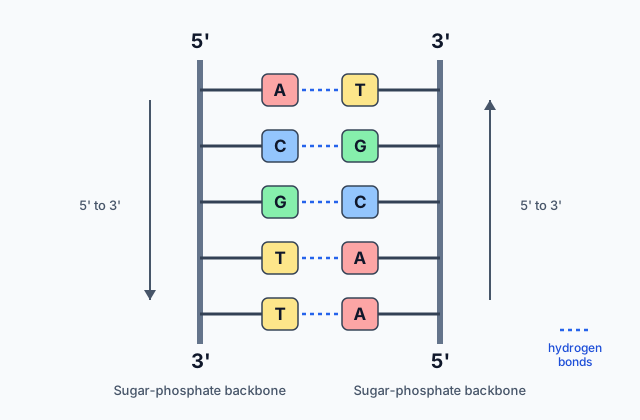 Tap to open the picture full size
Part 1 Think first Same letters, same message?
Commit to a guess first. Being wrong now makes the right idea stick better.
Predict first
The words "listen" and "silent" use exactly the same six letters. A cell's genetic molecules are built from only four kinds of units. Two such molecules each contain 1,000 units, with exactly the same number of each kind. Do they carry the same instructions?
In short. DNA and RNA store biological information in the sequence of their nucleotides, each made of a five-carbon sugar, a phosphate and a nitrogenous base, linked into strands with a 5' end and a 3' end.
- New nucleotides are added to the 3' end of a growing strand, joined by covalent bonds.
- DNA is an antiparallel double helix in which A pairs with T and C pairs with G by hydrogen bonds; in RNA, A pairs with U.
- DNA has deoxyribose and thymine and is usually double stranded; RNA has ribose and uracil and is usually single stranded.
Part 2 Learn it How DNA and RNA are built
2a. Nucleotides, and information in their order
The nucleic acids are DNA and RNA. Both are polymers, and their monomers are nucleotides.
Every nucleotide has three parts:
- a five-carbon sugar: deoxyribose in DNA, ribose in RNA;
- a phosphate group;
- a nitrogenous base: adenine (A), thymine (T), guanine (G), cytosine (C) or uracil (U).
The sugar and phosphate are the same from one nucleotide to the next, so they form the repeating backbone of the strand. The bases are what vary.
Biological information is encoded in the sequence of nucleotides: the order of the bases along the strand. ATGGCA and GCAATG contain the same bases but are different sequences, and they carry different information. That is why a strand's order, not just its makeup, is what a cell copies and reads.
Quick check · Fill the statement
Complete the description of a nucleotide.
Each nucleotide has a five-carbon , a group and a nitrogenous . The information in a nucleic acid is carried in the sequence of the bases.
2b. A strand has two different ends
Nucleotides join in a line, the phosphate of one bonded covalently to the sugar of the next. That makes a strand with two different ends, named for the carbons of the sugar.
- The 5' end ("five prime") has a phosphate attached to the 5' carbon of the sugar.
- The 3' end ("three prime") has a hydroxyl group (OH) on the 3' carbon of the sugar.
The ends matter because a strand grows in only one direction. During nucleic acid synthesis, each new nucleotide is added to the 3' end of the growing strand, forming a covalent bond between the new nucleotide and the last one. So a strand is always built from its 5' end toward its 3' end, and its sequence is written the same way: 5'-ATGC-3'.
Quick check · Multiple choice
A strand of DNA is being built, and its sequence so far is 5'-AGTC-3'. Where is the next nucleotide added?
2c. Two strands, paired and running opposite ways
DNA is usually two strands wound around each other in a double helix. The bases point into the middle, where each base on one strand pairs with a base on the other, held by hydrogen bonds.
The pairing follows a rule. In DNA, adenine pairs with thymine (A-T) and cytosine pairs with guanine (C-G). So if you know one strand's sequence, you know the other's. Where one strand has A, the other has T.
The two strands are also antiparallel: they run in opposite 5' to 3' directions. Where one strand's 5' end is at the top, the other strand's 3' end is at the top.
Put those together. The strand that pairs with 5'-ATGC-3' reads 3'-TACG-5' alongside it. Written 5' to 3', the usual way, it is 5'-GCAT-3'.
RNA pairs too, where it pairs at all, but it has uracil in place of thymine, so in RNA adenine pairs with uracil (A-U).
Quick check · Fill the statement
A model shows one DNA strand as 5'-AACG-3'. Complete the description of the strand paired with it.
Read alongside it, the paired strand is 3'--5'. It runs in the direction, so the two strands are antiparallel.
2d. How DNA and RNA differ
DNA and RNA are built the same way, nucleotides in a strand with 5' and 3' ends, but they differ in three ways.
- Sugar. DNA contains deoxyribose; RNA contains ribose. ("Deoxy" means one fewer oxygen.)
- Base. DNA contains thymine; RNA contains uracil in its place. Both have A, G and C.
- Strands. DNA is typically double stranded; RNA is typically single stranded.
These differences let you identify a sample. If a sample contains uracil and no thymine, it is RNA. If it is DNA and double stranded, its A and T must match in amount, and so must its C and G, because every A is paired with a T and every C with a G.
The details of each nucleotide's molecular structure are beyond this course. What matters is the parts, the pairing and the differences.
Quick check · Sort it
Each card describes a feature of a nucleic acid. Tap a card, then the bin it belongs in.
DNA only
RNA only
Both DNA and RNA
Part 3 Watch it done Working out the bases
Predict first, then watch each step, then finish the reasoning yourself.
A sample of double-stranded DNA is 30% adenine (A). What percentages of thymine (T), guanine (G) and cytosine (C) does it contain?
Predict first
Before you open the first step, predict: what percentage of the sample is guanine?
Step 1 · Use the A-T pairs
In double-stranded DNA every A is paired with a T, so there are exactly as many T as A. T is also 30%.
Step 2 · Find what is left
A and T together make 30% + 30% = 60%. The rest, 100% − 60% = 40%, is G and C.
Why this step?
Why must G and C split the rest evenly?
Every C is paired with a G across the two strands, so there are exactly as many of one as the other. 40% split evenly is 20% each.
Step 3 · State the answer
The sample is 30% A, 30% T, 20% G and 20% C. Check: 30 + 30 + 20 + 20 = 100.
Your step · Calculate
A different sample of double-stranded DNA is 18% cytosine (C). What percentage of it is adenine (A)?
%
Base pairing makes the two strands match, so knowing one base's share in double-stranded DNA tells you all four. It works only for double-stranded DNA: in a single strand, nothing forces A and T to match.
Part 4 Try it DNA or RNA?
A new sample. A lab finds the bases in a nucleic acid from a virus. These numbers are a teaching example.
- Adenine (A): 30%
- Uracil (U): 18%
- Guanine (G): 25%
- Cytosine (C): 27%
- Thymine (T): none
Try it · Calculate
What percentage of the sample's bases are guanine and cytosine together?
Try it · Decide and justify
Is this virus's nucleic acid double-stranded DNA?
Which reason supports your decision?
Part 5 Explain it Read a model of DNA
On the exam this is handwritten, so answer on paper first. Nothing you type here leaves this page. Then check your answer against the model and each scoring point.
Free response is 50% of the exam score. This one is shaped like Question 5, Analyze Model or Visual Representation of a Biological Concept or Process.
Free-response practice · Question 5 style
A model shows a short double-stranded DNA segment drawn flat. The left strand is labeled 5' at the top and 3' at the bottom, and reads G, A, T, C from top to bottom. The right strand is labeled 3' at the top and 5' at the bottom. Dotted lines join each base on the left strand to a base on the right strand.
(a) Describe what the 5' and 3' labels on a strand indicate.
(b) Explain why the two strands are described as antiparallel.
(c) Identify the sequence of the right strand from top to bottom.
(d) Predict at which end of the left strand, top or bottom, a new nucleotide would be added during synthesis, and justify your prediction.
Model answer
(a) They name the strand's two ends: the 5' end has a phosphate on the sugar's 5' carbon, and the 3' end has a hydroxyl group on the sugar's 3' carbon.
(b) The strands run in opposite 5' to 3' directions: the left strand runs 5' to 3' from top to bottom, and the right strand runs 3' to 5' from top to bottom.
(c) C, T, A, G (G pairs with C and A pairs with T).
(d) At the bottom, its 3' end, because during nucleic acid synthesis nucleotides are added to the 3' end of the growing strand.
Score your own answer. This is a self-check, not a grade. Tick each point your answer makes.
Part 6 Check yourself Three samples of nucleic acid
All three case questions use the table.
A lab measures the bases in three nucleic acid samples, W, X and Y. These numbers are a teaching example.
| Sample | A | T | G | C | U |
|---|---|---|---|---|---|
| W | 29 | 29 | 21 | 21 | 0 |
| X | 24 | 0 | 31 | 19 | 26 |
| Y | 33 | 19 | 22 | 26 | 0 |
Case question 1 · Multiple choice
Using the table: which sample is RNA?
Case question 2 · Decide and justify
Using the table: a student says sample Y is double-stranded DNA. Is the student right?
Which reason supports your decision?
Case question 3 · Calculate
Using the table: sample W is double-stranded DNA that is 3,000 base pairs long. How many guanine (G) nucleotides does it contain?
The rest stand on their own and do not use the case.
Check yourself · Spot the error
A student compares RNA with DNA. Tap the line with the mistake.
Check yourself · Match
Match each label on a model of DNA to what it means.
Part 7 Keep it Bring back earlier ideas
Nucleotides are joined into strands by the reaction from Topic 1.3, and the fatty acids of Topic 1.5 are worth one more look. Pulling both back up is what makes them last.
From 1.5 Lipids · Sort it
Each card describes a fatty acid or a fat. Tap a card, then the bin that describes it.
Saturated
Unsaturated
From 1.3 Introduction to Macromolecules · Put it in order
Put the events of building a chain by dehydration synthesis in order.
In three lines
- DNA and RNA store information in the sequence of their nucleotides, each a five-carbon sugar, a phosphate and a nitrogenous base.
- A strand has a 5' phosphate end and a 3' hydroxyl end, and new nucleotides are added to the 3' end by covalent bonds.
- DNA is an antiparallel double helix with A-T and C-G pairs; RNA has ribose and uracil and is usually single stranded.
Exam strategy for this topic
- Section I, Multiple Choice: 60 questions in 90 minutes.
- Section II, Free Response: 6 questions in 90 minutes.
- This lesson's Explain it is shaped like free-response question 5, Analyze Model or Visual Representation of a Biological Concept or Process.
- A four-function, scientific, or graphing calculator is allowed on both sections of the exam.
When a question gives a DNA sequence, write the paired strand base by base, label both ends, and only then reverse it if the answer must be written 5' to 3'.
Questions students ask
What are the three parts of a nucleotide?
A five-carbon sugar (deoxyribose in DNA, ribose in RNA), a phosphate group and a nitrogenous base (A, T, G, C or U).
What does antiparallel mean?
The two strands of DNA run in opposite directions: one runs 5' to 3' and its partner runs 3' to 5' alongside it.
Which bases pair in DNA and RNA?
In DNA, adenine pairs with thymine and cytosine with guanine, by hydrogen bonds. In RNA, adenine pairs with uracil.
To which end are new nucleotides added?
To the 3' end of the growing strand, forming a covalent bond with the last nucleotide.
What are the differences between DNA and RNA?
DNA has deoxyribose and thymine and is typically double stranded. RNA has ribose and uracil and is typically single stranded.
Beyond the AP Exam
College Board sets this limit on what the AP Exam asks about this topic. Anything past it is not on the exam.
The molecular structure of specific nucleotides is beyond the scope of the AP Exam.
Course alignment, for teachers
AP Biology topic 1.6, Unit 1: Chemistry of Life.
- Skill 2.A: Describe characteristics of visual representations of biological concepts and processes.
This lesson maps all 4 essential knowledge statements of the topic to the part that teaches each one: 4 are checked by a scored question. The map is in the lesson file.