Unit 2 · Topic 2.1 · about 30 minutes · 7 parts · 12 scored checks, 3 of them multiple choice, plus 2 from earlier lessons
AP Biology 2.1: Cell Structure and Function
Unit 2: 10 to 13% of the multiple-choice section
What you'll be able to do
- Explain how the structure and function of ribosomes and organelles such as the ER, Golgi complex, mitochondria, lysosomes, vacuoles and chloroplasts contribute to the work of a cell.
Key vocabulary
| Term | What it means | The exam trap |
|---|---|---|
| Ribosome | A structure made of rRNA and protein that synthesizes proteins by following the sequence of an mRNA. | Free ribosomes and ribosomes on the ER are the same kind of structure, so where a stem places a ribosome does not change what it is. |
| Endomembrane system | The membranes and membrane-bound organelles, from the nuclear envelope and ER to the Golgi complex, vesicles, lysosomes, vacuoles and plasma membrane, that work together to modify, package and transport the cell's products. | Not every membrane-bound organelle belongs to it, so check a structure against the list before you use it in an answer. |
| Golgi complex | A series of flattened membrane sacs that folds and chemically modifies newly made products and packages proteins for trafficking. | Diagrams often draw the Golgi complex right beside the ER, so label each by its shape rather than by where it sits. |
| Lysosome | A membrane-enclosed sac of hydrolytic enzymes that digests material and plays a role in programmed cell death. | Lysosomes and vacuoles look alike in drawings, so read the stem for what the sac does rather than how it looks. |
| Turgor pressure | The pressure of a plant cell's filled large vacuole pushing outward against the cell wall. | A stem about a plant wilting is often a stem about turgor pressure, so follow what happens to the water before you name an organelle. |
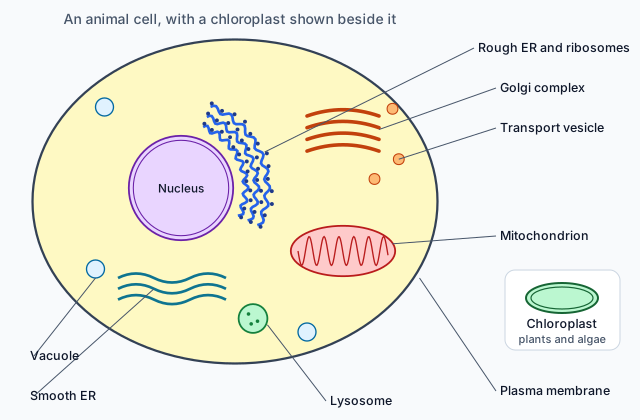 Tap to open the picture full size
Part 1 Think first Following a protein out of the cell
Commit to a guess first. Being wrong now makes the right idea stick better.
Predict first
Cells in the pancreas make digestive enzymes, which are proteins, and send them out of the cell into the gut. A biologist gives pancreas cells a few minutes' supply of amino acids that carry a harmless glowing tag, then switches them back to ordinary amino acids, so only the proteins made in those few minutes glow. Two hours later, where is most of the glow?
In short. Each part of a cell has a structure suited to a job: ribosomes build proteins, the endomembrane system modifies and ships the cell's products, mitochondria and chloroplasts handle energy, and lysosomes and vacuoles digest and store.
- Ribosomes, made of rRNA and protein with no membrane, synthesize proteins from mRNA in every form of life.
- The ER, Golgi complex, vesicles and plasma membrane work as one system that modifies, packages and transports products.
- Mitochondria and chloroplasts have double membranes; lysosomes digest material, and vacuoles store water and materials.
Part 2 Learn it The parts of a cell and their jobs
2a. Ribosomes build proteins in every cell
Every cell, from a bacterium to a neuron in your brain, has ribosomes. A ribosome is made of ribosomal RNA (rRNA) and protein. It has no membrane around it, so it is a subcellular structure, not a membrane-bound organelle.
A ribosome's job is to synthesize proteins. It follows the sequence of a messenger RNA (mRNA) and joins amino acids in the order that sequence sets.
Ribosomes are found in cells in all forms of life: Bacteria, Archaea and eukaryotes alike. That reflects the common ancestry of all known life. A structure that every lineage still carries is most simply explained as an inheritance from one ancestral cell.
In a eukaryotic cell, some ribosomes are free in the cytoplasm and others are bound to the membrane of the endoplasmic reticulum. Both kinds build proteins the same way.
Quick check · Fill the statement
Complete the description of ribosomes.
A ribosome is built from and protein. Ribosomes are found in , which reflects the common ancestry of all known life, and each one joins amino acids in the order set by the sequence of its .
2b. The endomembrane system ships the cell's products
Many of a eukaryotic cell's membranes work together as one system, the endomembrane system: the endoplasmic reticulum (ER), the Golgi complex, lysosomes, vacuoles and transport vesicles, the nuclear envelope and the plasma membrane. Together they modify, package and transport polysaccharides, lipids and proteins.
The ER is a network of membranes that gives the cell mechanical support, helping it keep its shape, and plays a role in moving materials within the cell. Rough ER has ribosomes bound to its membrane, so it helps carry out protein synthesis, and its membranes divide the cell into compartments. Smooth ER has no bound ribosomes; its jobs include synthesizing lipids and detoxifying the cell.
The Golgi complex is a series of flattened membrane sacs. It correctly folds and chemically modifies newly made products, then packages proteins for trafficking.
A protein the cell will export takes a set path. Its mRNA leaves the nucleus through the nuclear envelope. A ribosome on the rough ER builds the protein, a transport vesicle carries it to the Golgi complex to be modified and packaged, and another vesicle carries it to the plasma membrane, fuses with it and releases the protein outside.
Quick check · Put it in order
A pancreas cell makes a digestive enzyme and sends it out of the cell. Put the events in the order they happen.
2c. Mitochondria and chloroplasts have two membranes
Mitochondria carry out the reactions of aerobic cellular respiration, which make most of a eukaryotic cell's ATP. A mitochondrion has a double membrane, and the two membranes provide separate compartments for different metabolic reactions.
The two membranes are not alike. The outer membrane is smooth. The inner membrane is highly convoluted: it folds in on itself again and again. Those folds pack far more inner membrane into the same small organelle, which lets ATP be synthesized more efficiently. Cells that use ATP quickly, such as muscle cells, usually have many mitochondria.
Chloroplasts are specialized organelles found in plants and photosynthetic algae. They also have a double membrane, and they are the location of photosynthesis. Most plant cells have mitochondria as well: chloroplasts capture energy from light, and mitochondria release energy from sugars for the cell's work.
Quick check · Multiple choice
Mitochondria from a hummingbird's flight muscles have inner membranes with many more folds than mitochondria from the same bird's skin cells. Which explanation is best supported?
2d. Lysosomes digest and vacuoles store
Lysosomes are membrane-enclosed sacs that contain hydrolytic enzymes, enzymes that break molecules apart by hydrolysis. A lysosome digests material: particles the cell has taken in, worn-out organelles, and molecules the cell no longer needs. Lysosomes also play a role in programmed cell death, or apoptosis, the orderly way a cell destroys itself when it is damaged or no longer needed.
Vacuoles are membrane-bound sacs that play many different roles, and plant and animal cells use them differently. In a plant cell, one specialized large vacuole stores water and nutrients. As it fills, it presses outward against the cell wall. That pressure, turgor pressure, keeps the cell firm and helps hold the plant upright. In an animal cell, vacuoles are smaller and more plentiful than in a plant cell, and they store cellular materials.
Quick check · Sort it
Each card describes a membrane sac doing its job. Tap a card, then the kind of sac it describes.
A lysosome
A plant cell's large vacuole
An animal cell's vacuole
Part 3 Watch it done Which cell makes the lipid?
Predict first, then watch each step, then finish the reasoning yourself.
A biologist measures what percentage of each cell's volume is rough ER and what percentage is smooth ER, in two types of cell from the same animal.
- Cell type P: rough ER 20%, smooth ER 2%
- Cell type Q: rough ER 3%, smooth ER 15%
These numbers are a teaching example, not a published study. One cell type exports large amounts of a digestive enzyme, a protein. The other makes large amounts of a steroid hormone, a lipid. Which is which?
Predict first
Before you open the first step, predict: which cell type makes the steroid hormone?
Step 1 · Compare the two kinds of ER in each cell
In P, rough ER is 20% of the cell and smooth ER is 2%, so P has 20 divided by 2, or 10 times as much rough ER as smooth ER. In Q, smooth ER is 15% and rough ER is 3%, so Q has 15 divided by 3, or 5 times as much smooth ER as rough ER.
Why this step?
Why compare the two kinds of ER instead of the total amount of ER?
P has 22% ER in all and Q has 18%, which are close. The two kinds of ER do different jobs, so how much of each kind a cell has is what points to its product.
Step 2 · Link each kind of ER to its job
Rough ER has bound ribosomes and helps carry out protein synthesis. Smooth ER synthesizes lipids. A cell that makes a lot of one product needs a lot of the membrane that makes it.
Your step · Decide and justify
Which cell type is more likely the one that makes the steroid hormone?
Which reason supports your decision?
Each kind of ER points to a different product: rough ER to proteins, smooth ER to lipids. The pancreas cells in Think first are like cell type P: their rough ER builds the enzymes the Golgi complex then packages for export.
Part 4 Try it Lysosomes that cannot finish the job
A new cell, a new question. In some inherited conditions, a cell lacks one of the hydrolytic enzymes its lysosomes normally contain. A biologist compares cells grown with and without that enzyme. These numbers are a teaching example.
- Normal cells: lysosomes take up 2% of the cell's volume
- Cells lacking the enzyme: lysosomes take up 18% of the cell's volume
Try it · Calculate
In the cells lacking the enzyme, the lysosomes take up how many times as much of the cell's volume as in normal cells?
Try it · Decide and justify
Which explanation fits the larger lysosomes in the cells lacking the enzyme?
Which reason supports your decision?
Part 5 Explain it A blocked shipping route
On the exam this is handwritten, so answer on paper first. Nothing you type here leaves this page. Then check your answer against the model and each scoring point.
Free response is 50% of the exam score. This one is shaped like Question 4, Conceptual Analysis.
Free-response practice · Question 4 style
A drug stops transport vesicles from leaving the endoplasmic reticulum. A pancreas cell that exports a digestive enzyme is treated with the drug.
(a) Describe the role of the Golgi complex in producing a protein that the cell exports.
(b) Explain how the structure of rough ER lets it help carry out protein synthesis.
(c) Predict where in the treated cell the newly made digestive enzyme will build up.
(d) Justify your prediction in (c).
Model answer
(a) The Golgi complex receives newly made proteins from the ER, correctly folds and chemically modifies them, and packages them for trafficking to the plasma membrane.
(b) Rough ER has ribosomes bound to its membrane, and ribosomes synthesize proteins from mRNA, so proteins are made right at the ER.
(c) In the rough ER.
(d) The enzyme is made by ribosomes on the rough ER and normally leaves the ER in transport vesicles bound for the Golgi complex. With no vesicles leaving, the enzyme cannot reach the Golgi or the plasma membrane, so it stays where it was made.
Score your own answer. This is a self-check, not a grade. Tick each point your answer makes.
Part 6 Check yourself Three cells, three jobs
All three case questions use the table.
A student counts structures in three cells, each from a different tissue of a plant or an animal. These numbers are a teaching example.
| Cell | Chloroplasts per cell | Large central vacuole | Mitochondria per cell |
|---|---|---|---|
| X | 0 | No | 1,600 |
| Y | 50 | Yes | 200 |
| Z | 0 | Yes | 150 |
Case question 1 · Calculate
Using the table: cell X has how many times as many mitochondria as cell Y?
Case question 2 · Multiple choice
Using the table: which cell is most likely a plant cell that does not carry out photosynthesis?
Case question 3 · Multiple choice
Using the table: which claim best explains why cell X has far more mitochondria than the other two cells?
The rest stand on their own and do not use the case.
Check yourself · Spot the error
A student describes ribosomes. Tap the line with the mistake.
Check yourself · Match
Match each cell part to its description.
Part 7 Keep it Bring back earlier ideas
Ribosomes join amino acids into proteins, and smooth ER builds lipids. Both ideas come from Unit 1, and pulling them back up is what makes them last.
From 1.7 Proteins · Fill the statement
Complete the description of how two amino acids are joined.
A peptide bond forms between the group of one amino acid and the group of the next. The part of each amino acid that differs from one amino acid to another is its .
From 1.5 Lipids · Match
Match each lipid to its function.
In three lines
- Ribosomes, made of rRNA and protein with no membrane, build proteins from mRNA in every form of life, which reflects common ancestry.
- The ER, Golgi complex, vesicles and plasma membrane modify, package and transport products; rough ER makes proteins and smooth ER makes lipids.
- Mitochondria (folded inner membrane) and chloroplasts have double membranes; lysosomes digest, and vacuoles store water and materials.
Exam strategy for this topic
- Section I, Multiple Choice: 60 questions in 90 minutes.
- Section II, Free Response: 6 questions in 90 minutes.
- This lesson's Explain it is shaped like free-response question 4, Conceptual Analysis.
- A four-function, scientific, or graphing calculator is allowed on both sections of the exam.
When a stem describes what a cell makes or does, name the part whose structure fits that job and the feature that does it, such as the bound ribosomes of rough ER or the folded inner membrane of a mitochondrion.
Questions students ask
Are ribosomes organelles?
Ribosomes are subcellular structures made of rRNA and protein, with no membrane. Because they need no membrane, they are found in every form of life, bacteria included.
What is the difference between rough ER and smooth ER?
Rough ER has ribosomes bound to its membrane and helps carry out protein synthesis. Smooth ER has no bound ribosomes; it synthesizes lipids and detoxifies the cell.
What does the Golgi complex do?
It correctly folds and chemically modifies newly made products and packages proteins for trafficking, such as to the plasma membrane for release from the cell.
Why is the inner membrane of a mitochondrion folded?
The folds pack much more inner membrane into the organelle, which lets ATP be synthesized more efficiently. The outer membrane is smooth.
Do plant cells have mitochondria as well as chloroplasts?
Yes. Chloroplasts carry out photosynthesis, and mitochondria carry out aerobic respiration, which releases energy from sugar as ATP.
Course alignment, for teachers
AP Biology topic 2.1, Unit 2: Cells.
- Skill 1.A: Describe biological concepts and processes.
This lesson maps all 8 essential knowledge statements of the topic to the part that teaches each one: 8 are checked by a scored question. The map is in the lesson file.