Unit 2 · Topic 2.2 · about 30 minutes · 7 parts · 12 scored checks, 3 of them multiple choice, plus 2 from earlier lessons
AP Biology 2.2: Cell Size
Unit 2: 10 to 13% of the multiple-choice section
What you'll be able to do
- Explain how the surface area-to-volume ratio of a cell or an organism affects its exchange of materials and heat with the environment.
Key vocabulary
| Term | What it means | The exam trap |
|---|---|---|
| Surface area-to-volume ratio | A cell's or an organism's surface area divided by its volume. | Area and volume have different units, such as µm² and µm³, so write the units into the ratio and check which quantity is on top. |
| Surface area | The total area of an object's outer surface; for a cell, the area of its plasma membrane. | Check whether a stem gives a total area or an area for each unit of volume or mass before you compare two objects. |
| Volume | The space an object takes up; for a cell, the cytoplasm its membrane must supply. | Volumes are in cubed units, such as µm³, so keep them apart from areas, in squared units, when you set up a calculation. |
| Metabolic rate | The rate at which an organism uses energy, often measured as the oxygen it uses in a set time. | Data may give a whole-body rate or a rate per kilogram, so read the column heading before you compare animals. |
 Tap to open the picture full size
Part 1 Think first Who gets cold faster?
Commit to a guess first. Being wrong now makes the right idea stick better.
Predict first
A newborn baby and an adult sit in the same cool room for an hour with no blankets. Both start at the same body temperature. For each kilogram of body mass, who loses heat to the room faster?
In short. A cell exchanges materials and heat across its surface, but its needs grow with its volume, so the ratio of surface area to volume decides how well it can keep up.
- As a cell grows, its volume grows faster than its surface area, so its surface area-to-volume ratio falls.
- Long, thin or flattened shapes and membrane folds add surface area without adding much volume.
- Smaller organisms exchange heat faster per unit of mass and typically have a higher metabolic rate per unit of body mass.
Part 2 Learn it Surface area, volume and exchange
2a. Exchange happens at the surface
Everything a cell takes in or gets rid of crosses its plasma membrane: nutrients in, wastes out, heat in or out. The cell's needs, though, come from its whole volume, every bit of cytoplasm that must be supplied.
So what matters is the surface area-to-volume ratio: surface area divided by volume. It affects a biological system's ability to obtain nutrients, eliminate wastes, take in or give off thermal energy, and exchange chemicals and energy with its environment.
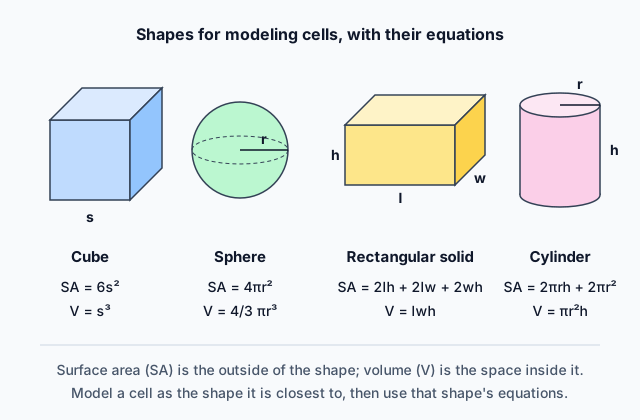
Biologists model cells as simple shapes. The equations you will use are these:
- Cube with side s: SA = 6s², V = s³
- Sphere with radius r: SA = 4πr², V = 4/3 πr³
- Rectangular solid: SA = 2lh + 2lw + 2wh, V = lwh
- Cylinder: SA = 2πrh + 2πr², V = πr²h
For a cube 1 µm on a side, SA is 6 µm² and V is 1 µm³, so the ratio is 6 per µm. Always find the area and the volume first, then divide area by volume.
Quick check · Calculate
A cell is modeled as a cube 2 µm on a side. What is its surface area-to-volume ratio, in µm² of surface per µm³ of volume?
2b. Bigger cells have less surface for each unit of volume
Surface area grows with the square of a cell's length, and volume grows with the cube. Double a cube's side and its surface area becomes 4 times as large, but its volume becomes 8 times as large. Its surface area-to-volume ratio halves.
That is why the ratio restricts cell size. Smaller cells typically have a higher surface area-to-volume ratio and a more efficient exchange of materials with the environment than larger cells. As a cell increases in volume, its ratio decreases while its demand for internal resources increases: more cytoplasm to supply, served by relatively less membrane.
For a cube the ratio works out to 6/s, and for a sphere to 3/r. Those shortcuts follow from the equations, so you can always check them by working out the area and the volume.
Quick check · Rank it
Four cells are modeled as simple shapes. Rank them by surface area-to-volume ratio.
Highest ratio first
Give each one a place, 1 for first. Give two the same place if they are equal.
Your ranking: none yet
2c. Shape and folds add surface
The surface area of the plasma membrane must be large enough to exchange materials adequately, so the surface area-to-volume ratio restricts a cell's shape as well as its size.
Two cells with the same volume can have very different surface areas. A long, thin cell or a flattened one has more surface than a round cell holding the same volume, because none of its cytoplasm is far from the membrane.
A cell that exchanges a lot of material may also need more complex structures, such as folds in its membrane. Cells lining your small intestine absorb nutrients through a membrane covered in tiny fingerlike folds. The folds add a great deal of surface area while adding very little volume, so the ratio rises.
Quick check · Multiple choice
Cells lining the small intestine absorb nutrients from digested food, and the side of each cell that faces the food is covered in tiny fingerlike folds of membrane. How do the folds help the cell?
2d. Body size, heat and metabolic rate
The same geometry applies to whole organisms. As organisms increase in size, their surface area-to-volume ratio decreases, and that affects properties like the rate of heat exchange with the environment.
Smaller amounts of mass exchange proportionally more heat with the surroundings than larger masses do. As mass increases, both the surface area-to-volume ratio and the rate of heat exchange decrease. A mouse loses heat through its skin far faster, for each gram of body, than an elephant does.
That links to energy use. There is a relationship between metabolic rate per unit body mass and the size of multicellular organisms: typically, the smaller the organism, the higher its metabolic rate per unit body mass. A small mammal that loses heat quickly has to release energy quickly to stay warm.
Careful with the word "total." An elephant has far more skin, far more volume and a far higher whole-body energy use than a mouse. It is the amounts for each unit of mass or volume that are higher in the mouse.
Quick check · Sort it
Compare a mouse with an elephant. Tap each card, then the animal in which that quantity is higher.
Higher in the mouse
Higher in the elephant
Part 3 Watch it done Doubling a cell's side
Predict first, then watch each step, then finish the reasoning yourself.
Two cells are modeled as cubes. Cell 1 is 10 µm on a side. Cell 2 is 20 µm on a side. How does the surface area-to-volume ratio change when the side doubles?
Predict first
Before you open the first step, predict: what happens to the ratio when the side doubles?
Step 1 · Find cell 1's area and volume
SA = 6s² = 6 × 10² = 600 µm². V = s³ = 10³ = 1,000 µm³. The ratio is 600 divided by 1,000, which is 0.6 per µm.
Why this step?
Why work out the ratio instead of comparing surface areas?
Cell 2 will have more surface area than cell 1, but it also has more cytoplasm to supply. The ratio says how much membrane serves each cubic micrometer, which is what decides whether exchange keeps up.
Step 2 · Find cell 2's area and volume
SA = 6 × 20² = 2,400 µm², 4 times cell 1's. V = 20³ = 8,000 µm³, 8 times cell 1's. Doubling the side made the area 4 times as large but the volume 8 times as large.
Your step · Calculate
What is cell 2's surface area-to-volume ratio, in µm² per µm³?
per µm
Cell 2 has half as much membrane for each cubic micrometer of cytoplasm. Its demand for resources grew eightfold while its surface grew only fourfold, which is why a cell that keeps growing reaches a size where exchange cannot keep up.
Part 4 Try it Agar cubes in dye
A new model, a new question. A class cuts cubes of agar jelly 1 cm, 2 cm and 3 cm on a side and soaks them in a dye. In 10 minutes the dye moves 0.5 cm into each cube from every face. The part it has not reached is a smaller cube in the center. These numbers are a teaching example.
- 1 cm cube: the dye reaches the center, so 100% of the cube is colored
- 2 cm cube: an uncolored center 1 cm on a side is left, so 87.5% of the cube is colored
Try it · Calculate
What percentage of the 3 cm cube's volume is colored after 10 minutes? Give your answer to the nearest whole percent.
Try it · Decide and justify
A classmate says the 3 cm cube took in the most dye, so it is the best model of a cell that exchanges materials well. Is the classmate right?
Which reason supports your decision?
Part 5 Explain it Same volume, different shapes
On the exam this is handwritten, so answer on paper first. Nothing you type here leaves this page. Then check your answer against the model and each scoring point.
Free response is 50% of the exam score. This one is shaped like Question 6, Analyze Data.
Free-response practice · Question 6 style
A biologist compares three cells. These numbers are a teaching example.
- Cell A, round: volume 1,000 µm³, surface area 484 µm²
- Cell B, flattened disk: volume 1,000 µm³, surface area 900 µm²
- Cell C, round: volume 8,000 µm³, surface area 1,934 µm²
(a) Calculate the surface area-to-volume ratio of cell B.
(b) Identify the cell with the lowest surface area-to-volume ratio.
(c) Explain how cell B's shape affects its exchange of materials compared with cell A.
(d) Predict how cell A's demand for internal resources and its ability to supply them would change if it grew to the size of cell C, and justify your prediction.
Model answer
(a) 900 divided by 1,000 is 0.9 per µm.
(b) Cell C, at 1,934 divided by 8,000, or about 0.24 per µm (cell A is about 0.48 per µm).
(c) Cell B has the same volume as A but nearly twice the surface area, so it has more membrane for each unit of volume and can exchange materials with its environment more efficiently.
(d) Its demand would rise eightfold, with its volume, but its surface area would rise only about fourfold, so its ratio would halve. Exchange across the membrane would no longer keep up as well with what the cell needs.
Score your own answer. This is a self-check, not a grade. Tick each point your answer makes.
Part 6 Check yourself Body size and oxygen use
All three case questions use the table.
A biologist measures how much oxygen four mammals use at rest, a measure of metabolic rate, and divides by each animal's body mass. These numbers are a teaching example.
| Animal | Body mass (kg) | Oxygen used (mL per kg per hour) |
|---|---|---|
| Mouse | 0.02 | 1,600 |
| Rat | 0.3 | 900 |
| Dog | 10 | 350 |
| Horse | 500 | 120 |
Case question 1 · Calculate
Using the table: the mouse's oxygen use per kilogram is how many times the horse's? Give your answer to the nearest whole number.
Case question 2 · Multiple choice
Using the table: which statement best describes the pattern in the data?
Case question 3 · Multiple choice
Using the table: which explanation best accounts for the mouse's high oxygen use per kilogram?
The rest stand on their own and do not use the case.
Check yourself · Spot the error
A student explains what happens as a cube-shaped cell grows. Tap the line with the mistake.
Check yourself · Fill the statement
Complete the comparison of two cells with the same volume.
Cell 1 is round. Cell 2 is long and thin, with folds in its membrane. Cell 2 has the surface area-to-volume ratio, so it can exchange materials efficiently with its environment.
Part 7 Keep it Bring back earlier ideas
The folds of the inner mitochondrial membrane and water's resistance to temperature change both return here. Pulling them back up is what makes them last.
From 2.1 Cell Structure and Function · Multiple choice
Mitochondria from a hummingbird's flight muscles have inner membranes with many more folds than mitochondria from the same bird's skin cells. Which explanation is best supported?
From 1.1 Structure of Water and Hydrogen Bonding · Multiple choice
A jellyfish and a dry rock sit in the same sunlight on a warm afternoon. The jellyfish's temperature rises much more slowly than the rock's. Which explanation is best supported?
In three lines
- A cell exchanges materials and heat across its surface but must supply its whole volume, so its surface area-to-volume ratio limits its size and shape.
- As a cell grows, volume rises faster than area and the ratio falls; thin shapes and membrane folds add surface without much volume.
- Smaller organisms exchange heat faster per unit of mass and typically have a higher metabolic rate per unit of body mass.
Exam strategy for this topic
- Section I, Multiple Choice: 60 questions in 90 minutes.
- Section II, Free Response: 6 questions in 90 minutes.
- This lesson's Explain it is shaped like free-response question 6, Analyze Data.
- A four-function, scientific, or graphing calculator is allowed on both sections of the exam.
Before comparing two cells or animals, work out the surface area and the volume separately with the given equations, divide area by volume, and then say what the ratio means for exchange or heat loss.
Questions students ask
Why are most cells so small?
As a cell grows, its volume rises faster than its surface area, so its surface area-to-volume ratio falls and its membrane can no longer exchange materials fast enough for all of its cytoplasm.
How do you calculate the surface area-to-volume ratio of a cube?
Find the surface area with SA = 6s² and the volume with V = s³, then divide the area by the volume. For a cube 2 µm on a side, that is 24 divided by 8, or 3 per µm.
Does a bigger cell have more surface area?
Yes, in total. But it has less surface area for each unit of volume, and that ratio is what decides how well it can exchange materials.
Why do small animals have higher metabolic rates per kilogram?
A small body has a high surface area-to-volume ratio, so it exchanges heat with its surroundings faster per unit of mass. It must release energy faster per kilogram to keep its body warm.
Course alignment, for teachers
AP Biology topic 2.2, Unit 2: Cells.
- Skill 2.D: Represent relationships within biological models, including mathematical models, diagrams, flowcharts, and systems.
- Skill 5.A: Perform mathematical calculations, including:
This lesson maps all 2 essential knowledge statements of the topic to the part that teaches each one: 2 are checked by a scored question. The map is in the lesson file.