Unit 2 · Topic 2.10 · about 30 minutes · 7 parts · 11 scored checks, 3 of them multiple choice, plus 2 from earlier lessons
AP Biology 2.10: Origins of Cell Compartmentalization
Unit 2: 10 to 13% of the multiple-choice section
What you'll be able to do
- Describe similarities and differences in compartmentalization between prokaryotic and eukaryotic cells, and how mitochondria and chloroplasts evolved by endosymbiosis.
Key vocabulary
| Term | What it means | The exam trap |
|---|---|---|
| Endosymbiosis | One organism living inside another; in cell evolution, the engulfing of free-living prokaryotes that became mitochondria and chloroplasts. | A stem may describe the engulfing without naming it, so look for a cell that lives inside another and is passed on. |
| Prokaryote | A single-celled organism, a bacterium or an archaeon, whose cells typically lack a nucleus and other membrane-bound organelles. | Typically is part of the description, so avoid absolute claims about every prokaryote's interior. |
| Eukaryote | An organism whose cells have a nucleus and other membrane-bound organelles. | Eukaryotes include single-celled organisms such as yeast, so being single-celled does not make an organism a prokaryote. |
| Nucleoid | The region of a prokaryotic cell where its DNA is gathered, with no membrane around it. | A nucleoid and a nucleus both hold DNA, so check for a surrounding membrane before you name which one a cell has. |
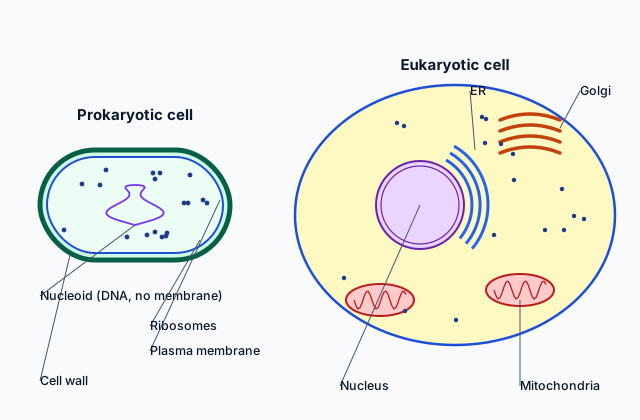 Tap to open the picture full size
Part 1 Think first A cell without mitochondria
Commit to a guess first. Being wrong now makes the right idea stick better.
Predict first
Mitochondria carry their own small loop of DNA, and they multiply inside a cell by growing and splitting in two. Suppose a cell somehow lost every one of its mitochondria. Could it build new ones?
In short. Mitochondria and chloroplasts evolved from once free-living prokaryotic cells by endosymbiosis; prokaryotes typically lack membrane-bound organelles but still have specialized internal regions, while eukaryotic cells keep internal membranes that partition them.
- Membrane-bound organelles such as mitochondria and chloroplasts evolved from once free-living prokaryotic cells via endosymbiosis.
- Prokaryotes typically lack internal membrane-bound organelles but have internal regions with specialized structures and functions.
- Eukaryotic cells maintain internal membranes that partition the cell into specialized regions.
Part 2 Learn it Where compartments came from
2a. Endosymbiosis
Membrane-bound organelles such as mitochondria and chloroplasts evolved from once free-living prokaryotic cells via endosymbiosis: one cell came to live inside another.
The story runs like this. A larger ancestral cell engulfed a free-living prokaryote, wrapping it in a piece of its own membrane. The engulfed cell was not digested. It survived inside, and the two came to depend on each other: the guest supplied energy, the host supplied shelter and raw materials. Over many generations the guest's descendants became mitochondria. Later, in the line that led to plants and algae, a cell that already had mitochondria engulfed a photosynthetic prokaryote, which became the chloroplast.
The organelles still carry clues to that past. Each has a double membrane, as one cell living inside another might. Each has its own DNA and its own ribosomes, which resemble a prokaryote's more than the rest of the cell's. And each multiplies by splitting in two, as a prokaryote does.
Quick check · Put it in order
Put the events of the origin of mitochondria by endosymbiosis in order.
2b. Prokaryotes: regions without membranes
Prokaryotic cells, bacteria and archaea, typically lack internal membrane-bound organelles. They have no nucleus, no ER, no mitochondria.
But "no membrane-bound organelles" does not mean "no organization." Prokaryotes have internal regions with specialized structures and functions:
- their DNA is gathered in a region called the nucleoid, with no membrane around it
- their ribosomes build proteins in the cytoplasm
- their plasma membrane carries out reactions, and in some prokaryotes it folds inward to give more surface for them
What prokaryotic and eukaryotic cells share is the core: a plasma membrane, cytoplasm, ribosomes and DNA. Ribosomes are found in all forms of life, which reflects common ancestry. What differs is whether membranes divide the inside of the cell.
Quick check · Sort it
Tap each structure, then the kinds of cell that have it.
Prokaryotic cells only
Eukaryotic cells only
Both
2c. Eukaryotes: a partitioned cell
Eukaryotic cells maintain internal membranes that partition the cell into specialized regions: the nucleus, the endoplasmic reticulum, the Golgi complex, lysosomes, vacuoles, mitochondria and, in plants and algae, chloroplasts.
Those membranes have two different histories. Mitochondria and chloroplasts arose by endosymbiosis, so their double membranes trace back to engulfed prokaryotes. The rest of the internal membranes, the endomembrane system, did not come from engulfed cells.
So the comparison is this. Both kinds of cell carry out specialized functions in specialized places. A prokaryote does it in regions of one open cytoplasm and on its plasma membrane. A eukaryote does it inside membrane-bound compartments, which keep competing reactions apart and add surface area, as the last lesson showed.
Quick check · Multiple choice
Which statement best compares compartmentalization in prokaryotic and eukaryotic cells?
Part 3 Watch it done Which clues count?
Predict first, then watch each step, then finish the reasoning yourself.
A student lists four facts about mitochondria:
- They have their own DNA.
- They multiply by growing and splitting in two.
- They make most of a eukaryotic cell's ATP.
- Their ribosomes resemble a prokaryote's ribosomes.
Which of these facts support the claim that mitochondria evolved from once free-living prokaryotes?
Predict first
Before you open the first step, predict: does the fact that mitochondria make ATP support the claim?
Step 1 · Ask what the model predicts
If mitochondria were once free-living prokaryotes, they should still carry features of independent prokaryotic cells: their own genetic material, their own protein-making machinery, and their own way of multiplying.
Step 2 · Check the first, second and fourth facts
Their own DNA, splitting in two, and prokaryote-like ribosomes are each a feature of an independent prokaryotic cell that the rest of the eukaryotic cell does not explain. All three fit the model.
Why this step?
Why does it matter whether a fact is something only a former free-living cell would have?
Evidence supports a claim when the claim explains it better than the alternative. A feature any organelle could have, whatever its origin, does not favor one history over another.
Your step · Decide and justify
Does the fact that mitochondria make most of the cell's ATP, on its own, support the claim that they were once free-living prokaryotes?
Which reason supports your decision?
The strongest clues are the ones only a former free-living cell explains: its own DNA, its own prokaryote-like ribosomes and multiplying by splitting. The same clues are found in chloroplasts, which is why both are traced to engulfed prokaryotes.
Part 4 Try it An antibiotic's side effect
A new piece of evidence. Some antibiotics kill bacteria by blocking their ribosomes. A biologist treats human cells with one of them and measures protein made per hour by the cell's main ribosomes, in the cytoplasm, and by the ribosomes inside its mitochondria. These numbers are a teaching example.
- Cytoplasmic ribosomes: 5,000 units without the antibiotic, 4,900 with it
- Mitochondrial ribosomes: 240 units without the antibiotic, 72 with it
Try it · Calculate
By what percentage did the antibiotic lower protein synthesis by the mitochondrial ribosomes?
Try it · Decide and justify
Do these results support the claim that mitochondria evolved from free-living prokaryotes?
Which reason supports your decision?
Part 5 Explain it A model of endosymbiosis
On the exam this is handwritten, so answer on paper first. Nothing you type here leaves this page. Then check your answer against the model and each scoring point.
Free response is 50% of the exam score. This one is shaped like Question 5, Analyze Model or Visual Representation of a Biological Concept or Process.
Free-response practice · Question 5 style
A textbook diagram shows a large cell engulfing a small prokaryote. In the next panel, the prokaryote sits inside the large cell surrounded by two membranes, and in the last panel it is labeled "mitochondrion."
(a) Describe the process the diagram represents.
(b) Identify one feature of modern mitochondria, other than the double membrane, that supports the model.
(c) Explain how a prokaryotic cell carries out specialized functions without membrane-bound organelles.
(d) Describe one difference in compartmentalization between the large cell's descendants, eukaryotic cells, and prokaryotic cells.
Model answer
(a) Endosymbiosis: a free-living prokaryote was engulfed by a larger cell, survived inside it, and over many generations became an organelle, the mitochondrion.
(b) Mitochondria have their own DNA (or their own ribosomes resembling a prokaryote's, or they multiply by splitting in two).
(c) It has internal regions with specialized structures and functions, such as a nucleoid region where its DNA is gathered and ribosomes that make proteins, without membranes around them.
(d) Eukaryotic cells maintain internal membranes that partition the cell into specialized compartments, such as the nucleus and mitochondria, while prokaryotic cells typically lack internal membrane-bound organelles.
Score your own answer. This is a self-check, not a grade. Tick each point your answer makes.
Part 6 Check yourself Three unknown cells
All three case questions use the table.
A student examines three cells from different organisms and records which structures each one has.
| Structure | Cell 1 | Cell 2 | Cell 3 |
|---|---|---|---|
| Plasma membrane | Yes | Yes | Yes |
| Ribosomes | Yes | Yes | Yes |
| Nucleus with a nuclear envelope | No | Yes | Yes |
| Mitochondria | No | Yes | Yes |
| Chloroplasts | No | No | Yes |
Case question 1 · Multiple choice
Using the table: which cell is most likely prokaryotic?
Case question 2 · Decide and justify
Using the table: a classmate says cell 1 cannot carry out any specialized functions in particular places, because it has no membrane-bound organelles. Is the classmate right?
Which reason supports your decision?
Case question 3 · Multiple choice
Using the table: which cell carries organelles that trace back to two different free-living prokaryotes?
The rest stand on their own and do not use the case.
Check yourself · Spot the error
A student explains where a eukaryotic cell's internal membranes came from. Tap the line with the mistake.
Check yourself · Fill the statement
Complete the comparison of prokaryotic and eukaryotic cells.
Prokaryotes typically lack internal organelles but have internal regions with specialized functions, such as the , where their DNA is gathered. Eukaryotic cells maintain internal that partition the cell into specialized regions.
Part 7 Keep it Bring back earlier ideas
Ribosomes in every form of life, from 2.1, and the compartments of the last lesson are both part of this story. Pulling them back up is what makes them last.
From 2.9 Cell Compartmentalization · Fill the statement
Complete the description of what internal membranes do.
Internal membranes facilitate cellular processes by minimizing interactions and by increasing the where reactions can occur.
From 2.1 Cell Structure and Function · Spot the error
A student describes ribosomes. Tap the line with the mistake.
In three lines
- Mitochondria and chloroplasts evolved from once free-living prokaryotic cells by endosymbiosis; their double membranes, own DNA and own ribosomes are clues.
- Prokaryotes typically lack internal membrane-bound organelles but have internal regions, such as the nucleoid, with specialized structures and functions.
- Eukaryotic cells maintain internal membranes that partition the cell into specialized regions.
Exam strategy for this topic
- Section I, Multiple Choice: 60 questions in 90 minutes.
- Section II, Free Response: 6 questions in 90 minutes.
- This lesson's Explain it is shaped like free-response question 5, Analyze Model or Visual Representation of a Biological Concept or Process.
- A four-function, scientific, or graphing calculator is allowed on both sections of the exam.
To support endosymbiosis, name a feature only a former free-living cell explains, such as the organelle's own DNA, its prokaryote-like ribosomes or its multiplying by splitting, and say why the model predicts it.
Questions students ask
What is the endosymbiotic theory?
The explanation that mitochondria and chloroplasts evolved from once free-living prokaryotic cells that were engulfed by a larger cell, survived inside it, and over many generations became organelles.
What evidence supports endosymbiosis?
Mitochondria and chloroplasts have double membranes, their own DNA, ribosomes that resemble a prokaryote's, and they multiply by splitting in two, much as prokaryotes do.
Do prokaryotes have organelles?
They typically lack membrane-bound organelles, but they have ribosomes and internal regions with specialized functions, such as the nucleoid, where their DNA is gathered.
How is compartmentalization different in eukaryotes and prokaryotes?
Eukaryotic cells maintain internal membranes that partition them into specialized regions. Prokaryotes carry out specialized functions in regions of one open cytoplasm and on their plasma membrane.
Course alignment, for teachers
AP Biology topic 2.10, Unit 2: Cells.
- Skill 6.B: Support a claim with evidence from biological principles, concepts, processes, and data.
This lesson maps all 3 essential knowledge statements of the topic to the part that teaches each one: 3 are checked by a scored question. The map is in the lesson file.