Unit 3 · Topic 3.1 · about 30 minutes · 7 parts · 12 scored checks, 3 of them multiple choice, plus 2 from earlier lessons
AP Biology 3.1: Enzymes
Unit 3: 12 to 16% of the multiple-choice section
What you'll be able to do
- Explain how enzymes affect the rate of biological reactions, by lowering the activation energy and by binding only substrates whose shape and charge fit the active site.
Key vocabulary
| Term | What it means | The exam trap |
|---|---|---|
| Enzyme | The kind of molecule that speeds up a particular chemical reaction in a cell. | Stems often name an enzyme by the reaction it catalyzes, so find the substrate in the stem before you reason about the enzyme. |
| Activation energy | The energy that must be put in for a chemical reaction to start. | On an energy diagram, measure it from the reactants up to the peak, not from the products and not from zero. |
| Substrate | The molecule an enzyme acts on. | A substrate need not be a protein; the enzyme is the protein, so keep the two roles apart when a stem describes both. |
| Active site | The region of an enzyme where the substrate binds. | The active site is part of the enzyme, so a mutation that alters it is a change to the enzyme, not to the substrate. |
| Enzyme-substrate complex | An enzyme and its substrate bound together at the active site. | A model of the complex shows one moment of a series; read its arrows to see which moment a question is asking about. |
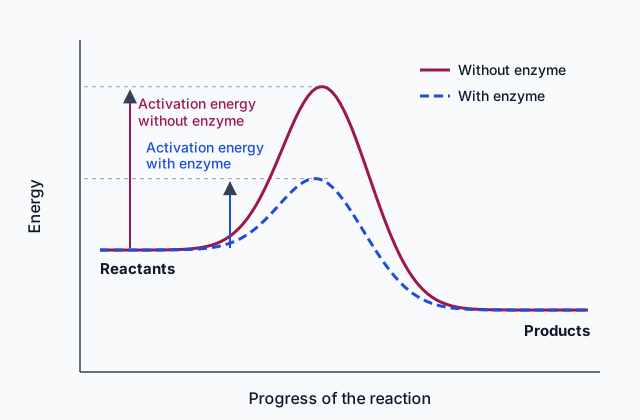 Tap to open the picture full size
Part 1 Think first The potato that fizzes twice
Commit to a guess first. Being wrong now makes the right idea stick better.
Predict first
Hydrogen peroxide from a pharmacy breaks down into water and oxygen so slowly that a bottle lasts for months. Drop a slice of raw potato into a cup of it and the slice fizzes with oxygen bubbles at once, because potato cells contain an enzyme that speeds up this reaction. When the fizzing dies down, a student rinses the slice and drops it into a fresh cup of hydrogen peroxide. What happens?
In short. An enzyme is a protein that speeds up a chemical reaction in a cell by lowering the activation energy, and it acts only on a substrate whose shape and charge fit its active site.
- Enzymes are biological catalysts: they speed up a reaction and come out of it unchanged, ready to act again.
- An enzyme lowers the activation energy of a reaction; it does not add energy or change how much energy the reaction releases.
- The substrate binds the active site, forming an enzyme-substrate complex, only when its shape and charge are compatible with the site.
Part 2 Learn it How enzymes speed up reactions
2a. Enzymes are biological catalysts
Many chemical reactions run in a cell at once, and most of them would be far too slow at body temperature on their own. Enzymes make them fast enough to keep the cell alive.
Enzymes are proteins that act as biological catalysts: they facilitate chemical reactions, making them happen much faster. A catalyst comes out of the reaction it speeds up unchanged. So an enzyme is not used up: one enzyme molecule can catalyze the same reaction again and again.
Because enzymes decide which reactions run fast, their structure and function contribute to the regulation of biological processes. A cell can control a process by controlling its enzymes: making more of one, making less, or changing how active it is. You will see that control again and again in this course, from the energy pathways in this unit to cell signaling.
Quick check · Fill the statement
Complete the description of an enzyme.
An enzyme is a that acts as a biological : it speeds up a chemical reaction and is by that reaction.
2b. Lowering the activation energy
Even a reaction that releases energy needs a push to get started. Bonds in the reactants have to be strained or broken before new ones can form, and that takes an input of energy called the activation energy. Look at the diagram at the top of the page: the reactants have to get over a hill before they can reach the products.
At a given temperature, only some colliding molecules have enough energy to get over that hill, so a reaction with a tall hill is slow. An enzyme lowers the activation energy. With a lower hill, many more of the colliding molecules can react, so the reaction runs much faster at the same temperature.
Notice what an enzyme does not do. It does not add energy to the reaction. It does not change the energy of the reactants or of the products, so the energy the reaction releases overall stays the same. It changes only the height of the hill, and so the rate.
Quick check · Sort it
An enzyme is added to a reaction. Tap each card, then the bin that says what happens to it.
Changes when the enzyme is added
Stays the same when the enzyme is added
2c. Shape and charge must fit
An enzyme acts on a particular molecule, its substrate. The substrate binds in the active site, a pocket in the enzyme's folded shape. For the reaction to happen, the shape and charge of the substrate must be compatible with the active site.
Shape is the easier half to picture: the substrate has to fit into the pocket. Charge matters too. The active site is lined with the R groups of particular amino acids, and some of them carry a charge. A negatively charged region of the active site attracts a positively charged part of the substrate, while two like charges repel. A molecule that matches the pocket's shape but carries the wrong charge in the wrong place binds poorly or not at all.
This is why most enzymes are so specific: each one catalyzes one reaction, or a small group of similar ones, because only those substrates fit its active site in both ways.
Quick check · Multiple choice
Part of an enzyme's active site is lined with R groups that carry a negative charge. Which molecule is most likely to bind there and react?
2d. The enzyme-substrate complex
Biologists show how an enzyme works with the enzyme-substrate complex model. The enzyme and its substrate meet, and the substrate binds in the active site. While they are bound together they form the enzyme-substrate complex. In the complex, the enzyme holds the substrate in a position that lowers the activation energy, so the substrate is changed into products. The products are released, and the active site is free again.
The model explains the rest of this lesson in one picture. The fit in shape and charge is why an enzyme acts only on its own substrate. The released, unchanged enzyme is why it is not used up. And the lower activation energy inside the complex is why the reaction is faster.
The model also tells you where to look when something goes wrong. Anything that changes the active site, or the substrate, can change whether the complex forms, and so how fast the reaction runs.
Quick check · Match
Match each term to its description.
Part 3 Watch it done How much faster?
Predict first, then watch each step, then finish the reasoning yourself.
A student sets up two tubes of hydrogen peroxide at the same temperature. She adds water to tube 1 and potato extract to tube 2, then collects the oxygen each tube gives off.
- Tube 1 (water): 0 mL at 0 s, 1 mL at 60 s, 2 mL at 120 s
- Tube 2 (potato extract): 0 mL at 0 s, 15 mL at 60 s, 30 mL at 120 s
These numbers are a teaching example, not a published study. How much faster does the extract make the reaction run, and what does that say about the enzyme?
Predict first
Before you open the first step, predict: how many times faster is tube 2 than tube 1?
Step 1 · Find each rate
Rate is the oxygen collected divided by the time taken. Tube 1: 2 mL in 2 minutes is 1 mL per minute. Tube 2: 30 mL in 2 minutes is 15 mL per minute. Each tube collected the same amount in both 60-second intervals, so both rates are steady over this stretch.
Step 2 · Compare the rates
15 divided by 1 is 15. The reaction in tube 2 runs 15 times as fast as in tube 1.
Why this step?
Why keep both tubes at the same temperature?
Warming also speeds up a reaction, because molecules move faster and more of them have enough energy to get over the activation energy. With the temperature the same, the extract is the only difference between the tubes, so the faster rate can be pinned on its enzyme.
Step 3 · Connect the rate to activation energy
At the same temperature, the molecules in both tubes have the same energies. Tube 2 is faster because its enzyme lowers the activation energy, so far more of the colliding molecules can react. The enzyme did not add any energy.
Your step · Decide and justify
After about 5 minutes, tube 2 stops giving off oxygen. The student adds more hydrogen peroxide, and tube 2 gives off oxygen again at about 15 mL per minute. Why had it stopped?
Which reason supports your decision?
That is the potato from the start of the lesson. The slice fizzes in a fresh cup because the enzyme was never used up; the first cup stopped when its hydrogen peroxide ran low.
Part 4 Try it Shape or charge?
A new experiment, a new question. A student tests enzyme E with its substrate, S, and with two look-alike molecules. M1 has the same shape as S, but where S carries a positive charge, M1 carries a negative one. M2 has the same charges as S, but one of its side groups is larger. Each molecule is tested at the same concentration, temperature and pH for 5 minutes. These numbers are a teaching example.
- S: 80 units of product
- M1: 4 units of product
- M2: 20 units of product
Try it · Calculate
M2 forms what percentage of the product that S forms? Give your answer to the nearest whole percent.
Try it · Decide and justify
Which difference from S most likely explains why M1 formed so little product?
Which piece of evidence supports your decision?
Part 5 Explain it When the charge changes
On the exam this is handwritten, so answer on paper first. Nothing you type here leaves this page. Then check your answer against the model and each scoring point.
Free response is 50% of the exam score. This one is shaped like Question 4, Conceptual Analysis.
Free-response practice · Question 4 style
Enzyme K catalyzes a reaction in liver cells. Its substrate has a negatively charged group, and the active site of K holds an amino acid with a positively charged R group that lines up with that group when the substrate binds.
(a) Describe how an enzyme such as K speeds up a chemical reaction.
(b) Explain why the substrate must be compatible with the active site in both shape and charge.
(c) A mutation replaces the positively charged amino acid in the active site with one that has a nonpolar R group, and the active site keeps its shape. Predict the effect of the mutation on the rate of the reaction.
(d) Justify your prediction.
Model answer
(a) An enzyme is a biological catalyst. It lowers the activation energy of the reaction, so more molecules can react at the same temperature, and it is not used up.
(b) The substrate has to bind in the active site to form an enzyme-substrate complex. It binds only if its shape fits the site and its charges are attracted to, not repelled by, the charges in the site.
(c) The rate of the reaction will decrease.
(d) Without the positive charge, the substrate's negatively charged group is no longer attracted to the active site, so the substrate binds less well and fewer enzyme-substrate complexes form.
Score your own answer. This is a self-check, not a grade. Tick each point your answer makes.
Part 6 Check yourself Two enzymes, one reaction
All three case questions use the table.
A biochemist measures the activation energy of one reaction three ways: with no enzyme, with enzyme X and with enzyme Y, two different enzymes that catalyze the same reaction. She also measures the energy the reaction releases overall. These numbers are a teaching example.
| Condition | Activation energy | Energy released overall |
|---|---|---|
| No enzyme | 80 | 40 |
| Enzyme X | 60 | 40 |
| Enzyme Y | 32 | 40 |
Case question 1 · Calculate
Using the table: by what percentage does enzyme Y lower the activation energy, compared with no enzyme? Give your answer to the nearest whole percent.
Case question 2 · Multiple choice
Using the table: three tubes are set up at the same temperature with the same amount of substrate, one with no enzyme, one with X and one with Y, using equal amounts of each enzyme. In which tube would product most likely form fastest?
Case question 3 · Multiple choice
Using the table: which claim do the data best support?
The rest stand on their own and do not use the case.
Check yourself · Put it in order
Put the events of one enzyme-catalyzed reaction in order, as the enzyme-substrate complex model shows them.
Check yourself · Spot the error
A student explains how an enzyme speeds up a reaction. Tap the line with the mistake.
Part 7 Keep it Bring back earlier ideas
An enzyme is a folded protein working inside a cell. Pulling back how proteins fold and how cells divide their work keeps those ideas ready for the rest of this unit.
From 2.10 Origins of Cell Compartmentalization · Fill the statement
Complete the comparison of prokaryotic and eukaryotic cells.
Prokaryotes typically lack internal organelles but have internal regions with specialized functions, such as the , where their DNA is gathered. Eukaryotic cells maintain internal that partition the cell into specialized regions.
From 1.7 Proteins · Match
Match each level of protein structure to its description.
In three lines
- Enzymes are proteins that act as biological catalysts, speeding up reactions in cells without being used up.
- An enzyme lowers the activation energy of a reaction; it adds no energy and leaves the energy released overall unchanged.
- A substrate reacts only if its shape and charge are compatible with the active site, where it forms an enzyme-substrate complex.
Exam strategy for this topic
- Section I, Multiple Choice: 60 questions in 90 minutes.
- Section II, Free Response: 6 questions in 90 minutes.
- This lesson's Explain it is shaped like free-response question 4, Conceptual Analysis.
- A four-function, scientific, or graphing calculator is allowed on both sections of the exam.
When a question asks how an enzyme affects a reaction, write that it lowers the activation energy, then name the fit between the substrate and the active site in shape and charge.
Questions students ask
How does an enzyme speed up a reaction?
It lowers the activation energy, the energy needed to start the reaction. With a lower barrier, more of the colliding molecules can react at the same temperature, so the reaction runs faster.
Is an enzyme used up in a reaction?
No. An enzyme is a catalyst, so it comes out of the reaction unchanged and can catalyze the same reaction again and again.
Does an enzyme change how much energy a reaction releases?
No. It changes only the activation energy. The energies of the reactants and the products, and so the energy released overall, stay the same.
Why does an enzyme act on only one substrate?
The substrate must be compatible with the active site in shape and in charge. Molecules that do not match in both ways bind poorly, so most enzymes catalyze one reaction or a few similar ones.
What is the enzyme-substrate complex model?
It shows a substrate binding in the active site to form a complex, being changed into products while bound, and the products being released so the enzyme can act again.
Course alignment, for teachers
AP Biology topic 3.1, Unit 3: Cellular Energetics.
- Skill 1.B: Explain biological concepts and processes.
- Skill 3.C: Identify experimental procedures that align with the question, including:
This lesson maps all 2 essential knowledge statements of the topic to the part that teaches each one: 2 are checked by a scored question. The map is in the lesson file.