Unit 2 · Topic 2.9 · about 30 minutes · 7 parts · 11 scored checks, 3 of them multiple choice, plus 2 from earlier lessons
AP Biology 2.9: Cell Compartmentalization
Unit 2: 10 to 13% of the multiple-choice section
What you'll be able to do
- Describe the membrane-bound structures of the eukaryotic cell and the processes each one holds.
- Explain how internal membranes and membrane-bound organelles contribute to the compartmentalization of eukaryotic cell functions.
Key vocabulary
| Term | What it means | The exam trap |
|---|---|---|
| Compartmentalization | The division of a cell, by membranes, into separate regions that each hold their own processes and reactions. | Compartments are a feature of the cell's structure, so name the membrane that forms one when you explain it. |
| Membrane-bound organelle | A structure inside a cell that is enclosed by one or more membranes, such as a mitochondrion or a lysosome. | Ribosomes have no membrane, so they are not membrane-bound organelles even though they are inside the cell. |
| Internal membrane | Any membrane inside the cell, such as the ER or the inner membrane of a mitochondrion, as opposed to the plasma membrane. | One membrane can be both a boundary and a work surface, so a stem about an internal membrane may be asking about either role. |
| Hydrolytic enzyme | An enzyme that breaks molecules apart by hydrolysis, adding water. | Hydrolytic enzymes break molecules apart, so do not confuse them with enzymes that build polymers by dehydration synthesis. |
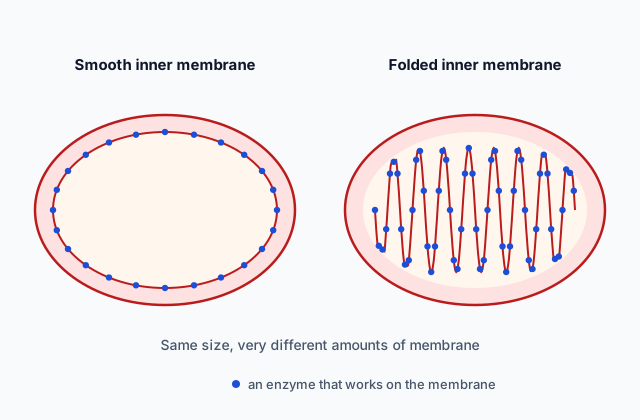 Tap to open the picture full size
Part 1 Think first When lysosomes burst
Commit to a guess first. Being wrong now makes the right idea stick better.
Predict first
A cell's lysosomes hold enzymes that break down proteins, fats and nucleic acids. If many of a cell's lysosomes burst open at once, what most likely happens next?
In short. Membranes and membrane-bound organelles divide a eukaryotic cell into compartments, each holding its own metabolic processes and enzymes, which keeps competing reactions apart and gives reactions more surface to happen on.
- Membranes and membrane-bound organelles compartmentalize intracellular metabolic processes and specific enzymatic reactions.
- Internal membranes minimize competing interactions, such as a molecule being built in one place and broken down in the same place.
- Internal membranes increase the surface area where reactions can occur, as in the folded inner membrane of a mitochondrion.
Part 2 Learn it A cell of many rooms
2a. Each compartment has its own work
A eukaryotic cell is divided by membranes into compartments, much as a house is divided into rooms. Membranes and membrane-bound organelles in eukaryotic cells compartmentalize intracellular metabolic processes and specific enzymatic reactions: each compartment holds its own enzymes and its own conditions.
You have met the rooms already:
- the nucleus holds the cell's DNA, inside the nuclear envelope
- the endoplasmic reticulum and Golgi complex make, modify and package proteins and lipids
- lysosomes hold hydrolytic enzymes that digest material
- mitochondria carry out the reactions of aerobic cellular respiration
- chloroplasts, in plants and algae, carry out photosynthesis
Because each set of enzymes is enclosed, each compartment can be kept at the conditions its enzymes work best in, and its products stay concentrated in one place instead of spreading through the whole cell.
Quick check · Match
Match each compartment to the process or reactions it holds.
2b. Keeping competing reactions apart
Internal membranes facilitate cellular processes by minimizing competing interactions.
Some reactions work against each other. A cell may build a molecule in one pathway and break the same molecule down in another. If both sets of enzymes shared one space, much of what one set made, the other would undo, and the cell would spend energy getting nowhere. Putting them in different compartments lets both happen where and when they are needed.
Other reactions would simply be harmful in the wrong place. A lysosome's hydrolytic enzymes digest proteins, fats and nucleic acids. Released into the cytoplasm, they can digest the cell's own working molecules. Inside the lysosome, they digest only what is delivered to them.
In both cases, the membrane is what keeps two things that should not meet apart.
Quick check · Multiple choice
A cell builds a fatty acid with one set of enzymes and breaks fatty acids down with another. Which arrangement lets it build fatty acids most efficiently?
2c. More membrane, more room for reactions
Internal membranes also facilitate cellular processes by increasing the surface area where reactions can occur.
Many of the cell's enzymes are not floating free. They sit in a membrane, and a reaction that needs them can happen only where that membrane is. More membrane means more enzymes working at once.
This is why the inner membrane of a mitochondrion is so folded: the folds pack far more membrane, and far more of the enzymes that make ATP, into the same small organelle. The endoplasmic reticulum works the same way: its network of membranes spreads through much of the cell, giving a large area for the reactions that make proteins and lipids.
So internal membranes do two jobs at once. They separate the cell into compartments, and they provide surfaces to work on.
Quick check · Fill the statement
Complete the description of what internal membranes do.
Internal membranes facilitate cellular processes by minimizing interactions and by increasing the where reactions can occur.
Part 3 Watch it done Membrane area and ATP
Predict first, then watch each step, then finish the reasoning yourself.
A biologist isolates mitochondria from two tissues and measures how much inner membrane each mitochondrion has and how much ATP it makes.
- Tissue A: 10 µm² of inner membrane, 50 units of ATP per minute
- Tissue B: 40 µm² of inner membrane, 200 units of ATP per minute
These numbers are a teaching example. Why do the mitochondria from tissue B make more ATP?
Predict first
Before you open the first step, predict: do tissue B's mitochondria make more ATP per µm² of inner membrane?
Step 1 · Find the ATP made per µm² in each tissue
Tissue A: 50 divided by 10 is 5 units per minute for each µm². Tissue B: 200 divided by 40 is also 5 units per minute for each µm².
Why this step?
Why divide by membrane area instead of comparing the totals?
The totals differ, 50 and 200, but they could differ for many reasons. Dividing by area asks whether each bit of membrane works harder in B, or whether B simply has more membrane.
Step 2 · Compare the areas
Each µm² makes the same 5 units, but B's mitochondria have 40 divided by 10, or 4 times, as much inner membrane. Four times the membrane gives four times the ATP.
Your step · Decide and justify
What best explains why tissue B's mitochondria make more ATP?
Which reason supports your decision?
This is surface area at work inside the cell: the reactions happen on the membrane, so a cell that needs more ATP benefits from more folded inner membrane, not from faster enzymes.
Part 4 Try it Breaking down the walls
A new experiment, a new question. In a kind of yeast, one set of enzymes builds molecule M inside one membrane-bound compartment, and another set breaks M down inside a different compartment. A biologist measures the net amount of M made per hour by intact cells, then breaks the cells open so all their compartments' contents mix, and measures again. These numbers are a teaching example.
- Intact cells: 120 units of M per hour
- Cells broken open, contents mixed: 18 units of M per hour
Try it · Calculate
By what percentage did the net amount of M made fall when the compartments were mixed? Give your answer to the nearest whole percent.
Try it · Decide and justify
Which explanation best fits the drop?
Which reason supports your decision?
Part 5 Explain it Flattened folds
On the exam this is handwritten, so answer on paper first. Nothing you type here leaves this page. Then check your answer against the model and each scoring point.
Free response is 50% of the exam score. This one is shaped like Question 4, Conceptual Analysis.
Free-response practice · Question 4 style
In a rare condition, the folds of the inner mitochondrial membrane are much smaller than normal, though each mitochondrion is the same size.
(a) Describe the role of membranes in compartmentalizing a eukaryotic cell's metabolic processes.
(b) Explain how the folds of the inner mitochondrial membrane contribute to the mitochondrion's function.
(c) Predict the effect of the smaller folds on the cell's ATP production.
(d) Justify your prediction in (c).
Model answer
(a) Membranes and membrane-bound organelles divide the cell into compartments, each holding specific metabolic processes and enzymatic reactions, which keeps competing reactions apart.
(b) The folds greatly increase the surface area of the inner membrane, where the reactions that make ATP occur, within the same small organelle.
(c) The cell would make less ATP.
(d) Smaller folds mean less inner membrane, so less surface area where the ATP-making reactions can occur, and fewer of those reactions can happen at once.
Score your own answer. This is a self-check, not a grade. Tick each point your answer makes.
Part 6 Check yourself Where the enzymes are
All three case questions use the table.
A biologist breaks liver cells open gently and separates their parts into four fractions. She then measures where three markers ended up: DNA, an enzyme of aerobic respiration, and a hydrolytic enzyme. These numbers are a teaching example.
| Fraction | DNA | Respiration enzyme | Hydrolytic enzyme |
|---|---|---|---|
| Nuclei | 95 | 2 | 1 |
| Mitochondria | 3 | 90 | 6 |
| Lysosomes | 0 | 3 | 88 |
| Cytosol | 2 | 5 | 5 |
Case question 1 · Calculate
Using the table: the respiration enzyme in the whole sample had a total activity of 250 units. How many units were in the mitochondria fraction?
Case question 2 · Multiple choice
Using the table: which claim do the data best support?
Case question 3 · Multiple choice
Using the table: 5% of the hydrolytic enzyme turned up in the cytosol fraction. Which explanation is most likely?
The rest stand on their own and do not use the case.
Check yourself · Spot the error
A student explains why lysosomes are enclosed by a membrane. Tap the line with the mistake.
Check yourself · Rank it
Three mitochondria are the same size, and each µm² of their inner membrane makes ATP at the same rate. Rank them by how much ATP they make.
Most ATP first
Give each one a place, 1 for first. Give two the same place if they are equal.
Your ranking: none yet
Part 7 Keep it Bring back earlier ideas
Gradients that must be maintained, from the last lesson, and the organelles of 2.1 both lead into compartments. Pulling them back up is what makes them last.
From 2.8 Mechanisms of Transport · Multiple choice
A cell's ion gradient stays the same for hours. Which statement best explains why the cell is still using ATP to keep it?
From 2.1 Cell Structure and Function · Match
Match each cell part to its description.
In three lines
- Membranes and membrane-bound organelles compartmentalize a eukaryotic cell's metabolic processes and specific enzymatic reactions.
- Internal membranes minimize competing interactions, keeping reactions that would undo or harm each other apart.
- Internal membranes increase the surface area where reactions can occur, as in the folded inner membrane of a mitochondrion.
Exam strategy for this topic
- Section I, Multiple Choice: 60 questions in 90 minutes.
- Section II, Free Response: 6 questions in 90 minutes.
- This lesson's Explain it is shaped like free-response question 4, Conceptual Analysis.
- A four-function, scientific, or graphing calculator is allowed on both sections of the exam.
When a stem asks how a membrane helps a cell, give one of the two named effects and tie it to the case: it keeps competing or harmful reactions apart, or it adds surface area where reactions occur.
Questions students ask
What is cell compartmentalization?
The division of a eukaryotic cell by membranes and membrane-bound organelles into compartments, each holding specific metabolic processes and enzymatic reactions.
Why do eukaryotic cells have internal membranes?
Internal membranes minimize competing interactions, keeping reactions that would undo or harm each other apart, and they increase the surface area where reactions can occur.
Why are lysosome enzymes kept inside a membrane?
Hydrolytic enzymes digest proteins, fats and nucleic acids, which the cell's own working parts are made of. The lysosome's membrane keeps them away from those molecules.
How does the inner mitochondrial membrane show compartmentalization?
It separates compartments inside the mitochondrion, and its folds give a large surface area for the reactions that make ATP.
Course alignment, for teachers
AP Biology topic 2.9, Unit 2: Cells.
- Skill 6.E: Predict the causes or effects of a change in, or disruption to, one or more components in a biological system.
This lesson maps all 2 essential knowledge statements of the topic to the part that teaches each one: 2 are checked by a scored question. The map is in the lesson file.