Unit 2 · Topic 2.4 · about 30 minutes · 7 parts · 11 scored checks, 3 of them multiple choice, plus 2 from earlier lessons
AP Biology 2.4: Membrane Permeability
Unit 2: 10 to 13% of the multiple-choice section
What you'll be able to do
- Explain how the hydrophobic interior of a biological membrane makes it selectively permeable to different kinds of molecules.
- Describe how the cell wall of bacteria, archaea, fungi and plants maintains a cell's structure and function.
Key vocabulary
| Term | What it means | The exam trap |
|---|---|---|
| Selective permeability | The property of a membrane that lets some substances cross it more easily than others. | Selective does not mean the membrane makes choices, so explain it with the membrane's structure rather than with what the cell wants. |
| Channel protein | An embedded protein that forms a passage through the membrane for particular ions or molecules. | A channel provides a path across; which way substances move through it is a question for later lessons, so do not assume a direction. |
| Transport protein | An embedded protein that moves particular substances across the membrane. | Some stems call a transport protein a carrier protein, so read the two names as the same idea. |
| Cell wall | A structural boundary outside the plasma membrane in bacteria, archaea, fungi and plants. | A wall sits outside the membrane rather than in place of it, so a cell with a wall still has a plasma membrane. |
| Osmotic lysis | The bursting of a cell when too much water moves into it. | Lysis means bursting, so keep it apart from a cell that shrinks as it loses water. |
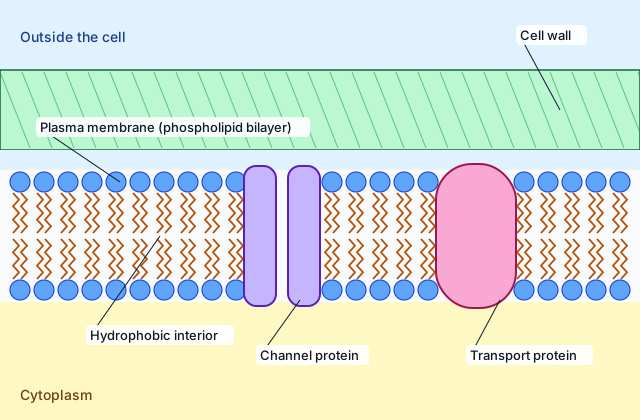 Tap to open the picture full size
Part 1 Think first Nitrogen in a diver's tissues
Commit to a guess first. Being wrong now makes the right idea stick better.
Predict first
A scuba diver deep underwater breathes compressed air. Extra nitrogen gas (N₂) dissolves into the blood and then into the cells of the diver's tissues, which is why divers must rise slowly. How does the nitrogen most likely get into those cells?
In short. A membrane is selectively permeable because its interior is hydrophobic: small nonpolar molecules pass straight through, while ions and large polar molecules need embedded proteins to cross.
- Small nonpolar molecules such as N₂, O₂ and CO₂ pass freely across the phospholipid bilayer.
- Small polar, uncharged molecules such as water and ammonia pass through only in small amounts; ions and large polar molecules need channels or transport proteins.
- The cell walls of bacteria, archaea, fungi and plants give structure, block some substances, and protect cells from osmotic lysis.
Part 2 Learn it What crosses a membrane, and why
2a. A boundary with a hydrophobic interior
The plasma membrane separates the cell's internal environment from the external environment. Without it, the cytoplasm would simply mix with whatever surrounds the cell.
But the membrane is not a wall that stops everything. It is selectively permeable: some substances cross it easily, some barely cross, and some cannot cross on their own at all.
That selectivity is the result of the membrane's structure. Its interior, the layer of fatty acid tails between the two rows of phosphate regions, is hydrophobic. A substance crossing the bilayer has to pass through that nonpolar layer. Whether it can depends on how well it can move through a nonpolar environment, which depends on the substance's size, polarity and charge.
Quick check · Multiple choice
Which statement best explains why a plasma membrane is selectively permeable?
2b. Size, polarity and charge decide
Three groups of substances behave very differently at the bilayer.
Small nonpolar molecules, including nitrogen (N₂), oxygen (O₂) and carbon dioxide (CO₂), freely pass across the membrane. They mix well with the nonpolar interior, so nothing holds them back.
Small polar, uncharged molecules, like water (H₂O) and ammonia (NH₃), pass through the membrane in small amounts. They are small enough to slip through, but their polarity makes the hydrophobic interior a poor place for them.
Ions and large polar molecules are stopped. The nonpolar hydrocarbon tails of the phospholipids prevent ions and polar molecules from moving across. These hydrophilic substances cross through embedded channel proteins and transport proteins, which give them a hydrophilic path through the membrane.
So a sodium ion, though tiny, cannot cross the bilayer on its own, and neither can a glucose molecule, which is large and polar.
Quick check · Sort it
Tap each substance, then how it crosses a plasma membrane.
Crosses the bilayer freely
Crosses the bilayer in small amounts
Needs a channel or transport protein
2c. The cell wall
The cells of Bacteria, Archaea, Fungi and plants have a second boundary outside the plasma membrane: a cell wall. Animal cells do not.
A cell wall does three jobs. It is a structural boundary that gives the cell its shape and support. It is a permeability barrier for some substances moving to or from the internal or external environment. And it protects the cell from osmotic lysis.
Osmotic lysis is a cell bursting because too much water has moved into it. When water flows into a cell, the cell swells and its membrane stretches. A thin plasma membrane alone can stretch only so far before it tears. A cell wall is strong enough to push back against the swelling, so a walled cell can take in water and stay whole.
The wall does not replace the membrane. A plant cell has both, with the wall outside the plasma membrane.
Quick check · Decide and justify
A plant cell and an animal cell are both placed in water, and water moves into each of them. Which cell is more likely to burst?
Which reason supports your decision?
Part 3 Watch it done Is small enough?
Predict first, then watch each step, then finish the reasoning yourself.
A student's hypothesis: any small enough molecule or ion crosses a phospholipid bilayer easily. A biologist measures how fast four substances cross an artificial bilayer with no proteins in it, in relative units.
- O₂ (small, nonpolar): 1,000
- Water (small, polar, uncharged): 10
- Glucose (large, polar): 0.001
- K⁺ (small ion): 0.0001
These numbers are a teaching example. Do the data support the hypothesis?
Predict first
Before you open the first step, predict: do the data support the hypothesis?
Step 1 · Compare the small substances
O₂, water and K⁺ are all small. O₂ crosses at 1,000 and water at 10, so O₂ crosses 1,000 divided by 10, or 100 times as fast. K⁺, at 0.0001, crosses 10 million times more slowly than O₂.
Why this step?
Why use a bilayer with no proteins in it?
With no channels or transport proteins, the only way across is through the bilayer itself. That isolates the property the hypothesis is about: what the hydrophobic interior lets through on its own.
Step 2 · Ask what separates them
Size cannot explain the gap, because all three are small. What differs is polarity and charge: O₂ is nonpolar, water is polar but uncharged, and K⁺ is charged. Each step away from nonpolar slows crossing enormously.
Your step · Decide and justify
Do the data support the hypothesis that any small enough molecule or ion crosses a bilayer easily?
Which reason supports your decision?
The nitrogen in a diver's tissues behaves like the O₂ here: small and nonpolar, it crosses freely. Ions behave like K⁺, which is why a cell needs proteins to move them.
Part 4 Try it Blocking the channels
A new experiment, a new question. A student hypothesizes that a drug which blocks channel proteins will lower the uptake of K⁺ into cells but not the uptake of O₂. She measures uptake into the same kind of cells with and without the drug, in units per minute. These numbers are a teaching example.
- K⁺ uptake: 50 without the drug, 4 with it
- O₂ uptake: 30 without the drug, 29 with it
Try it · Calculate
By what percentage did the drug lower K⁺ uptake? Give your answer to the nearest whole percent.
Try it · Decide and justify
Do the data support the student's hypothesis?
Which reason supports your decision?
Part 5 Explain it Testing whether an ion needs proteins
On the exam this is handwritten, so answer on paper first. Nothing you type here leaves this page. Then check your answer against the model and each scoring point.
Free response is 50% of the exam score. This one is shaped like Question 3, Scientific Investigation.
Free-response practice · Question 3 style
A researcher wants to know whether ion Z crosses membranes only through embedded proteins. She makes two kinds of tiny membrane sacs: sacs of pure phospholipid bilayer, and sacs of the same bilayer with a cell's membrane proteins added. She fills every sac with a solution containing no Z, places them in a solution of Z, and measures the Z inside each sac after 10 minutes.
(a) Identify the independent variable in this investigation.
(b) State the null hypothesis for this investigation.
(c) Predict the result for each kind of sac if Z crosses only through proteins.
(d) Justify your prediction for the pure bilayer sacs.
Model answer
(a) Whether the sac's membrane contains membrane proteins (pure bilayer or bilayer with proteins).
(b) Adding membrane proteins has no effect on how much Z enters the sacs.
(c) The sacs with proteins would contain Z after 10 minutes, and the pure bilayer sacs would contain little or none.
(d) Z is an ion, and the nonpolar hydrocarbon tails in the bilayer's hydrophobic interior prevent ions from moving across, so without channel or transport proteins Z has no way in.
Score your own answer. This is a self-check, not a grade. Tick each point your answer makes.
Part 6 Check yourself Bacteria without their walls
All three case questions use the table.
A microbiologist treats bacteria with an enzyme that removes their cell walls but leaves their plasma membranes whole. She puts samples in pure water or in a solution with the same solute concentration as the cells' cytoplasm, so water has no net tendency to enter them, and counts how many cells burst in 30 minutes. These numbers are a teaching example.
| Sample | Cell walls | Surrounding liquid | Cells counted | Cells that burst |
|---|---|---|---|---|
| A | Intact | Pure water | 400 | 8 |
| B | Removed | Pure water | 400 | 340 |
| C | Removed | Same solute concentration as cytoplasm | 400 | 16 |
Case question 1 · Calculate
Using the table: what percentage of the cells in sample B burst?
Case question 2 · Multiple choice
Using the table: which claim do samples A and B together best support?
Case question 3 · Multiple choice
Using the table: a classmate claims the enzyme makes bacteria burst directly, whether or not water moves in. Which result is the best evidence against that claim?
The rest stand on their own and do not use the case.
Check yourself · Spot the error
A student explains how substances cross a plasma membrane. Tap the line with the mistake.
Check yourself · Fill the statement
Complete the explanation of selective permeability.
Selective permeability is the result of the plasma membrane having a interior. The nonpolar tails of the phospholipids prevent the movement of and polar molecules across the membrane.
Part 7 Keep it Bring back earlier ideas
Which way the phospholipids face, from the last lesson, is what makes the interior hydrophobic, and water's polarity, from Unit 1, is why it barely gets through. Pulling them back up is what makes them last.
From 2.3 Plasma Membrane · Fill the statement
Complete the description of how phospholipids are arranged in a plasma membrane.
The phosphate regions face the watery environment outside and inside the cell, and the fatty acid tails of the two rows face each other in the of the membrane.
From 1.1 Structure of Water and Hydrogen Bonding · Fill the statement
Complete the description of a model of two neighboring water molecules.
Inside each molecule, the solid lines are bonds. The oxygen atom is labeled partially . The dashed line from a hydrogen of one molecule to the oxygen of the other is a bond.
In three lines
- A membrane is selectively permeable because its interior is hydrophobic, so size, polarity and charge decide what crosses on its own.
- Small nonpolar molecules (N₂, O₂, CO₂) cross freely, small polar uncharged ones (H₂O, NH₃) cross in small amounts, and ions and large polar molecules need proteins.
- The cell walls of bacteria, archaea, fungi and plants give structure, block some substances and protect against osmotic lysis.
Exam strategy for this topic
- Section I, Multiple Choice: 60 questions in 90 minutes.
- Section II, Free Response: 6 questions in 90 minutes.
- This lesson's Explain it is shaped like free-response question 3, Scientific Investigation.
- A four-function, scientific, or graphing calculator is allowed on both sections of the exam.
To predict whether something crosses the bilayer on its own, check three things in order: is it charged, is it polar, and is it large. Name the hydrophobic interior as the reason for whatever you predict.
Questions students ask
Why can oxygen cross a cell membrane but sodium ions cannot?
Oxygen is small and nonpolar, so it passes freely through the membrane's hydrophobic interior. Sodium ions are charged, and the nonpolar hydrocarbon tails prevent ions from crossing, so they need channel proteins.
Can water cross the phospholipid bilayer?
Yes, in small amounts. Water is small, polar and uncharged, so it slips through the bilayer slowly.
What makes a membrane selectively permeable?
Its hydrophobic interior. Substances must pass through that nonpolar layer, so their size, polarity and charge decide how easily they cross.
What does a cell wall do?
In bacteria, archaea, fungi and plants, the cell wall is a structural boundary, a permeability barrier for some substances, and protection against osmotic lysis, bursting when water moves in.
Course alignment, for teachers
AP Biology topic 2.4, Unit 2: Cells.
- Skill 5.D: Use data to evaluate a hypothesis or prediction, including rejecting or failing to reject the null hypothesis.
This lesson maps all 4 essential knowledge statements of the topic to the part that teaches each one: 4 are checked by a scored question. The map is in the lesson file.