Unit 2 · Topic 2.5 · about 30 minutes · 7 parts · 11 scored checks, 2 of them multiple choice, plus 2 from earlier lessons
AP Biology 2.5: Membrane Transport
Unit 2: 10 to 13% of the multiple-choice section
What you'll be able to do
- Describe the mechanisms, passive and active transport, that organisms use to maintain solute and water balance.
- Describe how endocytosis and exocytosis move large molecules across the plasma membrane.
Key vocabulary
| Term | What it means | The exam trap |
|---|---|---|
| Concentration gradient | A difference in the concentration of a substance between two regions, such as the inside and outside of a cell. | A gradient belongs to one substance, so a cell can have gradients running in opposite directions for two substances at the same time. |
| Passive transport | The net movement of molecules from a region of high concentration to one of low concentration without the direct input of metabolic energy. | Passive transport can still use a membrane protein, so the presence of a protein does not tell you which kind of transport it is. |
| Active transport | Movement of molecules across a membrane that requires the direct input of energy. | Energy, not direction or the presence of a protein, is what defines active transport, so do not classify by either of those alone. |
| Endocytosis | Taking in large molecules or particles by folding the plasma membrane inward to form a new vesicle around them. | Endocytosis forms a vesicle from the membrane itself, so the membrane never has to tear for material to get in. |
| Exocytosis | Releasing material from a cell when an internal vesicle fuses with the plasma membrane. | In exocytosis the vesicle's membrane joins the plasma membrane, so do not draw the vesicle leaving the cell whole. |
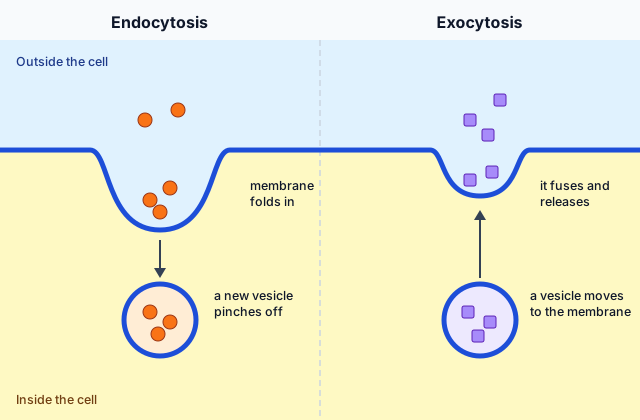 Tap to open the picture full size
Part 1 Think first Iodine in seaweed
Commit to a guess first. Being wrong now makes the right idea stick better.
Predict first
Kelp, a large seaweed, holds iodide ions inside its cells at a concentration far higher than in the seawater around it, and keeps taking in more. A biologist adds a poison that stops the kelp cells from making ATP. What most likely happens to the iodide inside the cells?
In short. Because membranes are selectively permeable, cells can hold different concentrations inside and out; substances move down those gradients passively, while active transport, endocytosis and exocytosis need energy.
- Selective permeability allows concentration gradients of solutes to form across a membrane.
- Passive transport is net movement from high to low concentration with no direct input of metabolic energy; active transport requires that energy, and can move molecules from low to high.
- Endocytosis and exocytosis use energy to move large substances, or large amounts of substances, into and out of cells in vesicles.
Part 2 Learn it Moving substances across the membrane
2a. Membranes let gradients form
A concentration gradient is a difference in the concentration of a substance between two regions, such as the inside and the outside of a cell.
If a membrane let everything through freely, every substance would end up at the same concentration on both sides, and there could be no gradients. Because the membrane is selectively permeable, it can keep a solute more concentrated on one side than the other. The selective permeability of membranes allows concentration gradients of solutes to form across the membrane.
Cells depend on those gradients. A nerve cell holds far more potassium ions inside than outside; a kelp cell holds far more iodide. Each gradient is a difference the membrane maintains, and the rest of this lesson is about how substances move across it.
Quick check · Fill the statement
Complete the explanation of how concentration gradients form.
Because membranes are , a solute can be kept at a different concentration on each side of the membrane. That difference is called a .
2b. Passive and active transport
Substances cross membranes in two basic ways.
Passive transport is the net movement of molecules from regions of high concentration to regions of low concentration without the direct input of metabolic energy. Molecules move randomly in both directions, but more of them leave the crowded side, so the net flow runs down the gradient. Oxygen entering a cell from blood that holds more oxygen is passive.
Active transport requires the direct input of energy to move molecules. In some cases, active transport moves molecules from regions of low concentration to regions of high concentration, up the gradient, which would never happen on its own. A kelp cell taking in more iodide is doing exactly that.
A useful test: if a cell keeps moving a substance toward the side where it is already more concentrated, that movement needs energy. Stop the cell's energy supply, and active transport stops while passive transport goes on.
Quick check · Sort it
Each card describes a substance crossing a membrane. Tap a card, then the kind of transport it describes.
Passive transport
Active transport
2c. Endocytosis and exocytosis
Some cargo is too big for any membrane protein: a whole bacterium, a large protein, or a large amount of material at once. The processes of endocytosis and exocytosis move large substances, or large amounts of substances, into and out of cells, and both require energy.
In endocytosis, the cell takes in large molecules and particles by folding its plasma membrane in on itself. The fold surrounds material from the outside, and the membrane pinches off to form a new small vesicle that holds it inside the cell. A white blood cell takes in a bacterium this way, and a lysosome can then digest it.
In exocytosis, internal vesicles release material from the cell. A vesicle fuses with the plasma membrane, and the large molecules it carries are secreted outside. This is how the Golgi complex's packaged proteins, such as digestive enzymes or hormones, leave the cell.
Quick check · Put it in order
A white blood cell takes in a bacterium and digests it. Put the events in the order they happen.
Part 3 Watch it done Past the halfway mark
Predict first, then watch each step, then finish the reasoning yourself.
Cells are placed in a solution that holds substance S at 10 mM, a concentration that stays the same throughout. A biologist measures S inside the cells.
- 0 min: 2 mM
- 10 min: 10 mM
- 20 min: 18 mM
- 30 min: 25 mM
These numbers are a teaching example. Is S moving into the cells by passive transport alone?
Predict first
Before you open the first step, predict: is S moving by passive transport alone?
Step 1 · Compare inside with outside early on
At 0 min S is 2 mM inside and 10 mM outside, so it is entering down its gradient. Passive transport could explain the first 10 minutes on its own.
Why this step?
Why compare the inside concentration with the outside one, instead of just noting that it rises?
A rise alone fits either kind of transport. The direction of the gradient is what separates them: passive transport only moves S from higher to lower concentration.
Step 2 · Compare after 10 minutes
At 10 min the two sides are equal, 10 mM each. Yet S keeps entering: 18 mM at 20 min and 25 mM at 30 min, which is 25 divided by 10, or 2.5 times the outside concentration. S is now moving from low concentration outside to high concentration inside.
Your step · Decide and justify
Is S moving into the cells by passive transport alone?
Which reason supports your decision?
S behaves like the iodide in kelp: once the cell holds more than its surroundings, any further uptake must be active. The next question is how to test that directly.
Part 4 Try it Testing the energy
A new substance, a new test. Cells are placed in a solution with substance T at 5 mM. After 30 minutes, cells given a poison that stops ATP production hold T at 5 mM inside, and untreated cells hold it at 40 mM inside. These numbers are a teaching example.
Try it · Calculate
In the untreated cells, the concentration of T inside is how many times the concentration outside?
Try it · Decide and justify
A student wants to check that the poison lowered uptake by stopping ATP production, not by damaging the cells in some other way. Which new investigation is better?
Which reason supports your decision?
Part 5 Explain it Releasing a hormone
On the exam this is handwritten, so answer on paper first. Nothing you type here leaves this page. Then check your answer against the model and each scoring point.
Free response is 50% of the exam score. This one is shaped like Question 4, Conceptual Analysis.
Free-response practice · Question 4 style
Cells in the pancreas release the hormone insulin, a large protein, into the blood.
(a) Describe how exocytosis moves insulin out of the cell.
(b) Explain why insulin cannot leave the cell simply by crossing the phospholipid bilayer.
(c) Predict the effect on insulin release of a drug that stops the cells from making ATP.
(d) Justify your prediction in (c).
Model answer
(a) Insulin is held in vesicles inside the cell. A vesicle moves to the plasma membrane and fuses with it, and the insulin is secreted outside the cell.
(b) Insulin is a large polar molecule, and the hydrophobic interior of the bilayer prevents large polar molecules from crossing on their own.
(c) Insulin release would fall or stop.
(d) Exocytosis requires energy to move large substances out of the cell, so without ATP the vesicles cannot fuse with the membrane and release the insulin.
Score your own answer. This is a self-check, not a grade. Tick each point your answer makes.
Part 6 Check yourself Three substances, one poison
All three case questions use the table.
A biologist places cells in a solution containing three substances, X, Y and W, at the outside concentrations shown, which stay the same throughout. She measures each substance inside the cells after 1 hour, in untreated cells and in cells given a poison that stops ATP production. Each substance starts at the outside concentration inside the cells. These numbers are a teaching example.
| Substance | Outside | Inside, untreated cells | Inside, poisoned cells |
|---|---|---|---|
| X | 10 | 10 | 10 |
| Y | 2 | 30 | 2 |
| W | 10 | 4 | 10 |
Case question 1 · Calculate
Using the table: in the untreated cells, Y's concentration inside is how many times its concentration outside?
Case question 2 · Multiple choice
Using the table: which substances do the untreated cells move by active transport?
Case question 3 · Multiple choice
Using the table: the biologist wants to know whether X crosses the membrane at all, since its inside concentration never changed. Which new investigation would best answer that?
The rest stand on their own and do not use the case.
Check yourself · Spot the error
A student describes how a cell exports a large protein. Tap the line with the mistake.
Check yourself · Match
Match each process to its description.
Part 7 Keep it Bring back earlier ideas
The last lesson's rules for what crosses the bilayer, and the lysosomes from 2.1 that digest what endocytosis brings in, both feed this one. Pulling them back up is what makes them last.
From 2.4 Membrane Permeability · Sort it
Tap each substance, then how it crosses a plasma membrane.
Crosses the bilayer freely
Crosses the bilayer in small amounts
Needs a channel or transport protein
From 2.1 Cell Structure and Function · Sort it
Each card describes a membrane sac doing its job. Tap a card, then the kind of sac it describes.
A lysosome
A plant cell's large vacuole
An animal cell's vacuole
In three lines
- Selective permeability lets concentration gradients of solutes form across a membrane.
- Passive transport is net movement from high to low concentration with no direct input of metabolic energy; active transport needs energy and can move from low to high.
- Endocytosis and exocytosis use energy to move large substances, or large amounts, into and out of the cell in vesicles.
Exam strategy for this topic
- Section I, Multiple Choice: 60 questions in 90 minutes.
- Section II, Free Response: 6 questions in 90 minutes.
- This lesson's Explain it is shaped like free-response question 4, Conceptual Analysis.
- A four-function, scientific, or graphing calculator is allowed on both sections of the exam.
To classify transport, compare the concentrations on the two sides and look for an energy test. Movement from low to high, or movement that stops when ATP is cut off, is active; movement down the gradient that keeps going without ATP is passive.
Questions students ask
What is the difference between active and passive transport?
Passive transport is net movement from high to low concentration without a direct input of metabolic energy. Active transport requires a direct input of energy, and in some cases moves molecules from low to high concentration.
Why do endocytosis and exocytosis need energy?
They move large substances, or large amounts, by reshaping the membrane: folding it into vesicles, moving the vesicles and fusing them. Those processes require energy.
How can you tell from data that a substance is actively transported?
It keeps moving toward the side where it is already more concentrated, or its movement stops when a poison cuts off the cell's ATP.
How do concentration gradients form across a membrane?
Because the membrane is selectively permeable, it can keep a solute more concentrated on one side than the other, so the difference does not even out.
Course alignment, for teachers
AP Biology topic 2.5, Unit 2: Cells.
- Skill 3.D: Propose a new investigation based on an evaluation of the experimental design or evidence.
This lesson maps all 4 essential knowledge statements of the topic to the part that teaches each one: 4 are checked by a scored question. The map is in the lesson file.