Unit 2 · Topic 2.6 · about 30 minutes · 7 parts · 11 scored checks, 3 of them multiple choice, plus 2 from earlier lessons
AP Biology 2.6: Facilitated Diffusion
Unit 2: 10 to 13% of the multiple-choice section
What you'll be able to do
- Explain how the structure of a molecule, its size, polarity and charge, affects its ability to pass through the plasma membrane by facilitated diffusion.
Key vocabulary
| Term | What it means | The exam trap |
|---|---|---|
| Facilitated diffusion | Passive movement of a substance across a membrane through a channel or transport protein. | Stems may call the protein a carrier, a transporter or a channel, so do not let the protein's name decide the process for you. |
| Channel protein | A membrane protein that forms a passage through which particular ions or molecules can cross. | A channel is specific, so a channel for one ion does not open a path for every ion. |
| Aquaporin | A channel protein that transports large quantities of water across a membrane. | Water also crosses the bilayer in small amounts, so a cell with its aquaporins blocked is not completely sealed against water. |
| Polarized membrane | A membrane with a difference in electric charge between its two sides. | Moving positive ions one way changes the charge on both sides, so say which side ends up more negative. |
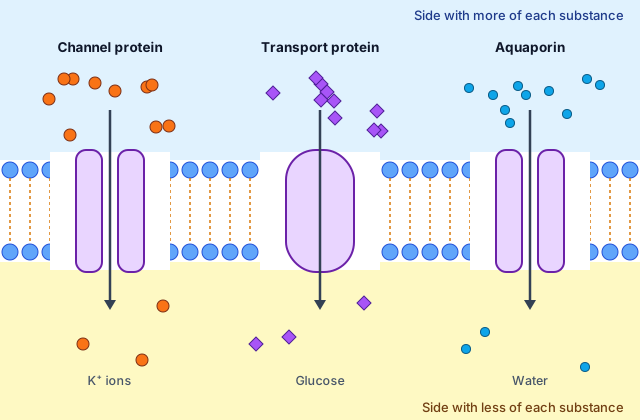 Tap to open the picture full size
Part 1 Think first A pufferfish toxin
Commit to a guess first. Being wrong now makes the right idea stick better.
Predict first
Pufferfish make a toxin that plugs the channel proteins sodium ions use to enter nerve cells. Normally, when those channels open, sodium ions rush into the cell, which holds far less sodium than the fluid around it. What happens to sodium entry in a nerve cell exposed to the toxin?
In short. Facilitated diffusion is passive transport through membrane proteins: ions, large polar molecules and large amounts of water move down their concentration gradients through channel or transport proteins, with no energy input.
- Charged ions such as Na⁺ and K⁺ need channel proteins to cross, and their movement can polarize the membrane.
- Large polar molecules cross through transport or channel proteins, always down their concentration gradient and with no energy input.
- Aquaporins are channel proteins that transport large quantities of water across membranes.
Part 2 Learn it Diffusion through proteins
2a. A protein path, no energy
Some substances cannot cross the bilayer on their own, yet move into and out of cells all the time with no energy spent. They use facilitated diffusion: passive transport through a membrane protein.
Two kinds of protein do this. Channel proteins form a passage through the membrane that particular substances move along. Transport proteins bind a particular substance and move it across.
Facilitated diffusion enables the movement of large polar molecules, such as glucose, through membranes with no energy input. The protein provides a hydrophilic path past the hydrophobic interior. But it does not push. In facilitated diffusion, substances always move down their concentration gradient, from high concentration to low, exactly as in any other passive transport. The protein only makes that movement possible, or much faster. If the gradient disappears, net movement stops.
Quick check · Fill the statement
Complete the description of facilitated diffusion.
In facilitated diffusion, a large polar molecule moves its concentration gradient through a protein, with input of energy.
2b. Ions need channels, and they carry charge
Charged ions, including sodium (Na⁺) and potassium (K⁺), require channel proteins to move through the membrane. Moving down their gradients, ions cross by facilitated diffusion through these channels, each kind of ion through its own kind of channel. (Moving an ion up its gradient takes a pump, a topic of 2.8.)
Ions carry charge, so moving them does more than change a concentration. A cell typically holds K⁺ at a much higher concentration inside than outside. When K⁺ channels open, K⁺ flows out, down its gradient. Each ion that leaves takes a positive charge with it, so the inside of the cell becomes more negative relative to the outside.
A membrane with a difference in charge between its two sides is polarized. Membranes may become polarized by the movement of ions across them, and nerve and muscle cells depend on exactly that difference in charge.
Quick check · Multiple choice
A cell holds K⁺ at a higher concentration inside than outside. Its K⁺ channels open, and K⁺ moves through them. What happens to the charge across the membrane?
2c. Aquaporins move water fast
Water is small and uncharged, so it crosses the bilayer on its own, but only in small amounts, because it is polar. Many cells need to move far more water than that.
Aquaporins are channel proteins that transport large quantities of water across membranes. Each one is a narrow passage lined with polar groups that water molecules pass through in single file.
Water through an aquaporin is still facilitated diffusion: no energy is spent, and the net movement follows the water's own gradient. An aquaporin changes how fast water crosses, not which way. A cell with many aquaporins in its membrane, such as a red blood cell, gains or loses water within seconds when its surroundings change, while a cell with few of them changes slowly.
Quick check · Sort it
Each card describes a substance crossing a membrane. Tap a card, then how it crosses.
Facilitated diffusion
Through the bilayer without a protein
Active transport
Part 3 Watch it done A frog egg with aquaporins
Predict first, then watch each step, then finish the reasoning yourself.
Frog eggs have very few aquaporins and swell only slowly in dilute water. A biologist injects one batch of eggs with the instructions (mRNA) for making aquaporins and a control batch with plain water. Three days later she moves both into dilute water, where water tends to enter the eggs, and measures egg volume after 3 minutes.
- Control eggs: 1.00 nL at the start, 1.03 nL after 3 minutes
- Aquaporin eggs: 1.00 nL at the start, 1.42 nL after 3 minutes
These numbers are a teaching example. How do the two batches compare?
Predict first
Before you open the first step, predict: how do the aquaporin eggs compare with the control eggs?
Step 1 · Find the control eggs' change
The control eggs grew from 1.00 to 1.03 nL, a change of 0.03 nL. 0.03 divided by 1.00 is 0.03, a 3% increase in 3 minutes. Water does cross the bilayer on its own, but slowly.
Why this step?
Why inject the control eggs with plain water instead of leaving them alone?
Injection itself might change an egg, for example by making a hole. Injecting both batches means the only difference between them is the aquaporin mRNA.
Step 2 · Set up the aquaporin eggs
The aquaporin eggs started at the same 1.00 nL and reached 1.42 nL in the same 3 minutes. Find their change the same way.
Your step · Calculate
By what percentage did the volume of the aquaporin eggs increase in 3 minutes?
%
Adding aquaporins made the eggs take in water about 14 times as fast, with nothing else changed and no energy supplied. The water moved the way it would anyway, into the eggs; the aquaporins gave it a fast path.
Part 4 Try it Potassium on the move
A new ion, a new question. A nerve cell holds K⁺ at 140 mM inside, and the fluid around it holds K⁺ at 5 mM. Some K⁺ channels in its membrane open. These numbers are a teaching example.
Try it · Calculate
The K⁺ concentration inside the cell is how many times the concentration outside?
Try it · Decide and justify
Which way does K⁺ move through the open channels?
Which reason supports your decision?
Part 5 Explain it A model of an aquaporin
On the exam this is handwritten, so answer on paper first. Nothing you type here leaves this page. Then check your answer against the model and each scoring point.
Free response is 50% of the exam score. This one is shaped like Question 5, Analyze Model or Visual Representation of a Biological Concept or Process.
Free-response practice · Question 5 style
A model of a kidney cell's membrane shows phospholipids with an aquaporin crossing the bilayer. Arrows show water molecules passing through the aquaporin in single file, from the side of the membrane with more water toward the side with less.
(a) Describe the role of the aquaporin shown in the model.
(b) Explain why the water movement in the model requires no input of energy.
(c) Predict how the rate of water movement would change if the cell inserted many more aquaporins into its membrane, with the same conditions on each side.
(d) A sodium ion is about the size of a water molecule. Explain why it cannot use the phospholipid part of the model to cross the membrane.
Model answer
(a) The aquaporin is a channel protein that transports large quantities of water across the membrane.
(b) The water moves down its own concentration gradient, from where there is more water to where there is less, by facilitated diffusion, which is passive.
(c) The rate of water movement would increase, because there would be more channels for water to pass through, though the direction would not change.
(d) A sodium ion is charged, and the nonpolar interior of the bilayer stops ions, so Na⁺ needs a channel protein to cross.
Score your own answer. This is a self-check, not a grade. Tick each point your answer makes.
Part 6 Check yourself Blocking a red blood cell's aquaporins
All three case questions use the table.
A biologist measures how fast three substances cross three membranes, each time with the substance more concentrated on one side: an artificial bilayer with no proteins, a red blood cell membrane, and a red blood cell membrane treated with a drug that blocks aquaporins. Rates are in relative units. These numbers are a teaching example.
| Substance | Bilayer, no proteins | Red blood cell membrane | Red blood cell membrane, aquaporins blocked |
|---|---|---|---|
| Water | 1 | 50 | 3 |
| Glucose | 0.001 | 20 | 20 |
| O₂ | 100 | 100 | 100 |
Case question 1 · Calculate
Using the table: by what percentage did blocking aquaporins lower the rate at which water crosses the red blood cell membrane? Give your answer to the nearest whole percent.
Case question 2 · Multiple choice
Using the table: which claim about glucose is best supported?
Case question 3 · Multiple choice
Using the table: why is O₂'s rate the same across all three membranes?
The rest stand on their own and do not use the case.
Check yourself · Spot the error
A student explains how glucose enters a liver cell from the blood after a meal. Tap the line with the mistake.
Check yourself · Match
Match each substance to the way it most often crosses a plasma membrane.
Part 7 Keep it Bring back earlier ideas
Passive and active transport, from the last lesson, and the hydrophobic interior from 2.4 are what facilitated diffusion is built on. Pulling them back up is what makes them last.
From 2.5 Membrane Transport · Sort it
Each card describes a substance crossing a membrane. Tap a card, then the kind of transport it describes.
Passive transport
Active transport
From 2.4 Membrane Permeability · Spot the error
A student explains how substances cross a plasma membrane. Tap the line with the mistake.
In three lines
- Facilitated diffusion moves substances down their concentration gradient through channel or transport proteins, with no energy input.
- Charged ions such as Na⁺ and K⁺ require channel proteins, and moving them across can polarize the membrane.
- Aquaporins are channel proteins that transport large quantities of water across membranes.
Exam strategy for this topic
- Section I, Multiple Choice: 60 questions in 90 minutes.
- Section II, Free Response: 6 questions in 90 minutes.
- This lesson's Explain it is shaped like free-response question 5, Analyze Model or Visual Representation of a Biological Concept or Process.
- A four-function, scientific, or graphing calculator is allowed on both sections of the exam.
When a protein moves a substance, decide passive or active from the gradient and the energy, never from the protein alone. For ions, follow the charge too: the side that positive ions leave becomes more negative.
Questions students ask
Is facilitated diffusion active or passive transport?
Passive. A channel or transport protein gives the substance a path, but it moves down its concentration gradient with no energy input.
What do aquaporins do?
Aquaporins are channel proteins that transport large quantities of water across membranes, far faster than water crosses the bilayer on its own.
Why do ions like Na⁺ and K⁺ need channel proteins?
Ions are charged, and the nonpolar interior of the bilayer stops charged particles, so they cross through channel proteins.
How does moving ions polarize a membrane?
Ions carry charge. When positive ions such as K⁺ flow out of a cell, the inside becomes more negative than the outside, so the membrane has a difference in charge across it.
Course alignment, for teachers
AP Biology topic 2.6, Unit 2: Cells.
- Skill 6.E: Predict the causes or effects of a change in, or disruption to, one or more components in a biological system.
This lesson maps all 3 essential knowledge statements of the topic to the part that teaches each one: 3 are checked by a scored question. The map is in the lesson file.