Unit 2 · Topic 2.7 · about 30 minutes · 7 parts · 12 scored checks, 3 of them multiple choice, plus 2 from earlier lessons
AP Biology 2.7: Tonicity and Osmoregulation
Unit 2: 10 to 13% of the multiple-choice section
What you'll be able to do
- Explain how concentration gradients of solutes and differences in water potential affect the movement of water across membranes.
- Explain how osmoregulatory mechanisms contribute to the health and survival of organisms.
Key vocabulary
| Term | What it means | The exam trap |
|---|---|---|
| Hypotonic | Having a lower solute concentration than the solution it is compared with. | Hypotonic describes one solution compared with another, so always say what it is hypotonic to. |
| Hypertonic | Having a higher solute concentration than the solution it is compared with. | The same solution can be hypertonic to one cell and hypotonic to another, so name the comparison in your answer. |
| Isotonic | Having the same solute concentration as the solution it is compared with. | Isotonic compares concentrations of all solutes together, so two solutions of different solutes can still be isotonic. |
| Water potential | A measure of water's tendency to move, written Ψ, equal to pressure potential plus solute potential. | Water potential is given in bars in this course's equation, so check the unit before you compare values from different sources. |
| Osmoregulation | The control of an organism's water balance and internal solute composition. | Osmoregulation can mean getting rid of water as well as taking it in, so read which problem the organism in the stem faces. |
 Tap to open the picture full size
Part 1 Think first Limp lettuce
Commit to a guess first. Being wrong now makes the right idea stick better.
Predict first
Crisp lettuce leaves are tossed in a very salty dressing. Within an hour they are limp. Leaves left in plain water stay crisp. What most likely made the dressed leaves go limp?
In short. Water moves by osmosis from regions of high water potential to regions of low water potential, which means from hypotonic to hypertonic solutions, and organisms osmoregulate to keep their water and solutes in balance.
- A solution can be hypotonic, hypertonic or isotonic to a cell, and water moves from the hypotonic side to the hypertonic side.
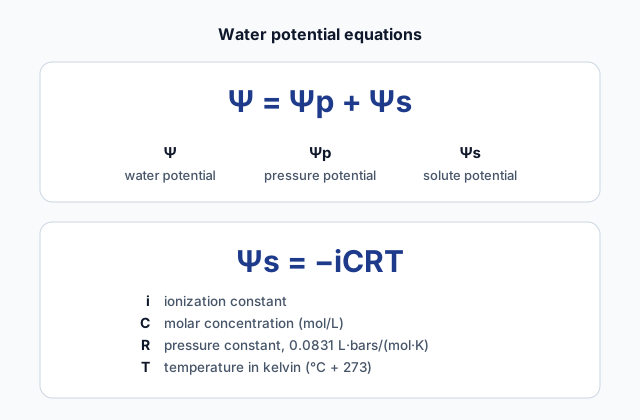
- Water potential Ψ = Ψp + Ψs, and solute potential Ψs = −iCRT, so adding solute lowers water potential.
- Growth and homeostasis depend on constant movement of molecules across membranes, and osmoregulation controls water balance and solute composition.
Part 2 Learn it Which way water moves
2a. Hypotonic, hypertonic, isotonic
Osmosis is the movement of water across a selectively permeable membrane. To predict its direction, compare the solute concentrations on the two sides.
An external environment can be hypotonic, hypertonic or isotonic to the internal environment of a cell. A hypotonic solution has a lower solute concentration than the cell; a hypertonic one has a higher solute concentration; an isotonic one has the same.
Water moves from hypotonic regions to hypertonic regions. Put another way, water moves from regions of low osmolarity, or low solute concentration, to regions of high osmolarity. Solutes tie up water molecules, so where there are fewer solutes, more water is free to move.
So a cell in a hypotonic solution gains water and swells; a cell in a hypertonic solution loses water and shrinks; a cell in an isotonic solution has no net movement of water, though water keeps crossing in both directions.
Quick check · Sort it
Each card describes a cell in a solution. Tap a card, then what happens to water overall.
Net movement of water into the cell
Net movement of water out of the cell
No net movement of water
2b. Water potential
Biologists put a number on water's tendency to move: water potential, written Ψ (the Greek letter psi). Water moves by osmosis from regions of high water potential to regions of low water potential.
Water potential has two parts:
Ψ = Ψp + Ψs
- Pressure potential, Ψp, is the effect of physical pressure. In a plant cell, the cell wall pushing back on a full vacuole gives a positive Ψp. In an open beaker, Ψp is 0.
- Solute potential, Ψs, is the effect of dissolved solutes. Pure water has Ψs = 0, and every solute added makes Ψs more negative.
Add them as signed numbers. A plant cell with Ψs = −7 bars and Ψp = +2 bars has Ψ = −7 + 2 = −5 bars. Since Ψs is usually negative, most water potentials are negative too, and the higher water potential is the one closer to zero. Water flows downhill: from the higher Ψ to the lower.
Quick check · Calculate
A plant cell has a solute potential of −9 bars and a pressure potential of +3 bars. What is its water potential, in bars?
2c. Solute potential from concentration
You can calculate a solution's solute potential:
Ψs = −iCRT
- i is the ionization constant: how many particles each unit of solute makes in water. Sucrose and glucose stay whole, so i = 1. NaCl splits into Na⁺ and Cl⁻, so i = 2.
- C is the molar concentration, in moles per liter.
- R is the pressure constant, 0.0831 liter bars per mole kelvin.
- T is the temperature in kelvin: °C + 273.
The minus sign makes Ψs negative, and the more particles there are, the more negative it gets. At the same temperature, compare solutions by i times C: 0.1 M NaCl makes 0.2 M of particles, more than 0.15 M sucrose does, so the NaCl solution has the lower solute potential.
Quick check · Multiple choice
Four solutions are at the same temperature. Which has the lowest (most negative) solute potential?
2d. Osmoregulation
Water and solutes never stop moving. Growth and homeostasis are maintained by the constant movement of molecules across membranes: water entering and leaving, nutrients coming in, wastes going out.
Left alone, osmosis would push many cells out of balance. Osmoregulation maintains water balance and allows organisms to control their internal solute composition and water potential.
A single-celled protist living in a pond is a clear case. Its cytoplasm is hypertonic to the pond water, so water keeps entering it by osmosis. Many such protists have a contractile vacuole, a vacuole that collects the extra water and then contracts to push it out of the cell, over and over, so the cell does not swell and burst. Freshwater fish face the same problem across their gills: they get rid of the extra water as large amounts of dilute urine and take up salts at their gills, which controls the solutes in their blood as well as the water. Plants handle it differently: their cell walls push back, and the resulting pressure potential helps stop the inflow.
Quick check · Put it in order
A pond protist keeps its water balance with a contractile vacuole. Put the events in the order they happen.
Part 3 Watch it done Salt versus sugar
Predict first, then watch each step, then finish the reasoning yourself.
Two solutions are at 22 °C. Solution 1 is 0.2 M sucrose. Solution 2 is 0.2 M NaCl. What is each one's solute potential?
Predict first
Before you open the first step, predict: how does the NaCl solution's solute potential compare with the sucrose solution's?
Step 1 · Convert the temperature
T must be in kelvin: 22 °C + 273 = 295 K.
Step 2 · Work the sucrose solution
Sucrose stays whole in water, so i = 1. Ψs = −iCRT = −(1)(0.2)(0.0831)(295) = −4.9 bars.
Why this step?
Why does i matter if both solutions are 0.2 M?
Water potential depends on the number of dissolved particles. 0.2 M of a solute that splits into two ions puts twice as many particles in the water as 0.2 M of one that stays whole.
Your step · Calculate
What is the solute potential of the 0.2 M NaCl solution at 22 °C, in bars? Give your answer to one decimal place.
bars
Same molarity, twice the particles, twice as negative a solute potential. That is why a salty dressing pulls so much water out of lettuce: salt lowers water potential more, mole for mole, than sugar does.
Part 4 Try it Potato cores in sugar
A new tissue, a new question. A student soaks equal cores of potato in sucrose solutions of different molarity at 20 °C for a day and records the percent change in each core's mass. These numbers are a teaching example.
- 0.0 M: +20%
- 0.2 M: +8%
- 0.4 M: −2%
- 0.6 M: −10%
- 0.8 M: −16%
- 1.0 M: −20%
Try it · Sketch the graph
Potato cores soaked in sucrose solutions changed mass by +20% at 0.0 M, +8% at 0.2 M, −2% at 0.4 M, −10% at 0.6 M, −16% at 0.8 M and −20% at 1.0 M. Use the data to sketch the shape of the graph of percent change in mass against sucrose molarity: drag the points so the curve rises or falls, and bends or runs straight, the way the data do.
One shape that fits
Drag a point up or down, or tap it and use the arrow keys. Only the shape is checked.
Try it · Calculate
Assuming the graph runs straight between 0.2 M and 0.4 M, at what sucrose molarity would the cores neither gain nor lose mass? Give your answer to two decimal places.
Part 5 Explain it A fish in fresh water
On the exam this is handwritten, so answer on paper first. Nothing you type here leaves this page. Then check your answer against the model and each scoring point.
Free response is 50% of the exam score. This one is shaped like Question 4, Conceptual Analysis.
Free-response practice · Question 4 style
A freshwater fish lives in water whose solute concentration is much lower than that of its body fluids. Its gill cells are in direct contact with the water.
(a) Describe the direction of net water movement between the gill cells and the surrounding water.
(b) Explain that direction in terms of water potential.
(c) Predict what would happen to the solute concentration of the fish's body fluids if it could not get rid of the extra water.
(d) Explain how osmoregulation helps the fish survive in fresh water.
Model answer
(a) Water moves from the surrounding water into the gill cells.
(b) The fresh water has fewer solutes, so it has a higher (less negative) solute potential and water potential than the cells, and water moves from high water potential to low.
(c) The body fluids would become more dilute; their solute concentration would fall.
(d) Osmoregulation lets the fish control its water balance and internal solute composition, here by getting rid of extra water, for example as large amounts of dilute urine, so its cells keep a stable water potential.
Score your own answer. This is a self-check, not a grade. Tick each point your answer makes.
Part 6 Check yourself Plant cells in three beakers
All three case questions use the table.
A plant tissue's cells have a solute potential of −8 bars and a pressure potential of +2 bars, so their water potential is −6 bars. Samples of the tissue go into three open beakers at 27 °C (300 K), where pressure potential is 0. These numbers are a teaching example.
| Beaker | Solution | Ionization constant (i) |
|---|---|---|
| A | Pure water | none |
| B | 0.1 M sucrose | 1 |
| C | 0.4 M sucrose | 1 |
Case question 1 · Calculate
Using the table: what is the solute potential of the solution in beaker C, in bars? Give your answer to one decimal place.
Case question 2 · Multiple choice
Using the table: in which beakers will the plant cells gain water? Beaker B's solution has a water potential of about −2.5 bars.
Case question 3 · Multiple choice
Using the table: which statement correctly describes beaker C's solution and the cells placed in it?
The rest stand on their own and do not use the case.
Check yourself · Spot the error
A student calculates the solute potential of 0.3 M glucose at 27 °C. Tap the line with the mistake.
Check yourself · Match
Match each term to its description.
Part 7 Keep it Bring back earlier ideas
Aquaporins, from the last lesson, are the path water takes, and the plant cell's large vacuole and turgor pressure from 2.1 are what limp lettuce has lost. Pulling them back up is what makes them last.
From 2.6 Facilitated Diffusion · Match
Match each substance to the way it most often crosses a plasma membrane.
From 2.1 Cell Structure and Function · Sort it
Each card describes a membrane sac doing its job. Tap a card, then the kind of sac it describes.
A lysosome
A plant cell's large vacuole
An animal cell's vacuole
In three lines
- Water moves by osmosis from hypotonic to hypertonic regions: from high water potential to low, from low solute concentration to high.
- Ψ = Ψp + Ψs, and Ψs = −iCRT with T in kelvin, so more dissolved particles make water potential more negative.
- Osmoregulation, such as a protist's contractile vacuole, maintains water balance and controls solute composition for growth and homeostasis.
Exam strategy for this topic
- Section I, Multiple Choice: 60 questions in 90 minutes.
- Section II, Free Response: 6 questions in 90 minutes.
- This lesson's Explain it is shaped like free-response question 4, Conceptual Analysis.
- A four-function, scientific, or graphing calculator is allowed on both sections of the exam.
For any osmosis question, write each side's water potential, or at least which side has more solute, and say water moves from high water potential to low. For −iCRT, convert to kelvin and decide i before you multiply.
Questions students ask
Which way does water move in osmosis?
From hypotonic to hypertonic: from lower solute concentration to higher, which is from high water potential to low water potential.
How do you calculate solute potential?
Ψs = −iCRT: i is the ionization constant, C the molar concentration, R = 0.0831 liter bars per mole kelvin, and T the temperature in kelvin (°C + 273). The result is negative.
What is the water potential of pure water?
In an open container, 0 bars: pure water has a solute potential of 0, and an open container adds no pressure potential.
What is osmoregulation?
The control of water balance and internal solute composition, such as a pond protist's contractile vacuole pumping out the water that enters it by osmosis.
Course alignment, for teachers
AP Biology topic 2.7, Unit 2: Cells.
- Skill 4.A: Construct a graph to represent the data, including: x-y graphs (bar, histogram, line, log scale, dual y), scatter plot, box and whisker plot, and pie chart.
This lesson maps all 3 essential knowledge statements of the topic to the part that teaches each one: 3 are checked by a scored question. The map is in the lesson file.