Unit 2 · Topic 2.8 · about 30 minutes · 7 parts · 11 scored checks, 3 of them multiple choice, plus 2 from earlier lessons
AP Biology 2.8: Mechanisms of Transport
Unit 2: 10 to 13% of the multiple-choice section
What you'll be able to do
- Describe the processes, powered by metabolic energy and membrane proteins, that move ions and other molecules across membranes and maintain electrochemical gradients.
Key vocabulary
| Term | What it means | The exam trap |
|---|---|---|
| Electrochemical gradient | A difference across a membrane in both the concentration of an ion and electric charge. | An ion's gradient has a concentration part and a charge part, so a stem may describe either one and still mean the same gradient. |
| Sodium-potassium pump | A membrane protein, an ATPase, that uses energy from ATP to move sodium ions and potassium ions across the plasma membrane. | The pump moves two kinds of ion in opposite directions, so name both directions when you describe it. |
| ATPase | An enzyme that breaks down ATP and uses the energy released. | An ATPase spends ATP rather than making it, so keep it apart from the processes that make ATP. |
| Membrane potential | The difference in electric charge across a cell's membrane. | A membrane potential compares two sides, so describe the inside relative to the outside. |
 Tap to open the picture full size
Part 1 Think first A plant toxin and a pump
Commit to a guess first. Being wrong now makes the right idea stick better.
Predict first
A cell keeps sodium ions (Na⁺) about ten times as concentrated outside as inside, even though its membrane has open channels that let a few Na⁺ ions through. A toxin from a plant stops the protein that pumps Na⁺ out of the cell. Over the next hour, what happens to the Na⁺ concentration inside the cell?
In short. Active transport moves ions and molecules across a membrane using metabolic energy, usually ATP, and membrane proteins; cells use it to build and keep electrochemical gradients, such as those the sodium-potassium pump maintains.
- Metabolic energy such as ATP is required for active transport and to establish and maintain electrochemical gradients.
- Membrane proteins are necessary for active transport.
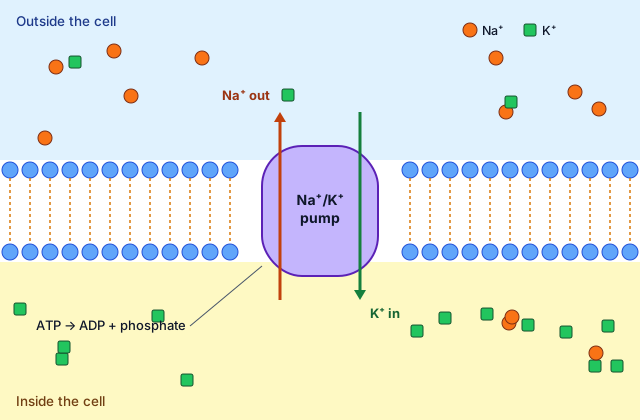
- The Na⁺/K⁺ pump, an ATPase, moves Na⁺ out and K⁺ in, and contributes to the maintenance of the membrane potential.
Part 2 Learn it Paying for gradients
2a. Energy and a protein
Active transport moves molecules and ions across a membrane with a direct input of energy. Two things are required.
The first is metabolic energy, such as that from ATP. Moving a substance from low concentration to high concentration is like pushing it uphill: it will not happen on its own, so the cell spends energy to do it.
The second is a membrane protein. Membrane proteins are necessary for active transport, because the ions and polar molecules a cell pumps cannot cross the hydrophobic interior of the bilayer by themselves. The protein, often called a pump, binds the substance and changes shape to carry it across, powered by the energy it receives.
No energy, no pumping. No protein, no path. Take away either one and active transport stops.
Quick check · Fill the statement
Complete the description of active transport.
Active transport requires metabolic energy, such as that from , and a to carry the substance across.
2b. Gradients have to be maintained
An ion carries a charge, so a difference in ion concentration across a membrane is also a difference in charge. The two together make an electrochemical gradient: a difference across the membrane in both the concentration of an ion and electric charge.
Metabolic energy is required both to establish electrochemical gradients and to maintain them. Maintaining is the part that is easy to miss. Membranes are never perfectly sealed: ions leak back through channels, down their gradients, all the time. Left alone, every gradient would slowly run down until the two sides matched.
So a cell does not build a gradient once and stop. Its pumps keep working, spending ATP to move ions back as fast as they leak. A steady gradient is a balance between passive leaking and active pumping, and if the pumping stops, the gradient fades.
Quick check · Multiple choice
A cell's ion gradient stays the same for hours. Which statement best explains why the cell is still using ATP to keep it?
2c. The sodium-potassium pump
The best-known pump is the sodium-potassium (Na⁺/K⁺) pump. It is an ATPase: an enzyme that breaks down ATP and uses the energy released to change its shape. Each cycle, it carries sodium ions out of the cell and potassium ions into it, each against its own concentration gradient.
The result is two gradients running in opposite directions: Na⁺ is much more concentrated outside the cell, and K⁺ is much more concentrated inside.
Those gradients are what give the cell its membrane potential, the difference in electric charge across the membrane. K⁺ leaks out through channels, carrying positive charge away, and the inside of the cell ends up negative relative to the outside. The Na⁺/K⁺ pump and its ATPase activity contribute to the maintenance of that membrane potential by restoring both gradients as fast as they leak. Nerve and muscle cells rely on this charge difference to send their signals.
Quick check · Sort it
Think about a resting animal cell with working Na⁺/K⁺ pumps. Tap each card, then the ion it describes.
Sodium (Na⁺)
Potassium (K⁺)
Part 3 Watch it done When the pump stops
Predict first, then watch each step, then finish the reasoning yourself.
A cell normally holds Na⁺ at 12 mM inside, with 145 mM outside. A biologist blocks its Na⁺/K⁺ pumps and measures Na⁺ inside.
- 0 min: 12 mM
- 20 min: 20 mM
- 40 min: 28 mM
These numbers are a teaching example. What does this show about how the cell normally keeps its Na⁺ low?
Predict first
Before you open the first step, predict: before the pump was blocked, was Na⁺ entering the cell at all?
Step 1 · Find the rate of the rise
In the first 20 minutes Na⁺ rose by 20 minus 12, or 8 mM, which is 8 divided by 20, or 0.4 mM per minute. In the next 20 minutes it rose another 8 mM, the same rate.
Why this step?
Why does Na⁺ rise at all once the pump is blocked?
Na⁺ is far more concentrated outside, 145 mM against 12 mM, so it moves in passively through channels, down its gradient. Blocking the pump does not open the channels; it only stops the Na⁺ from being sent back out.
Step 2 · Ask what was happening before
The channels were there before the pump was blocked, and the gradient was the same, so Na⁺ must have been leaking in all along. Yet the inside stayed at 12 mM. Something was removing Na⁺ at the same rate it leaked in.
Your step · Decide and justify
What do the data show about how the cell normally keeps Na⁺ at 12 mM inside?
Which reason supports your decision?
This is the plant toxin's effect from Think first: with the pump stopped, Na⁺ keeps leaking in and the gradient runs down. A steady gradient is the pump winning a race against the leak, paid for in ATP.
Part 4 Try it Warming stored blood cells
A new situation, a new question. Red blood cells stored cold for a week slowly lose K⁺, because their pumps work very slowly in the cold. A biologist warms two samples to body temperature for 3 hours: one with glucose, which the cells use to make ATP, and one without. These numbers are a teaching example.
- K⁺ inside before warming: 90 mM in both samples
- After 3 hours with glucose: 130 mM
- After 3 hours without glucose: 88 mM
- K⁺ outside the cells: 5 mM throughout
Try it · Calculate
By what percentage did K⁺ inside the cells warmed with glucose increase? Give your answer to the nearest whole percent.
Try it · Decide and justify
Which explanation fits the cells warmed with glucose?
Which reason supports your decision?
Part 5 Explain it Does uptake need ATP?
On the exam this is handwritten, so answer on paper first. Nothing you type here leaves this page. Then check your answer against the model and each scoring point.
Free response is 50% of the exam score. This one is shaped like Question 3, Scientific Investigation.
Free-response practice · Question 3 style
Gut cells take in an amino acid even when it is already more concentrated inside the cells than in the gut. A student wants to test whether this uptake requires ATP. She can measure the amino acid inside cells and can add a chemical that stops ATP production.
(a) Identify the independent variable and the dependent variable in her investigation.
(b) Identify an appropriate control.
(c) State the null hypothesis.
(d) Predict the result if uptake is active transport, and justify your prediction.
Model answer
(a) Independent variable: whether the chemical that stops ATP production is added. Dependent variable: the amount of the amino acid taken into the cells.
(b) Cells from the same source, in the same amino acid solution and conditions, with no chemical added.
(c) Stopping ATP production has no effect on the uptake of the amino acid.
(d) Cells with the chemical would take up much less of the amino acid, or stop gaining it once it matched the outside level, because active transport requires metabolic energy such as ATP to move the amino acid from low to high concentration.
Score your own answer. This is a self-check, not a grade. Tick each point your answer makes.
Part 6 Check yourself Three conditions, two gradients
All three case questions use the table.
A biologist measures Na⁺ and K⁺ inside nerve cells, and the difference in charge across their membranes (inside relative to outside, in millivolts), after 2 hours in each of three conditions. Outside the cells, Na⁺ is 145 mM and K⁺ is 5 mM throughout. These numbers are a teaching example.
| Condition | Na⁺ inside (mM) | K⁺ inside (mM) | Membrane potential (mV) |
|---|---|---|---|
| Normal | 12 | 140 | −70 |
| Na⁺/K⁺ pumps blocked | 60 | 90 | −40 |
| ATP production stopped | 58 | 92 | −42 |
Case question 1 · Calculate
Using the table: Na⁺ inside the cells with blocked pumps is how many times Na⁺ inside the normal cells?
Case question 2 · Multiple choice
Using the table: why do the cells with ATP production stopped look almost the same as the cells with blocked pumps?
Case question 3 · Multiple choice
Using the table: which explanation best fits the change in membrane potential when the pumps were blocked?
The rest stand on their own and do not use the case.
Check yourself · Spot the error
A student explains how a root cell takes in nitrate ions from soil that holds less nitrate than the cell does. Tap the line with the mistake.
Check yourself · Match
Match each term to its description.
Part 7 Keep it Bring back earlier ideas
Which way water moves, from the last lesson, and ion channels and polarization from 2.6 are the passive half of this story. Pulling them back up is what makes them last.
From 2.7 Tonicity and Osmoregulation · Sort it
Each card describes a cell in a solution. Tap a card, then what happens to water overall.
Net movement of water into the cell
Net movement of water out of the cell
No net movement of water
From 2.6 Facilitated Diffusion · Multiple choice
A cell holds K⁺ at a higher concentration inside than outside. Its K⁺ channels open, and K⁺ moves through them. What happens to the charge across the membrane?
In three lines
- Active transport needs metabolic energy, such as ATP, and a membrane protein.
- Ions leak back down their gradients, so cells spend energy both to establish and to maintain electrochemical gradients.
- The Na⁺/K⁺ pump, an ATPase, moves Na⁺ out and K⁺ in, and contributes to the maintenance of the membrane potential.
Exam strategy for this topic
- Section I, Multiple Choice: 60 questions in 90 minutes.
- Section II, Free Response: 6 questions in 90 minutes.
- This lesson's Explain it is shaped like free-response question 3, Scientific Investigation.
- A four-function, scientific, or graphing calculator is allowed on both sections of the exam.
When a stem cuts a cell's ATP or blocks a pump, predict that every gradient the pump maintains runs down, and say why: ions keep leaking back passively while nothing moves them back.
Questions students ask
Why does active transport need a membrane protein?
The ions and polar molecules a cell pumps cannot cross the hydrophobic interior of the bilayer on their own. A membrane protein binds them and carries them across, powered by energy such as ATP.
What does the sodium-potassium pump do?
It is an ATPase that uses ATP to move Na⁺ out of the cell and K⁺ into it, each against its gradient, keeping Na⁺ high outside and K⁺ high inside, which helps maintain the membrane potential.
Why do cells keep using ATP to maintain a gradient that is not changing?
Ions leak back down their gradients all the time through channels. Pumps must keep moving them back, or the gradient would run down.
What is an electrochemical gradient?
A difference across a membrane in both an ion's concentration and electric charge. Because ions are charged, moving them changes both at once.
Course alignment, for teachers
AP Biology topic 2.8, Unit 2: Cells.
- Skill 1.B: Explain biological concepts and processes.
This lesson maps the one essential knowledge statement of the topic to the part that teaches each one: 1 is checked by a scored question. The map is in the lesson file.