Unit 3 · Topic 3.2 · about 30 minutes · 7 parts · 14 scored checks, 4 of them multiple choice
AP Biology 3.2: Environmental Impacts on Enzyme Function
Unit 3: 12 to 16% of the multiple-choice section
What you'll be able to do
- Explain how a change to an enzyme's structure, such as denaturation, can change its function, and when that change can reverse.
- Explain how temperature, substrate and product concentrations and inhibitors in the cellular environment affect an enzyme's activity.
Key vocabulary
| Term | What it means | The exam trap |
|---|---|---|
| Active site | The region of an enzyme where the substrate binds and the reaction is catalyzed. | A question about the active site is usually about fit, so check whether the change described alters the enzyme's shape or only how often molecules meet. |
| Denaturation | A disruption of a protein's folded structure, by temperature, pH or the chemical environment, that removes its ability to do its job. | Denaturation is a change in shape, not a broken chain, and some exam stems show it reversing; read the whole data set before calling it permanent. |
| Optimal range | The temperatures or pH values in which a particular enzyme works most efficiently. | The optimum belongs to one enzyme, so read it from the stem or the data rather than assuming a body temperature. |
| Competitive inhibitor | A molecule that binds reversibly to an enzyme's active site, where the substrate would bind. | Questions often hide the type of inhibitor in what happens when more substrate is added, so look for that comparison before you decide. |
| Noncompetitive inhibitor | A molecule that binds to an allosteric site on an enzyme and changes the enzyme's activity. | An inhibitor that binds away from the active site still lowers activity, so where it binds, not whether it lowers the rate, is what tells the two kinds apart. |
| Allosteric site | A binding site on an enzyme other than its active site. | Binding at an allosteric site can change the active site's shape from a distance, so do not rule it out because the substrate is not blocked. |
 Tap to open the picture full size
Part 1 Think first Pineapple in gelatin
Commit to a guess first. Being wrong now makes the right idea stick better.
Predict first
Fresh pineapple keeps gelatin from setting, because it contains enzymes that cut gelatin's protein strands. Canned pineapple, which was heated during canning, sets fine. A cook chills fresh pineapple in the refrigerator overnight, lets it warm back to room temperature, and stirs it into gelatin. What happens?
In short. An enzyme's activity depends on its shape, so anything in its environment that changes that shape, or how often it meets its substrate, changes how fast it works.
- Temperature, pH and chemicals outside an enzyme's optimal range disrupt its structure, and denaturation is sometimes reversible.
- Below the optimum, warming speeds up the reaction by increasing collisions; the relative amounts of substrate and product also set the rate.
- Competitive inhibitors bind the active site, and noncompetitive inhibitors bind an allosteric site.
Part 2 Learn it What changes an enzyme's activity
2a. Shape decides what an enzyme can do
An enzyme is a protein, and like every protein its job depends on its three-dimensional shape. The active site is a pocket in that shape where the substrate binds. For the reaction to happen, the substrate's shape and charge have to fit the active site.
So anything that changes the molecular structure of a part of the system, the enzyme or its substrate, can change how well the reaction works. A small change can make the enzyme slower or less efficient. A large change can stop it entirely.
The extreme case is denaturation: the folded structure of the protein is disrupted, so the active site no longer has its working shape and the enzyme can no longer catalyze its reaction. Denaturation can be caused by a change in temperature, a change in pH, or a change in the chemical environment, such as a salt or a solvent. Notice that denaturation does not break the chain of amino acids. The chain is still there; it has lost its folded shape.
Quick check · Fill the statement
Complete the explanation of what happens to an enzyme that is heated far past its working range.
Heating disrupts the enzyme's folded , so the loses the shape that fits the substrate, and the enzyme can no longer the reaction.
2b. Temperature and pH have a working range
Each enzyme works best within an optimal range of temperature and pH, and that range differs from enzyme to enzyme. An enzyme from a human stomach works in strong acid; one from a hot spring bacterium works near boiling.
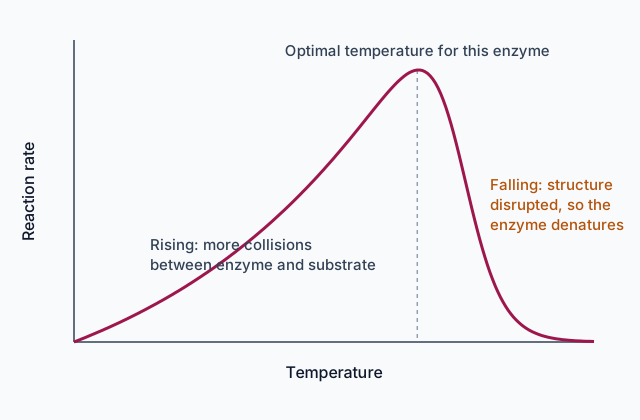
Below the optimum, warming helps. Molecules in a warmer solution move faster on average, so enzymes and substrates collide more often and the rate rises, up to the optimal temperature. A cold enzyme is slow because it has fewer collisions, not because it is damaged.
Past the optimal range, temperature or pH starts to change the enzyme's structure by disrupting the hydrogen bonds that hold its shape, and the rate falls. Far enough past it, the enzyme denatures.
Is that damage permanent? Sometimes not. In some cases denaturation is reversible: when conditions return to the working range, the protein refolds and regains activity. The only way to know which case you have is evidence, such as testing the enzyme again after conditions are restored.
Quick check · Sort it
Each card describes one enzyme sample. Tap a card, then the bin that best describes what happened to that sample's enzyme.
Rate changed, but its structure is unchanged
Structure changed, and activity can return
Structure changed, and activity does not return
2c. Concentration sets the pace
An enzyme with a perfect shape still needs substrate to work on. The relative concentrations of substrate and product decide how efficiently the reaction proceeds.
With more substrate, an enzyme's active site is filled more often, so the rate goes up. As product builds up and substrate is used up, the balance shifts and the reaction proceeds less efficiently. That is why the rate in a test tube is fastest at the start and slows as the reaction goes on, even when the enzyme is undamaged.
This matters when you read an experiment. A falling rate over time, or a lower rate in one tube, is not by itself evidence that an enzyme was damaged. First ask whether the tubes had the same amounts of substrate and product, and the same temperature and pH. Only when everything else is the same does a difference in rate point at the enzyme itself.
Quick check · Multiple choice
In a tube with an enzyme and its substrate, product forms quickly at first, then more and more slowly. The temperature and pH stay at the enzyme's optimum throughout. Which explanation is best supported?
2d. Inhibitors bind in two places
Some molecules lower an enzyme's activity by binding to it. Where they bind matters.
A competitive inhibitor binds reversibly to the active site itself. While it is there, the substrate cannot bind, so the inhibitor and the substrate compete for the same spot. Because the binding is reversible, adding a lot more substrate means substrate wins the active site more often, and the rate climbs back toward normal.
A noncompetitive inhibitor binds to an allosteric site, a different place on the enzyme. Its binding changes the enzyme's activity, often by changing the shape of the active site, even though the active site is not blocked directly. Since the inhibitor is not competing for the active site, adding more substrate does not undo its effect.
Neither of these is denaturation. The enzyme keeps its overall structure, and inhibition is a normal way cells regulate their enzymes.
Quick check · Match
Match each description to the term it describes.
Part 3 Watch it done Cold or damaged?
Predict first, then watch each step, then finish the reasoning yourself.
A student mixes the same amounts of an enzyme and its substrate in two tubes. Tube A is kept at the enzyme's optimal temperature. Tube B is kept in an ice bath. She measures the product (in arbitrary units) every 20 seconds.
- Tube A: 0 at 0 s, 8 at 20 s, 16 at 40 s
- Tube B: 0 at 0 s, 4 at 20 s, 8 at 40 s
These numbers are a teaching example, not a published study. How do the two rates compare, and does the data show that the cold enzyme was damaged?
Predict first
Before you open the first step, predict: is the enzyme in tube B denatured?
Step 1 · Find each rate
Rate is product made divided by time taken. Tube A: 16 units in 40 s is 0.4 units per second. Both 20-second intervals give the same 0.4, so the rate is steady over this stretch. Tube B: 8 units in 40 s is 0.2 units per second.
Step 2 · Compare the rates
Tube B's rate is 0.2 divided by 0.4, which is 0.5, or 50% of tube A's. The cold tube makes product at half the speed.
Why this step?
Why compare tubes that differ only in temperature?
The tubes have the same enzyme and the same substrate amounts, so temperature is the only thing that differs. That lets the difference in rate be pinned on temperature, not on concentration.
Step 3 · Separate the observation from the inference
The observation is that tube B is slower. Both explanations from this lesson predict that: fewer collisions in the cold, or a disrupted structure. A lower rate alone cannot choose between them. We need a test that the two explanations answer differently.
Your step · Decide and justify
The student moves tube B out of the ice bath to the optimal temperature. Its new rate is 0.4 units per second, the same as tube A's. Was tube B's enzyme denatured by the cold?
Which reason supports your decision?
Cooling slowed this enzyme without changing its structure, just as chilling left the pineapple's enzymes able to cut gelatin once they warmed up. The heat of canning is the opposite case: it changed the enzymes' structure, and cooling did not bring the activity back.
Part 4 Try it Which kind of inhibitor?
A new experiment, a new question. A student tests a molecule, X, that lowers an enzyme's activity. She runs four tubes for 50 seconds at the enzyme's optimal temperature and pH, at a low and a high substrate concentration, with and without X. These numbers are a teaching example.
- Low substrate, no X: 30 units of product
- Low substrate, with X: 12 units
- High substrate, no X: 60 units
- High substrate, with X: 59 units
Try it · Calculate
At the high substrate concentration, the tube with X makes what percentage of the product made by the tube without X? Give your answer to the nearest whole percent.
Try it · Decide and justify
Which kind of inhibitor does the data suggest X is?
Which piece of evidence supports your decision?
Part 5 Explain it Is the damage permanent?
On the exam this is handwritten, so answer on paper first. Nothing you type here leaves this page. Then check your answer against the model and each scoring point.
Free response is 50% of the exam score. This one is shaped like Question 3, Scientific Investigation.
Free-response practice · Question 3 style
A biologist studies an enzyme from a plant. She wants to know whether a short exposure to 60 °C, well above the enzyme's optimal temperature, permanently reduces its activity. She has enzyme extract, its substrate, water baths at 25 °C and 60 °C, and a way to measure the rate of product formation.
(a) Describe how a temperature far above the optimum can affect the structure of an enzyme.
(b) Identify an appropriate control for her investigation.
(c) State the null hypothesis for her investigation.
(d) She finds that enzyme held at 60 °C for 5 minutes and then returned to 25 °C has the same rate as the control. Justify the claim that the change caused by 60 °C was reversible.
Model answer
(a) The high temperature disrupts the hydrogen bonds that hold the enzyme's folded shape, so the shape of the active site changes and the enzyme can lose its ability to catalyze the reaction (denaturation).
(b) Enzyme extract from the same batch kept at 25 °C the whole time, then tested in the same way with the same amount of substrate.
(c) A short exposure to 60 °C has no effect on the enzyme's rate after it is returned to 25 °C.
(d) After it was returned to 25 °C, the heated enzyme catalyzed the reaction at the same rate as enzyme that was never heated, so any change to its structure was undone and its activity was regained.
Score your own answer. This is a self-check, not a grade. Tick each point your answer makes.
Part 6 Check yourself An enzyme from the stomach
All three case questions use the table.
A student studies enzyme P, which digests proteins in an animal's stomach. She measures its rate at several pH values at the same temperature. Then she holds two samples at pH 5 and pH 7 for 10 minutes and returns each to pH 2 before measuring again. Every test starts with fresh substrate. These numbers are a teaching example.
| pH during the test | Rate | Rate after being returned to pH 2 |
|---|---|---|
| 1 | 3.0 | not tested |
| 2 | 6.0 | not tested |
| 3 | 4.5 | not tested |
| 5 | 1.2 | 5.8 |
| 7 | 0.0 | 0.0 |
Case question 1 · Calculate
Using the table for enzyme P: the rate at pH 5 is what percentage of the rate at pH 2? Give your answer to the nearest whole percent.
Case question 2 · Multiple choice
Using the table for enzyme P: which claim about the sample held at pH 5 do the data best support?
Case question 3 · Multiple choice
Using the table for enzyme P: which explanation best fits the sample held at pH 7?
The rest stand on their own and do not use the case.
Check yourself · Put it in order
An enzyme is heated far above its optimal temperature. Put the events in the order they happen.
Check yourself · Spot the error
A student explains why an enzyme's rate rises as it is warmed from 15 °C to 30 °C, both below its optimum. Tap the line with the mistake.
Part 7 Keep it Bring back earlier ideas
This lesson leans on two earlier ideas: how a protein gets its shape, and why the substrate has to fit. Pulling them back up is what makes them last.
Bring it back · Multiple choice
For an enzyme-catalyzed reaction to occur, what must be true of the substrate?
Bring it back · Fill the statement
Complete the description of how a protein folds.
Hydrogen bonds between atoms of the backbone form structures such as alpha-helices. Hydrogen bonds, hydrophobic interactions, ionic interactions and disulfide bridges give the protein its three-dimensional structure.
In three lines
- An enzyme's function depends on its structure: the active site must fit the substrate, and a change in structure can change or stop its activity.
- Temperature and pH outside an enzyme's optimal range disrupt hydrogen bonds and can denature it; sometimes the change reverses when conditions are restored.
- Rate also depends on collisions and on substrate and product levels, and inhibitors lower activity by binding at the active site or at an allosteric site.
Exam strategy for this topic
- Section I, Multiple Choice: 60 questions in 90 minutes.
- Section II, Free Response: 6 questions in 90 minutes.
- This lesson's Explain it is shaped like free-response question 3, Scientific Investigation.
- A four-function, scientific, or graphing calculator is allowed on both sections of the exam.
When a question shows a lower rate, name both possible causes, fewer collisions or a changed structure, and then point to the part of the data that tells them apart, such as a recovery test or a change in substrate level.
Questions students ask
What is the difference between a cold enzyme and a denatured one?
A cold enzyme is slow because its molecules collide less often, but its structure is intact, so it speeds up again when warmed. A denatured enzyme has lost its working shape, so it does not work until, and unless, its structure recovers.
Can denaturation be reversed?
Sometimes. In some cases the protein refolds when temperature or pH returns to its working range and regains activity; in others, such as boiling, it does not. Evidence from a recovery test decides which.
Why does the rate of an enzyme reaction slow down over time?
As substrate is used up and product builds up, the relative concentrations shift and the reaction proceeds less efficiently, even if the enzyme itself is undamaged.
How can you tell a competitive inhibitor from a noncompetitive one?
A competitive inhibitor binds the active site, so adding much more substrate restores the rate. A noncompetitive inhibitor binds an allosteric site, so more substrate does not undo its effect.
Does every enzyme work best at 37 °C?
No. Each enzyme has its own optimal temperature and pH, set by where it works, from the acid of the stomach to hot springs.
Course alignment, for teachers
AP Biology topic 3.2, Unit 3: Cellular Energetics.
- Skill 6.E: Predict the causes or effects of a change in, or disruption to, one or more components in a biological system.
This lesson maps all 5 essential knowledge statements of the topic to the part that teaches each one: 5 are checked by a scored question. The map is in the lesson file.