Unit 3 · Topic 3.3 · about 30 minutes · 7 parts · 12 scored checks, 3 of them multiple choice, plus 2 from earlier lessons
AP Biology 3.3: Cellular Energy
Unit 3: 12 to 16% of the multiple-choice section
What you'll be able to do
- Describe the role of energy in living organisms: why they need an input of energy greater than what they lose, how coupling powers their work, and why their energy pathways run in steps.
- Explain how core metabolic pathways shared by organisms in all three domains support the idea of common ancestry for all organisms.
Key vocabulary
| Term | What it means | The exam trap |
|---|---|---|
| Metabolic pathway | A series of reactions in which the product of one reaction is typically the reactant for the next. | A stem may name a pathway by what it does overall without listing every step; work only from the steps the stem gives. |
| First law of thermodynamics | Energy is neither created nor destroyed; it is only transferred or transformed. | The law is about the total; a single cell can still gain or lose energy, as long as that energy comes from or goes somewhere. |
| Second law of thermodynamics | In every energy transfer, some energy becomes unusable. | Heat is still energy, so this law is about energy becoming unusable for work, not about energy disappearing. |
| Energy coupling | Linking a process that releases energy to a process that requires energy, so the first powers the second. | A coupled pair is two different processes, and a stem may describe only one of them, so look for its partner. |
| Conserved | Kept with little change across many different groups of organisms. | Conserved does not mean identical; small differences between organisms are expected even in a conserved pathway. |
 Tap to open the picture full size
Part 1 Think first A marshmallow, two ways
Commit to a guess first. Being wrong now makes the right idea stick better.
Predict first
Set a marshmallow on fire and the energy in its sugar is released in a few seconds as heat and light. Eat it instead, and your cells release the energy in the same sugar through a long series of small reactions. Why do cells break sugar down in many small steps instead of all at once?
In short. Living things stay highly ordered only by taking in more energy than they lose, and they handle that energy through linked reactions that run in controlled steps.
- All living systems need an input of energy; life follows the laws of thermodynamics, and losing order or energy flow for long results in death.
- Processes that release energy can be coupled with processes that require it, so one powers the other.
- Energy pathways run in sequence, each product typically the next step's reactant, and core pathways are shared by all three domains of life.
Part 2 Learn it Energy in living systems
2a. Order costs energy
All living systems require an input of energy. Plants and algae take it in as light; animals and fungi take it in as the energy stored in food.
They need it because life is highly ordered. A cell keeps its molecules sorted into membranes, organelles and gradients, and it builds large, precise molecules from small ones. Life does not break the laws of thermodynamics to do this. The first law says energy is never created or destroyed, only transferred or transformed. The second law says that in every transfer some energy becomes unusable, often as heat, so disorder tends to increase.
So a living thing is always losing usable energy, and its order tends to slip away. It stays ordered, and powers its work, only while its energy input exceeds its energy loss. The order inside it is paid for with energy taken from outside, and the heat it gives off adds disorder to its surroundings.
If the input stops for long, the order cannot be kept. A significant loss of order or of energy flow results in death.
Quick check · Fill the statement
Complete the description of how a living system stays alive.
To stay highly , a living system needs an energy that is greater than its energy .
2b. Coupling: one process pays for another
Some cellular processes release energy, such as breaking a large molecule into smaller ones. Others require energy, such as building a protein from amino acids or pumping ions against their concentration gradient.
Cells link the two. In energy coupling, a process that releases energy is joined to a process that requires energy, so the energy released by the first powers the second. The breakdown of ATP is the cell's most common partner: it releases energy, and that energy is coupled to work such as active transport, which you met in Unit 2.
Coupling never captures all of the energy released. Some is always lost as heat, which is the second law at work. That is one more reason the cell's energy input has to keep coming.
Quick check · Sort it
Tap each process, then the bin that says whether it releases or requires energy.
Releases energy
Requires energy
2c. Pathways run in steps
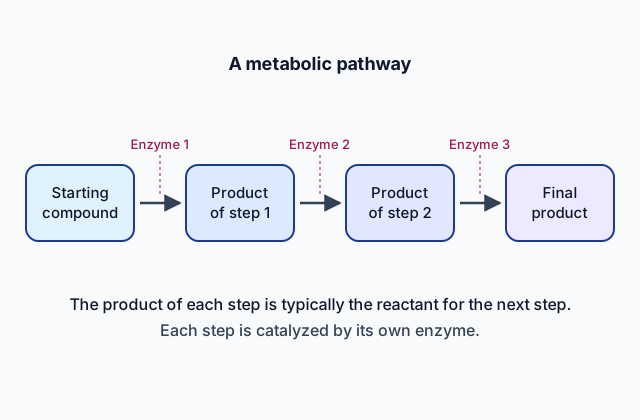
Energy-related pathways in cells are sequential: a metabolic pathway is a series of reactions, each usually catalyzed by its own enzyme. A product of one reaction is typically the reactant for the next step. The diagram at the top of the page shows one with three steps.
Why so many steps? Releasing energy in small amounts allows a more controlled transfer of energy. The cell can capture a little energy at each step instead of losing a large burst at once as heat.
The chain of steps also shows you how to read a pathway. If one enzyme stops working, its reactant is no longer converted, so that compound builds up. Everything downstream of the blocked step stops being made, because each later step needs the product of the one before it.
Quick check · Multiple choice
In a pathway W to X to Y to Z, each step is catalyzed by its own enzyme. A poison stops only the enzyme that converts X to Y. What happens in the cell?
2d. Pathways shared by all life
Some pathways are found almost everywhere. Core metabolic pathways, such as glycolysis, which begins the breakdown of glucose, and oxidative phosphorylation, which makes most of the ATP in cells that use oxygen, are conserved across all currently recognized domains of life: Archaea, Bacteria and Eukarya. You will study both pathways in this unit.
A conserved pathway is a strong piece of evidence for common ancestry. These pathways are long series of reactions, each with its own enzyme. Finding such similar series in a bacterium, an archaean and a human is hard to explain if each group invented it separately. It is easy to explain if all three inherited it from a shared ancestor that already had it, and each line kept it.
Conserved pathways join other shared features, such as the ribosomes found in cells in all forms of life, that reflect the common ancestry of all known life.
Quick check · Match
Match each term to its description.
Part 3 Watch it done Does the energy cover the cost?
Predict first, then watch each step, then finish the reasoning yourself.
In a cell, reaction R releases 50 units of energy each time it runs. Building one molecule of M requires 30 units. The cell couples one run of R to building one M.
These numbers are a teaching example, not measured values. How much of R's energy ends up in M, and what happens to the rest?
Predict first
Before you open the first step, predict: what happens to the energy from R that does not go into building M?
Step 1 · Find what is left over
R releases 50 units, and building M takes 30 of them. 50 minus 30 leaves 20 units that do not go into M.
Step 2 · Find the share captured
30 divided by 50 is 0.6, so 60% of the energy R releases ends up in M. The other 40%, the 20 units, is not captured.
Why this step?
Where do the other 20 units go?
Energy cannot be destroyed, so the 20 units still exist. They leave as heat, energy the cell can no longer use for work. That loss is why a cell needs a steady input of energy to keep running.
Step 3 · Check the books
30 units in M plus 20 units as heat is 50 units, exactly what R released. No energy was created or destroyed, only transferred into M and transformed into heat.
Your step · Decide and justify
Building one molecule of N requires 70 units of energy. Can a single run of reaction R, coupled to it, power the building of one N?
Which reason supports your decision?
Every coupling loses some energy as heat, like the 20 units here. That is the same reason the marshmallow's energy is released in steps: each small transfer lets the cell capture part of the energy before it is lost.
Part 4 Try it Which step stopped?
A new pathway, a new question. A bacterium makes compound D from compound A in three steps, A to B, B to C and C to D, each catalyzed by its own enzyme. Researchers measure the amount of each compound in normal cells and in a mutant strain. These numbers are a teaching example.
- Normal cells: A 10, B 5, C 5, D 40
- Mutant cells: A 10, B 55, C 0, D 0
Try it · Calculate
The amount of B in the mutant cells is how many times the amount of B in normal cells?
Try it · Decide and justify
Which step is blocked in the mutant cells?
Which piece of evidence supports your decision?
Part 5 Explain it Reading an energy model
On the exam this is handwritten, so answer on paper first. Nothing you type here leaves this page. Then check your answer against the model and each scoring point.
Free response is 50% of the exam score. This one is shaped like Question 5, Analyze Model or Visual Representation of a Biological Concept or Process.
Free-response practice · Question 5 style
A model of an animal cell shows energy entering the cell in glucose. Arrows show part of that energy being used to build proteins and to pump ions across the plasma membrane, and the rest leaving the cell as heat.
(a) Describe why the cell needs a continuous input of energy.
(b) Explain how the model is consistent with the first law of thermodynamics.
(c) Identify a process in the model that releases energy and a process that requires energy, which the cell can couple.
(d) The cell's supply of glucose stops and nothing replaces it. Predict what will happen to the cell over time.
Model answer
(a) The cell is highly ordered, and in every energy transfer some energy is lost as heat. To keep its order and power its processes, its energy input must exceed its energy loss.
(b) The energy that enters in glucose is not created or destroyed. It is transferred into proteins and ion gradients or transformed into heat, so the energy in proteins, gradients and heat together equals the energy that entered.
(c) Breaking down glucose releases energy; building proteins (or pumping ions against their gradient) requires energy.
(d) Without an energy input, the cell can no longer replace the energy it loses, so it loses order, stops its processes and dies.
Score your own answer. This is a self-check, not a grade. Tick each point your answer makes.
Part 6 Check yourself Four tadpoles
All three case questions use the table.
A student keeps four tadpoles of the same species at the same temperature for 10 days, each with a different amount of food. She estimates the energy each takes in from food and the energy each releases as heat, and tracks its body mass. These numbers are a teaching example.
| Tadpole | Energy taken in from food | Energy released as heat | Body mass after 10 days |
|---|---|---|---|
| A | 40 | 30 | grew 6% |
| B | 30 | 30 | no change |
| C | 15 | 25 | shrank 8% |
| D | 0 | 20 | died on day 6 |
Case question 1 · Calculate
Using the table: what percentage of tadpole A's energy input was released as heat? Give your answer to the nearest whole percent.
Case question 2 · Multiple choice
Using the table: which tadpole was able to build new body tissue, and why?
Case question 3 · Multiple choice
Using the table: which explanation best fits what happened to tadpole D?
The rest stand on their own and do not use the case.
Check yourself · Put it in order
Energy from the sun ends up powering an animal's muscles. Put the events in order.
Check yourself · Spot the error
A student explains how a growing seedling builds its body. Tap the line with the mistake.
Part 7 Keep it Bring back earlier ideas
Pathways run on enzymes, and coupling runs on the transport you studied in Unit 2. Pulling both back ties them to energy.
From 3.2 Environmental Impacts on Enzyme Function · Match
Match each description to the term it describes.
From 2.5 Membrane Transport · Match
Match each process to its description.
In three lines
- All living systems need an energy input greater than their energy loss to keep their order; a significant loss of order or energy flow results in death.
- Life follows the laws of thermodynamics, and cells couple processes that release energy with processes that require it.
- Energy pathways run in steps for a controlled transfer, and core pathways shared by all three domains are evidence of common ancestry.
Exam strategy for this topic
- Section I, Multiple Choice: 60 questions in 90 minutes.
- Section II, Free Response: 6 questions in 90 minutes.
- This lesson's Explain it is shaped like free-response question 5, Analyze Model or Visual Representation of a Biological Concept or Process.
- A four-function, scientific, or graphing calculator is allowed on both sections of the exam.
When a question asks how an organism stays alive or grows, compare its energy input with its energy loss, and say where the lost energy goes, usually heat.
Questions students ask
Do living things break the second law of thermodynamics?
No. They build and keep order only by taking in energy, and the heat they give off increases disorder in their surroundings, so the system and its surroundings together still become less ordered.
Why do all living things need energy?
Life is highly ordered, and every energy transfer loses some energy as heat. An organism keeps its order and powers its processes only while its energy input exceeds its energy loss.
What is energy coupling?
Linking a process that releases energy, such as breaking down ATP, to one that requires energy, such as active transport, so the first powers the second.
Why do cells release energy in many small steps?
Sequential pathways allow a more controlled transfer of energy, so the cell captures more of it instead of losing it all at once as heat. The total energy released is the same.
How do shared metabolic pathways support common ancestry?
Core pathways such as glycolysis and oxidative phosphorylation are found in all three domains. The same long series of reactions is best explained by inheritance from a common ancestor.
Beyond the AP Exam
College Board sets this limit on what the AP Exam asks about this topic. Anything past it is not on the exam.
Students will need to understand the concept of energy, but the equation for Gibbs free energy is beyond the scope of the AP Exam.
Course alignment, for teachers
AP Biology topic 3.3, Unit 3: Cellular Energetics.
- Skill 6.C: Provide reasoning to justify a claim by connecting evidence to biological theories.
This lesson maps all 4 essential knowledge statements of the topic to the part that teaches each one: 4 are checked by a scored question. The map is in the lesson file.