Unit 3 · Topic 3.4 · about 30 minutes · 7 parts · 12 scored checks, 3 of them multiple choice, plus 2 from earlier lessons
AP Biology 3.4: Photosynthesis
Unit 3: 12 to 16% of the multiple-choice section
What you'll be able to do
- Describe the photosynthetic processes and the structures of the chloroplast, stroma, thylakoids and grana, that let organisms capture and store energy.
- Explain how photosystems, an electron transport chain and a proton gradient capture energy from light as ATP and NADPH, which power the building of carbohydrates.
Key vocabulary
| Term | What it means | The exam trap |
|---|---|---|
| Thylakoid | A flattened sac of membrane inside a chloroplast. | The inside of a thylakoid and the fluid outside it are different regions, so check which side of the membrane a question means. |
| Stroma | The fluid within the inner chloroplast membrane and outside the thylakoids. | The stroma of a chloroplast and the matrix of a mitochondrion are both inner fluids, so check which organelle a stem describes. |
| Photosystem | One of two light-capturing groups of chlorophyll pigments and proteins in a chloroplast, called photosystem I and photosystem II. | A stem may describe a photosystem by what it does instead of by its number, so match the process in the stem to the photosystem. |
| ATP synthase | A protein in a membrane that makes ATP. | In a diagram the protein sits in the membrane, so follow the arrow of protons to see which side is which. |
| Calvin cycle | The cycle of reactions in a chloroplast that builds carbohydrates. | Its individual steps and molecules are not tested; know what goes in, what comes out, and where it happens. |
| Photophosphorylation | The name for making ATP in the light reactions of photosynthesis. | It uses the same kind of machinery as oxidative phosphorylation in mitochondria; the source of the energy is what differs. |
 Tap to open the picture full size
Part 1 Think first Where does a tree come from?
Commit to a guess first. Being wrong now makes the right idea stick better.
Predict first
A small willow seedling is planted in a large tub of soil and watered for five years. It grows into a tree whose dry wood, leaves and roots weigh many times what the seedling did, yet the soil in the tub loses almost no mass. Where did most of the tree's new dry mass come from?
In short. Photosynthesis uses carbon dioxide, water and light energy to make carbohydrates and oxygen: the light reactions in the thylakoids capture energy as ATP and NADPH, and the Calvin cycle in the stroma uses them to build sugar.
- Photosynthesis first evolved in prokaryotes, and evidence supports the claim that cyanobacteria produced an oxygenated atmosphere.
- In the thylakoid membranes, light boosts electrons in photosystems II and I; water is split to replace lost electrons, and NADP⁺ is reduced to NADPH.
- Electron transport builds a proton gradient across the thylakoid membrane, and protons flowing back through ATP synthase make ATP by photophosphorylation.
Part 2 Learn it How chloroplasts capture energy
2a. What photosynthesis makes, and where it came from
Photosynthesis is the series of reactions that use carbon dioxide (CO₂), water (H₂O) and light energy to make carbohydrates and oxygen (O₂). Photosynthetic organisms capture energy from the sun and store it in sugars, which they can use right away in their own processes or store.
Photosynthesis is ancient, and it started small. It first evolved in prokaryotic organisms. Scientific evidence supports the claim that photosynthesis by prokaryotes called cyanobacteria was responsible for producing an oxygenated atmosphere; before it, Earth's air had very little oxygen.
Eukaryotes came later, and they did not invent photosynthesis from scratch. Prokaryotic photosynthetic pathways were the foundation of eukaryotic photosynthesis. The reason is endosymbiosis, which you met in Unit 2. Chloroplasts evolved from once free-living prokaryotic cells, and they brought those pathways with them.
Quick check · Multiple choice
Which claim about the history of photosynthesis does scientific evidence support?
2b. Inside the chloroplast
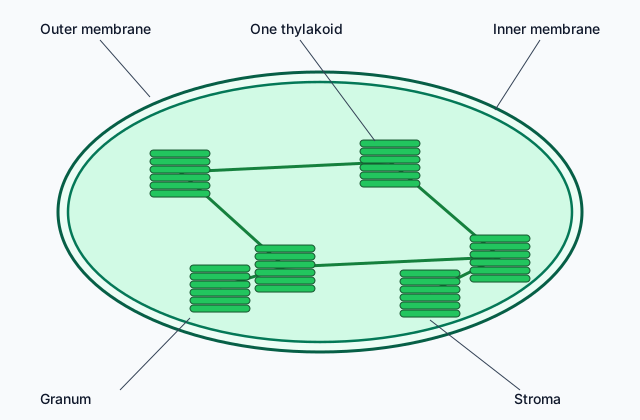
In plants and algae, photosynthesis happens in chloroplasts. The diagram at the top of the page shows the parts.
The stroma is the fluid within the inner chloroplast membrane and outside the thylakoids. The carbon fixation reactions of photosynthesis, the Calvin cycle, occur in the stroma.
The thylakoids are flattened sacs of membrane. Their membranes contain chlorophyll pigments organized into two photosystems, photosystem I and photosystem II, as well as electron transport proteins. Thylakoids are organized in stacks called grana, and the light reactions of photosynthesis occur in the grana.
So a chloroplast divides the work between two places. The thylakoid membranes capture energy from light; the stroma around them uses that energy to build sugar. Each process sits where its molecules are.
Quick check · Fill the statement
Complete the description of where photosynthesis happens in a chloroplast.
The light reactions take place in the , where thylakoid membranes hold chlorophyll organized into two . The Calvin cycle takes place in the .
2c. The light reactions: from light to NADPH
The light reactions are a series of coordinated reaction pathways that capture the energy in light and yield two energy-carrying molecules, ATP and NADPH.
It starts with chlorophyll. When chlorophylls absorb energy from light, they boost electrons to a higher energy level, in both photosystem II and photosystem I. The boosted electrons leave photosystem II. To replace them, water is split, supplying new electrons to photosystem II. Splitting water also releases oxygen, the O₂ that photosynthesis gives off.
The two photosystems are embedded in the thylakoid membrane and are connected by the transfer of electrons through an electron transport chain (ETC). Electrons pass along the chain to photosystem I, where light boosts them again. Then they are picked up and ultimately transferred to NADP⁺, reducing it to NADPH.
Electron transport chains are not unique to chloroplasts: ETC reactions also occur in mitochondria and across the plasma membranes of prokaryotes, as you will see in the next topic.
Quick check · Sort it
Tap each event, then the photosystem it belongs to.
Photosystem II only
Photosystem I only
Both photosystems
2d. A proton gradient makes ATP
As electrons pass through the ETC, they are transferred between molecules in a series of oxidation and reduction reactions. Those transfers move protons (hydrogen ions) across the thylakoid membrane and establish an electrochemical gradient. The membrane separates a region of low proton concentration outside the thylakoid from a region of high proton concentration inside it.
The gradient is stored energy, like water behind a dam. Protons flow back out through ATP synthase, a protein in the membrane, by chemiosmosis. That flow drives the formation of ATP from ADP and inorganic phosphate. Because the energy came from light, this is called photophosphorylation.
Now the light reactions have made ATP and NADPH. The energy captured in them powers the production of carbohydrates from carbon dioxide in the Calvin cycle, in the stroma. The specific steps and molecules of that cycle are beyond this course; what matters is what goes in, what comes out, and where.
Quick check · Match
Match each term to its description.
Part 3 Watch it done ATP in the dark
Predict first, then watch each step, then finish the reasoning yourself.
A biologist soaks isolated thylakoids in an acidic solution until the inside of each thylakoid has a high proton concentration. Then, in complete darkness, she moves them into two tubes that both hold ADP and inorganic phosphate.
- Tube 1: the solution outside has a low proton concentration. Inside to outside: 100 to 1. ATP made in 30 seconds: 60 units.
- Tube 2: the solution outside has the same high proton concentration as the inside. Inside to outside: 100 to 100. ATP made in 30 seconds: 2 units.
These numbers are a teaching example, not a published study. What do the results show about how a chloroplast makes ATP?
Predict first
Before you open the first step, predict: can thylakoids make ATP in complete darkness?
Step 1 · Compare the gradients
In tube 1, the inside has 100 times the proton concentration of the outside, high inside and low outside, the same direction as in a working chloroplast. In tube 2, inside and outside are equal, so there is no gradient.
Step 2 · Compare the ATP
60 divided by 2 is 30. Tube 1, with a gradient, made 30 times as much ATP as tube 2, without one.
Why this step?
Why run the tubes in complete darkness?
In the dark, chlorophyll boosts no electrons, so no electrons move through the electron transport chain and it builds no new gradient. Any ATP made must come from the gradient the biologist set up by soaking the thylakoids, not from light.
Step 3 · Draw the conclusion
A proton gradient across the thylakoid membrane drives the formation of ATP, even without light. In a working chloroplast, light and electron transport build that gradient, and the gradient makes the ATP.
Your step · Decide and justify
A third tube is set up like tube 1, with the same 100 to 1 gradient in the dark, but it also holds a chemical that blocks ATP synthase. Will it make about as much ATP as tube 1?
Which reason supports your decision?
In a leaf in sunlight, the light reactions keep rebuilding this gradient, so ATP synthase keeps making ATP. Together with NADPH, that ATP is what the Calvin cycle spends to build sugar from carbon dioxide.
Part 4 Try it When the light goes off
A new experiment, a new question. A student shines light on a suspension of algae, then switches the light off. She measures how fast the algae take up CO₂ from the water around them. These numbers are a teaching example.
- Light on: 12 units per minute
- 1 minute after the light goes off: 3 units per minute
- 3 minutes after the light goes off: 0 units per minute
Try it · Calculate
One minute after the light goes off, the rate of CO₂ uptake is what percentage of the rate with the light on? Give your answer to the nearest whole percent.
Try it · Decide and justify
A classmate says CO₂ uptake stops in the dark because the Calvin cycle needs light to shine on it directly. Is the classmate right?
Which piece of evidence or reasoning supports your decision?
Part 5 Explain it Light and oxygen
On the exam this is handwritten, so answer on paper first. Nothing you type here leaves this page. Then check your answer against the model and each scoring point.
Free response is 50% of the exam score. This one is shaped like Question 6, Analyze Data.
Free-response practice · Question 6 style
A student places a water plant under a lamp at five light intensities and counts the oxygen bubbles it releases. These numbers are a teaching example.
- 0 units of light: 0 bubbles per minute
- 100 units: 6 bubbles per minute
- 200 units: 12 bubbles per minute
- 400 units: 20 bubbles per minute
- 800 units: 21 bubbles per minute
(a) Describe the relationship between light intensity and the rate of oxygen release.
(b) Calculate the rate of change in oxygen release, in bubbles per minute per unit of light, between 100 and 200 units of light.
(c) Explain why oxygen release increases as light intensity increases from 0 to 200 units.
(d) Identify a factor other than light that could limit the rate of oxygen release at 800 units, and give a reason.
Model answer
(a) As light intensity increases, oxygen release increases, quickly at first, then more slowly, and it levels off between 400 and 800 units.
(b) (12 − 6) bubbles per minute divided by (200 − 100) units is 0.06 bubbles per minute per unit of light.
(c) More light means chlorophyll absorbs more energy and boosts more electrons in the photosystems. More water is split to replace the electrons lost from photosystem II, and splitting water releases oxygen.
(d) The supply of carbon dioxide. The Calvin cycle needs carbon dioxide to build carbohydrates, so when light is plentiful, carbon dioxide can set the rate of photosynthesis.
Score your own answer. This is a self-check, not a grade. Tick each point your answer makes.
Part 6 Check yourself Taking a chloroplast apart
All three case questions use the table.
A biologist breaks chloroplasts open and separates the thylakoids from the stroma. She tests each part for 10 minutes with carbon dioxide, water, ADP, phosphate and NADP⁺ supplied, and measures the oxygen released and the sugar made from carbon dioxide. These numbers are a teaching example.
| Sample | Light | O₂ released | Sugar made from CO₂ |
|---|---|---|---|
| Thylakoids only | on | 20 | 0 |
| Stroma only | on | 0 | 0 |
| Stroma only, with ATP and NADPH added | off | 0 | 9 |
| Thylakoids and stroma together | on | 20 | 12 |
Case question 1 · Calculate
Using the table: the sugar made by stroma with ATP and NADPH added, in the dark, is what percentage of the sugar made by thylakoids and stroma together in the light? Give your answer to the nearest whole percent.
Case question 2 · Multiple choice
Using the table: which part of the chloroplast carries out the light reactions?
Case question 3 · Multiple choice
Using the table: what does the third row show about the Calvin cycle?
The rest stand on their own and do not use the case.
Check yourself · Put it in order
Follow one electron through the light reactions. Put the events in order.
Check yourself · Spot the error
A student explains how a chloroplast makes ATP. Tap the line with the mistake.
Part 7 Keep it Bring back earlier ideas
Photosynthesis is where most of life's energy input begins, and protons cross the thylakoid membrane through a protein, just as molecules crossed membranes in Unit 2.
From 3.3 Cellular Energy · Sort it
Tap each process, then the bin that says whether it releases or requires energy.
Releases energy
Requires energy
From 2.6 Facilitated Diffusion · Fill the statement
Complete the description of facilitated diffusion.
In facilitated diffusion, a large polar molecule moves its concentration gradient through a protein, with input of energy.
In three lines
- Photosynthesis uses CO₂, water and light energy to make carbohydrates and O₂; it first evolved in prokaryotes, and evidence supports the claim that cyanobacteria produced an oxygenated atmosphere.
- In the thylakoid membranes of the grana, light boosts electrons in two photosystems, water is split, and electrons reduce NADP⁺ to NADPH.
- A proton gradient drives ATP synthase to make ATP, and ATP and NADPH power the Calvin cycle, which builds carbohydrates in the stroma.
Exam strategy for this topic
- Section I, Multiple Choice: 60 questions in 90 minutes.
- Section II, Free Response: 6 questions in 90 minutes.
- This lesson's Explain it is shaped like free-response question 6, Analyze Data.
- A four-function, scientific, or graphing calculator is allowed on both sections of the exam.
Questions about photosynthesis are often about location and dependence: say where each process happens and what it needs from the other, without naming the steps or molecules inside the Calvin cycle.
Questions students ask
Where do the light reactions and the Calvin cycle happen?
The light reactions happen in the thylakoid membranes, which are stacked into grana. The Calvin cycle happens in the stroma, the fluid around the thylakoids.
Where does the oxygen from photosynthesis come from?
From water. Water is split to replace the electrons lost from photosystem II, and splitting it releases oxygen.
What are ATP and NADPH used for?
The energy captured in the light reactions and transferred to ATP and NADPH powers the production of carbohydrates from carbon dioxide in the Calvin cycle.
What is photophosphorylation?
Making ATP from ADP and inorganic phosphate as protons flow back through ATP synthase across the thylakoid membrane, using a gradient built with energy from light.
Did photosynthesis evolve in plants?
No. It first evolved in prokaryotes, and evidence supports cyanobacteria as the source of an oxygenated atmosphere. Eukaryotic photosynthesis is built on those prokaryotic pathways.
Beyond the AP Exam
College Board sets these limits on what the AP Exam asks about this topic. Anything past them is not on the exam.
The full names of the specific electron carriers in the electron transport chain are beyond the scope of the AP Exam.
Specific steps, names of enzymes, and intermediates of the pathways for these processes are beyond the scope of this course and the AP Exam.
Course alignment, for teachers
AP Biology topic 3.4, Unit 3: Cellular Energetics.
- Skill 6.B: Support a claim with evidence from biological principles, concepts, processes, and data.
This lesson maps all 9 essential knowledge statements of the topic to the part that teaches each one: 9 are checked by a scored question. The map is in the lesson file.