Unit 3 · Topic 3.5 · about 30 minutes · 7 parts · 12 scored checks, 3 of them multiple choice, plus 2 from earlier lessons
AP Biology 3.5: Cellular Respiration
Unit 3: 12 to 16% of the multiple-choice section
What you'll be able to do
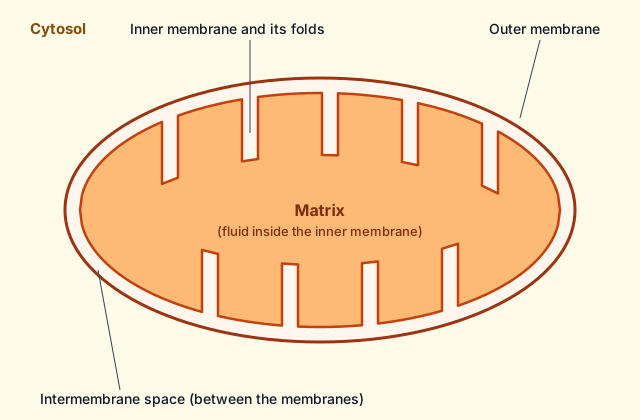
- Describe the processes of cellular respiration and the structures of the mitochondrion, its matrix, inner membrane and folds, that let organisms use the energy stored in macromolecules.
- Explain how cells obtain energy from glucose through glycolysis, the Krebs cycle, electron transport and chemiosmosis, and how fermentation lets glycolysis continue without oxygen.
Key vocabulary
| Term | What it means | The exam trap |
|---|---|---|
| Glycolysis | The pathway that begins the breakdown of glucose, in both cellular respiration and fermentation. | Its steps, enzymes and intermediates are not tested; know what goes in and what comes out. |
| Krebs cycle | The cycle of reactions, also called the citric acid cycle, that continues the breakdown of the carbon from glucose. | Do not list its intermediates in an answer; questions ask what it releases and what it hands on. |
| Electron transport chain | A series of electron acceptors in a membrane that pass electrons along in oxidation-reduction reactions. | Chains like this run in chloroplasts, in mitochondria and across prokaryotic membranes, so check which membrane a stem describes. |
| Oxidative phosphorylation | Making ATP in aerobic respiration as protons flow back through ATP synthase, using a gradient built by electron transport. | It and photophosphorylation use the same kind of machinery; the source of the energy that builds the gradient is what differs. |
| Fermentation | Reactions some cells run when oxygen is absent, producing organic molecules such as alcohol or lactic acid. | Some prokaryotes live without oxygen by a route other than fermentation; read which one a stem describes. |
 Tap to open the picture full size
Part 1 Think first Why you need to breathe
Commit to a guess first. Being wrong now makes the right idea stick better.
Predict first
A person who stops breathing loses consciousness within minutes, even though their body still holds plenty of stored sugar and fat. Why does a lack of oxygen shut the body down so fast?
In short. Cellular respiration uses the energy in biological macromolecules such as glucose to make ATP: glycolysis and the Krebs cycle strip electrons from glucose, and the electron transport chain uses them to build a proton gradient that drives ATP synthase.
- Glycolysis in the cytosol forms ATP, NADH and pyruvate; in the mitochondrial matrix, the Krebs cycle releases CO₂ and forms ATP, NADH and FADH₂.
- NADH and FADH₂ deliver electrons to the chain in the inner membrane, which ends with oxygen and pumps protons out of the matrix; their flow back through ATP synthase is oxidative phosphorylation.
- Fermentation lets glycolysis continue without oxygen, making alcohol or lactic acid, and decoupling the gradient from ATP synthesis releases heat.
Part 2 Learn it From glucose to ATP
2a. Glycolysis starts the job
Cellular respiration uses energy from biological macromolecules, such as glucose, to synthesize ATP, the molecule cells spend to power their work. Respiration and fermentation are characteristic of all forms of life.
Aerobic cellular respiration in eukaryotes involves a series of coordinated, enzyme-catalyzed reactions that capture energy from biological macromolecules. It runs in stages, a sequential pathway like the ones two topics back, so energy is transferred in a controlled way.
The first stage is glycolysis, which happens in the cytosol. Glycolysis is a biochemical pathway that releases energy from glucose molecules. That energy forms ATP from ADP and inorganic phosphate, and NADH from NAD⁺. What is left of the glucose leaves glycolysis as pyruvate.
Keep an eye on the NADH. It is carrying electrons taken from glucose, and those electrons are where most of the ATP will eventually come from.
Quick check · Fill the statement
Complete the description of glycolysis.
Glycolysis breaks glucose down into , and the energy it releases forms from ADP and inorganic phosphate, and from NAD⁺.
2b. Into the mitochondrion
Pyruvate is transported from the cytosol into the mitochondrion, where it is oxidized. This releases electrons during the Krebs cycle, also called the citric acid cycle, which takes place in the mitochondrial matrix, the fluid inside the inner membrane.
During the Krebs cycle, three things happen:
- Carbon dioxide is released from organic intermediates. This is where the CO₂ you breathe out comes from: the carbon in your food.
- ATP is synthesized from ADP and inorganic phosphate.
- Electrons are transferred to the coenzymes NAD⁺ and FAD, reducing them to NADH and FADH₂.
By now the glucose's carbon is all gone as CO₂, yet only a little ATP has been made. Most of the energy is riding with the electrons. NADH and FADH₂ carry the electrons extracted in glycolysis and the Krebs cycle to the electron transport chain in the inner mitochondrial membrane.
The names of the cycle's intermediates and enzymes are beyond this course. Know where it happens, what it releases, and what it hands on.
Quick check · Sort it
Tap each event, then where it happens in a eukaryotic cell.
Cytosol
Mitochondrial matrix
Inner mitochondrial membrane
2c. The chain, the gradient and ATP synthase
The electron transport chain transfers electrons in a series of oxidation-reduction reactions. Electrons delivered by NADH and FADH₂ are passed to a series of electron acceptors as they move toward the terminal electron acceptor, oxygen.
As electrons pass along the chain, protons are moved across the inner mitochondrial membrane. This establishes an electrochemical gradient: a region of high proton concentration in the intermembrane space, outside the inner membrane, and low proton concentration in the matrix, inside it. More protons means a lower pH, so the pH inside the matrix is higher than in the intermembrane space. In prokaryotes, the same thing happens across the plasma membrane.
The flow of protons back through membrane-bound ATP synthase, by chemiosmosis, drives the formation of ATP from ADP and inorganic phosphate. In aerobic respiration this is called oxidative phosphorylation, and it makes most of the cell's ATP. The inner membrane is folded, which increases its surface area and allows more ATP to be synthesized.
Quick check · Multiple choice
In a working mitochondrion, how does the intermembrane space compare with the matrix?
2d. Without oxygen, and making heat
Not every cell has oxygen. Aerobic prokaryotes use oxygen as their terminal electron acceptor, while anaerobic prokaryotes use other molecules.
A cell with no electron acceptor for its chain still has glycolysis. Fermentation allows glycolysis to proceed in the absence of oxygen and produces organic molecules such as alcohol (in yeast) and lactic acid (in your muscles). Glycolysis turns NAD⁺ into NADH, and without oxygen the chain cannot take those electrons back. Fermentation passes them to an organic molecule instead, forming the alcohol or lactic acid, which frees NAD⁺ for glycolysis to use again.
Cells can also release the energy as heat instead of making ATP. In aerobic respiration, decoupling oxidative phosphorylation from electron transport generates heat: protons cross back into the matrix without passing through ATP synthase, so the energy of the gradient is released as heat instead of being captured. Endothermic organisms can use this heat to regulate their body temperature.
Quick check · Match
Match each term to its description.
Part 3 Watch it done Where did the energy go?
Predict first, then watch each step, then finish the reasoning yourself.
A biologist studies mitochondria isolated from liver cells, supplied with everything respiration needs. She measures them with and without chemical D, which is suspected of decoupling.
- Without D: oxygen used 10 units per minute, ATP made 25 units per minute, temperature rose 0.1 °C
- With D: oxygen used 12 units per minute, ATP made 2 units per minute, temperature rose 0.9 °C
These numbers are a teaching example, not a published study. What does D do to the mitochondria?
Predict first
Before you open the first step, predict: with D added, is the electron transport chain still running?
Step 1 · Find the drop in ATP
ATP made fell from 25 to 2 units per minute. 25 minus 2 is 23, and 23 divided by 25 is 0.92, so D cut ATP production by 92%.
Step 2 · Check the electron transport chain
Oxygen use did not fall; it went from 10 to 12 units per minute. Oxygen is the terminal electron acceptor, so electrons are still reaching the end of the chain. The chain is still running, and still moving protons.
Why this step?
Why measure oxygen use as well as ATP?
A drop in ATP alone has two possible causes: the chain has stopped, or the chain runs but its gradient is not being used to make ATP. Oxygen use tells them apart, because oxygen is used only while electrons flow down the chain.
Step 3 · Put it together
The chain keeps building a proton gradient, but almost no ATP is made. So protons must be getting back into the matrix without passing through ATP synthase. Electron transport has been decoupled from oxidative phosphorylation.
Your step · Decide and justify
With D added, where did most of the energy released by electron transport go?
Which evidence supports your decision?
This is what endothermic organisms do on purpose in some of their cells: decoupling releases the gradient's energy as heat, which helps keep the body warm.
Part 4 Try it Yeast with and without oxygen
A new organism, a new question. Yeast cells are grown in two sealed flasks with a steady supply of glucose at the same temperature. One flask has oxygen; the other has none. These numbers are a teaching example.
- With oxygen: 10 units of glucose used per hour, 2 units of alcohol made
- Without oxygen: 60 units of glucose used per hour, 110 units of alcohol made
Try it · Calculate
Without oxygen, the yeast use how many times as much glucose per hour as with oxygen?
Try it · Decide and justify
A student claims the yeast without oxygen use more glucose because fermentation captures more energy from each glucose molecule than aerobic respiration does. Is the claim correct?
Which reasoning supports your decision?
Part 5 Explain it Seeds that breathe
On the exam this is handwritten, so answer on paper first. Nothing you type here leaves this page. Then check your answer against the model and each scoring point.
Free response is 50% of the exam score. This one is shaped like Question 3, Scientific Investigation.
Free-response practice · Question 3 style
A student wants to compare the rate of cellular respiration in germinating pea seeds, which are sprouting, with dry pea seeds, which are dormant. She will measure how much oxygen each set of seeds uses in a sealed container at 20 °C over 30 minutes.
(a) Describe the role of oxygen in aerobic cellular respiration.
(b) Identify an appropriate control for her investigation.
(c) State the null hypothesis for her investigation.
(d) The germinating seeds use oxygen much faster than the dry seeds. Justify this result in terms of the seeds' need for energy.
Model answer
(a) Oxygen is the terminal electron acceptor at the end of the electron transport chain. It keeps electrons flowing, so a proton gradient forms and ATP synthase can make ATP.
(b) A sealed container with glass beads in place of seeds, the same volume and set up the same way, to show any change in gas volume not caused by respiration.
(c) There is no difference in the rate of oxygen use between germinating and dry pea seeds.
(d) Germinating seeds are growing, building new cells and molecules, which requires a lot of ATP. They carry out more cellular respiration to make that ATP, so they use oxygen faster than dormant seeds.
Score your own answer. This is a self-check, not a grade. Tick each point your answer makes.
Part 6 Check yourself Two drugs and no oxygen
All three case questions use the table.
A biochemist studies isolated mitochondria supplied with the molecules respiration breaks down. She measures the pH on each side of the inner membrane and the ATP made under four conditions. These numbers are a teaching example.
| Condition | Matrix pH | Intermembrane space pH | ATP made (units per minute) |
|---|---|---|---|
| Normal, oxygen present | 8.0 | 7.0 | 40 |
| No oxygen | 7.2 | 7.2 | 0 |
| Drug A added, oxygen present | 7.3 | 7.1 | 6 |
| Drug B added, oxygen present | 8.3 | 6.8 | 0 |
Case question 1 · Calculate
Using the table: the ATP made with drug A is what percentage of the ATP made by normal mitochondria? Give your answer to the nearest whole percent.
Case question 2 · Multiple choice
Using the table: which drug most likely blocks ATP synthase?
Case question 3 · Multiple choice
Using the table: which explanation best fits the mitochondria with no oxygen?
The rest stand on their own and do not use the case.
Check yourself · Put it in order
Follow the energy in one glucose molecule through aerobic respiration. Put the events in order.
Check yourself · Spot the error
A student explains the role of oxygen in cellular respiration. Tap the line with the mistake.
Part 7 Keep it Bring back earlier ideas
Respiration mirrors the chloroplast you just studied, and it runs in an organelle that was once a free-living cell. Pulling both back now ties Units 2 and 3 together.
From 3.4 Photosynthesis · Fill the statement
Complete the description of where photosynthesis happens in a chloroplast.
The light reactions take place in the , where thylakoid membranes hold chlorophyll organized into two . The Calvin cycle takes place in the .
From 2.10 Origins of Cell Compartmentalization · Put it in order
Put the events of the origin of mitochondria by endosymbiosis in order.
In three lines
- Cellular respiration uses energy in macromolecules to make ATP: glycolysis in the cytosol, then the Krebs cycle in the mitochondrial matrix, which releases CO₂.
- NADH and FADH₂ deliver electrons to the chain in the inner membrane; oxygen accepts them, and the proton gradient drives ATP synthase.
- Fermentation lets glycolysis continue without oxygen, and decoupling the gradient from ATP synthase releases heat that endotherms can use.
Exam strategy for this topic
- Section I, Multiple Choice: 60 questions in 90 minutes.
- Section II, Free Response: 6 questions in 90 minutes.
- This lesson's Explain it is shaped like free-response question 3, Scientific Investigation.
- A four-function, scientific, or graphing calculator is allowed on both sections of the exam.
For any respiration question, say where each stage happens and what it hands to the next: pyruvate, then NADH and FADH₂, then a proton gradient, then ATP. Do not name intermediates or enzymes.
Questions students ask
Where does each stage of cellular respiration happen?
Glycolysis happens in the cytosol. The Krebs cycle happens in the mitochondrial matrix. The electron transport chain and ATP synthase are in the inner mitochondrial membrane.
What is the role of oxygen in cellular respiration?
Oxygen is the terminal electron acceptor at the end of the electron transport chain. Without it, electron transport stops, the proton gradient is lost, and most ATP production stops.
Where does the carbon dioxide we breathe out come from?
From the carbon in food molecules. It is released as pyruvate is oxidized and during the Krebs cycle, not made from the oxygen we breathe in.
What does fermentation do?
It allows glycolysis to continue without oxygen, producing organic molecules such as alcohol or lactic acid. The ATP comes from glycolysis alone.
Why is the matrix pH higher than the intermembrane space pH?
Electron transport moves protons out of the matrix into the intermembrane space. Fewer protons means a higher pH, so the matrix has the higher pH.
Beyond the AP Exam
College Board sets these limits on what the AP Exam asks about this topic. Anything past them is not on the exam.
The full names of the specific electron carriers in the electron transport chain are beyond the scope of the AP Exam.
Specific steps, names of enzymes, and intermediates of the pathways for these processes are beyond the scope of this course and the AP Exam.
Course alignment, for teachers
AP Biology topic 3.5, Unit 3: Cellular Energetics.
- Skill 4.A: Construct a graph to represent the data, including: x-y graphs (bar, histogram, line, log scale, dual y), scatter plot, box and whisker plot, and pie chart.
This lesson maps all 9 essential knowledge statements of the topic to the part that teaches each one: 9 are checked by a scored question. The map is in the lesson file.