Unit 4 · Topic 4.1 · about 30 minutes · 7 parts · 12 scored checks, 3 of them multiple choice, plus 2 from earlier lessons
AP Biology 4.1: Cell Communication
Unit 4: 10 to 15% of the multiple-choice section
What you'll be able to do
- Describe the ways cells communicate with one another, by direct contact or by chemical signals sent from a distance.
- Explain how cells communicate over short distances with local regulators and over long distances with signals that reach cells of another type.
Key vocabulary
| Term | What it means | The exam trap |
|---|---|---|
| Chemical signaling | Communication in which one cell releases a molecule that changes the behavior of another cell. | A stem may not say how far the molecule travels; look for distance, the blood or a filter in the setup. |
| Local regulator | A signal molecule whose targets are cells in the vicinity of the cell that released it. | Short distance and direct contact are different routes, so read the setup to see which one it describes. |
| Hormone | A signaling molecule that travels long distances in the body to reach its target cells. | A stem may describe a hormone without naming it; ask where it was made and where it acts. |
| Target cell | A cell that responds to a particular signal. | A stem can name the signaling cells and leave you to find the targets; look for the cells whose activity changes. |
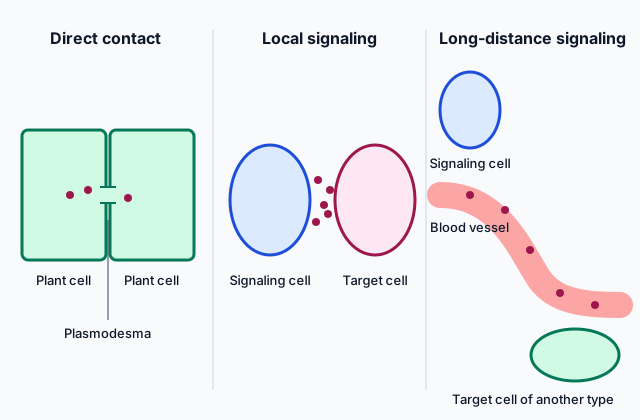 Tap to open the picture full size
Part 1 Think first Bacteria that glow in a crowd
Commit to a guess first. Being wrong now makes the right idea stick better.
Predict first
Some marine bacteria give off light. Spread thin in the open sea, they stay dark. Packed tightly inside a squid's light organ, they glow. Each bacterium is a single cell. How can a single cell tell that it is in a crowd?
In short. Cells communicate either through direct contact or from a distance by chemical signaling, with signals that act on nearby cells or travel long distances to target cells of another type.
- In direct contact, a signal passes between touching or joined cells, such as through the channels between plant cells or by molecules on cell surfaces.
- Local regulators target cells in the vicinity of the cell that released them, such as a neurotransmitter crossing to the next cell.
- Long-distance signals, such as hormones carried in the blood, reach target cells of a different type elsewhere in the body.
Part 2 Learn it Three ways cells communicate
2a. Signals by direct contact
Cells communicate with one another in two broad ways: through direct contact with other cells, or from a distance by chemical signaling.
In direct contact, the signal never has to cross the fluid outside the cells. Plant cells are walled in, but channels called plasmodesmata pass through the walls and join the cytoplasm of neighboring cells, so a signal molecule can move from one cell straight into the next. Animal cells can signal by touch too. An immune cell can recognize another cell by binding molecules on that cell's surface, and that contact switches on the immune cell's response.
Contact signaling is precise: only the cells that touch, or that are joined, get the message.
Quick check · Fill the statement
Complete the description of two cells signaling by direct contact.
In a leaf, channels through the cell walls join the of neighboring cells, so a signal molecule passes straight into the next cell. In the body, an immune cell recognizes another cell by binding molecules on that cell's . In both cases the signal does not have to .
2b. Local regulators reach nearby cells
Many signals do leave the cell. In chemical signaling, a cell releases a molecule that reaches other cells through the fluid around them.
Over short distances, cells use local regulators: signals that target cells in the vicinity of the cell that released them. A neuron, for example, releases a neurotransmitter into the narrow gap between it and the next cell, and the cell across that gap responds. The glowing bacteria in Think first work the same way: their signal reaches the crowd packed around them.
A local regulator typically does not get far before it is broken down, taken up or diluted, so cells farther away are not affected. The cell that releases it changes the behavior of its neighbors, not of cells across the body.
Quick check · Multiple choice
A neuron releases a neurotransmitter into the narrow gap between it and a muscle cell. That muscle cell contracts, but muscle cells elsewhere in the body do not. Which statement best explains why?
2c. Long-distance signals reach other cell types
Some signals travel far. A signal released by one cell type can travel long distances to target cells of a different type. Hormones are the familiar example: in animals, cells in a gland release a hormone into the bloodstream, which carries it throughout the body.
Insulin shows how this works. Cells in the pancreas release insulin into the blood, and it changes how cells in muscle, the liver and other tissues take up glucose. The cells that send the signal and the cells that respond are different types, in different organs.
The blood carries a hormone to nearly every tissue, yet only its target cells respond: the cells that can recognize that particular signal. The next lesson shows how they recognize it.
Quick check · Match
Cells of a gland in the neck release a hormone that travels through the body and speeds up how fast cells in the muscles and liver use energy. Match each role in this signal to the part of the example that plays it.
2d. Reading the route from evidence
A question rarely names the route. It describes an experiment, and you work out the route from what the signal needs.
- If target cells respond only when they touch or are joined to the signaling cells, and fluid from around the signaling cells does nothing, the signal passes by direct contact.
- If fluid taken from around the signaling cells, with no cells in it, triggers the response, a released chemical carries the signal.
- A released chemical that affects only cells close to where it was released is a local regulator. One that reaches cells of another type in distant organs, carried by the blood, is a long-distance signal.
Always look for the control: the same target cells with no signaling cells at all, which shows how much the cells respond on their own.
Quick check · Sort it
Each card describes the result of an experiment on a signal. Tap a card, then the route the signal most likely takes.
Direct contact
Local regulator
Long-distance signal
Part 3 Watch it done Touch or chemical?
Predict first, then watch each step, then finish the reasoning yourself.
A biologist suspects that cell type A sends a signal that makes cell type B produce a glowing protein. She sets up four dishes, each with 200 B cells, and counts how many B cells glow after 6 hours.
- Dish 1, B cells alone: 4 glow
- Dish 2, B cells mixed with A cells, touching: 164 glow
- Dish 3, B cells kept apart from A cells by a filter that lets molecules through but not cells: 158 glow
- Dish 4, B cells given only the fluid taken from a dish of A cells: 156 glow
These numbers are a teaching example, not a published study. Does the signal need A and B cells to touch?
Predict first
Before you open the first step, predict: does the signal from A cells need direct contact?
Step 1 · Turn counts into percentages
Divide each count by 200. Dish 1: 4 of 200 is 2%. Dish 2: 164 of 200 is 82%. Dish 3: 158 of 200 is 79%. Dish 4: 156 of 200 is 78%.
Step 2 · Check that A cells cause the response
With no A cells, only 2% of B cells glow. With A cells mixed in, 82% glow. So something from the A cells switches the response on.
Why this step?
Why include dish 1, with no A cells at all?
It is the control. Without it you could not tell whether B cells glow on their own. Its 2% is the background that every other dish is compared with.
Step 3 · Compare touching with not touching
In dish 3 the cells could not touch, yet 79% glowed, almost the 82% of dish 2. In dish 4 there were no A cells at all, only fluid from their dish, and 78% glowed.
Your step · Decide and justify
Does the signal from A cells need direct contact with B cells?
Which evidence supports your decision?
A released chemical carries this signal, as the glowing bacteria's signal travels through the fluid around them. Whether it is a local regulator or a long-distance signal would take another test, such as measuring how the response changes with distance from the A cells.
Part 4 Try it A signal from the neck
A new experiment. Researchers study gland G in the neck of a small mammal, which they suspect controls bone growth. They measure how much a leg bone grows in 4 weeks in four groups of young animals. Serum is the liquid part of blood, with no cells in it. These numbers are a teaching example.
- Normal animals: 12.0 mm
- Gland G removed: 3.0 mm
- Gland G removed, injected daily with serum from normal animals: 10.2 mm
- Gland G removed, injected daily with serum from animals without gland G: 3.3 mm
Try it · Calculate
The animals with gland G removed and given serum from normal animals grew what percentage of the normal growth? Give your answer to the nearest whole percent.
Try it · Decide and justify
Do these data support the claim that gland G signals the leg bone with a signal carried in the blood?
Which evidence supports your decision?
Part 5 Explain it Near and far
On the exam this is handwritten, so answer on paper first. Nothing you type here leaves this page. Then check your answer against the model and each scoring point.
Free response is 50% of the exam score. This one is shaped like Question 4, Conceptual Analysis.
Free-response practice · Question 4 style
Cells in an animal's body communicate in several ways.
(a) Describe two ways that cells can communicate with one another.
(b) Explain how a local regulator affects cells close to the cell that released it but not cells in distant parts of the body.
(c) Cells in a gland release a hormone into the blood. Predict which cells in the body will respond to the hormone.
(d) Justify your prediction in (c).
Model answer
(a) Cells can communicate by direct contact, through channels that join their cytoplasm or by binding molecules on each other's surfaces, or from a distance, by releasing a chemical signal that reaches other cells.
(b) A local regulator is released into the fluid around the cell and targets cells in its vicinity. It does not travel far, so cells in distant parts of the body do not receive it.
(c) Only the hormone's target cells will respond, and they can be cells of a different type, in organs far from the gland.
(d) The blood carries the hormone throughout the body, so it reaches many cells, but only cells that can recognize that particular signal respond to it.
Score your own answer. This is a self-check, not a grade. Tick each point your answer makes.
Part 6 Check yourself A signal in a leaf
All three case questions use the table.
A botanist damages a single cell in a leaf and measures what percentage of cells at different distances switch on a defense response within one hour. In a second set of leaves, she first applies a chemical that closes the channels joining the cytoplasm of neighboring cells; the fluid around the cells is not changed. These numbers are a teaching example.
| Distance from the damaged cell | Untreated leaves | Channels closed |
|---|---|---|
| 1 cell | 92 | 15 |
| 3 cells | 70 | 6 |
| 10 cells | 31 | 2 |
| 50 cells | 4 | 3 |
Case question 1 · Calculate
Using the table: one cell away from the damaged cell, the response in untreated leaves is how many times the response with the channels closed? Give your answer to one decimal place.
Case question 2 · Multiple choice
Using the table: which claim about how the signal spreads do the data best support?
Case question 3 · Multiple choice
Using the table: in untreated leaves, which explanation best fits the fall in the response with distance from the damaged cell?
The rest stand on their own and do not use the case.
Check yourself · Put it in order
After a meal, insulin from the pancreas signals muscle cells in the legs. Put the events in the order they happen.
Check yourself · Spot the error
A student explains how a hormone works. Tap the line with the mistake.
Part 7 Keep it Bring back earlier ideas
A signal is made, carried and answered by cells that run on ATP, and many signals act at the plasma membrane. Pulling back respiration and the membrane now sets up the rest of this unit.
From 3.5 Cellular Respiration · Put it in order
Follow the energy in one glucose molecule through aerobic respiration. Put the events in order.
From 2.3 Plasma Membrane · Match
Match each membrane component to its description.
In three lines
- Cells communicate through direct contact, such as channels between plant cells or molecules on cell surfaces, or from a distance by chemical signals.
- Local regulators, such as neurotransmitters, target cells in the vicinity of the cell that released them.
- Long-distance signals, such as hormones carried in the blood, travel to target cells of another type, and only target cells respond.
Exam strategy for this topic
- Section I, Multiple Choice: 60 questions in 90 minutes.
- Section II, Free Response: 6 questions in 90 minutes.
- This lesson's Explain it is shaped like free-response question 4, Conceptual Analysis.
- A four-function, scientific, or graphing calculator is allowed on both sections of the exam.
When a stem describes cells signaling, name the route (direct contact, local regulator or long distance) and point to the part of the setup that shows it: touching cells, fluid alone, distance or the blood.
Questions students ask
What are the ways cells communicate?
Cells communicate through direct contact with other cells, or from a distance by chemical signaling. Chemical signals act over short distances, as local regulators, or travel long distances, as hormones do.
What is a local regulator?
A signal that targets cells in the vicinity of the cell that released it. A neurotransmitter crossing the narrow gap to the next cell is one example.
How do hormones reach their target cells?
In animals, a hormone is released into the bloodstream and carried throughout the body. Only its target cells respond, and they are often of a different type, in a different organ, from the cells that released it.
How do plant cells communicate by direct contact?
Channels called plasmodesmata pass through plant cell walls and join the cytoplasm of neighboring cells, so signal molecules can move from one cell straight into the next.
How can an experiment tell contact signaling from a released chemical?
Separate the cells. If fluid from around the signaling cells, with no cells in it, triggers the response, a released chemical carries the signal. If the response needs the cells to touch, the signal passes by contact.
Course alignment, for teachers
AP Biology topic 4.1, Unit 4: Cell Communication and Cell Cycle.
- Skill 1.B: Explain biological concepts and processes.
This lesson maps all 3 essential knowledge statements of the topic to the part that teaches each one: 3 are checked by a scored question. The map is in the lesson file.