Unit 4 · Topic 4.2 · about 30 minutes · 7 parts · 12 scored checks, 3 of them multiple choice, plus 2 from earlier lessons
AP Biology 4.2: Introduction to Signal Transduction
Unit 4: 10 to 15% of the multiple-choice section
What you'll be able to do
- Describe the components of a signal transduction pathway, from the ligand and its receptor to the relay molecules inside the cell.
- Describe how those components produce a cellular response, including how a series of molecules relays the signal inside the cell.
Key vocabulary
| Term | What it means | The exam trap |
|---|---|---|
| Ligand | A chemical messenger, a peptide or a small molecule, that binds a specific receptor. | A stem may call it a signal, a messenger or a hormone; any of these can be the ligand. |
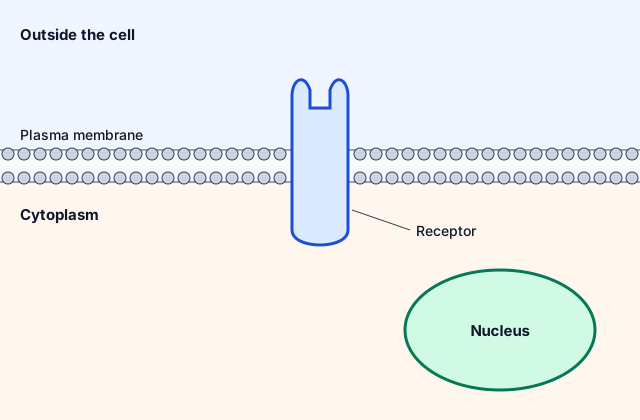
| Receptor | A protein in a target cell that recognizes and binds a particular ligand. | Read which part of the receptor a stem describes, the part that binds or the part that relays, before predicting an effect. |
| Signal transduction pathway | The series of steps that links a signal's reception by a receptor to the cell's response. | A question may skip steps; fill in what must happen between binding and the response. |
| G protein-coupled receptor | A type of receptor protein in eukaryotes that works together with a G protein. | Not every pathway uses one; a stem may describe a channel or another kind of receptor instead. |
| Phosphorylation | Adding a phosphate group to a protein, which changes its activity. | A phosphate can switch a protein on or off; check which the stem says. |
 Tap to open the picture full size
Part 1 Think first A fright and a flood of sugar
Commit to a guess first. Being wrong now makes the right idea stick better.
Predict first
When you are startled, your adrenal glands release a small amount of the hormone adrenaline (epinephrine). Within seconds, your liver cells release a large amount of glucose into the blood. Only a few adrenaline molecules reach each liver cell. How can so few molecules make one cell release so much glucose?
In short. A signal transduction pathway links a ligand binding its receptor to a response in the cell, relaying the signal, often through enzymes, second messengers and phosphorylation cascades that can amplify it.
- A receptor's ligand-binding domain recognizes a specific messenger, a peptide or a small molecule, and receptors can be on the cell surface or in the cytoplasm or nucleus.
- Once the ligand binds, the receptor's intracellular domain changes shape; enzymes and second messengers such as cAMP then relay the signal, often amplifying it.
- Responses include cell growth, secretion of molecules and changes in gene expression, and a ligand can make a ligand-gated channel open or close.
Part 2 Learn it From receptor to response
2a. Reception: a ligand meets its receptor
Signaling begins when a target cell recognizes a chemical messenger, a ligand, with a receptor protein. The receptor's ligand-binding domain has a shape that fits one specific messenger, much as an active site fits its substrate. Ligands can be peptides (proteins) or small molecules.
Where the receptor sits depends on the ligand. A large or polar ligand, such as a protein hormone, cannot cross the plasma membrane, so its receptor is on the cell surface, with the ligand-binding domain facing outside. A small nonpolar ligand can cross the bilayer, so its receptor can be in the cytoplasm or the nucleus.
In eukaryotes, many surface receptors are G protein-coupled receptors. Other surface receptors are ligand-gated channels: binding the ligand makes the channel open or close.
Quick check · Sort it
Each card describes a chemical messenger. Tap a card, then where its receptor is most likely found.
On the cell surface
Inside the cell
2b. Transduction: relaying the signal inside
A surface receptor faces two ways. When the ligand binds outside, the receptor's intracellular domain, the part inside the cell, changes shape, and that change starts the transduction of the signal.
With a G protein-coupled receptor, the changed receptor activates a G protein. The G protein switches on an enzyme that makes cyclic AMP (cAMP), a small molecule called a second messenger. cAMP spreads through the cytoplasm and activates protein kinases.
Many pathways work by modifying proteins. A kinase adds a phosphate group to its target protein, and that phosphorylation switches the target's activity on or off. Often the target is itself a kinase that phosphorylates the next protein, so the signal passes along a phosphorylation cascade. Notice that the ligand itself stays outside; what travels inward is a series of changes in molecules.
Quick check · Put it in order
A hormone binds a G protein-coupled receptor. Put the events in the order they happen.
2c. Cascades amplify the signal
Signaling cascades relay a signal from the receptor to its targets, and they often amplify it along the way.
Amplification happens wherever one active molecule switches on many of the next. One receptor can activate many G proteins. Each enzyme they switch on makes many cAMP molecules. Each active kinase can phosphorylate many target proteins before it is switched off. Multiply those steps together and a handful of ligand molecules can change thousands or millions of molecules inside the cell.
That is how adrenaline, at a tiny concentration in the blood, makes liver cells release glucose within seconds. It also explains why a cascade has so many steps: each step is another chance to multiply the signal, and another place where the cell can regulate it.
Quick check · Multiple choice
In a signaling cascade, each activated protein activates many molecules of the next protein. What is the main effect of this on the cell's response?
2d. Response: what the cell does
Every pathway ends in a response, and responses vary with the pathway and the cell. Common ones are:
- Cell growth, when the pathway switches on the proteins a cell needs to grow.
- Secretion of molecules, such as a hormone or an enzyme released from the cell.
- Changes in gene expression, when the pathway's last targets switch genes on or off, so the cell makes different proteins.
Some responses are almost immediate. When a ligand binds a ligand-gated channel, the channel opens or closes, and the flow of ions across the membrane changes at once. Hormones are a kind of signaling messenger that can travel long distances in the bloodstream to start these pathways in distant target cells.
Quick check · Fill the statement
Complete the description of the responses a signaling pathway can produce.
Depending on the pathway, the response to a signal can be cell , the of molecules such as enzymes, or a change in which genes are expressed. When a ligand binds a ligand-gated channel, the channel , changing the flow of ions across the membrane.
Part 3 Watch it done Counting the amplification
Predict first, then watch each step, then finish the reasoning yourself.
Follow one cascade in a liver cell. One adrenaline molecule binds one receptor. While it stays bound:
- The receptor activates 10 G proteins, and each G protein switches on 1 enzyme.
- Each enzyme makes 100 cAMP molecules.
- In this example, every 2 cAMP molecules activate 1 kinase molecule.
- Each kinase phosphorylates 20 molecules of a target enzyme.
These numbers are a teaching example, not measurements. How many target enzyme molecules does one bound receptor switch on?
Predict first
Before you open the first step, predict: about how many target enzyme molecules does one bound receptor switch on?
Step 1 · Count the enzymes switched on
The receptor activates 10 G proteins, and each switches on 1 enzyme, so 10 enzymes are working.
Step 2 · Count the cAMP made
Each of the 10 enzymes makes 100 cAMP molecules: 10 × 100 = 1,000 cAMP molecules from one bound receptor.
Why this step?
Why multiply at each step instead of adding?
Every molecule at one level acts on its own set of molecules at the next. Ten enzymes each making 100 cAMP give 10 sets of 100, which is 10 × 100, not 10 + 100.
Step 3 · Count the kinases
Every 2 cAMP molecules activate 1 kinase, so 1,000 ÷ 2 = 500 kinase molecules are active.
Your step · Calculate
Each of the 500 active kinases phosphorylates 20 molecules of the target enzyme. How many target enzyme molecules are phosphorylated for each bound receptor?
One adrenaline molecule switched on ten thousand target enzymes in this example, and each of those enzymes can act on many molecules of its own. That is how a few hormone molecules make a liver cell release a large amount of glucose within seconds.
Part 4 Try it Two cells, one hormone
A new experiment. Hormone H makes some cells secrete a protein. A researcher adds the same amount of H to two cell types and measures the protein secreted in one hour. Then she gives cell type 2 a gene for the receptor that cell type 1 uses to recognize H, changing nothing else, and tests it again. These numbers are a teaching example.
- Cell type 1, no H: 2 units
- Cell type 1, with H: 48 units
- Cell type 2, with H: 3 units
- Cell type 2 given the receptor gene, with H: 45 units
Try it · Calculate
With H added, cell type 2 given the receptor gene secretes what percentage of the protein that cell type 1 secretes? Give your answer to the nearest whole percent.
Try it · Decide and justify
Do the data support the claim that cell type 2 barely responded to H at first because it lacked a receptor that recognizes H?
Which evidence supports your decision?
Part 5 Explain it A model of a pathway
On the exam this is handwritten, so answer on paper first. Nothing you type here leaves this page. Then check your answer against the model and each scoring point.
Free response is 50% of the exam score. This one is shaped like Question 5, Analyze Model or Visual Representation of a Biological Concept or Process.
Free-response practice · Question 5 style
A student builds a model of a signaling pathway in a liver cell. It shows a hormone outside the cell, a receptor protein that spans the plasma membrane, a G protein, an enzyme that makes cAMP, a protein kinase, and an enzyme that releases glucose from the cell's stores.
(a) Describe the role of the receptor's ligand-binding domain in the model.
(b) Explain how the hormone binding outside the cell causes a change inside it, even though the hormone does not enter.
(c) Explain how this pathway can produce a large response from a small amount of hormone.
(d) The student wants to model a second hormone that is small and nonpolar. Predict where its receptor would be placed in the model, and justify your prediction.
Model answer
(a) The ligand-binding domain recognizes and binds the specific hormone, so only this messenger starts the pathway.
(b) When the hormone binds, the receptor's intracellular domain changes shape. That change activates the G protein, which switches on the enzyme that makes cAMP, and cAMP relays the signal inside the cell.
(c) The pathway amplifies the signal: one receptor activates many G proteins, each enzyme makes many cAMP molecules, and each kinase phosphorylates many target molecules, so a few hormone molecules switch on a very large number of enzymes.
(d) Its receptor would be inside the cell, in the cytoplasm or nucleus, because a small nonpolar molecule can cross the plasma membrane.
Score your own answer. This is a self-check, not a grade. Tick each point your answer makes.
Part 6 Check yourself Where did the relay stop?
All three case questions use the table.
A researcher treats liver cells with a hormone that acts through a G protein-coupled receptor, cAMP and a protein kinase. Drug X and drug Y each block one protein in this pathway. She measures cAMP inside the cells, the percentage of a target enzyme that is phosphorylated, and the glucose the cells release. These numbers are a teaching example.
| Treatment | cAMP inside the cells | Target enzyme phosphorylated (%) | Glucose released |
|---|---|---|---|
| No hormone | 1 | 5 | 2 |
| Hormone | 50 | 80 | 40 |
| Hormone and drug X | 2 | 6 | 3 |
| Hormone and drug Y | 50 | 7 | 4 |
Case question 1 · Calculate
Using the table: with the hormone and no drug, the cells hold how many times as much cAMP as cells with no hormone?
Case question 2 · Multiple choice
Using the table: which step does drug Y most likely block?
Case question 3 · Multiple choice
Using the table: which explanation best fits the result with drug X?
The rest stand on their own and do not use the case.
Check yourself · Match
Match each part of a signaling pathway to its description.
Check yourself · Spot the error
A student explains how a hormone acts through a G protein-coupled receptor. Tap the line with the mistake.
Part 7 Keep it Bring back earlier ideas
A target cell has to recognize a signal before any pathway starts, and many receptors are proteins that cross the membrane. Pulling both back now ties this lesson to the last one and to Unit 2.
From 4.1 Cell Communication · Spot the error
A student explains how a hormone works. Tap the line with the mistake.
From 2.3 Plasma Membrane · Sort it
Each card describes a region of a protein that crosses the plasma membrane. Tap a card, then the kind of region it most likely is.
Hydrophobic region
Hydrophilic region
In three lines
- Signaling begins when a receptor's ligand-binding domain recognizes a specific ligand; receptors can be on the surface or in the cytoplasm or nucleus.
- Binding changes the receptor's intracellular domain, and enzymes, second messengers such as cAMP and phosphorylation cascades relay and often amplify the signal.
- Responses include cell growth, secretion and changes in gene expression; a ligand-gated channel opens or closes.
Exam strategy for this topic
- Section I, Multiple Choice: 60 questions in 90 minutes.
- Section II, Free Response: 6 questions in 90 minutes.
- This lesson's Explain it is shaped like free-response question 5, Analyze Model or Visual Representation of a Biological Concept or Process.
- A four-function, scientific, or graphing calculator is allowed on both sections of the exam.
For a pathway question, name each component in order (ligand, receptor, relay molecules, response) and say what each passes to the next. To find a blocked step, look for the last measurement that still changed.
Questions students ask
What are the main parts of a signal transduction pathway?
A ligand, a receptor that recognizes it, relay molecules such as G proteins, enzymes, second messengers and kinases that carry the signal inside the cell, and the cell's response.
Where are receptors found?
On the surface of the target cell, in its cytoplasm or in its nucleus. Ligands that cannot cross the plasma membrane bind surface receptors; small nonpolar ligands can bind receptors inside the cell.
What does a second messenger do?
A second messenger, such as cyclic AMP (cAMP), is a small molecule made inside the cell after the receptor is activated. It relays the signal through the cytoplasm and helps amplify it.
How does a signaling cascade amplify a signal?
At many steps, one active molecule switches on many molecules of the next, so the number of active molecules multiplies and a few ligand molecules can produce a large response.
What responses can a signaling pathway produce?
Cell growth, secretion of molecules and changes in gene expression are common responses. A ligand-gated channel responds by opening or closing.
Course alignment, for teachers
AP Biology topic 4.2, Unit 4: Cell Communication and Cell Cycle.
- Skill 1.A: Describe biological concepts and processes.
This lesson maps all 4 essential knowledge statements of the topic to the part that teaches each one: 3 are checked by a scored question and 1 by the written response. The map is in the lesson file.