Unit 4 · Topic 4.3 · about 30 minutes · 7 parts · 12 scored checks, 3 of them multiple choice, plus 2 from earlier lessons
AP Biology 4.3: Signal Transduction Pathways
Unit 4: 10 to 15% of the multiple-choice section
What you'll be able to do
- Describe the kinds of cellular responses a signal transduction pathway can cause, including changes in gene expression and cell function, changes in phenotype and programmed cell death.
- Explain how a change in the structure of any component of a signaling pathway, by a mutation or by a chemical, can activate or inhibit the pathway.
Key vocabulary
| Term | What it means | The exam trap |
|---|---|---|
| Gene expression | The process by which the information in a gene is used to make a product, such as a protein. | It is taught in depth in a later unit; here it is one of the responses a pathway can produce. |
| Phenotype | The observable traits of a cell or an organism. | A change in many cells' responses can change the phenotype of a tissue or an organism; follow the effect up a level. |
| Apoptosis | Programmed cell death, an orderly process in which a cell dismantles itself. | It happens in healthy development as well as after damage, so read what the stem says set it off. |
| Mutation | A change in the DNA sequence of a gene, which can change the structure of the protein it codes for. | Read which protein a mutation changes before predicting which steps of a pathway it affects. |
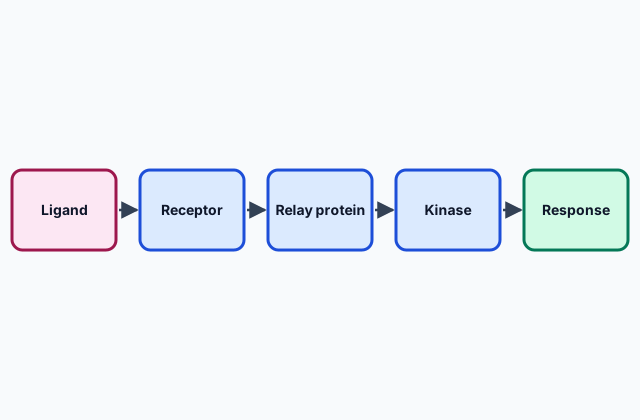 Tap to open the picture full size
Part 1 Think first A toxin that keeps a switch on
Commit to a guess first. Being wrong now makes the right idea stick better.
Predict first
Cholera bacteria release a toxin that enters the cells lining the intestine. The toxin does not kill the cells. It changes one protein in a signaling pathway so that the protein stays switched on, even when no signal arrives. When that pathway is signaled normally, the cells secrete salt, and water follows the salt out of the cells. What happens to a person with cholera?
In short. Signal transduction can change gene expression and cell function, altering phenotype or causing apoptosis, and a mutation or chemical that changes any component of a pathway can change the response.
- Responses include changes in gene expression and in the activity of proteins already present, which may alter phenotype, and programmed cell death (apoptosis).
- A mutation in any domain of the receptor, or in any component of the pathway, may affect the components downstream by altering how the signal is passed on.
- Chemicals that interact with any component of a pathway may activate it or inhibit it, as many drugs and toxins do.
Part 2 Learn it Responses, and what changes them
2a. What a pathway can change
The response at the end of a pathway can be quick or lasting. Some pathways change the activity of proteins the cell already has, such as an enzyme switched on by phosphorylation or a channel that opens. Others reach the nucleus and change gene expression, so the cell starts making new proteins or stops making old ones.
Changes in gene expression and cell function may alter the cell's phenotype, the traits it shows, and across many cells, the traits of a tissue or an organism.
A signal can even tell a cell to die. In apoptosis, programmed cell death, a cell dismantles itself in an orderly way. It is a normal part of life: in a human embryo, apoptosis removes the cells between the developing fingers, separating them.
Quick check · Sort it
Each card describes a cell's response to a signal. Tap a card, then the kind of response it is.
A change in gene expression
A change in the activity of proteins already present
Programmed cell death
2b. A mutation in the receptor
Each component of a pathway passes the signal to the next, so a change in any one of them can change the response. Changes start with mutations, changes in a gene that change the structure of the protein it codes for.
A receptor has two domains, and a mutation in either can matter.
- Ligand-binding domain. If its shape changes, the ligand may no longer bind. The pathway never starts, and the cell does not respond even when the signal is present.
- Intracellular domain. If it can no longer change shape, binding outside the cell is not passed inward. If instead it is stuck in the shape it normally takes only after binding, it may relay a signal with no ligand at all.
So a mutation can turn a pathway down, turn it off or leave it on. Which one happens depends on how the structure changed.
Quick check · Multiple choice
A mutation changes a receptor's intracellular domain so that it stays in the shape it normally takes only after the ligand binds. The ligand-binding domain is normal. Which prediction is best?
2c. A change further down the line
The same logic holds past the receptor. A mutation in any component of the pathway may affect the components downstream of it, the ones that come after it, by altering how the signal is passed on.
A useful rule for a simple chain of steps: a changed component usually affects the steps after it, not the steps before it. If a kinase in the middle of a pathway cannot work, the ligand still binds and the receptor still changes shape, but nothing after the kinase happens, so there is no response. If instead a relay protein is locked in its active form, everything after it keeps running, signal or not.
That rule is how researchers find a defect. They measure each step and look for the first one that fails to change.
Quick check · Fill the statement
Complete the description of a pathway with a mutant kinase that cannot work.
The ligand still binds and the receptor still changes shape, because those steps come the kinase. The steps the kinase stop, so the cell's does not happen.
2d. Chemicals that switch pathways on or off
Chemicals that interact with any component of a signaling pathway may activate or inhibit the pathway. Many drugs, poisons and toxins work this way.
- A chemical that binds the ligand-binding domain without activating the receptor keeps the real ligand out, so the pathway is inhibited.
- A chemical that binds the receptor and activates it, as the ligand would, switches the pathway on with no natural signal.
- A chemical that acts on a later component, as cholera toxin does on a G protein, mainly affects what comes after that component.
Where a chemical acts sets what can undo it. A drug that blocks the receptor cannot stop a pathway whose relay protein is already locked on, because that relay protein comes after the receptor.
Quick check · Match
Each chemical acts on one component of a pathway. Match each chemical to the result it would cause.
Part 3 Watch it done Finding the broken step
Predict first, then watch each step, then finish the reasoning yourself.
When ligand L binds its receptor, a pathway raises cAMP, and the cells secrete an enzyme. Researchers test normal cells and two mutant cell lines. They test each line twice: once with L, and once with a chemical that enters the cell and does cAMP's job, skipping the receptor and the steps that make cAMP. Secretion is given as a percentage of what normal cells secrete with L.
- Normal cells: 100% with L, 96% with the cAMP-like chemical
- Mutant 1: 3% with L, 94% with the cAMP-like chemical
- Mutant 2: 4% with L, 5% with the cAMP-like chemical
These numbers are a teaching example, not a published study. Where is each mutant's defect?
Predict first
Before you open the first step, predict: which mutant could have its defect in the receptor?
Step 1 · Read the normal cells
Normal cells secrete with either treatment: 100% with L and 96% with the cAMP-like chemical. So the chemical can stand in for everything up to cAMP.
Step 2 · Read mutant 1
With L, mutant 1 barely responds (3%). With the cAMP-like chemical, it responds almost normally (94%). Everything after cAMP works, so the defect lies before cAMP: in the receptor or in the steps that make cAMP.
Why this step?
Why test with the cAMP-like chemical at all?
It skips the receptor and the steps that make cAMP. If a cell responds to it, every component after cAMP must work, so a weak response to L must come from a step before cAMP.
Step 3 · Read mutant 2
Mutant 2 fails with both treatments: 4% with L and 5% with the cAMP-like chemical. Skipping the receptor did not help.
Your step · Decide and justify
Could mutant 2's only defect be in its receptor?
Which evidence supports your decision?
Mutant 1's defect lies before cAMP, such as in the receptor; mutant 2's lies after cAMP. One mutation, wherever it sits, changes only the steps downstream of it, which is why a test that skips the early steps can locate it.
Part 4 Try it Two chemicals on one pathway
A new pathway. When signal S binds its receptor, cells release a hormone. A pharmacologist tests chemical K and chemical M on these cells and measures the hormone released in one hour. A drug that blocks S's receptor so that it cannot signal is used in one test. These numbers are a teaching example.
- No S: 5 units
- S: 60 units
- S and chemical K: 6 units
- No S, chemical M: 58 units
- No S, chemical M and the receptor-blocking drug: 57 units
Try it · Calculate
Compared with S alone, by what percentage did adding chemical K lower the hormone released? Give your answer to the nearest whole percent.
Try it · Decide and justify
Does chemical M act by binding S's receptor?
Which evidence supports your decision?
Part 5 Explain it A pesticide and a pathway
On the exam this is handwritten, so answer on paper first. Nothing you type here leaves this page. Then check your answer against the model and each scoring point.
Free response is 50% of the exam score. This one is shaped like Question 3, Scientific Investigation.
Free-response practice · Question 3 style
A researcher suspects that a pesticide, P, inhibits a signaling pathway in fish liver cells by binding the ligand-binding domain of the pathway's receptor. She can grow the cells with or without P, add the pathway's natural ligand, and measure the cells' response.
(a) Describe how a chemical that binds the ligand-binding domain could inhibit the pathway.
(b) Identify an appropriate control for her investigation.
(c) State the null hypothesis for her investigation.
(d) She then gives cells treated with P a second chemical that activates a relay protein after the receptor. Predict the cells' response, and justify your prediction.
Model answer
(a) P could occupy the ligand-binding domain without activating the receptor. The natural ligand then cannot bind, the intracellular domain does not change shape, and no signal is relayed to the components downstream.
(b) Cells from the same batch grown without P, given the same amount of ligand and measured the same way.
(c) P has no effect on the cells' response to the ligand.
(d) The cells would respond, close to normal, because the second chemical activates a component after the receptor, so the blocked receptor is skipped and the steps downstream still run.
Score your own answer. This is a self-check, not a grade. Tick each point your answer makes.
Part 6 Check yourself A signal to self-destruct
All three case questions use the table.
Signal S binds a receptor and triggers apoptosis in damaged cells. A researcher measures the percentage of damaged cells undergoing apoptosis within 24 hours. Mutant A has a change in its receptor's ligand-binding domain. Mutant B has a normal receptor but a change in a relay protein that acts after the receptor. These numbers are a teaching example.
| Cells | Without S | With S |
|---|---|---|
| Normal | 3 | 60 |
| Mutant A | 3 | 4 |
| Mutant B | 57 | 59 |
Case question 1 · Calculate
Using the table: in normal cells, S makes the percentage undergoing apoptosis how many times as large?
Case question 2 · Multiple choice
Using the table: which explanation best fits mutant B?
Case question 3 · Multiple choice
Using the table: a drug that blocks S's receptor is given to normal cells and to mutant B cells, along with S. Which prediction is best supported?
The rest stand on their own and do not use the case.
Check yourself · Put it in order
A mutation leaves a relay protein in the middle of a pathway active with no signal. Put the events in the order they happen.
Check yourself · Spot the error
A student explains the effect of a mutation in a receptor's ligand-binding domain. Tap the line with the mistake.
Part 7 Keep it Bring back earlier ideas
Finding a broken step means knowing the steps of a pathway, and a chemical that blocks a binding site works like an enzyme inhibitor. Pulling both back now ties this lesson to the last one and to Unit 3.
From 4.2 Introduction to Signal Transduction · Put it in order
A hormone binds a G protein-coupled receptor. Put the events in the order they happen.
A new experiment, a new question. A student tests a molecule, X, that lowers an enzyme's activity. She runs four tubes for 50 seconds at the enzyme's optimal temperature and pH, at a low and a high substrate concentration, with and without X. These numbers are a teaching example.
- Low substrate, no X: 30 units of product
- Low substrate, with X: 12 units
- High substrate, no X: 60 units
- High substrate, with X: 59 units
From 3.2 Environmental Impacts on Enzyme Function · Decide and justify
Which kind of inhibitor does the data suggest X is?
Which piece of evidence supports your decision?
In three lines
- Signal transduction may change gene expression and cell function, which may alter phenotype, or result in programmed cell death (apoptosis).
- A mutation in any domain of a receptor, or in any component of a pathway, may affect the components downstream of it.
- Chemicals that interact with any component of a pathway may activate or inhibit it, and where they act sets which steps change.
Exam strategy for this topic
- Section I, Multiple Choice: 60 questions in 90 minutes.
- Section II, Free Response: 6 questions in 90 minutes.
- This lesson's Explain it is shaped like free-response question 3, Scientific Investigation.
- A four-function, scientific, or graphing calculator is allowed on both sections of the exam.
To predict the effect of a mutation or a drug, name the component it changes, then say what happens to every step after it. Steps before it are usually unaffected, and a test that skips early steps shows where the change lies.
Questions students ask
What responses can a signaling pathway cause?
It may change gene expression and cell function, which may alter the phenotype of the cell or organism, or it may trigger programmed cell death, apoptosis.
What is apoptosis?
Programmed cell death: an orderly process in which a cell, often on receiving a signal, dismantles itself. It is part of normal development, such as separating the fingers of an embryo.
How can a mutation in a receptor change a cell's response?
A mutation in the ligand-binding domain can stop the ligand from binding, so the pathway never starts. A mutation in the intracellular domain can stop the signal being relayed, or leave the receptor relaying with no ligand.
Which steps does a mutation in a pathway affect?
It may affect the components downstream of the changed one, the steps after it. The steps before the changed component still happen.
How do drugs and toxins affect signaling pathways?
Chemicals that interact with any component of a pathway may activate or inhibit it. A drug can block a receptor, and a toxin can lock a relay protein on, as cholera toxin does to a G protein.
Course alignment, for teachers
AP Biology topic 4.3, Unit 4: Cell Communication and Cell Cycle.
- Skill 6.C: Provide reasoning to justify a claim by connecting evidence to biological theories.
This lesson maps all 3 essential knowledge statements of the topic to the part that teaches each one: 3 are checked by a scored question. The map is in the lesson file.