Unit 4 · Topic 4.4 · about 30 minutes · 7 parts · 12 scored checks, 3 of them multiple choice, plus 2 from earlier lessons
AP Biology 4.4: Feedback
Unit 4: 10 to 15% of the multiple-choice section
What you'll be able to do
- Explain how negative and positive feedback mechanisms change a regulated variable, and how feedback helps maintain homeostasis.
Key vocabulary
| Term | What it means | The exam trap |
|---|---|---|
| Homeostasis | The maintenance of a stable internal environment in an organism. | Stable does not mean unchanging; conditions move and are brought back. |
| Set point | The target value of a variable, such as body temperature, that a regulated system works toward. | A set point is a target, not a fixed reading; the variable moves around it. |
| Negative feedback | A feedback mechanism that works against a change in a variable. | Negative here describes direction, opposing the change; it does not mean harmful. |
| Positive feedback | A feedback mechanism that adds to a change in a variable. | Positive here describes direction, adding to the change; it does not mean good or healthy. |
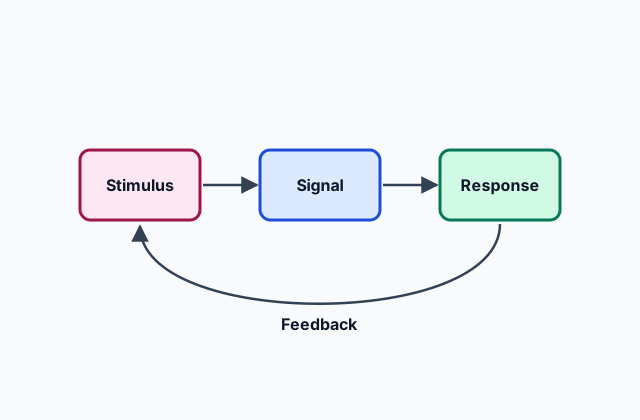 Tap to open the picture full size
Part 1 Think first One ripe banana
Commit to a guess first. Being wrong now makes the right idea stick better.
Predict first
A bag of green bananas ripens slowly. Put one ripe banana in with them and close the bag, and the whole bunch ripens within a day or two. Why?
In short. Organisms use feedback to maintain their internal environments: negative feedback reduces the initial stimulus and returns a system to its set point, while positive feedback amplifies a response.
- Negative feedback maintains homeostasis by reducing the initial stimulus; if a system is disrupted, it returns the system to its target set point.
- Negative feedback operates at the molecular, cellular and organismal levels, from a product slowing its own pathway to insulin lowering blood glucose.
- Positive feedback amplifies responses: the variable moves further from its initial set point, as when contractions intensify during childbirth.
Part 2 Learn it Feedback that steadies and feedback that amplifies
2a. Set points and negative feedback
Organisms use feedback mechanisms to maintain their internal environments in response to internal and external changes. Many variables, such as body temperature, have a target value, a set point.
In negative feedback, a change away from the set point triggers a response that pushes the variable back. The response reduces the initial stimulus. If the system is perturbed or disrupted, negative feedback returns it to its target set point.
Body temperature shows the loop. On a hot day, temperature rises above its set point. The brain detects the rise and signals the sweat glands, and evaporating sweat cools the body. As temperature falls back toward the set point, the stimulus shrinks, so the response shrinks too, and sweating slows. Because the response weakens as the variable returns, the variable settles near the set point instead of overshooting far past it.
Quick check · Put it in order
A person exercising on a hot day starts to overheat. Put the events of the feedback loop in order.
2b. Negative feedback at every level
Negative feedback operates at the molecular, cellular and organismal levels.
At the molecular level, the product at the end of a pathway can inhibit an enzyme near the start of that pathway, often by binding an allosteric site. When product builds up, the enzyme is inhibited and less product is made. When product runs low, the enzyme is freed and production speeds up again. The product level stays near a set point with no outside control.
At the organismal level, blood glucose is held near a set point by hormones. After a meal, glucose rises, and cells in the pancreas release insulin, which makes body cells take up glucose. As glucose falls back, insulin release falls too. If glucose drops too low, the pancreas releases a different hormone, glucagon, which raises it.
Quick check · Fill the statement
Complete the description of feedback in a cell's pathway.
When the product of a pathway builds up, it binds an enzyme near the start of the pathway and it, so less product is made. When the product runs low, the enzyme becomes more . The product level stays near a .
2c. Positive feedback amplifies
Positive feedback mechanisms amplify responses and processes in organisms. The variable that starts the response is moved further away from its initial set point. Amplification occurs when the stimulus is further intensified, which in turn starts an additional response, and the system changes.
Childbirth is the classic case. As labor begins, the baby's head presses on the cervix. The stretch triggers the release of the hormone oxytocin, which makes the uterus contract more strongly. Stronger contractions press the baby harder against the cervix, which triggers more oxytocin, and so on. The loop ends with an outside event, the birth, which removes the stretch.
Fruit ripening works the same way: ripening fruit release ethylene, which speeds ripening and the release of more ethylene. Positive feedback does not hold anything steady; it drives a process forward.
Quick check · Sort it
Each card describes a process in an organism. Tap a card, then the kind of feedback it shows.
Negative feedback
Positive feedback
2d. When feedback fails
A feedback loop works only if every part of it works. Break one, and the variable it controls is no longer held where it should be.
Blood glucose is the familiar example. If the pancreas releases too little insulin, or body cells stop responding to it, glucose still rises after a meal, but the response that lowers it is weak, so glucose stays high for much longer. Diabetes is a disease of this kind.
The loop itself tells you how to predict a disruption. Find the part that is missing or weakened. A weak response in a negative feedback loop means the variable returns to its set point slowly, or not at all. The stimulus is still there; what fails is the correction.
Quick check · Multiple choice
A person's pancreas releases very little insulin. Which change in blood glucose after a meal is most likely?
Part 3 Watch it done Glucose after a sugary drink
Predict first, then watch each step, then finish the reasoning yourself.
After fasting overnight, a healthy volunteer drinks a glucose solution. Every 30 minutes, blood glucose and insulin are measured.
- Glucose, in mg/dL, at 0, 30, 60, 90 and 120 minutes: 90, 140, 120, 100, 90
- Insulin, in arbitrary units, at the same times: 10, 60, 40, 20, 10
These numbers are a teaching example, not a published study. What kind of feedback do the data show?
Predict first
Before you open the first step, predict: what kind of feedback do these data show?
Step 1 · Find the stimulus
Glucose starts at 90 mg/dL, its fasting level, and rises by 50, to 140 mg/dL, by 30 minutes. That rise is the stimulus.
Step 2 · Follow the response
Insulin rises from 10 to 60 as glucose rises: 60 divided by 10 is 6 times its fasting level. Insulin makes body cells take up glucose.
Why this step?
Why measure insulin as well as glucose?
Glucose alone shows that the level came back, not what brought it back. Insulin rising with glucose, then falling as glucose falls, links the response to the stimulus.
Step 3 · Follow both back
Glucose falls to 120, then 100, then 90 mg/dL, its starting level. Insulin falls with it, to 40, 20 and then 10.
Your step · Decide and justify
Do these data show negative feedback or positive feedback?
Which evidence supports your decision?
Insulin pulled glucose back to its starting level, and as glucose fell, the insulin signal shrank too. A response that weakens as it removes its own stimulus is the signature of negative feedback.
Part 4 Try it Contractions that build
A new situation. During labor, a midwife records how many contractions happen in each 10 minutes, once an hour. Blood tests show oxytocin rising each hour too. These numbers are a teaching example.
- Hour 1: 2 contractions in 10 minutes
- Hour 2: 3 contractions
- Hour 3: 5 contractions
- Hour 4: 8 contractions
Try it · Calculate
By what percentage did the number of contractions in 10 minutes increase from hour 1 to hour 4?
Try it · Decide and justify
Which kind of feedback do these data fit?
Which evidence supports your decision?
Part 5 Explain it When labor ends
On the exam this is handwritten, so answer on paper first. Nothing you type here leaves this page. Then check your answer against the model and each scoring point.
Free response is 50% of the exam score. This one is shaped like Question 4, Conceptual Analysis.
Free-response practice · Question 4 style
During childbirth, stretching of the cervix triggers the release of oxytocin, and oxytocin makes the uterus contract more strongly.
(a) Describe how positive feedback differs from negative feedback.
(b) Explain how oxytocin and contractions form a positive feedback loop during labor.
(c) A drug blocks the receptor for oxytocin on the cells of the uterus. Predict the effect of the drug on contractions during labor.
(d) Justify your prediction in (c).
Model answer
(a) Negative feedback reduces the initial stimulus and returns a variable to its set point. Positive feedback amplifies the response, moving the variable further from its initial set point.
(b) Stretching of the cervix triggers oxytocin release; oxytocin makes the contractions stronger; stronger contractions stretch the cervix more, which triggers more oxytocin. Each response intensifies the stimulus.
(c) Contractions would be weaker, or would not build in strength.
(d) Oxytocin could not bind its receptor, so the uterus cells would not respond to it. The loop would be broken, and contractions would not be amplified.
Score your own answer. This is a self-check, not a grade. Tick each point your answer makes.
Part 6 Check yourself A hot room
All three case questions use the table.
A volunteer sits quietly in a hot room for 40 minutes. Every 10 minutes, a researcher records the volunteer's core body temperature and the rate at which the volunteer sweats. These numbers are a teaching example.
| Time (minutes) | Core temperature (°C) | Sweat rate (grams per minute) |
|---|---|---|
| 0 | 37.0 | 1 |
| 10 | 37.5 | 8 |
| 20 | 37.6 | 12 |
| 30 | 37.4 | 10 |
| 40 | 37.2 | 7 |
Case question 1 · Calculate
Using the table: the sweat rate at 20 minutes is how many times the sweat rate at 0 minutes?
Case question 2 · Multiple choice
Using the table: which statement best describes what happens from 20 to 40 minutes?
Case question 3 · Multiple choice
Using the table: the volunteer repeats the test after taking a drug that stops the sweat glands from releasing sweat. Which prediction is best supported?
The rest stand on their own and do not use the case.
Check yourself · Match
Match each part of the positive feedback loop in childbirth to the event that plays it.
Check yourself · Spot the error
A student explains how the body keeps its temperature steady on a hot day. Tap the line with the mistake.
Part 7 Keep it Bring back earlier ideas
Feedback often acts through a signaling pathway, and a cell holding its water steady is homeostasis at work. Pulling both back now ties this lesson to the last one and to Unit 2.
From 4.3 Signal Transduction Pathways · Match
Each chemical acts on one component of a pathway. Match each chemical to the result it would cause.
From 2.7 Tonicity and Osmoregulation · Put it in order
A pond protist keeps its water balance with a contractile vacuole. Put the events in the order they happen.
In three lines
- Organisms use feedback mechanisms to maintain their internal environments in response to internal and external changes.
- Negative feedback reduces the initial stimulus and returns a disrupted system to its set point, at the molecular, cellular and organismal levels.
- Positive feedback amplifies a response, moving the variable further from its initial set point, as in childbirth or fruit ripening.
Exam strategy for this topic
- Section I, Multiple Choice: 60 questions in 90 minutes.
- Section II, Free Response: 6 questions in 90 minutes.
- This lesson's Explain it is shaped like free-response question 4, Conceptual Analysis.
- A four-function, scientific, or graphing calculator is allowed on both sections of the exam.
To name a feedback loop, say what the response does to the stimulus: reduces it (negative) or intensifies it (positive). Then point to the data, a variable returning to its starting value or moving further away.
Questions students ask
What is the difference between negative and positive feedback?
Negative feedback reduces the initial stimulus and returns a system to its set point. Positive feedback amplifies the response, moving the variable further from its initial set point.
What is an example of negative feedback?
Blood glucose regulation: after a meal glucose rises, insulin is released, cells take up glucose, and as glucose returns to its set point insulin release falls. Body temperature control by sweating is another.
What is an example of positive feedback?
Childbirth: stretching of the cervix triggers oxytocin release, which strengthens contractions, which stretch the cervix more. Fruit ripening, driven by ethylene, is another.
At what levels does negative feedback work?
At the molecular, cellular and organismal levels, from a pathway's product inhibiting an enzyme near its start to hormones regulating blood glucose.
What happens when a feedback mechanism is disrupted?
The variable it controls is no longer held near its set point. If the pancreas releases too little insulin, for example, blood glucose stays high after a meal, as in diabetes.
Course alignment, for teachers
AP Biology topic 4.4, Unit 4: Cell Communication and Cell Cycle.
- Skill 6.E: Predict the causes or effects of a change in, or disruption to, one or more components in a biological system.
This lesson maps the one essential knowledge statement of the topic to the part that teaches each one: 1 is checked by a scored question. The map is in the lesson file.