Unit 4 · Topic 4.5 · about 30 minutes · 7 parts · 12 scored checks, 3 of them multiple choice, plus 2 from earlier lessons
AP Biology 4.5: Cell Cycle
Unit 4: 10 to 15% of the multiple-choice section
What you'll be able to do
- Describe the events of the cell cycle: interphase (G1, S and G2), mitosis and cytokinesis, and what happens to cells that leave the cycle.
- Explain how mitosis passes a complete genome from a parent cell to two genetically identical daughter cells.
Key vocabulary
| Term | What it means | The exam trap |
|---|---|---|
| Cell cycle | The series of events through which a eukaryotic cell grows and divides. | A stem may begin partway through the cycle; find the stage before predicting what comes next. |
| Interphase | The part of the cell cycle between divisions, made up of the stages G1, S and G2. | Each of its three stages has its own events, so name the stage, not just interphase. |
| Mitosis | The process in eukaryotic cells that divides the chromosomes between two new nuclei. | It has four named steps, and questions often turn on which one a picture or a description shows. |
| Cytokinesis | The division of the cytoplasm that produces two daughter cells. | It looks different in different kinds of cells, so check which kind a stem describes. |
| Chromatin | DNA together with its proteins, in the loosely packed form found in the nucleus between divisions. | Chromatin and chromosomes are the same DNA in different states of packing. |
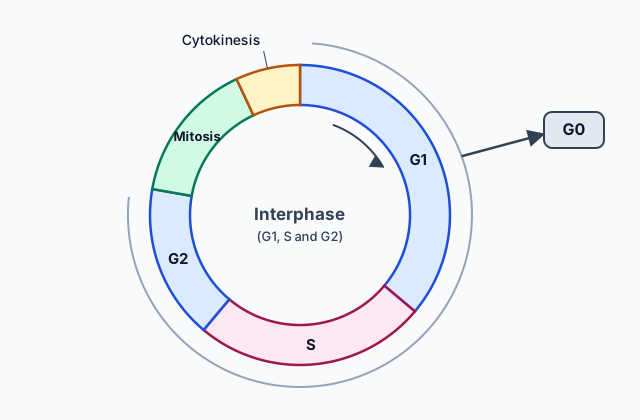 Tap to open the picture full size
Part 1 Think first 46 into two
Commit to a guess first. Being wrong now makes the right idea stick better.
Predict first
A human skin cell has 46 chromosomes. It divides into two cells, and each new cell also has 46 chromosomes, carrying the same genes as the parent cell. How can one cell give a full set of 46 to each of two cells?
In short. The cell cycle is a highly regulated series of events, interphase, mitosis and cytokinesis, by which a eukaryotic cell grows and divides, and mitosis passes a complete genome to two genetically identical daughter cells.
- In interphase the cell duplicates organelles (G1), replicates its DNA into sister chromatids (S), and makes proteins and ATP (G2); a cell in G0 no longer divides but can reenter the cycle.
- Mitosis runs through prophase, metaphase, anaphase and telophase, separating sister chromatids so that each daughter cell gets a complete set of chromosomes.
- Cytokinesis divides the cytoplasm, by a cleavage furrow in animal cells or a cell plate in plant cells; mitosis plays a role in growth, tissue repair and asexual reproduction.
Part 2 Learn it The cell cycle, stage by stage
2a. Interphase: growing and copying
The cell cycle is a highly regulated series of events that controls the growth and reproduction of eukaryotic cells. It consists of interphase, which has three stages, G1, S and G2, followed by mitosis and cytokinesis.
- G1: the cell is metabolically active, duplicating its organelles and cytosolic components.
- S: the DNA, in the form of chromatin, replicates. Each chromosome now consists of two sister chromatids connected at a centromere.
- G2: protein synthesis occurs, ATP is produced in large quantities, and centrosomes replicate.
In G1 each chromosome is a single, unreplicated DNA molecule; from the end of S until anaphase, each chromosome is two identical copies held together as sister chromatids. Interphase is not a rest: it is when the cell grows and prepares everything the division will need.
Quick check · Sort it
Each card describes a cell in interphase. Tap a card, then the stage the cell is in.
G1
S
G2
2b. Mitosis in four steps
Mitosis alternates with interphase in the cell cycle, and it occurs in sequential steps.
- Prophase: sister chromatids condense, the mitotic spindle begins to form, and centrosomes move to opposite poles of the cell.
- Metaphase: spindle fibers align the chromosomes along the equator of the cell.
- Anaphase: paired sister chromatids separate as spindle fibers pull the chromatids toward the poles.
- Telophase: the mitotic spindle breaks down, a new nuclear envelope develops around each set of chromosomes, and then the cytoplasm divides.
The order matters. The chromosomes must be lined up before they are pulled apart, so that each pole receives exactly one copy of each.
Quick check · Put it in order
Put the events of mitosis and cytokinesis in the order they happen.
2c. Two identical daughter cells
Mitosis ensures the transfer of a complete genome from a parent cell to two genetically identical daughter cells. S phase makes an exact copy of every chromosome, and anaphase sends one copy of each to each pole, so each daughter cell gets the same number of chromosomes as the parent, with the same genes.
Count carefully. A cell with 8 chromosomes still has 8 after S phase, but each is now two sister chromatids, 16 chromatids in all. In anaphase the 16 separate, 8 to each pole, and each daughter cell has 8 chromosomes, like the parent.
Mitosis plays a role in growth, tissue repair and asexual reproduction. A seedling's root lengthens, skin closes over a cut, and a single-celled eukaryote splits into two new organisms, all by mitosis.
Quick check · Multiple choice
A cell with 6 chromosomes goes through S phase, mitosis and cytokinesis. Which describes the two daughter cells?
2d. Cytokinesis, and cells that stop
Cytokinesis divides the cytoplasm, resulting in two new daughter cells, and it differs between animal and plant cells. In an animal cell, a cleavage furrow forms: the membrane pinches inward around the middle until the cell splits in two. A plant cell's rigid wall cannot pinch, so a cell plate forms across the middle of the cell, and it becomes the new wall between the two daughter cells.
Not every cell keeps cycling. A cell can enter a stage called G0, in which it no longer divides, but it can reenter the cell cycle in response to appropriate cues. Most nerve cells in an adult stay in G0, while liver cells that are not dividing can start again after part of the liver is lost. Other nondividing cells may exit the cycle or be held at a particular stage.
Quick check · Fill the statement
Complete the description of how cells finish dividing, and of cells that stop.
An animal cell divides its cytoplasm as a pinches the cell in two. A plant cell's rigid wall cannot pinch, so a forms across the middle instead. A nerve cell that no longer divides but stays alive and working has entered .
Part 3 Watch it done Timing the cycle from a slide
Predict first, then watch each step, then finish the reasoning yourself.
A student counts 200 cells in a slide of an onion root tip, where cells divide often, and records the stage of each.
- Interphase: 160
- Prophase: 20
- Metaphase: 8
- Anaphase: 4
- Telophase: 8
In these root tip cells, one full cell cycle takes about 24 hours, and the cells divide at random times, so the share of cells in a stage gives the share of the cycle spent in that stage. These numbers are a teaching example. How long do the cells spend in metaphase?
Predict first
Before you open the first step, predict: do these cells spend most of the cycle dividing, or between divisions?
Step 1 · Count the cells in mitosis
Prophase, metaphase, anaphase and telophase together: 20 + 8 + 4 + 8 = 40 cells.
Step 2 · Find the share of cells in mitosis
40 of 200 cells is 0.20, or 20%. This share is called the mitotic index. It means about 20% of the cycle is spent in mitosis and 80% in interphase.
Why this step?
Why can a count of cells stand in for time?
The cells divide at random times, so a stage that takes twice as long holds twice as many cells at any moment. The share of cells in a stage matches the share of the cycle that the stage takes.
Step 3 · Turn the share into hours
20% of 24 hours is 0.20 × 24 = 4.8 hours in mitosis.
Your step · Calculate
How many hours do these cells spend in metaphase? Give your answer to two decimal places.
hours
Interphase took up about 80% of the cycle here. Most of a dividing cell's life is spent growing and copying its DNA, not dividing.
Part 4 Try it Cells stuck in the middle
A new experiment. A student treats onion root tips with a chemical that stops spindle fibers from pulling chromatids apart. She counts 200 cells in an untreated tip and 200 cells in a treated tip. These numbers are a teaching example.
- Untreated: interphase 160, prophase 20, metaphase 8, anaphase 4, telophase 8
- Treated: interphase 136, prophase 18, metaphase 46, anaphase 0, telophase 0
Try it · Calculate
What percentage of the cells in the treated tip are in metaphase?
Try it · Decide and justify
Where in mitosis does the chemical most likely stop the cells?
Which evidence supports your decision?
Part 5 Explain it Copy, then divide
On the exam this is handwritten, so answer on paper first. Nothing you type here leaves this page. Then check your answer against the model and each scoring point.
Free response is 50% of the exam score. This one is shaped like Question 4, Conceptual Analysis.
Free-response practice · Question 4 style
Skin cells divide by mitosis to replace cells that are lost.
(a) Describe what happens to a cell's DNA during S phase.
(b) Explain how mitosis results in two daughter cells with the same genetic information as the parent cell.
(c) A skin cell has 46 chromosomes in G1. Predict the number of chromosomes in each daughter cell after mitosis and cytokinesis.
(d) In one cell, mitosis is completed normally but cytokinesis fails. Predict the number of nuclei and chromosomes in the resulting cell, and justify your prediction.
Model answer
(a) The DNA, in the form of chromatin, replicates, so each chromosome becomes two identical sister chromatids connected at a centromere.
(b) In metaphase, spindle fibers align the chromosomes along the equator. In anaphase, the sister chromatids of each chromosome separate and are pulled to opposite poles, so each pole, and then each daughter cell, receives one identical copy of every chromosome.
(c) 46 chromosomes in each daughter cell.
(d) One cell with two nuclei, each holding 46 chromosomes, 92 in all. Mitosis separated the chromatids and a nuclear envelope formed around each set, but without cytokinesis the cytoplasm never divided, so both nuclei stay in one cell.
Score your own answer. This is a self-check, not a grade. Tick each point your answer makes.
Part 6 Check yourself DNA in a growing culture
All three case questions use the table.
A biologist measures the amount of DNA in each of 1,000 cells from a growing culture of human cells, whose cells divide at random times. In this culture, a cell in G1 holds 10 units of DNA. These numbers are a teaching example.
| DNA per cell (units) | Number of cells |
|---|---|
| 10 | 620 |
| Between 10 and 20 | 180 |
| 20 | 200 |
Case question 1 · Calculate
Using the table: what percentage of the cells are partway through replicating their DNA?
Case question 2 · Multiple choice
Using the table: which cells are most likely in the group with 20 units of DNA?
Case question 3 · Multiple choice
Using the table: a drug that blocks DNA replication is added to the culture for 24 hours. Which change is most likely?
The rest stand on their own and do not use the case.
Check yourself · Match
Match each structure to what it does during the cell cycle.
Check yourself · Spot the error
A student explains how a dividing cell passes on its chromosomes. Tap the line with the mistake.
Part 7 Keep it Bring back earlier ideas
The cell cycle is held in check by feedback and signals, and S phase depends on how DNA strands pair. Pulling both back now ties this lesson to the last one and to Unit 1.
From 4.4 Feedback · Sort it
Each card describes a process in an organism. Tap a card, then the kind of feedback it shows.
Negative feedback
Positive feedback
From 1.6 Nucleic Acids · Fill the statement
A model shows one DNA strand as 5'-AACG-3'. Complete the description of the strand paired with it.
Read alongside it, the paired strand is 3'--5'. It runs in the direction, so the two strands are antiparallel.
In three lines
- The cell cycle is a highly regulated series of events: interphase (G1, S and G2), then mitosis and cytokinesis; a cell in G0 no longer divides but can reenter.
- In S phase each chromosome replicates into two sister chromatids; in mitosis they line up at metaphase and separate at anaphase.
- Mitosis gives two genetically identical daughter cells a complete genome each, for growth, tissue repair and asexual reproduction.
Exam strategy for this topic
- Section I, Multiple Choice: 60 questions in 90 minutes.
- Section II, Free Response: 6 questions in 90 minutes.
- This lesson's Explain it is shaped like free-response question 4, Conceptual Analysis.
- A four-function, scientific, or graphing calculator is allowed on both sections of the exam.
For a cell cycle question, track the copies: unreplicated chromosomes in G1, two sister chromatids per chromosome from the end of S through metaphase, and one copy of each chromosome in each daughter cell after anaphase. Name the step of mitosis by what the spindle is doing.
Questions students ask
What are the stages of the cell cycle?
Interphase, made up of G1, S and G2, then mitosis and cytokinesis. A cell can also leave the cycle for G0, where it no longer divides.
What happens in each stage of interphase?
In G1 the cell is metabolically active and duplicates organelles and cytosolic components. In S the DNA replicates, forming sister chromatids. In G2 proteins are made, ATP is produced in large quantities and centrosomes replicate.
What happens in each step of mitosis?
Prophase: chromatids condense, the spindle forms and centrosomes move to the poles. Metaphase: chromosomes line up at the equator. Anaphase: sister chromatids separate toward the poles. Telophase: the spindle breaks down and a new nuclear envelope develops.
How is cytokinesis different in plant and animal cells?
In animal cells a cleavage furrow pinches the cell in two. In plant cells, whose walls cannot pinch, a cell plate forms across the middle and becomes the new wall.
Why are the daughter cells of mitosis genetically identical?
Every chromosome is copied in S phase, and in anaphase one copy of each goes to each pole, so both daughter cells get the same complete set of chromosomes as the parent.
Course alignment, for teachers
AP Biology topic 4.5, Unit 4: Cell Communication and Cell Cycle.
- Skill 4.B: Describe data from a table or graph, including:
- Skill 5.A: Perform mathematical calculations, including:
This lesson maps all 2 essential knowledge statements of the topic to the part that teaches each one: 2 are checked by a scored question. The map is in the lesson file.