Unit 4 · Topic 4.6 · about 30 minutes · 7 parts · 12 scored checks, 3 of them multiple choice, plus 2 from earlier lessons
AP Biology 4.6: Regulation of Cell Cycle
Unit 4: 10 to 15% of the multiple-choice section
What you'll be able to do
- Describe how internal controls regulate a cell's progress through the cell cycle, and how interactions between cyclins and cyclin-dependent kinases control it.
- Describe how disruptions to the cell cycle can affect the cell or the organism, including cancer and apoptosis.
Key vocabulary
| Term | What it means | The exam trap |
|---|---|---|
| Cyclin | A protein whose concentration rises and falls in a regular pattern during the cell cycle. | Specific cyclins are not asked by name; describe what the rise and fall does. |
| Cyclin-dependent kinase (CDK) | A kinase that works together with a cyclin to control the cell cycle. | Do not name specific CDKs or match them to cyclins; describe what the complex does. |
| Cancer | A disease in which cells divide without the normal controls on the cell cycle. | A disruption to the cycle can also end in cell death instead; read which outcome the data show. |
 Tap to open the picture full size
Part 1 Think first Two nuclei, one cell
Commit to a guess first. Being wrong now makes the right idea stick better.
Predict first
Researchers fuse a cell that is in mitosis with a cell that is in G1, making one cell with two nuclei. The G1 nucleus has not copied its DNA. What happens to the G1 nucleus?
In short. Internal checkpoints and the interactions of cyclins with cyclin-dependent kinases control a cell's progress through the cell cycle, and disruptions to that control may result in cancer or apoptosis.
- A number of internal controls, or checkpoints, regulate progression through the cell cycle, pausing a cell until conditions are right to move on.
- Interactions between cyclins and cyclin-dependent kinases control the cycle: the kinase is active when bound to a cyclin, whose level rises and falls.
- Disruptions to the cell cycle may result in cancer, when damaged cells keep dividing, or in apoptosis, programmed cell death.
Part 2 Learn it What keeps the cycle in check
2a. Checkpoints
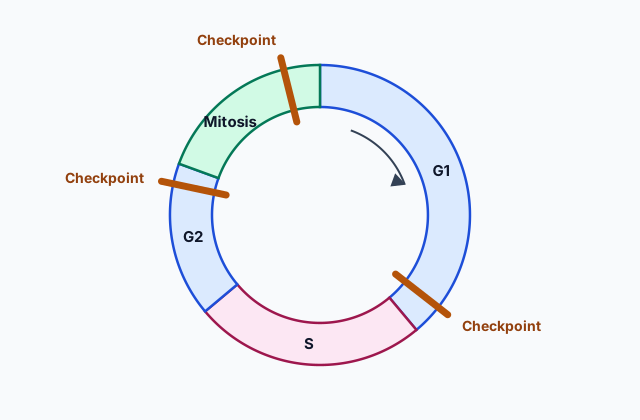
The cell cycle does not simply run from one stage to the next. A number of internal controls, called checkpoints, regulate progression through the cycle. At a checkpoint, the cell's progress can be paused until the stage before it is complete and conditions are right.
Checkpoints are commonly described at three places: late in G1, before the DNA is replicated; at the end of G2, before mitosis; and during mitosis, before sister chromatids separate, where the cell waits until every chromosome is attached to the spindle.
If the DNA is damaged, for example, a checkpoint can hold the cell until the damage is repaired, and then the cycle resumes. If the damage cannot be repaired, the cell may undergo apoptosis instead of dividing.
Quick check · Fill the statement
Complete the description of how a cell's progress through the cycle is regulated.
At a , a cell's progress through the cycle can be until the stage before it is complete. A cell whose damaged DNA cannot be repaired may undergo instead of dividing.
2b. Cyclins and cyclin-dependent kinases
Interactions between cyclins and cyclin-dependent kinases (CDKs) control the cell cycle. A CDK is a kinase: it phosphorylates target proteins, switching their activity on or off, as kinases did in the pathways of earlier lessons. A CDK is present throughout the cycle, but it is active only when it is bound to a cyclin.
The cyclin is the part that changes. Its concentration rises as the cell approaches a particular stage. Cyclin binds the CDK, and the active cyclin-CDK complex phosphorylates proteins that move the cell into that stage. Afterward the cyclin is broken down, its concentration falls, and the CDK becomes inactive again.
That is what the fused cells in Think first revealed: the cytoplasm of a cell in mitosis is full of active cyclin-CDK complexes, and they act on any nucleus they reach.
Quick check · Sort it
Each card describes a moment in the cell cycle. Tap a card, then whether the CDK is active.
CDK active
CDK inactive
2c. When control fails: cancer
Disruptions to the cell cycle may result in cancer or apoptosis.
Checkpoints depend on proteins, and proteins are coded by genes. If mutations disable the proteins that run a checkpoint, a cell with damaged DNA is no longer paused. It keeps dividing, its daughter cells inherit the damage, and further mutations can build up with each division. A mutation that leaves a cyclin-CDK complex active when it should not be has a similar effect: the cell keeps moving through the cycle without the normal signal.
Cells that divide without the normal controls, and pass the fault to their daughter cells, can give rise to cancer, a disease of uncontrolled cell division. Cancer usually involves several such disruptions, not just one.
Quick check · Multiple choice
A mutation disables the checkpoint that pauses cells with damaged DNA before replication. Which outcome is most likely?
2d. When control triggers death: apoptosis
The other outcome is apoptosis. When a checkpoint finds damage that cannot be repaired, the cell can be signaled to undergo programmed cell death. Removing the cell protects the organism, because the damage is never passed on.
So a working checkpoint has two ways to handle a damaged cell: a pause for repair, then onward, or apoptosis. A cell whose checkpoint is broken has neither, which is why such cells often divide more and die less than normal cells. A disruption that blocks apoptosis can be as dangerous as one that speeds division.
A disruption can also run the other way. A cell that cannot pass a point in the cycle, because a cyclin cannot bind its CDK, stops there, and cells held too long may undergo apoptosis.
Quick check · Match
Match each event in a cell to its most likely result.
Part 3 Watch it done What switches the kinase on?
Predict first, then watch each step, then finish the reasoning yourself.
A researcher follows a group of cells that divide in step and measures one cyclin, the CDK it binds and that CDK's activity every 4 hours. The cells enter mitosis at 16 hours. All three are in arbitrary units.
- Time, in hours: 0, 4, 8, 12, 16, 20
- Cyclin: 1, 3, 6, 10, 12, 2
- CDK amount: 10, 10, 10, 10, 10, 10
- CDK activity: 0, 2, 5, 9, 11, 1
These numbers are a teaching example, not a published study. What sets the CDK's activity?
Predict first
Before you open the first step, predict: which measurement does the CDK's activity follow?
Step 1 · Read the CDK amount
The CDK stays at 10 units the whole time. A level that never changes cannot explain an activity that rises from 0 to 11 and falls back to 1.
Step 2 · Read the cyclin
Cyclin climbs from 1 to 12 as the cells approach mitosis at 16 hours, then drops to 2 by 20 hours, after mitosis.
Why this step?
Why measure the amount of CDK at all?
If the CDK's amount had risen along with its activity, more enzyme alone could explain more activity. Showing that it stays at 10 rules that out.
Step 3 · Compare the activity with each
The activity goes 0, 2, 5, 9, 11, then 1. It peaks at 16 hours, when the cells enter mitosis, and drops by 20 hours, when the cyclin has been broken down.
Your step · Decide and justify
What sets the CDK's activity in these cells?
Which evidence supports your decision?
The CDK waits in the cell the whole time; cyclin decides when it works. Because the cyclin is broken down after mitosis, the CDK switches off again, and the cell does not run straight back into mitosis.
Part 4 Try it Damaged cells that keep going
A new experiment. A researcher exposes two kinds of cells to radiation that damages DNA, then follows them for 12 hours. The mutant cells lack a protein that the cell's DNA-damage checkpoints need. These numbers are a teaching example.
- Normal cells: 4% enter mitosis, and 30% undergo apoptosis
- Mutant cells: 56% enter mitosis, and 3% undergo apoptosis
Try it · Calculate
The percentage of mutant cells that enter mitosis is how many times the percentage of normal cells that do?
Try it · Decide and justify
Do these data support the claim that the mutant cells' checkpoints fail to stop cells with damaged DNA?
Which evidence supports your decision?
Part 5 Explain it A kinase that never switches off
On the exam this is handwritten, so answer on paper first. Nothing you type here leaves this page. Then check your answer against the model and each scoring point.
Free response is 50% of the exam score. This one is shaped like Question 4, Conceptual Analysis.
Free-response practice · Question 4 style
Cyclins and cyclin-dependent kinases (CDKs) control when a cell moves from one stage of the cell cycle to the next.
(a) Describe how a cyclin and a CDK interact to move a cell into the next stage of the cycle.
(b) Explain how a checkpoint can protect an organism from a cell with damaged DNA.
(c) A mutation makes a CDK active even when no cyclin is bound to it. Predict the effect of this mutation on the cell.
(d) Justify your prediction in (c).
Model answer
(a) Cyclin concentration rises as the cell nears a stage. The cyclin binds the CDK, which activates it, and the active complex phosphorylates proteins that move the cell into that stage. The cyclin is then broken down and the CDK becomes inactive.
(b) The checkpoint pauses the cell until the damage is repaired, or, if it cannot be repaired, the cell may undergo apoptosis. Either way the damaged DNA is not passed to daughter cells.
(c) The cell would keep moving past the point that CDK controls, dividing more often than normal, which could lead to cancer.
(d) Cyclin binding normally limits the CDK's activity to one part of the cycle. Without that limit, the CDK phosphorylates its targets all the time, so the cell's progress no longer waits for the cyclin level to rise.
Score your own answer. This is a self-check, not a grade. Tick each point your answer makes.
Part 6 Check yourself Two drugs on the cycle
All three case questions use the table.
A researcher grows dividing cells for 24 hours with no drug, with drug P, which stops a cyclin from binding its CDK, or with drug Q, which stops that cyclin from being broken down. The cyclin-CDK complex moves cells into mitosis, and breakdown of the cyclin lets cells leave mitosis. She records the percentage of cells in mitosis and the percentage undergoing apoptosis. These numbers are a teaching example.
| Treatment | Cells in mitosis (%) | Cells undergoing apoptosis (%) |
|---|---|---|
| No drug | 5 | 2 |
| Drug P | 0.5 | 3 |
| Drug Q | 38 | 20 |
Case question 1 · Calculate
Using the table: with drug Q, the percentage of cells in mitosis is how many times the percentage with no drug? Give your answer to one decimal place.
Case question 2 · Multiple choice
Using the table: which explanation best fits the result with drug P?
Case question 3 · Multiple choice
Using the table: which explanation best fits the result with drug Q?
The rest stand on their own and do not use the case.
Check yourself · Put it in order
Put the events in order as a cyclin and a CDK move a cell into the next stage of the cycle.
Check yourself · Spot the error
A student explains how disruptions to the cell cycle affect cells. Tap the line with the mistake.
Part 7 Keep it Bring back earlier ideas
Checkpoints control the steps of mitosis you just learned, and a failed checkpoint can end in the programmed cell death of the signaling lessons. Pulling both back now ties the unit together.
From 4.5 Cell Cycle · Put it in order
Put the events of mitosis and cytokinesis in the order they happen.
From 4.3 Signal Transduction Pathways · Sort it
Each card describes a cell's response to a signal. Tap a card, then the kind of response it is.
A change in gene expression
A change in the activity of proteins already present
Programmed cell death
In three lines
- A number of internal controls, or checkpoints, regulate progression through the cell cycle, pausing a cell until it is ready to move on.
- Interactions between cyclins and cyclin-dependent kinases control the cycle: a CDK is active when bound to a cyclin, whose level rises and falls.
- Disruptions to the cell cycle may result in cancer, when damaged cells keep dividing, or in apoptosis, programmed cell death.
Exam strategy for this topic
- Section I, Multiple Choice: 60 questions in 90 minutes.
- Section II, Free Response: 6 questions in 90 minutes.
- This lesson's Explain it is shaped like free-response question 4, Conceptual Analysis.
- A four-function, scientific, or graphing calculator is allowed on both sections of the exam.
For a cell cycle control question, name the control (a checkpoint, or a cyclin binding a CDK), say what it normally does, and then say what its loss would do: more division and possibly cancer, or a stopped cell and possibly apoptosis.
Questions students ask
What are cell cycle checkpoints?
Internal controls that regulate progression through the cell cycle. At a checkpoint, a cell's progress can be paused until the stage before it is complete, for example until damaged DNA is repaired.
How do cyclins and CDKs control the cell cycle?
A cyclin-dependent kinase is active when bound to a cyclin. Cyclin levels rise as a cell nears a stage, the active complex phosphorylates proteins that move the cell into it, and then the cyclin is broken down.
How can a disruption to the cell cycle lead to cancer?
If checkpoints stop working, often because of mutations, cells with damaged DNA keep dividing and pass the damage to their daughter cells. Uncontrolled division of this kind can lead to cancer.
What role does apoptosis play in cell cycle control?
When a cell's DNA damage cannot be repaired, the cell may undergo apoptosis, programmed cell death, so the damage is not passed on.
Do I need to know specific cyclins, CDKs or growth factors?
No. Knowledge of specific cyclin-CDK pairs or growth factors is beyond what is tested. Describe what cyclins and CDKs do together instead.
Beyond the AP Exam
College Board sets this limit on what the AP Exam asks about this topic. Anything past it is not on the exam.
Knowledge of specific cyclin-CdK pairs or growth factors is beyond the scope of the AP Exam.
Course alignment, for teachers
AP Biology topic 4.6, Unit 4: Cell Communication and Cell Cycle.
- Skill 6.E: Predict the causes or effects of a change in, or disruption to, one or more components in a biological system.
This lesson maps all 3 essential knowledge statements of the topic to the part that teaches each one: 3 are checked by a scored question. The map is in the lesson file.