Unit 5 · Topic 5.1 · about 30 minutes · 7 parts · 12 scored checks, 2 of them multiple choice, plus 2 from earlier lessons
AP Biology 5.1: Meiosis
Unit 5: 8 to 11% of the multiple-choice section
What you'll be able to do
- Explain how meiosis passes chromosomes from one generation to the next.
- Describe how the phases and outcomes of mitosis and meiosis are alike and how they differ.
Key vocabulary
| Term | What it means | The exam trap |
|---|---|---|
| Homologous chromosomes | The two chromosomes of a matching pair, one inherited from each parent. | They are not copies of each other. Read whether a step moves homologs or the two chromatids of one chromosome. |
| Sister chromatids | The two identical copies of a chromosome made when DNA is replicated, joined at the centromere. | Keep a separate count of chromatids and chromosomes; questions often ask for one and offer the other. |
| Haploid | Having one set of chromosomes, written 1n; a diploid cell has two sets, written 2n. | Before comparing two cells, decide which count a question asks about: sets, chromosomes or DNA. |
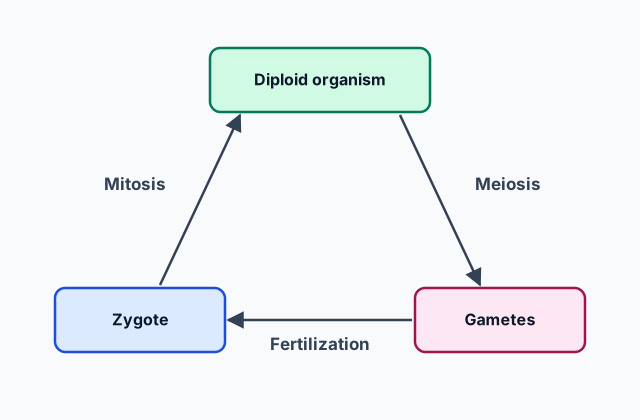 Tap to open the picture full size
Part 1 Think first If gametes were made by mitosis
Commit to a guess first. Being wrong now makes the right idea stick better.
Predict first
Picture a species whose body cells each carry two sets of chromosomes. Suppose its sperm and eggs were made by mitosis, so each one carried as many chromosomes as a body cell, and each offspring formed when one sperm fused with one egg. What would happen to the chromosome number over several generations?
In short. Meiosis is a process that ensures the formation of haploid gamete cells in sexually reproducing diploid organisms, in two divisions: meiosis I separates homologous chromosomes, and meiosis II separates sister chromatids.
- Meiosis I pairs and then separates homologous chromosomes, while sister chromatids stay attached, and ends with two haploid daughter cells.
- Meiosis II separates sister chromatids and ends with four haploid daughter cells, each with an unduplicated chromatid.
- Mitosis and meiosis both use a spindle apparatus to move chromosomes, but differ in the number of cells produced and their genetic content.
Part 2 Learn it Two divisions, half the chromosomes
2a. Why gametes carry one set
Most body cells of a sexually reproducing organism are diploid (2n): they carry two sets of chromosomes, one set inherited from each parent. The two chromosomes of each matching pair are homologous chromosomes.
Meiosis is a process that ensures the formation of haploid (1n) gamete cells, sometimes referred to as daughter cells, in sexually reproducing diploid organisms. A haploid cell carries one set of chromosomes. When two haploid gametes fuse at fertilization, as happens in most cases, the diploid number is restored, so the chromosome number stays the same from one generation to the next. That is how meiosis passes chromosomes on from parents to offspring.
Before meiosis begins, the cell replicates its DNA, so each chromosome is made of two sister chromatids. Meiosis then has two divisions in a row, meiosis I and meiosis II, with no DNA replication between them.
Quick check · Fill the statement
Complete the description of how chromosomes pass from one generation to the next.
In a sexually reproducing organism, meiosis forms gametes. When two gametes fuse at , the chromosome number of the parents is restored.
2b. Meiosis I: homologous chromosomes separate
Meiosis I has four phases.
- Prophase I. Homologous chromosomes pair up and condense. Synapsis occurs, the close pairing of the homologs, and then chiasmata may form where they touch. The meiotic spindle begins to form, centrosomes move to opposite poles of the cell, and the nuclear envelope breaks down.
- Metaphase I. Meiotic spindle fibers align homologous pairs of chromosomes along the equator of the cell, at the metaphase plate.
- Anaphase I. Homologous chromosomes separate, while sister chromatids remain attached, as spindle fibers pull chromosomes toward the poles.
- Telophase I. The spindle breaks down, a new nuclear envelope develops, a cleavage furrow (animal cell) or cell plate (plant cell) forms, and cytokinesis occurs.
Two haploid daughter cells are formed at the end of meiosis I. Each holds one chromosome from every homologous pair, and each of those chromosomes is still two sister chromatids. A cell with 2n = 8 starts with four homologous pairs and ends meiosis I as two cells with 4 chromosomes each.
Quick check · Put it in order
Put the events of meiosis I in the order they happen.
2c. Meiosis II: sister chromatids separate
Each cell from meiosis I goes straight into meiosis II.
- Prophase II. A meiotic spindle forms, and sister chromatids, still connected at the centromere, attach to it.
- Metaphase II. Chromosomes align along the metaphase plate. The kinetochore of each chromatid is attached to a microtubule extending from the poles.
- Anaphase II. Proteins at the centromeres break down, and sister chromatids are pulled apart and toward opposite poles of the cell.
- Telophase II. The spindle breaks down, a new nuclear envelope develops, a cleavage furrow or cell plate forms, chromatids begin to decondense, and cytokinesis occurs.
Four haploid daughter cells are formed, each with an unduplicated chromatid of every chromosome. Meiosis II does not change the number of chromosomes in a cell; it splits each chromosome's two chromatids between two cells. The 2n = 8 cell from above ends as four cells, each with 4 single-chromatid chromosomes.
Quick check · Sort it
Each card describes an event in meiosis. Tap a card, then the division it belongs to.
Meiosis I
Meiosis II
2d. Mitosis and meiosis side by side
Mitosis and meiosis are similar in the use of a spindle apparatus to move chromosomes. In both, spindle fibers attach to chromosomes and pull them toward opposite poles, and in both the cell divides by cytokinesis.
They differ in the number of cells produced and in the genetic content of the daughter cells. Mitosis is one division: one cell becomes two, each with the same chromosomes as the parent cell. Meiosis is two divisions: one cell becomes four, each haploid, with one set of chromosomes instead of two. The next lesson shows why those four cells also differ genetically from one another.
For the 2n = 8 cell: mitosis gives two cells with 8 chromosomes each, and meiosis gives four cells with 4 chromosomes each.
Quick check · Match
A cell has 2n = 8 and has already copied its DNA. Match each process or part to what it gives.
Part 3 Watch it done Counting through meiosis
Predict first, then watch each step, then finish the reasoning yourself.
A cell from a diploid organism with 2n = 6 has replicated its DNA and is about to begin meiosis. This organism is a teaching example. How many chromosomes, and how many chromatids, does each cell have at each point?
Predict first
Before you open the first step, predict: when does each cell first have 3 chromosomes?
Step 1 · Count the starting cell
2n = 6 means 6 chromosomes in 3 homologous pairs. The DNA is replicated, so each chromosome is two sister chromatids: 6 × 2 = 12 chromatids.
Step 2 · Follow meiosis I
In anaphase I the homologs of each pair go to opposite poles, while sister chromatids stay attached. Each of the two cells gets one chromosome from each of the 3 pairs: 3 chromosomes, each still two chromatids, so 3 × 2 = 6 chromatids per cell.
Why this step?
Why is each cell already haploid at the end of meiosis I, when its chromosomes are still doubled?
Haploid means one set: one chromosome from every homologous pair. Each cell has one of each of the 3 pairs, so it holds one set, even though each of those chromosomes still has two chromatids.
Step 3 · Set up meiosis II
Each of the two cells now lines its 3 chromosomes up at the metaphase plate, with the kinetochore of each chromatid attached to a microtubule from a pole. In anaphase II, sister chromatids are pulled apart.
Your step · Calculate
A cell with 2n = 6 replicates its DNA and goes through meiosis I and meiosis II. How many chromatids does each of the four cells have at the end of meiosis II?
The chromosome number halves once, in meiosis I, from 6 to 3. The chromatid count halves twice, from 12 to 6 to 3, because the DNA was replicated once and divided twice. A gamete ends with one unduplicated copy of each chromosome in one set.
Part 4 Try it Following the DNA
A new measurement. A researcher stains the DNA in cells of a diploid organism and measures how much DNA a cell holds, in arbitrary units. A cell that has not yet replicated its DNA holds 10 units. These numbers are a teaching example.
Try it · Calculate
One of these cells replicates its DNA and then goes through meiosis I and meiosis II. How many units of DNA does each of the resulting cells hold?
Try it · Decide and justify
The researcher finds a dividing cell of this organism, whose body cells have 2n = 4. Its 4 chromosomes, each made of two chromatids, are lined up at the metaphase plate as 2 homologous pairs, side by side. Is the cell in metaphase of mitosis or in metaphase I of meiosis?
Which evidence supports your decision?
Part 5 Explain it A model that divides once
On the exam this is handwritten, so answer on paper first. Nothing you type here leaves this page. Then check your answer against the model and each scoring point.
Free response is 50% of the exam score. This one is shaped like Question 5, Analyze Model or Visual Representation of a Biological Concept or Process.
Free-response practice · Question 5 style
A student builds a model of how a diploid animal with 2n = 4 makes gametes. In the model, a cell with 4 chromosomes, each made of two sister chromatids, lines its chromosomes up one at a time at the metaphase plate. Spindle fibers then pull the sister chromatids of each chromosome to opposite poles, and the cell divides once. The student labels the two resulting cells, each with 4 single-chromatid chromosomes, as gametes.
(a) Describe what separates in anaphase I of meiosis, and how that differs from what separates in the student's model.
(b) Explain why the cells in the student's model could not serve as gametes for this animal.
(c) Identify the number of cells, and the number of chromosomes in each cell, that meiosis of this cell would actually produce.
(d) Explain one feature of the student's model that correctly shows something mitosis and meiosis have in common.
Model answer
(a) In anaphase I, homologous chromosomes separate while sister chromatids remain attached. The student's model separates sister chromatids instead, as happens in mitosis or in anaphase II.
(b) Each of the student's cells keeps all 4 chromosomes, two sets, so it is diploid, not haploid. Two such cells fusing at fertilization would give an offspring with 8 chromosomes, double the parent's number.
(c) Four cells, each with 2 chromosomes, one from each homologous pair.
(d) Spindle fibers pull chromosomes toward opposite poles. Mitosis and meiosis both use a spindle apparatus to move chromosomes.
Score your own answer. This is a self-check, not a grade. Tick each point your answer makes.
Part 6 Check yourself Four cells from one organism
All three case questions use the table.
A researcher examines four cells, W, X, Y and Z, from the reproductive tissue of a diploid organism whose body cells have 2n = 8. For each cell she records the number of chromosomes, the DNA in the cell in arbitrary units, and what the chromosomes look like. These numbers are a teaching example.
| Cell | Chromosomes | DNA (units) | What the chromosomes look like |
|---|---|---|---|
| W | 8 | 20 | Lined up at the metaphase plate in pairs, side by side |
| X | 4 | 10 | Lined up singly at the metaphase plate |
| Y | 4 | 5 | Decondensing inside a new nuclear envelope |
| Z | 8 | 10 | Not dividing |
Case question 1 · Calculate
Using the table: the DNA in cell W is how many times the DNA in cell Y?
Case question 2 · Multiple choice
Using the table: which cell is most likely in metaphase II?
Case question 3 · Multiple choice
Using the table: cells X and Z hold the same amount of DNA. Which best explains why cell X has half as many chromosomes?
The rest stand on their own and do not use the case.
Check yourself · Spot the error
A student explains meiosis I. Tap the line with the mistake.
Check yourself · Rank it
Four cells come from the same diploid organism. Rank them by how much DNA each cell holds.
Most DNA first
Give each one a place, 1 for first. Give two the same place if they are equal.
Your ranking: none yet
Part 7 Keep it Bring back earlier ideas
Meiosis uses the same spindle and cytokinesis as mitosis, and the cell cycle sets the stage for it. Pulling both back now shows what is new about meiosis.
From 4.6 Regulation of Cell Cycle · Fill the statement
Complete the description of how a cell's progress through the cycle is regulated.
At a , a cell's progress through the cycle can be until the stage before it is complete. A cell whose damaged DNA cannot be repaired may undergo instead of dividing.
From 4.5 Cell Cycle · Multiple choice
A cell with 6 chromosomes goes through S phase, mitosis and cytokinesis. Which describes the two daughter cells?
In three lines
- Meiosis ensures the formation of haploid gametes in sexually reproducing diploid organisms, and in most cases fertilization restores the diploid number.
- Meiosis I separates homologous chromosomes while sister chromatids remain attached; meiosis II separates sister chromatids, leaving four haploid cells.
- Mitosis and meiosis both use a spindle apparatus, but differ in the number of cells produced and their genetic content.
Exam strategy for this topic
- Section I, Multiple Choice: 60 questions in 90 minutes.
- Section II, Free Response: 6 questions in 90 minutes.
- This lesson's Explain it is shaped like free-response question 5, Analyze Model or Visual Representation of a Biological Concept or Process.
- A four-function, scientific, or graphing calculator is allowed on both sections of the exam.
For a meiosis question, say what separates in each division (homologous chromosomes in meiosis I, sister chromatids in meiosis II) and count chromosomes and chromatids as two separate numbers at each step.
Questions students ask
What does meiosis produce?
Meiosis ensures the formation of haploid gamete cells in sexually reproducing diploid organisms. One diploid cell gives four haploid daughter cells, each with an unduplicated chromatid of every chromosome.
What is the difference between meiosis I and meiosis II?
In meiosis I, homologous chromosomes pair, line up as pairs and separate, while sister chromatids stay attached, giving two haploid cells. In meiosis II, sister chromatids separate, giving four haploid cells.
How are mitosis and meiosis alike, and how do they differ?
Both use a spindle apparatus to move chromosomes. They differ in the number of cells produced, two in mitosis and four in meiosis, and in the genetic content of the daughter cells.
When are chiasmata formed?
In prophase I, after homologous chromosomes pair up and synapsis occurs, chiasmata may form between them.
Course alignment, for teachers
AP Biology topic 5.1, Unit 5: Heredity.
- Skill 1.B: Explain biological concepts and processes.
This lesson maps all 4 essential knowledge statements of the topic to the part that teaches each one: 4 are checked by a scored question. The map is in the lesson file.