Unit 5 · Topic 5.2 · about 30 minutes · 7 parts · 12 scored checks, 3 of them multiple choice, plus 2 from earlier lessons
AP Biology 5.2: Meiosis and Genetic Diversity
Unit 5: 8 to 11% of the multiple-choice section
What you'll be able to do
- Explain how the process of meiosis produces genetic diversity among gametes and offspring.
Key vocabulary
| Term | What it means | The exam trap |
|---|---|---|
| Crossing over | The exchange of genetic material between non-sister chromatids of a homologous pair, also called recombination. | Read which chromatids a question says took part before you decide whether anything new was made. |
| Random assortment | The shuffling of the chromosomes inherited from the two parents into gametes during meiosis. | Keep random assortment and crossing over apart; they happen at different stages of meiosis I. |
| Nondisjunction | Incorrect separation of homologous chromosomes or of sister chromatids during meiosis. | Say which division failed before you count gametes. |
 Tap to open the picture full size
Part 1 Think first Why siblings differ
Commit to a guess first. Being wrong now makes the right idea stick better.
Predict first
Siblings with the same two parents, other than identical twins, rarely look exactly alike. Picture a simpler species with 3 pairs of chromosomes, one of each pair inherited from each parent. Counting only which member of each pair goes into a gamete, how many different gametes could one individual make?
In short. Meiosis gives each gamete a haploid set made of an assortment of maternal and paternal chromosomes, and crossing over, random assortment and fertilization together increase genetic variation.
- Correct separation of homologs in meiosis I and of sister chromatids in meiosis II gives each gamete a haploid set; when separation fails (nondisjunction), gametes are no longer haploid.
- In prophase I, non-sister chromatids exchange genetic material by crossing over, which increases genetic diversity among the gametes.
- Sexual reproduction increases genetic variation through crossing over, random assortment of chromosomes during meiosis, and fertilization.
Part 2 Learn it Where the variation comes from
2a. A mix of both parents' chromosomes
In metaphase I, each homologous pair lines up at the metaphase plate. Which member of the pair, the one inherited from the mother or the one from the father, faces which pole is random, and each pair lines up independently of the others. This is the random assortment of chromosomes during meiosis.
Correct separation of the homologous chromosomes in meiosis I and the sister chromatids in meiosis II ensures that each gamete receives a haploid (1n) set of chromosomes that comprises an assortment of both maternal and paternal chromosomes: one of every pair, with a different mix in different gametes.
Because each pair can go two ways, an individual with 3 pairs can make 2 × 2 × 2 = 8 different combinations in its gametes, and every added pair doubles the number.
Quick check · Fill the statement
Complete the description of how chromosomes are sorted into gametes.
Each gamete gets one chromosome from every pair. Which member of a pair it gets depends on how that pair lines up at the plate in metaphase , and each pair lines up the others.
2b. Crossing over
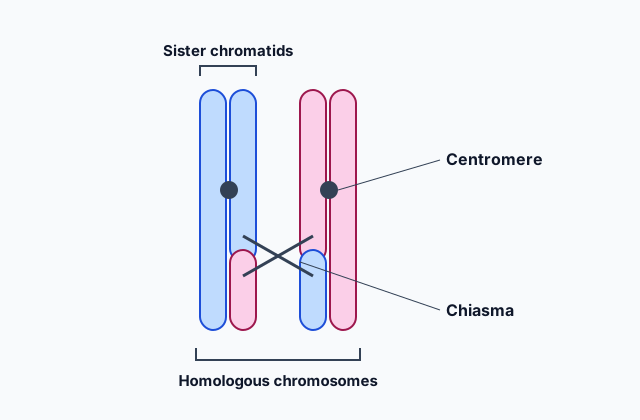
During prophase I of meiosis, while homologous chromosomes are paired, non-sister chromatids exchange genetic material by a process called crossing over, or recombination. Each chiasma marks a place where two chromatids, one from each homolog, have crossed.
Suppose the chromosome from one parent carries alleles A and B, and its homolog from the other parent carries a and b. A crossover between the two genes gives two chromatids with new combinations, A with b and a with B, while the other two chromatids keep A with B and a with b.
Crossing over increases genetic diversity among the resultant gametes. Without it, the alleles on one chromosome would always be passed on together. Sister chromatids are identical copies, so a swap between them would make no new combination.
Quick check · Sort it
One parent's chromosome carries alleles A and B, and its homolog carries a and b. One crossover happens between the two genes. Each card is a chromatid after meiosis. Tap a card, then the kind of chromatid it is.
Same as a parent's chromosome
A new combination
2c. When separation fails
When homologous chromosomes fail to separate in meiosis I, or sister chromatids fail to separate in meiosis II, the error is called nondisjunction, and the gametes are no longer haploid. Some get an extra copy of a chromosome, and some lack that chromosome.
Where it happens changes how many gametes are affected. Take a species with 2n = 8, so a normal gamete has 4 chromosomes.
- If one homologous pair fails to separate in meiosis I, one cell gets both members and the other gets neither. After meiosis II, two gametes have 5 chromosomes and two have 3.
- If one pair of sister chromatids fails to separate in meiosis II, only one of the two cells is affected. One gamete has 5, one has 3, and the other two have the normal 4.
A gamete with 5 chromosomes that fuses with a normal gamete gives a zygote with 9, one more than the diploid number.
Quick check · Multiple choice
In a species with 2n = 12, the homologous chromosomes of one pair fail to separate in meiosis I, and meiosis II goes normally. Which describes the four gametes?
2d. Three sources of variation
Sexual reproduction in eukaryotes increases genetic variation, including crossing over, random assortment of chromosomes during meiosis, and subsequent fertilization of gametes.
- Crossing over makes chromatids that carry alleles from both parents.
- Random assortment gives each gamete a different mix of whole maternal and paternal chromosomes.
- Fertilization joins one gamete from each parent, and which two meet is a matter of chance. If each parent can make 8 kinds of gamete, there are 8 × 8 = 64 combinations of the two, before crossing over adds more.
Offspring made by mitosis alone, as in asexual reproduction, receive copies of one parent's chromosomes, so they miss all three sources.
Quick check · Match
Match each process to what it does to the chromosomes that reach the next generation.
Part 3 Watch it done Counting the combinations
Predict first, then watch each step, then finish the reasoning yourself.
A species has 2n = 8, and in each parent every homologous pair has two different members. This species is a teaching example. Ignoring crossing over, how many different gametes can one parent make by random assortment, and how many combinations can fertilization of two parents' gametes give?
Predict first
Before you open the first step, predict: which gives more combinations?
Step 1 · Find the number of pairs
2n = 8, so there are 8 ÷ 2 = 4 homologous pairs, and each gamete gets one chromosome from each pair.
Step 2 · Count one parent's gametes
Each pair can send either member to a given gamete, 2 ways, and each pair lines up independently: 2 × 2 × 2 × 2 = 16 kinds of gamete.
Why this step?
Why multiply the 2 ways for each pair, rather than add them?
Because each pair lines up independently, each of the 2 ways for one pair can go with every arrangement of the other pairs. Independent choices multiply.
Step 3 · Set up fertilization
The other parent can also make 16 kinds of gamete, and any gamete from one parent may fuse with any gamete from the other.
Your step · Calculate
Each of two parents of this species can make 16 kinds of gamete, and any gamete from one may fuse with any from the other. Ignoring crossing over, how many different combinations of the two gametes are possible?
Random assortment in one parent gives 16. Fertilization multiplies one parent's 16 by the other's, giving 256. Crossing over then makes new combinations of alleles within chromosomes, so the true number of different offspring is larger still.
Part 4 Try it Counting chromosomes in gametes
A new count. A researcher counts the chromosomes in 200 gametes from one individual of a species whose normal gametes have 4 chromosomes. These numbers are a teaching example.
- 196 gametes have 4 chromosomes
- 2 gametes have 5 chromosomes
- 2 gametes have 3 chromosomes
Try it · Calculate
What percentage of the 200 gametes are not haploid?
Try it · Decide and justify
The researcher traces four of these gametes back to the same cell. They have 5, 5, 3 and 3 chromosomes. Did the chromosomes most likely fail to separate in meiosis I or in meiosis II?
Which evidence supports your decision?
Part 5 Explain it A species without crossing over
On the exam this is handwritten, so answer on paper first. Nothing you type here leaves this page. Then check your answer against the model and each scoring point.
Free response is 50% of the exam score. This one is shaped like Question 4, Conceptual Analysis.
Free-response practice · Question 4 style
Sexual reproduction makes offspring that differ genetically from their parents and from each other.
(a) Describe crossing over, including when in meiosis it occurs.
(b) Explain how the way homologous pairs line up in metaphase I leads to gametes that differ from one another.
(c) In a population of one species, a mutation stops crossing over in every individual. Predict the effect on the genetic variation among the gametes those individuals make.
(d) Justify your prediction in (c).
Model answer
(a) In prophase I, while homologous chromosomes are paired, non-sister chromatids exchange genetic material. This makes chromatids that carry new combinations of alleles from both parents.
(b) Each homologous pair lines up independently, and which member faces which pole is random. So each gamete gets a different assortment of maternal and paternal chromosomes.
(c) The gametes would be less varied than normal, but they would still differ from one another.
(d) Without crossing over, the alleles on each chromosome are always passed on together, so one source of variation is lost. Random assortment still gives gametes different mixes of whole maternal and paternal chromosomes.
Score your own answer. This is a self-check, not a grade. Tick each point your answer makes.
Part 6 Check yourself Four cells, sixteen gametes
All three case questions use the table.
A researcher follows four cells of a species with 2n = 6 through meiosis and counts the chromosomes in each of the four gametes every cell makes. A normal gamete of this species has 3 chromosomes. These numbers are a teaching example.
| Cell | Gamete 1 | Gamete 2 | Gamete 3 | Gamete 4 |
|---|---|---|---|---|
| Cell 1 | 3 | 3 | 3 | 3 |
| Cell 2 | 4 | 4 | 2 | 2 |
| Cell 3 | 4 | 2 | 3 | 3 |
| Cell 4 | 3 | 3 | 3 | 3 |
Case question 1 · Calculate
Using the table: what percentage of all 16 gametes are not haploid? Give your answer to one decimal place.
Case question 2 · Multiple choice
Using the table: in which division did chromosomes most likely fail to separate in cell 3?
Case question 3 · Multiple choice
Using the table: a gamete from cell 2 with 4 chromosomes fuses with a normal gamete of this species. Which describes the zygote?
The rest stand on their own and do not use the case.
Check yourself · Put it in order
Put the events in order, from a pair of homologous chromosomes to a gamete carrying a recombinant chromatid.
Check yourself · Spot the error
A student explains why offspring of the same two parents differ. Tap the line with the mistake.
Part 7 Keep it Bring back earlier ideas
Variation depends on what separates in each division of meiosis, and on the chromosomes each cell gets in any division. Pulling both back now shows where the mixing happens.
From 5.1 Meiosis · Match
A cell has 2n = 8 and has already copied its DNA. Match each process or part to what it gives.
From 4.5 Cell Cycle · Spot the error
A student explains how a dividing cell passes on its chromosomes. Tap the line with the mistake.
In three lines
- Correct separation in meiosis gives each gamete a haploid set of maternal and paternal chromosomes; nondisjunction leaves gametes that are not haploid.
- In prophase I, non-sister chromatids exchange genetic material by crossing over, which increases genetic diversity among gametes.
- Sexual reproduction increases genetic variation through crossing over, random assortment of chromosomes and fertilization.
Exam strategy for this topic
- Section I, Multiple Choice: 60 questions in 90 minutes.
- Section II, Free Response: 6 questions in 90 minutes.
- This lesson's Explain it is shaped like free-response question 4, Conceptual Analysis.
- A four-function, scientific, or graphing calculator is allowed on both sections of the exam.
When a question asks how meiosis produces variation, name the source (crossing over, random assortment or fertilization), say when it happens, and say what new combination it makes. For a nondisjunction question, say which division failed and follow the chromosomes into each gamete.
Questions students ask
How does meiosis increase genetic diversity?
In prophase I, non-sister chromatids exchange genetic material by crossing over, and in meiosis I each homologous pair lines up and separates independently, so each gamete gets a different assortment of maternal and paternal chromosomes.
What is nondisjunction?
Incorrect separation of homologous chromosomes in meiosis I or of sister chromatids in meiosis II. When it occurs, gametes are no longer haploid: some have an extra chromosome and some are missing one.
What are the sources of genetic variation in sexual reproduction?
Sexual reproduction in eukaryotes increases genetic variation, including crossing over, random assortment of chromosomes during meiosis, and fertilization of gametes.
Do I need to know the reproductive cycles of particular plants and animals?
No. The details of sexual reproduction cycles in various plants and animals are beyond the scope of the AP Exam. Focus on what meiosis and fertilization do to chromosomes.
Beyond the AP Exam
College Board sets this limit on what the AP Exam asks about this topic. Anything past it is not on the exam.
Knowledge of the details of sexual reproduction cycles in various plants and animals is beyond the scope of the AP Exam.
Course alignment, for teachers
AP Biology topic 5.2, Unit 5: Heredity.
- Skill 3.A: Identify or pose a testable question based on an observation, data, or a model.
This lesson maps all 3 essential knowledge statements of the topic to the part that teaches each one: 3 are checked by a scored question. The map is in the lesson file.