Unit 5 · Topic 5.3 · about 30 minutes · 7 parts · 12 scored checks, 3 of them multiple choice, plus 2 from earlier lessons
AP Biology 5.3: Mendelian Genetics
Unit 5: 8 to 11% of the multiple-choice section
What you'll be able to do
- Explain how genes and traits are inherited according to Mendel's laws, and use probability to predict the offspring of a cross.
Key vocabulary
| Term | What it means | The exam trap |
|---|---|---|
| Genotype | The set of alleles an individual organism inherits for one or more genes. | Write a genotype with one letter for each allele, two letters for each gene in a diploid organism. |
| Phenotype | The observable expression of an organism's inherited traits. | Name the trait you observe, such as flower color, rather than the alleles behind it. |
| Test cross | A cross of an individual that shows the dominant phenotype with an individual that is homozygous recessive. | Expect a ratio, not an exact count; a small number of offspring can stray from it. |
 Tap to open the picture full size
Part 1 Think first White flowers from purple parents
Commit to a guess first. Being wrong now makes the right idea stick better.
Predict first
A gardener crosses two pea plants that both have purple flowers. About one in four of the offspring has white flowers. What is the best explanation?
In short. Mendel's laws of segregation and independent assortment can be applied to genes on different chromosomes, and the rules of probability and Punnett squares predict the genotypes and phenotypes of offspring.
- An organism's genotype is the set of alleles it inherits, homozygous or heterozygous for each gene; its phenotype is the observable expression of the traits.
- In most cases fertilization fuses two haploid gametes, restoring the diploid number and creating new combinations of alleles in the zygote.
- Monohybrid, dihybrid and test crosses, and data such as pedigrees, can often show whether an allele is dominant or recessive.
Part 2 Learn it Predicting offspring
2a. Genotype, phenotype and segregation
An organism's genotype is the set of alleles it inherits for one or more genes. For each gene a diploid organism has two alleles, one from each parent. It is homozygous for a gene if the two are the same (PP or pp) and heterozygous if they differ (Pp).
Its phenotype is the observable expression of its inherited traits, such as purple flowers. When an allele is dominant, one copy sets the phenotype, masking a recessive allele, so PP and Pp plants look the same.
Mendel's law of segregation says the two alleles of a gene separate into different gametes, so each gamete carries one. That follows from meiosis I, when homologous chromosomes separate. In most cases, fertilization then fuses two haploid gametes, restoring the diploid number and creating new combinations of alleles in the zygote.
Quick check · Sort it
In a pea plant, the allele for purple flowers is dominant to the allele for white. Each card describes something about one plant. Tap a card, then whether you could tell it just by looking at the plant.
Can be seen by looking
Needs a cross or other data
2b. Probability and Punnett squares
Rules of probability can be applied to analyze the passing of single-gene traits from parent to offspring. A heterozygous parent (Pp) passes P in half its gametes and p in the other half.
- And. If A and B are independent, P(A and B) = P(A) × P(B). For an offspring of Pp × Pp to be pp, it must get p from one parent and p from the other: 1/2 × 1/2 = 1/4.
- Or. If A and B are mutually exclusive, P(A or B) = P(A) + P(B). An offspring is Pp if it gets P from the first parent and p from the second (1/4) or the other way around (1/4): 1/4 + 1/4 = 1/2.
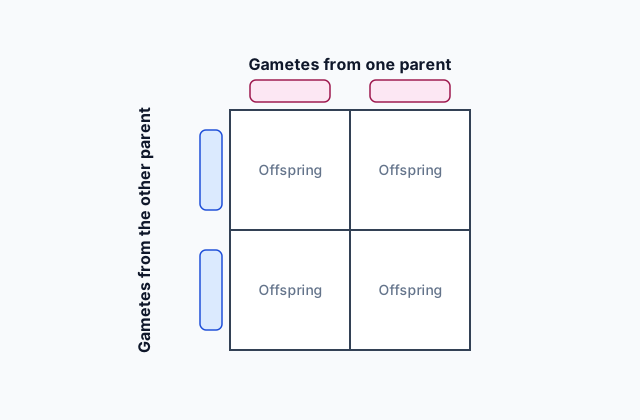
A Punnett square lays out the same result: each parent's gametes along one side, and one box for each pairing. For Pp × Pp the boxes give PP, Pp, Pp and pp, so 3 in 4 offspring are expected to have purple flowers. Each offspring is a separate event, so a small family can stray from the ratio.
Quick check · Fill the statement
Two plants with genotype Aa are crossed, and A is dominant to a. Complete the probabilities for one offspring.
The probability that the offspring is aa is . The probability that it is Aa is . The probability that it shows the dominant phenotype is .
2c. Two genes at once
Mendel's law of independent assortment says the alleles of different genes are sorted into gametes independently of each other. Mendel's laws of segregation and independent assortment can be applied to genes that are on different chromosomes, because each homologous pair lines up independently in metaphase I.
A plant that is PpTt, with the two genes on different chromosomes, makes four kinds of gamete, PT, Pt, pT and pt, each 1/4 of the total. A cross of two such plants (a dihybrid cross) can be worked one gene at a time and then combined with the product rule. The chance of a pptt offspring, for example, is 1/4 × 1/4 = 1/16, and if each gene has a dominant allele, the four phenotypes are expected in a 9 to 3 to 3 to 1 ratio.
Genes that sit close together on the same chromosome do not assort independently, which the next lesson takes up.
Quick check · Multiple choice
Genes A and B are on different chromosomes. A plant with genotype AaBb inherited A and B from its mother, and a and b from its father. What fraction of its gametes carry A and b?
2d. Crosses and pedigrees as evidence
Monohybrid, dihybrid and test crosses can be used to determine whether alleles are dominant or recessive. In a test cross, an individual with the dominant phenotype is crossed with one that is homozygous recessive. Every offspring gets a recessive allele from the second parent, so the offspring show which allele the first parent passed on. If any offspring show the recessive phenotype, the first parent must carry the recessive allele, and a heterozygote gives the two phenotypes in about a 1 to 1 ratio.
In humans, families stand in for crosses. Patterns of inheritance (autosomal, genetically linked, sex-linked) and whether an allele is dominant or recessive can often be predicted from data, including pedigrees. If two parents who do not show a trait have a daughter who does, each parent must carry a masked allele for it, so that allele is recessive. (A son is not enough on his own: for a gene on the X, his father passes him no X at all.) Punnett squares can then predict the genotypes and phenotypes of parents and offspring.
Quick check · Match
Purple flowers are dominant to white in a plant species. Match each cross or result to the conclusion or prediction it best supports.
Part 3 Watch it done One gene at a time
Predict first, then watch each step, then finish the reasoning yourself.
In a plant species, purple flowers (P) are dominant to white (p), and tall stems (T) are dominant to short (t). The two genes are on different chromosomes. This species is a teaching example. Two PpTt plants are crossed. What is the probability that an offspring has white flowers and a tall stem?
Predict first
Before you open the first step, predict: to combine the two genes, will you add their probabilities or multiply them?
Step 1 · Split the cross
Because the genes are on different chromosomes, they assort independently. Treat the cross as two crosses, Pp × Pp and Tt × Tt.
Step 2 · Flower color
White flowers need pp: p from each parent, 1/2 × 1/2 = 1/4.
Why this step?
Why can the two genes be worked separately?
They are on different chromosomes, so the allele for flower color that a gamete carries tells nothing about its allele for stem height. Independent events can be combined with the product rule.
Step 3 · Stem height
A tall stem needs TT or Tt. These are mutually exclusive, so add: 1/4 + 1/2 = 3/4.
Your step · Calculate
For an offspring of PpTt × PpTt, the probability of white flowers is 1/4 and of a tall stem is 3/4, and the genes are on different chromosomes. What is the probability that the offspring has white flowers and a tall stem? Give your answer as a decimal to four decimal places.
3/16 is the same as 3 of the 16 boxes of a full dihybrid Punnett square, which is the 3 in the 9 to 3 to 3 to 1 ratio. Working each gene alone and multiplying gets there without drawing all 16 boxes.
Part 4 Try it A test cross
A new question. A breeder wants to know whether a purple-flowered plant of the same species is PP or Pp. She crosses it with a white-flowered (pp) plant and counts 100 offspring: 52 with purple flowers and 48 with white flowers. These numbers are a teaching example.
Try it · Calculate
If the purple parent were heterozygous (Pp), how many of the 100 offspring would you expect to have white flowers?
Try it · Decide and justify
Is the purple parent homozygous or heterozygous?
Which evidence supports your decision?
Part 5 Explain it Two genes in a test cross
On the exam this is handwritten, so answer on paper first. Nothing you type here leaves this page. Then check your answer against the model and each scoring point.
Free response is 50% of the exam score. This one is shaped like Question 6, Analyze Data.
Free-response practice · Question 6 style
A researcher crosses a plant that is heterozygous for both flower color and stem height (PpTt) with a plant that has white flowers and a short stem (pptt). Purple (P) is dominant to white (p), and tall (T) is dominant to short (t). She counts 400 offspring: 102 purple and tall, 98 purple and short, 97 white and tall, and 103 white and short. These numbers are a teaching example.
(a) Identify the four kinds of gamete the PpTt parent can make, and the ratio of the four offspring phenotypes expected if the two genes assort independently.
(b) Calculate the number of offspring expected in each phenotype class out of 400 under that hypothesis.
(c) Explain whether the data support the hypothesis that the two genes are on different chromosomes.
(d) Explain how meiosis in the PpTt parent produces its four kinds of gamete in equal numbers.
Model answer
(a) PT, Pt, pT and pt. The pptt parent passes only pt, so the offspring phenotypes are expected in a 1 to 1 to 1 to 1 ratio.
(b) Each class is 1/4 of 400, so 100 offspring in each.
(c) Yes. The counts, 102, 98, 97 and 103, are each close to the 100 expected, which fits independent assortment, as expected for genes on different chromosomes.
(d) The two homologous pairs line up independently in metaphase I, so P is as likely to go to a pole with T as with t. Segregation in meiosis gives each gamete one allele of each gene, and each of the four combinations makes up a quarter of the gametes.
Score your own answer. This is a self-check, not a grade. Tick each point your answer makes.
Part 6 Check yourself Lobed leaves and smooth leaves
All three case questions use the table.
A plant breeder crosses plants of a species that have lobed leaves with plants that have smooth leaves, then crosses their offspring. Leaf shape is set by one gene. These numbers are a teaching example.
| Cross | Parents | Lobed-leaved offspring | Smooth-leaved offspring |
|---|---|---|---|
| 1 | Lobed × smooth | 200 | 0 |
| 2 | Offspring of cross 1 × each other | 301 | 99 |
| 3 | Offspring of cross 1 × smooth | 152 | 148 |
Case question 1 · Calculate
Using the table: in cross 2, the number of lobed-leaved offspring is how many times the number of smooth-leaved offspring? Give your answer to one decimal place.
Case question 2 · Multiple choice
Using the table: what does cross 3 show about the offspring of cross 1?
Case question 3 · Multiple choice
Using the table: two offspring of cross 1 are crossed with each other. What is the probability that the first two offspring of that cross both have smooth leaves?
The rest stand on their own and do not use the case.
Check yourself · Put it in order
Put the steps in order to predict the offspring of a cross with a Punnett square.
Check yourself · Spot the error
A student reads a family pedigree. Tap the line with the mistake.
Part 7 Keep it Bring back earlier ideas
Mendel's laws describe what meiosis does to alleles: homologs separate, and pairs assort independently. Pulling both back now shows the link.
From 5.2 Meiosis and Genetic Diversity · Fill the statement
Complete the description of how chromosomes are sorted into gametes.
Each gamete gets one chromosome from every pair. Which member of a pair it gets depends on how that pair lines up at the plate in metaphase , and each pair lines up the others.
From 5.1 Meiosis · Put it in order
Put the events of meiosis I in the order they happen.
In three lines
- Mendel's laws of segregation and independent assortment can be applied to genes on different chromosomes.
- The rules of probability and Punnett squares predict genotypes and phenotypes: multiply for independent events, add for mutually exclusive ones.
- Crosses, including test crosses, and data such as pedigrees can often show whether an allele is dominant or recessive.
Exam strategy for this topic
- Section I, Multiple Choice: 60 questions in 90 minutes.
- Section II, Free Response: 6 questions in 90 minutes.
- This lesson's Explain it is shaped like free-response question 6, Analyze Data.
- A four-function, scientific, or graphing calculator is allowed on both sections of the exam.
For a genetics probability question, write the genotypes of the parents first, work one gene at a time, and say "and" (multiply) or "or" (add) before you combine probabilities.
Questions students ask
What are Mendel's laws?
The law of segregation says the two alleles of a gene separate into different gametes. The law of independent assortment says alleles of different genes are sorted into gametes independently. Both can be applied to genes on different chromosomes.
When do you add probabilities and when do you multiply them?
If A and B are mutually exclusive, P(A or B) = P(A) + P(B). If A and B are independent, P(A and B) = P(A) × P(B).
What is the difference between genotype and phenotype?
An organism's genotype is the set of alleles it inherits for one or more genes, homozygous or heterozygous for each. Its phenotype is the observable expression of the inherited traits.
How does a test cross show a parent's genotype?
An individual with the dominant phenotype is crossed with a homozygous recessive one. If any offspring show the recessive phenotype, the parent carries the recessive allele, and a heterozygote gives about half and half.
Course alignment, for teachers
AP Biology topic 5.3, Unit 5: Heredity.
- Skill 6.E: Predict the causes or effects of a change in, or disruption to, one or more components in a biological system.
This lesson maps all 2 essential knowledge statements of the topic to the part that teaches each one: 2 are checked by a scored question. The map is in the lesson file.