Unit 5 · Topic 5.4 · about 30 minutes · 7 parts · 12 scored checks, 3 of them multiple choice, plus 2 from earlier lessons
AP Biology 5.4: Non-Mendelian Genetics
Unit 5: 8 to 11% of the multiple-choice section
What you'll be able to do
- Explain how and why the inheritance of many traits departs from the ratios Mendel's model predicts.
Key vocabulary
| Term | What it means | The exam trap |
|---|---|---|
| Linked genes | Genes located on the same chromosome. | Being on one chromosome can change the expected ratios; compare the counts with Mendel's before naming a pattern. |
| Sex-linked trait | A trait determined by a gene on a sex chromosome, the X or the Y. | Read the sex of each affected individual in a pedigree before you name the pattern. |
| Non-nuclear inheritance | Inheritance of traits determined by DNA in mitochondria or chloroplasts rather than in the nucleus. | Mendel's ratios do not apply to these traits; trace the organelles, not the chromosomes. |
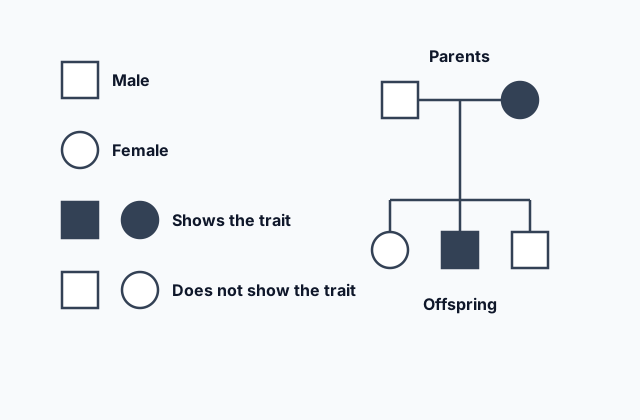 Tap to open the picture full size
Part 1 Think first A trait passed on by mothers
Commit to a guess first. Being wrong now makes the right idea stick better.
Predict first
Doctors follow a rare inherited condition that weakens the muscles. In the families they study, affected mothers pass it to their sons and daughters alike, but the children of affected fathers do not have it. What best explains this pattern?
In short. Patterns of inheritance of many traits do not follow the ratios predicted by Mendel's laws, and can be identified when observed phenotypic ratios statistically differ from the predicted ratios.
- Linked genes, on the same chromosome, tend to segregate together; how often they do can be used to calculate the map distance between them.
- In codominance a heterozygote expresses both alleles' phenotypes, and in incomplete dominance it has a blended phenotype; sex-linked traits can often be predicted from pedigrees.
- Pleiotropic traits come from one gene and do not segregate independently, and traits set by mitochondrial or chloroplast DNA are typically maternally inherited.
Part 2 Learn it When the ratios change
2a. Both seen, or blended
Patterns of inheritance of many traits do not follow the ratios predicted by Mendel's laws. They can be identified by quantitative analysis, when the observed phenotypic ratios statistically differ from the predicted ratios.
Two patterns change what a heterozygote looks like.
- Codominance occurs when the phenotype from both alleles is expressed, so the heterozygote has a different phenotype from either homozygote. A flower with red patches and white patches, from a red parent and a white parent, shows both.
- Incomplete dominance occurs when neither allele can mask the other, so the heterozygote's phenotype is a blended version of the two. A pink flower from a red parent and a white parent is a blend.
In both, the heterozygote has a phenotype of its own. So a cross of two heterozygotes gives three phenotypes in about a 1 to 2 to 1 ratio, the same as the genotypes, rather than Mendel's 3 to 1.
Quick check · Sort it
Each card describes a heterozygote whose two parents were homozygous for different alleles. Tap a card, then the pattern it shows.
Codominance
Incomplete dominance
2b. Genes on the same chromosome
Genes located on the same chromosome are referred to as genetically linked. Mendel's law of independent assortment applies to genes on different chromosomes; linked genes tend to segregate together during meiosis, because they travel on one chromosome.
Crossing over between two linked genes in prophase I can separate them, giving recombinant chromatids. The probability that linked genes segregate together during meiosis can be used to calculate the map distance between them. The percentage of offspring that are recombinant is the map distance in map units: 1 map unit for each 1%.
The farther apart two genes are on a chromosome, the more often a crossover falls between them, so the larger the share of recombinant offspring. This calculation is called gene, or genetic, mapping.
Quick check · Fill the statement
Complete the description of genes that sit on one chromosome.
Genes on the same chromosome tend to be inherited . Crossing over between them can separate them, and the percentage of offspring gives the distance between them in .
2c. Traits on sex chromosomes
Some traits, known as sex-linked traits (X- or Y-linked), are determined by genes on sex chromosomes. In humans and many other animals, females are XX and males are XY.
A male has one X, which he received from his mother, and he passes it to all of his daughters and none of his sons; his sons get his Y. So a male has only one copy of each X-linked gene, and a recessive X-linked allele shows in his phenotype. That is why X-linked recessive traits usually appear more often in males. A Y-linked trait passes from a father to his sons.
The pattern of inheritance of sex-linked traits can often be predicted from data, including pedigrees, indicating the genotypes and phenotypes of both parents and offspring. Read the sex of each affected individual and which parent they could have received the allele from.
Quick check · Multiple choice
A woman is heterozygous for a recessive X-linked allele. She has children with a man who does not carry the allele. What is the probability that a son of theirs shows the trait?
2d. One gene, many traits, and genes outside the nucleus
Pleiotropy is a phenomenon in which the expression of a single gene results in multiple traits or effects. Because the traits come from one gene, they do not segregate independently: an offspring that inherits the allele gets all of its effects together.
Some traits result from non-nuclear inheritance. Chloroplasts and mitochondria have their own DNA, and they are randomly assorted to gametes and daughter cells; thus, traits determined by chloroplast and mitochondrial DNA do not follow simple Mendelian rules.
- In animals, mitochondria are usually transmitted by the egg and not by sperm, so traits determined by mitochondrial DNA are typically maternally inherited.
- In plants, mitochondria and chloroplasts are transmitted in the ovule and not in the pollen, so mitochondria-determined and chloroplast-determined traits are typically maternally inherited.
Quick check · Match
Match each pattern seen in families or crosses to the kind of inheritance it points to.
Part 3 Watch it done Mapping two genes
Predict first, then watch each step, then finish the reasoning yourself.
In a fly species, genes A and B are on the same chromosome. A fly that got a chromosome carrying A and B from one parent and a chromosome carrying a and b from the other is crossed with an aabb fly. Of 1,000 offspring, 412 are AaBb, 408 are aabb, 92 are Aabb and 88 are aaBb. These numbers are a teaching example. How far apart are the two genes?
Predict first
Before you open the first step, predict: if the two genes assorted independently, what would the four classes look like?
Step 1 · Compare with independent assortment
Genes that assort independently would give four kinds of gamete in equal numbers, so about 1,000 ÷ 4 = 250 offspring in each class. 412 and 92 are far from 250, so these genes do not assort independently: they are linked.
Step 2 · Find the parental classes
The two largest classes, AaBb and aabb, received A with B or a with b from the heterozygous parent, the combinations it inherited. They are the parental classes.
Why this step?
Why are the two smallest classes the recombinants?
Aabb and aaBb needed a chromatid with A and b, or a and B, which only a crossover between the two genes in prophase I can make. A crossover falls between them in only some cells, so these classes are the rare ones.
Step 3 · Count the recombinants
92 + 88 = 180 of the 1,000 offspring are recombinant.
Your step · Calculate
Of the 1,000 offspring of the cross, 92 + 88 = 180 are recombinant. What is the map distance between genes A and B, in map units?
map units
The genes are 18 map units apart. Two genes farther apart on the chromosome would give a larger share of recombinants, because a crossover would fall between them more often.
Part 4 Try it Sons like their mothers
A new cross. In another fly species, males are XY and females are XX, and red eyes are dominant to white eyes. A white-eyed female is crossed with a red-eyed male. Of 400 offspring, all 200 daughters have red eyes and all 200 sons have white eyes. These numbers are a teaching example.
Try it · Calculate
Suppose instead the eye color gene were on an autosome and the red-eyed male were heterozygous, while the white-eyed female is homozygous recessive. How many of the 200 sons would you expect to have white eyes?
Try it · Decide and justify
Is the eye color gene in these flies X-linked or autosomal?
Which evidence supports your decision?
Part 5 Explain it Pollen or ovule
On the exam this is handwritten, so answer on paper first. Nothing you type here leaves this page. Then check your answer against the model and each scoring point.
Free response is 50% of the exam score. This one is shaped like Question 1, Interpreting and Evaluating Experimental Results.
Free-response practice · Question 1 style
A researcher studies a plant with pale green leaves, caused by a mutation in chloroplast DNA. She makes two crosses with plants that have normal green leaves. In cross 1, the pale plant supplies the ovules and a green plant supplies the pollen; all 200 offspring have pale leaves. In cross 2, a green plant supplies the ovules and the pale plant supplies the pollen; all 200 offspring have green leaves. These numbers are a teaching example.
(a) Identify the variable the researcher changed between the two crosses.
(b) Describe how the offspring's leaf color relates to the parents in each cross.
(c) Explain why the results do not follow the ratios predicted by Mendel's laws.
(d) An offspring of cross 1 supplies the ovules in a new cross with pollen from a green plant. Predict the leaf color of the offspring, and justify your prediction.
Model answer
(a) Which parent, pale or green, supplied the ovules and which supplied the pollen.
(b) In both crosses, every offspring had the leaf color of the parent that supplied the ovules: pale in cross 1 and green in cross 2.
(c) The trait is set by chloroplast DNA, and chloroplasts are transmitted in the ovule and not in the pollen. So the offspring get their chloroplasts from the ovule parent alone, and the two parents' contributions are not combined the way two alleles of a nuclear gene are.
(d) Pale leaves. The offspring of cross 1 carries the mutant chloroplasts and passes them on in its ovules, while the green plant's pollen passes none.
Score your own answer. This is a self-check, not a grade. Tick each point your answer makes.
Part 6 Check yourself Medium fruit
All three case questions use the table.
In a plant species, fruit length is set by one gene. A breeder crosses a long-fruited plant with a short-fruited plant, and every offspring has medium fruit. She then crosses two of the medium-fruited plants and counts their offspring. These numbers are a teaching example.
| Fruit length | Number of offspring |
|---|---|
| Long | 96 |
| Medium | 206 |
| Short | 98 |
| Total | 400 |
Case question 1 · Calculate
Using the table: what percentage of the offspring have medium fruit? Give your answer to one decimal place.
Case question 2 · Multiple choice
Using the table: which pattern of inheritance best fits these results?
Case question 3 · Multiple choice
Using the table: the breeder crosses a medium-fruited plant with a short-fruited plant. Which offspring are expected?
The rest stand on their own and do not use the case.
Check yourself · Spot the error
A student explains how a man inherits and passes on an X-linked allele. Tap the line with the mistake.
Check yourself · Rank it
A researcher test-crosses flies that are heterozygous for each pair of genes below and records the percentage of recombinant offspring. Rank the pairs by how often their alleles are inherited together.
Most often inherited together first
Give each one a place, 1 for first. Give two the same place if they are equal.
Your ranking: none yet
Part 7 Keep it Bring back earlier ideas
Every departure from Mendel's ratios is measured against the probabilities of the last lesson, and linked genes are separated by the crossing over of the one before. Pulling both back now keeps the baseline in view.
From 5.3 Mendelian Genetics · Fill the statement
Two plants with genotype Aa are crossed, and A is dominant to a. Complete the probabilities for one offspring.
The probability that the offspring is aa is . The probability that it is Aa is . The probability that it shows the dominant phenotype is .
From 5.2 Meiosis and Genetic Diversity · Put it in order
Put the events in order, from a pair of homologous chromosomes to a gamete carrying a recombinant chromatid.
In three lines
- Many traits do not follow Mendel's ratios, which can be identified when observed ratios statistically differ from predicted ones.
- Linked genes tend to segregate together and can be mapped by recombination; codominance, incomplete dominance and sex-linked genes change the expected ratios.
- Pleiotropic traits do not segregate independently, and traits set by mitochondrial or chloroplast DNA are typically maternally inherited.
Exam strategy for this topic
- Section I, Multiple Choice: 60 questions in 90 minutes.
- Section II, Free Response: 6 questions in 90 minutes.
- This lesson's Explain it is shaped like free-response question 1, Interpreting and Evaluating Experimental Results.
- A four-function, scientific, or graphing calculator is allowed on both sections of the exam.
When a ratio does not match Mendel's, compare the observed counts with the expected ones, then name the pattern that explains the difference: linkage, codominance, incomplete dominance, a sex-linked gene, pleiotropy or organelle DNA. For linked genes, the map distance is the percentage of recombinant offspring.
Questions students ask
How do you calculate map distance between linked genes?
The probability that linked genes segregate together can be used to calculate the map distance between them. The percentage of offspring that are recombinant is the distance in map units, 1 map unit for each 1%.
What is the difference between codominance and incomplete dominance?
In codominance the phenotype from both alleles is expressed, so the heterozygote differs from either homozygote. In incomplete dominance neither allele masks the other, so the heterozygote has a blended phenotype.
Why are mitochondrial traits inherited from the mother?
In animals, mitochondria are usually transmitted by the egg and not by sperm, so traits set by mitochondrial DNA are typically maternally inherited. In plants, mitochondria and chloroplasts come in the ovule, not the pollen.
What is pleiotropy?
A phenomenon in which the expression of a single gene results in multiple traits or effects. Because they come from one gene, these traits do not segregate independently.
Course alignment, for teachers
AP Biology topic 5.4, Unit 5: Heredity.
- Skill 5.A: Perform mathematical calculations, including:
This lesson maps all 4 essential knowledge statements of the topic to the part that teaches each one: 4 are checked by a scored question. The map is in the lesson file.