Unit 5 · Topic 5.5 · about 30 minutes · 7 parts · 12 scored checks, 3 of them multiple choice, plus 2 from earlier lessons
AP Biology 5.5: Environmental Effects on Phenotype
Unit 5: 8 to 11% of the multiple-choice section
What you'll be able to do
- Explain how one genotype can produce different phenotypes when it develops under different environmental conditions.
Key vocabulary
| Term | What it means | The exam trap |
|---|---|---|
| Phenotypic plasticity | The ability of individual genotypes to produce different phenotypes. | Say whose phenotype changed, and under what conditions, before calling it plasticity. |
| Gene expression | The use of a gene's information to make its product in a cell. | A gene can be present in every cell and still be expressed in only some of them, or at different levels. |
| Clone | An organism, or a group of cells, that is genetically identical to the one it came from. | Check that the organisms really come from one parent before treating them as clones. |
 Tap to open the picture full size
Part 1 Think first A cutting moved to the cold
Commit to a guess first. Being wrong now makes the right idea stick better.
Predict first
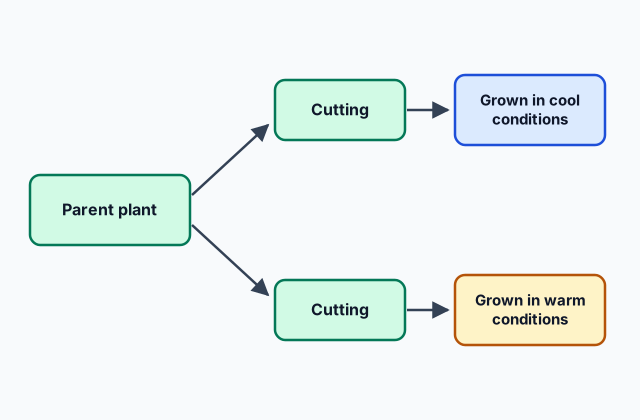
A gardener grows cuttings of one plant, so every cutting has the same genotype. Cuttings grown at 15 °C have red flowers, and cuttings grown at 30 °C have white flowers. She takes a new cutting from a white-flowered plant grown at 30 °C and grows it at 15 °C. What color will its flowers most likely be? (This plant is a teaching example.)
In short. Environmental conditions influence gene expression and can lead to phenotypic plasticity, the ability of individual genotypes to produce different phenotypes.
- The environment an organism develops in, such as its temperature, light or soil, can change which genes are expressed and how much.
- So organisms with the same genotype can develop different phenotypes in different conditions, while their alleles stay the same.
- To show plasticity, keep the genotype the same and change only the environment; how much a phenotype changes can differ from one genotype to another.
Part 2 Learn it Genotype and environment
2a. One genotype, more than one phenotype
A phenotype is not set by the alleles alone. Environmental conditions influence gene expression and can lead to phenotypic plasticity: the ability of individual genotypes to produce different phenotypes.
The genotype is the same in each case; what differs is the conditions the organism develops in. Cuttings of one plant, grown in the shade and in full sun, may grow leaves of different sizes. Genetically identical seedlings, given different amounts of nitrogen, may grow to different heights.
A difference in phenotype can therefore come from a difference in genotype, a difference in environment, or both. Only organisms that share a genotype show plainly what the environment does.
Quick check · Sort it
Each card describes a difference between plants. Tap a card, then what causes the difference.
Different genotypes, same conditions
Same genotype, different conditions
2b. How the environment acts
In phenotypic plasticity, the environment does not change the organism's alleles. It changes gene expression: whether a gene is expressed, and how much of its product the cell makes. A change in temperature, light or the chemicals around a cell can raise the expression of some genes and lower that of others, and the different amounts of their products give a different phenotype.
Because the alleles stay the same, a phenotype produced this way is not written into the genotype. Cuttings or offspring that inherit the same alleles and develop in a different environment produce the phenotype that environment leads to, not the one their parent showed.
Quick check · Put it in order
Put the events in order as a change in the environment leads to a different phenotype, and back again.
2c. Telling genes from environment
Plants of one species growing on a mountain may be shorter than plants of the same species in a valley. That difference alone cannot say why: the two groups may differ in genotype, and they certainly differ in environment.
To test for phenotypic plasticity, keep the genotype the same and change only the environment. Cuttings or clones of one plant, grown in different conditions, do this. If they come to differ, the environment influenced the phenotype.
To test for a difference in genotype, do the opposite: grow different genotypes in the same conditions. If they still differ, their genotypes differ.
Quick check · Multiple choice
Plants on a mountain are shorter than plants of the same species in a nearby valley. Which experiment best tests whether the difference comes from phenotypic plasticity?
2d. Genotypes can respond differently
Phenotypic plasticity is a property of a genotype, and genotypes can differ in how plastic they are. Here are two genotypes of a plant, each grown as cuttings in cold and in warm conditions. These numbers are a teaching example.
- Genotype A: 20 cm tall in the cold, 40 cm tall in the warm
- Genotype B: 30 cm tall in the cold, 32 cm tall in the warm
The same change in temperature changes the height of one genotype far more than the other. So the phenotype depends on the genotype and the environment together, and on how the two interact.
Quick check · Fill the statement
Cuttings of genotype A grow 20 cm tall in the cold and 40 cm tall in the warm. Cuttings of genotype B grow 30 cm tall in the cold and 32 cm tall in the warm. Complete the description.
From cold to warm, genotype A's height changes by cm and genotype B's by cm, so the height of genotype responds more to temperature.
Part 3 Watch it done Leaves at three temperatures
Predict first, then watch each step, then finish the reasoning yourself.
Researchers grow cuttings of one plant at 10, 20 and 30 °C and measure the mean length of their leaves: 8 cm at 10 °C, 12 cm at 20 °C and 15 cm at 30 °C. These numbers are a teaching example. By what percentage does mean leaf length increase from 10 °C to 30 °C, and what does the change show?
Predict first
Before you open the first step, predict: what is the leaf-length difference between the temperatures evidence of?
Step 1 · Check the genotypes
Every cutting came from one plant, so all share one genotype. Any difference between the groups comes from the temperature they grew at.
Step 2 · Read the change
Mean leaf length rises from 8 cm at 10 °C to 15 cm at 30 °C, a change of 15 − 8 = 7 cm.
Why this step?
Why does it matter that the plants are cuttings of one plant?
If the plants were seedlings of different parents, longer leaves at 30 °C might come from different alleles. Cuttings rule that out, so the change shows phenotypic plasticity.
Step 3 · Set up the percent change
A percent change compares the change with the starting value: the 7 cm change divided by the length at 10 °C, times 100.
Your step · Calculate
Mean leaf length of the cuttings is 8 cm at 10 °C and 15 cm at 30 °C. By what percentage does it increase from 10 °C to 30 °C? Give your answer to one decimal place.
%
Leaves were 87.5% longer at 30 °C than at 10 °C, with the genotype held the same. That is phenotypic plasticity: one genotype producing different phenotypes at different temperatures.
Part 4 Try it Dark wings in the cold
A new species. Researchers raise larvae of two genotypes of an insect at 20 °C and at 30 °C and record the percentage of adults with dark wings. These numbers are a teaching example.
- Genotype A: 90% dark at 20 °C, 10% dark at 30 °C
- Genotype B: 5% dark at 20 °C, 5% dark at 30 °C
Try it · Calculate
For genotype A, the percentage of dark-winged adults at 20 °C is how many times the percentage at 30 °C?
Try it · Decide and justify
Does genotype B show phenotypic plasticity for wing color between these two temperatures?
Which evidence supports your decision?
Part 5 Explain it Soil and flower color
On the exam this is handwritten, so answer on paper first. Nothing you type here leaves this page. Then check your answer against the model and each scoring point.
Free response is 50% of the exam score. This one is shaped like Question 3, Scientific Investigation.
Free-response practice · Question 3 style
A shrub species has blue flowers in some gardens and pink flowers in others. A researcher hypothesizes that the flower color depends on the acidity of the soil the shrub grows in, rather than on differences in genotype. This shrub is a teaching example.
(a) Describe how the researcher could make sure that every plant in the experiment has the same genotype.
(b) Identify the independent variable and the dependent variable in an experiment that tests the hypothesis.
(c) Identify one variable, other than genotype, that the researcher should keep the same for every plant, and justify why.
(d) Predict the results that would support the hypothesis.
Model answer
(a) Grow every plant as a cutting from one parent shrub, so all of them share its genotype.
(b) The independent variable is the acidity of the soil, for example several soils of different pH. The dependent variable is the flower color.
(c) The amount of light (or the temperature, or the amount of water), because it could also influence gene expression and so change the flower color, which would make it impossible to tell whether the soil caused any difference.
(d) Cuttings grown in soils of different acidity would produce flowers of different colors, for example one color in more acidic soil and the other in less acidic soil, even though they share one genotype.
Score your own answer. This is a self-check, not a grade. Tick each point your answer makes.
Part 6 Check yourself Three genotypes, two light levels
All three case questions use the table.
A researcher takes cuttings of three plants, genotypes G1, G2 and G3, and grows half the cuttings of each in low light and half in high light. After eight weeks she records the mean height of each group. These numbers are a teaching example.
| Genotype | Low light (cm) | High light (cm) |
|---|---|---|
| G1 | 22 | 40 |
| G2 | 25 | 27 |
| G3 | 18 | 36 |
Case question 1 · Calculate
Using the table: by what percentage did the mean height of G3 increase from low light to high light?
Case question 2 · Multiple choice
Using the table: which genotype shows the least phenotypic plasticity for height between these two light levels?
Case question 3 · Multiple choice
Using the table: which conclusion do the data best support?
The rest stand on their own and do not use the case.
Check yourself · Spot the error
A student explains why cuttings of one plant grown in different soils look different. Tap the line with the mistake.
Check yourself · Match
Match each observation to the conclusion it supports.
Part 7 Keep it Bring back earlier ideas
Plasticity starts where the last lessons left off: a genotype, then the phenotype it produces. Pulling back how phenotypes follow from genotypes, and how genotypes differ from phenotypes, sets plasticity against them.
From 5.4 Non-Mendelian Genetics · Sort it
Each card describes a heterozygote whose two parents were homozygous for different alleles. Tap a card, then the pattern it shows.
Codominance
Incomplete dominance
From 5.3 Mendelian Genetics · Sort it
In a pea plant, the allele for purple flowers is dominant to the allele for white. Each card describes something about one plant. Tap a card, then whether you could tell it just by looking at the plant.
Can be seen by looking
Needs a cross or other data
In three lines
- Environmental conditions influence gene expression and can lead to phenotypic plasticity, one genotype producing different phenotypes.
- In plasticity the environment changes which genes are expressed and how much, not the alleles, so the phenotype is not passed on through the alleles.
- To show plasticity, keep the genotype the same and change only the environment; genotypes can differ in how plastic they are.
Exam strategy for this topic
- Section I, Multiple Choice: 60 questions in 90 minutes.
- Section II, Free Response: 6 questions in 90 minutes.
- This lesson's Explain it is shaped like free-response question 3, Scientific Investigation.
- A four-function, scientific, or graphing calculator is allowed on both sections of the exam.
To explain a difference in phenotype, say first whether the organisms share a genotype. If they do and their conditions differ, name the condition and say it influenced gene expression, which is phenotypic plasticity; do not say the environment changed the alleles.
Questions students ask
What is phenotypic plasticity?
The ability of individual genotypes to produce different phenotypes. Environmental conditions influence gene expression and can lead to phenotypic plasticity.
In phenotypic plasticity, does the environment change an organism's genes?
Not in phenotypic plasticity. There the environment influences gene expression, whether genes are expressed and how much, while the alleles stay the same, which is why organisms with one genotype can still differ.
How do you test whether a difference is caused by the environment?
Keep the genotype the same and change only the environment, for example by growing cuttings or clones of one plant in different conditions. If they come to differ, the environment influenced the phenotype.
Is a phenotype produced by the environment passed on to offspring?
Not through the alleles, which the environment does not change. Offspring with the same alleles that develop in a different environment produce the phenotype that environment leads to.
Course alignment, for teachers
AP Biology topic 5.5, Unit 5: Heredity.
- Skill 1.C: Explain biological concepts and processes in applied contexts.
This lesson maps the one essential knowledge statement of the topic to the part that teaches each one: 1 is checked by a scored question. The map is in the lesson file.