Unit 6 · Topic 6.1 · about 30 minutes · 7 parts · 12 scored checks, 2 of them multiple choice, plus 2 from earlier lessons
AP Biology 6.1: DNA and RNA Structure
Unit 6: 12 to 16% of the multiple-choice section
What you'll be able to do
- Describe the molecules and structures that store hereditary information and pass it from one generation to the next.
- Describe the features of DNA's bases and how they pair that let DNA serve as hereditary material.
Key vocabulary
| Term | What it means | The exam trap |
|---|---|---|
| Chromosome | A long DNA molecule, with the proteins bound to it, that carries many genes. | Say which kind of cell you mean before describing a chromosome's shape or number. |
| Histone | A protein that DNA winds around as it is packed into a chromosome. | Keep the DNA and the proteins it winds around apart: the proteins pack the information but do not carry it. |
| Nitrogenous base | The part of a nucleotide that varies from one nucleotide to the next and carries the sequence. | Keep the base apart from the whole nucleotide, which also has a sugar and a phosphate group. |
| Complementary strands | Two strands whose bases pair with each other all along their length. | Check that a molecule really has two paired strands before using the pairing rules to count its bases. |
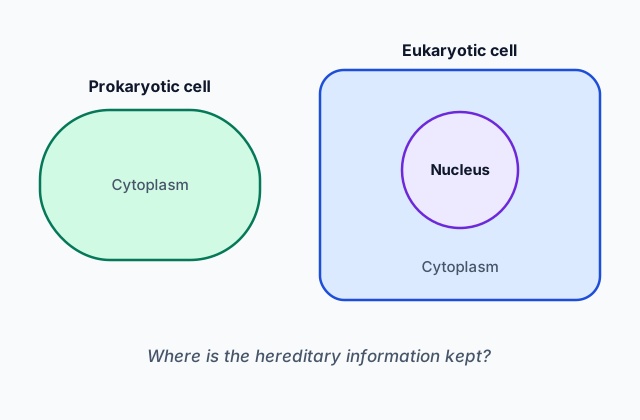 Tap to open the picture full size
Part 1 Think first A helix of even width
Commit to a guess first. Being wrong now makes the right idea stick better.
Predict first
X-ray pictures of DNA from many species show a double helix that is the same width along its whole length, whatever its sequence. DNA's four bases come in two sizes: two of them have two rings, and two have one ring. Which way of pairing bases across the helix keeps the width the same everywhere?
In short. Genetic information is stored in and passed to later generations through DNA molecules and, in some cases, RNA molecules, whose bases pair in fixed ways.
- Prokaryotes typically have a circular chromosome; eukaryotes typically have several linear chromosomes, condensed using histones and associated proteins.
- Both prokaryotes and eukaryotes can also carry plasmids, small circular DNA molecules outside the chromosomes.
- Purines (adenine, guanine) have two rings and pair with pyrimidines (cytosine, thymine, uracil), which have one: A with T, or with U in RNA, and G with C.
Part 2 Learn it How hereditary information is stored
2a. DNA, chromosomes and two kinds of cell
Genetic information is stored in and passed to later generations through DNA molecules and, in some cases, RNA molecules; some viruses, for example, carry their genetic information as RNA.
In a cell, the DNA is organized into chromosomes, and the two kinds of cell organize them differently.
- Prokaryotic organisms typically have circular chromosomes.
- Eukaryotic organisms typically have multiple linear chromosomes made of DNA. These chromosomes are condensed using histones and associated proteins, which the DNA winds around so that a long molecule packs into a small space.
Quick check · Sort it
Each card describes the chromosomes of a cell. Tap a card, then the kind of cell it typically describes.
Prokaryotic cell
Eukaryotic cell
2b. Plasmids: DNA outside the chromosomes
Not all of a cell's DNA is in its chromosomes. Prokaryotes and eukaryotes can contain plasmids: extra-chromosomal circular molecules of DNA.
A plasmid is separate from the chromosomes and usually much smaller. Many bacteria carry plasmids, and so do some eukaryotes, such as baker's yeast. Finding a small circle of DNA in a cell therefore does not, on its own, tell you whether the cell is prokaryotic or eukaryotic: look at the chromosomes for that.
Quick check · Decide and justify
A yeast cell has a nucleus with linear chromosomes. A researcher also finds a small circular DNA molecule in it, separate from those chromosomes. Can this molecule be a plasmid?
Which statement supports your decision?
2c. Two sizes of base
Each nucleotide in DNA or RNA carries one nitrogenous base, and the bases come in two shapes.
- Purines, guanine (G) and adenine (A), have a double ring structure.
- Pyrimidines, cytosine (C), thymine (T) and uracil (U), have a single ring structure.
Thymine is found in DNA and uracil in RNA; the other three bases are in both. A memory aid: the two purines are the bases whose names come first in the alphabet, A and G.
Quick check · Fill the statement
Complete the description of the bases in nucleic acids.
Adenine and guanine are , which have a ring structure. Cytosine, thymine and uracil are , which have a ring structure.
2d. Base pairing, the same in every organism
Nucleic acids show specific base pairing, and the pairing rules are conserved through evolution: the same in bacteria, plants and people.
Purines pair with pyrimidines:
- Adenine with thymine in DNA, or adenine with uracil where RNA is involved.
- Guanine with cytosine.
So each base pair in a double-stranded DNA molecule holds one purine and one pyrimidine, which keeps the helix the same width. It also makes the two strands complementary: knowing one strand's sequence gives the other's, which is what lets DNA be copied and passed on.
Quick check · Match
Match each base, in the molecule named, to the base it pairs with.
Part 3 Watch it done Counting purines in a double helix
Predict first, then watch each step, then finish the reasoning yourself.
A segment of double-stranded DNA is 20 base pairs long. One of its strands has 6 A, 4 T, 7 G and 3 C. These numbers are a teaching example. How many purines does the whole segment, both strands, contain?
Predict first
Before you open the first step, predict: do you need the strand's base counts to answer?
Step 1 · Build the other strand
Each base pairs with its partner, so the other strand has a T for each A, an A for each T, a C for each G and a G for each C: 6 T, 4 A, 7 C and 3 G.
Step 2 · Count purines on each strand
Purines are A and G. The first strand has 6 + 7 = 13. The second has 4 + 3 = 7.
Why this step?
Why do the two strands' purine counts add up to the number of base pairs?
Every pair is one purine and one pyrimidine. Wherever the first strand has a pyrimidine, the second has a purine, so each of the 20 pairs adds exactly one purine.
Step 3 · Add the strands
Add the purines on the first strand to those on the second.
Your step · Calculate
A 20-base-pair segment of double-stranded DNA has one strand with 6 A, 4 T, 7 G and 3 C. How many purines does the whole segment, both strands, contain?
20 purines in 20 base pairs: in any double-stranded DNA, purines make up exactly half the bases, because each pair is a purine with a pyrimidine.
Part 4 Try it A virus made of RNA
A new molecule. A virus carries its genetic information as RNA. Researchers break down its genome and find these percentages of each base: 30% adenine, 20% uracil, 28% guanine and 22% cytosine. These numbers are a teaching example.
Try it · Calculate
A virus's RNA genome is 30% adenine, 20% uracil, 28% guanine and 22% cytosine. What percentage of its bases are purines?
Try it · Decide and justify
A virus's RNA genome is 30% adenine, 20% uracil, 28% guanine and 22% cytosine. Could all of its bases be paired in a double-stranded molecule?
Which evidence supports your decision?
Part 5 Explain it Chromosomes in two cells
On the exam this is handwritten, so answer on paper first. Nothing you type here leaves this page. Then check your answer against the model and each scoring point.
Free response is 50% of the exam score. This one is shaped like Question 4, Conceptual Analysis.
Free-response practice · Question 4 style
A student compares a bacterial cell with a plant cell.
(a) Describe one difference between the chromosomes typically found in a prokaryotic cell and those typically found in a eukaryotic cell.
(b) The student finds a small circular DNA molecule, separate from the chromosomes, in a fungal cell and concludes that the fungus must be a prokaryote. Explain why the evidence does not support that conclusion.
(c) Explain why, in a double-stranded DNA molecule, the number of purines equals the number of pyrimidines.
(d) One strand of a DNA molecule reads 5'-ATTGC-3'. Identify the bases of the complementary strand that pair with it, in order.
Model answer
(a) Prokaryotes typically have a circular chromosome, while eukaryotes typically have multiple linear chromosomes, condensed using histones and associated proteins.
(b) The molecule could be a plasmid, an extra-chromosomal circular DNA molecule, and eukaryotes as well as prokaryotes can contain plasmids. To tell the kind of cell, the student should look at its chromosomes, for example whether they are linear and in a nucleus.
(c) Purines pair with pyrimidines: adenine with thymine and guanine with cytosine. Every base pair therefore holds one purine and one pyrimidine, so the two counts are equal.
(d) T, A, A, C, G, pairing with A, T, T, G, C in turn (the complementary strand reads 3'-TAACG-5').
Score your own answer. This is a self-check, not a grade. Tick each point your answer makes.
Part 6 Check yourself Four nucleic acid samples
All three case questions use the table.
A researcher measures the percentage of each base in four samples of nucleic acid. These numbers are a teaching example.
| Sample | A | G | C | T | U |
|---|---|---|---|---|---|
| 1 | 31 | 19 | 19 | 31 | 0 |
| 2 | 24 | 30 | 18 | 0 | 28 |
| 3 | 20 | 30 | 30 | 20 | 0 |
| 4 | 35 | 20 | 15 | 30 | 0 |
Case question 1 · Calculate
Using the table: what percentage of the bases in sample 2 are pyrimidines?
Case question 2 · Multiple choice
Using the table: which samples could be double-stranded DNA?
Case question 3 · Multiple choice
Using the table: in sample 1, adenine and thymine are both 31%. Which best explains this?
The rest stand on their own and do not use the case.
Check yourself · Spot the error
A student describes how cells store their genetic information. Tap the line with the mistake.
Check yourself · Match
Match each source of genetic information to the description that fits it best.
Part 7 Keep it Bring back earlier ideas
This unit opens up the genes that the last unit followed from parent to offspring. Pulling back how the environment changes gene expression, and how DNA strands pair, sets up how hereditary information is stored.
From 5.5 Environmental Effects on Phenotype · Spot the error
A student explains why cuttings of one plant grown in different soils look different. Tap the line with the mistake.
From 1.6 Nucleic Acids · Fill the statement
A model shows one DNA strand as 5'-AACG-3'. Complete the description of the strand paired with it.
Read alongside it, the paired strand is 3'--5'. It runs in the direction, so the two strands are antiparallel.
In three lines
- Genetic information is stored and passed on in DNA and, in some cases, RNA; prokaryotes typically have circular chromosomes and eukaryotes several linear ones.
- Eukaryotic chromosomes are condensed with histones, and both kinds of cell can carry plasmids, circular DNA outside the chromosomes.
- Purines (A, G) pair with pyrimidines (T or U, C), so a double helix has as many purines as pyrimidines.
Exam strategy for this topic
- Section I, Multiple Choice: 60 questions in 90 minutes.
- Section II, Free Response: 6 questions in 90 minutes.
- This lesson's Explain it is shaped like free-response question 4, Conceptual Analysis.
- A four-function, scientific, or graphing calculator is allowed on both sections of the exam.
When a question gives base percentages, decide first whether the molecule is double-stranded DNA: only then does A equal T, G equal C, and purines make up half the bases. Uracil in the list means RNA.
Questions students ask
What molecules carry genetic information?
Genetic information is stored in and passed to later generations through DNA molecules and, in some cases, RNA molecules, as in some viruses.
How do prokaryotic and eukaryotic chromosomes differ?
Prokaryotes typically have circular chromosomes. Eukaryotes typically have multiple linear chromosomes made of DNA, condensed using histones and associated proteins.
What is a plasmid?
An extra-chromosomal circular molecule of DNA. Both prokaryotes and eukaryotes can contain plasmids.
What is the difference between purines and pyrimidines?
Purines, guanine and adenine, have a double ring structure. Pyrimidines, cytosine, thymine and uracil, have a single ring structure. Purines pair with pyrimidines: A with T (or U in RNA) and G with C.
Why is a DNA double helix the same width all along?
Every base pair joins a two-ring purine with a one-ring pyrimidine, so every pair spans the same distance.
Course alignment, for teachers
AP Biology topic 6.1, Unit 6: Gene Expression and Regulation.
- Skill 1.C: Explain biological concepts and processes in applied contexts.
This lesson maps all 3 essential knowledge statements of the topic to the part that teaches each one: 3 are checked by a scored question. The map is in the lesson file.