Unit 6 · Topic 6.2 · about 30 minutes · 7 parts · 11 scored checks, 3 of them multiple choice, plus 2 from earlier lessons
AP Biology 6.2: DNA Replication
Unit 6: 12 to 16% of the multiple-choice section
What you'll be able to do
- Describe how a cell copies its DNA so that the hereditary information passes to the next generation of cells.
Key vocabulary
| Term | What it means | The exam trap |
|---|---|---|
| Template strand | A strand of nucleic acid whose bases set the order of bases in a new strand built against it. | Name the template and the new strand separately before saying which way each runs. |
| Replication fork | The Y-shaped region where a DNA double helix is opened and its strands are being copied. | Say where an event happens, at the fork or ahead of it, before deciding which enzyme is responsible. |
| Supercoiling | Extra twisting of a DNA double helix on itself. | Picture where along the DNA the twisting builds up before naming the enzyme that eases it. |
| Primer | A short strand, paired with the template, that a new chain is built onto. | Keep the primer apart from the template strand it pairs with. |
 Tap to open the picture full size
Part 1 Think first Heavy DNA, copied once
Commit to a guess first. Being wrong now makes the right idea stick better.
Predict first
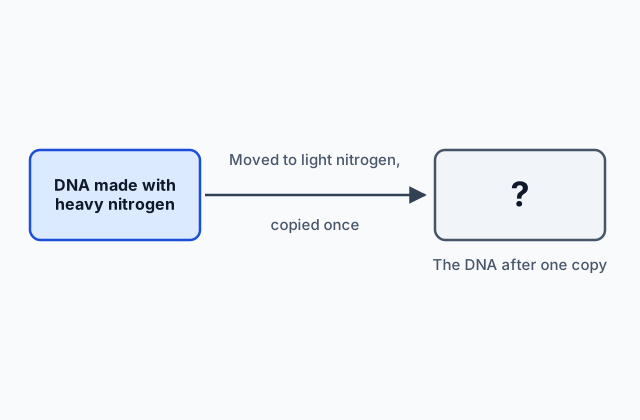
Bacteria are grown for many generations on food containing heavy nitrogen, so both strands of their DNA are heavy. They are moved to food containing only light nitrogen and copy their DNA once. What will the copied DNA molecules most likely be like?
In short. DNA replication ensures continuity of hereditary information: each strand of the double helix serves as the template for a new complementary strand.
- Replication is semiconservative, so each new DNA molecule has one original strand and one new strand.
- Helicase unwinds the strands, topoisomerase relaxes supercoiling ahead of the fork, and DNA polymerase, which needs an RNA primer to start, builds new DNA in the 5' to 3' direction.
- The leading strand is made continuously and the lagging strand discontinuously, in fragments that ligase joins.
Part 2 Learn it How DNA is copied
2a. Each strand is a template
DNA replication ensures continuity of hereditary information: before a cell divides, its DNA is copied so that each new cell gets the same information.
Replication is semiconservative: one strand of DNA serves as the template for a new strand of complementary DNA. The two strands of the helix separate, and against each one a new strand is built, base by base, by the pairing rules (A with T, G with C).
So each of the two DNA molecules that result has one original strand and one new strand. Neither molecule is entirely old, and neither is entirely new.
Quick check · Multiple choice
Both strands of a DNA molecule carry a radioactive label. The molecule is copied once, using only unlabeled nucleotides. Which describes the two molecules that result?
2b. The enzymes at the fork
Copying happens at a replication fork, where the double helix is opened. Four enzymes do the work.
- Helicase unwinds the DNA strands, separating them at the fork.
- Topoisomerase relaxes supercoiling in front of the replication fork. Unwinding a twisted helix in one place makes the DNA ahead of it twist more tightly, and without relief the fork would stall.
- DNA polymerase builds the new strands, adding nucleotides that pair with the template. It requires RNA primers to initiate DNA synthesis: it can only add to a strand already paired with the template, so each new strand must begin from a short RNA primer.
- Ligase joins pieces of new DNA together, as the next chunk shows.
Quick check · Match
Match each enzyme to its job during DNA replication.
2c. One direction, two kinds of strand
DNA is synthesized in the 5' to 3' direction: DNA polymerase adds each new nucleotide to the 3' end of the growing strand. The two template strands run in opposite directions, and that has a consequence.
- On one template, the new strand grows 5' to 3' toward the moving fork. DNA polymerase can keep adding as the fork opens, so this leading strand is made continuously.
- On the other template, growing 5' to 3' means growing away from the fork. Each time the fork opens a new stretch, a new RNA primer is laid down and a short piece is built back toward the last one. This lagging strand is made discontinuously, in fragments, each started from its own primer.
Ligase joins the fragments on the lagging strand into one continuous strand.
Quick check · Fill the statement
Complete the description of how the two new strands are made at a replication fork.
New DNA is synthesized in the direction. On the leading strand it is made ; on the lagging strand it is made , in fragments that joins.
Part 3 Watch it done Three rounds of copying
Predict first, then watch each step, then finish the reasoning yourself.
One DNA molecule with two heavy strands is copied three times in a row, using only light nucleotides, giving 8 molecules. What percentage of the 8 molecules contain a heavy strand?
Predict first
Before you open the first step, predict: as the rounds go on, how does the number of molecules with a heavy strand change?
Step 1 · Round 1
The two heavy strands separate, and each is the template for a light strand. Result: 2 molecules, each one heavy and one light.
Step 2 · Round 2
Four strands separate: 2 heavy and 2 light. Each gets a new light partner. Result: 4 molecules, 2 of them heavy and light, 2 of them light and light.
Why this step?
Why does the number of molecules with a heavy strand stop growing?
There are only ever two heavy strands, the original ones. Each stays whole and ends up in one molecule, and every new strand is light.
Step 3 · Round 3
8 molecules. The 2 heavy strands are still in 2 of them; the other 6 are light and light.
Your step · Calculate
A DNA molecule with two heavy strands is copied three times in a row using only light nucleotides, giving 8 molecules. What percentage of the 8 molecules contain a heavy strand?
%
2 of 8, or 25%. However many rounds follow, the two original strands survive whole, one in each of two molecules. That is what semiconservative means.
Part 4 Try it Fragments on a lagging strand
Two new questions. First, as a replication fork opens, a lagging strand 6,000 nucleotides long is made in fragments of 1,500 nucleotides each, and ligase joins them. Second, at another fork, the new strand on one template grows in the 5' to 3' direction toward the fork, the same way the fork is moving. These numbers are a teaching example.
Try it · Calculate
A lagging strand 6,000 nucleotides long is made in fragments of 1,500 nucleotides each. How many RNA primers did DNA polymerase need to make it?
Try it · Decide and justify
At a replication fork, the new strand on one template grows in the 5' to 3' direction toward the fork, the same way the fork is moving. Is that new strand made continuously or in fragments?
Which statement supports your decision?
Part 5 Explain it A model of the fork
On the exam this is handwritten, so answer on paper first. Nothing you type here leaves this page. Then check your answer against the model and each scoring point.
Free response is 50% of the exam score. This one is shaped like Question 5, Analyze Model or Visual Representation of a Biological Concept or Process.
Free-response practice · Question 5 style
A textbook model of a replication fork shows a double helix opening into two single strands. Along one template a new strand is drawn as one long piece; along the other, the new strand is drawn as several short pieces, each beginning with a short stretch of RNA.
(a) Identify the enzyme that separates the two strands at the fork.
(b) Explain why the new strand on one template is drawn as several short pieces.
(c) Explain why each short piece begins with a short stretch of RNA.
(d) A cell's ligase stops working. Predict how the new DNA on the lagging strand would differ from normal.
Model answer
(a) Helicase.
(b) DNA is synthesized only in the 5' to 3' direction, and the two templates run in opposite directions. On one template, growing 5' to 3' means growing away from the fork, so the strand is made discontinuously, a new piece begun each time the fork opens more template.
(c) DNA polymerase requires an RNA primer to initiate DNA synthesis, so each piece starts from a primer.
(d) The fragments would not be joined, so the lagging strand would stay as many separate short pieces instead of one continuous strand.
Score your own answer. This is a self-check, not a grade. Tick each point your answer makes.
Part 6 Check yourself Two drugs and a fork
All three case questions use the table.
Researchers treat dividing bacterial cells with one of two drugs, each of which blocks one replication enzyme, and compare them with untreated cells. They measure how much DNA is unwound at the replication forks, how tightly twisted the DNA is just ahead of the forks, and what share of new lagging-strand DNA is still in separate fragments. These numbers are a teaching example.
| Treatment | DNA unwound at forks (relative) | Twisting ahead of forks (relative) | New lagging-strand DNA still in fragments (%) |
|---|---|---|---|
| None | 100 | 1 | 4 |
| Drug X | 100 | 1 | 60 |
| Drug Y | 15 | 5 | 4 |
Case question 1 · Calculate
Using the table: the share of new lagging-strand DNA still in fragments with drug X is how many times the share with no drug?
Case question 2 · Multiple choice
Using the table: which enzyme does drug X most likely block?
Case question 3 · Multiple choice
Using the table: with drug Y, the DNA ahead of the forks is five times as twisted, and much less DNA is unwound. Which enzyme does drug Y most likely block?
The rest stand on their own and do not use the case.
Check yourself · Put it in order
Put the events in order as one fragment of the lagging strand is made and joined into the new strand.
Check yourself · Spot the error
A student explains why the two new strands at a replication fork are made differently. Tap the line with the mistake.
Part 7 Keep it Bring back earlier ideas
Copying DNA depends on base pairing, and it happens before a cell divides. Pulling back the pairing rules and the direction a strand grows sets up how each new strand is built.
From 6.1 DNA and RNA Structure · Match
Match each base, in the molecule named, to the base it pairs with.
From 1.6 Nucleic Acids · Multiple choice
A strand of DNA is being built, and its sequence so far is 5'-AGTC-3'. Where is the next nucleotide added?
In three lines
- DNA replication ensures continuity of hereditary information; it is semiconservative, each strand the template for a new complementary strand.
- Helicase unwinds the strands, topoisomerase relaxes supercoiling ahead of the fork, and DNA polymerase needs RNA primers to start.
- DNA is made 5' to 3', continuously on the leading strand and in fragments on the lagging strand, which ligase joins.
Exam strategy for this topic
- Section I, Multiple Choice: 60 questions in 90 minutes.
- Section II, Free Response: 6 questions in 90 minutes.
- This lesson's Explain it is shaped like free-response question 5, Analyze Model or Visual Representation of a Biological Concept or Process.
- A four-function, scientific, or graphing calculator is allowed on both sections of the exam.
When a question names one replication enzyme as missing, say what it does and where (helicase at the fork, topoisomerase ahead of it, DNA polymerase building from a primer, ligase joining fragments), then predict what is left undone.
Questions students ask
What does semiconservative replication mean?
One strand of DNA serves as the template for a new strand of complementary DNA, so each new DNA molecule has one original strand and one new strand.
What do helicase and topoisomerase do?
Helicase unwinds the DNA strands at the replication fork. Topoisomerase relaxes supercoiling in front of the replication fork.
Why does DNA polymerase need a primer?
DNA polymerase requires RNA primers to initiate DNA synthesis: it can add nucleotides to a strand already started, but cannot begin one on its own.
What is the difference between the leading and lagging strands?
DNA is synthesized 5' to 3'. DNA polymerase makes the leading strand continuously and the lagging strand discontinuously, and ligase joins the fragments on the lagging strand.
Beyond the AP Exam
College Board sets this limit on what the AP Exam asks about this topic. Anything past it is not on the exam.
The names of the steps and particular enzymes involved, excluding DNA polymerase, ligase, RNA polymerase, helicase, and topoisomerase, are beyond the scope of the AP Exam.
Course alignment, for teachers
AP Biology topic 6.2, Unit 6: Gene Expression and Regulation.
- Skill 2.B: Explain relationships between characteristics of biological models in both theoretical and applied contexts.
This lesson maps the one essential knowledge statement of the topic to the part that teaches each one: 1 is checked by a scored question. The map is in the lesson file.