Unit 6 · Topic 6.3 · about 30 minutes · 7 parts · 12 scored checks, 3 of them multiple choice, plus 2 from earlier lessons
AP Biology 6.3: Transcription and RNA Processing
Unit 6: 12 to 16% of the multiple-choice section
What you'll be able to do
- Describe how the information in a gene passes from DNA to RNA, and how RNA carries it on toward a protein.
Key vocabulary
| Term | What it means | The exam trap |
|---|---|---|
| Transcription | Making an RNA molecule whose sequence follows the sequence of a gene's DNA. | Say which strand of the gene serves as the template before writing the RNA's sequence. |
| Codon | A sequence of three bases in an mRNA. | Read codons on the mRNA, not on the DNA or the tRNA. |
| Ribosome | The structure in the cytoplasm where proteins are made. | Keep the ribosome's own RNA apart from the RNA it reads. |
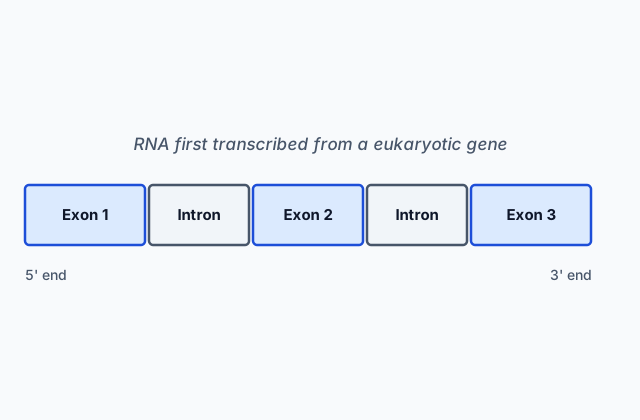
| Pre-mRNA | The RNA first transcribed from a eukaryotic gene, before it is modified into mature mRNA. | Ask whether a length or sequence describes the first transcript or the finished mRNA before comparing. |
 Tap to open the picture full size
Part 1 Think first Two versions of one message
Commit to a guess first. Being wrong now makes the right idea stick better.
Predict first
Researchers inject frog eggs with two versions of the same mRNA. Version 1 ends in a long run of adenine nucleotides; in version 2 that run has been cut off. Everything else about the two is the same. A day later, which version will most likely still be present in larger amounts?
In short. In transcription, RNA polymerase uses a single template strand of DNA to build an RNA molecule, and the sequence and structure of each RNA determine its function.
- mRNA carries information from DNA to the ribosome, tRNA brings specific amino acids and pairs with codons by its anticodon, and rRNA builds ribosomes.
- RNA polymerase builds mRNA in the 5' to 3' direction, reading the template strand 3' to 5'.
- In eukaryotes the transcript is modified: a poly-A tail makes it more stable, a GTP cap helps ribosomes recognize it, and introns are cut out, while which exons are kept can vary (alternative splicing).
Part 2 Learn it From DNA to RNA
2a. Three kinds of RNA
The sequence of an RNA's bases, together with the structure of the molecule, determines what the RNA does. Three kinds take part in making a protein.
- Messenger RNA (mRNA) carries information from DNA in the nucleus to the ribosome in the cytoplasm.
- Transfer RNA (tRNA): distinct tRNA molecules bind specific amino acids, and each has an anticodon, three bases that pair with a codon, three bases of the mRNA. tRNA is recruited to the ribosome during translation to build the primary peptide sequence the mRNA specifies.
- Ribosomal RNA (rRNA) molecules are functional building blocks of ribosomes.
Quick check · Match
Match each molecule or part to what it does in making a protein.
2b. Transcription
RNA polymerases use a single template strand of DNA to direct which bases go into a newly formed RNA molecule. This process is called transcription.
The enzyme RNA polymerase synthesizes mRNA in the 5' to 3' direction, reading the template DNA strand in the 3' to 5' direction. Each RNA base pairs with the template's base: A on the template gives U in the RNA, T gives A, C gives G and G gives C.
So a template reading 3'-TACG-5' is transcribed into mRNA reading 5'-AUGC-3'. Only one of the gene's two DNA strands is the template.
Quick check · Fill the statement
Complete the description of transcription.
RNA polymerase reads one template strand of DNA in the direction and builds mRNA in the direction. A template reading 3'-ACTG-5' is transcribed into mRNA reading 5'--3'.
2c. Finishing a eukaryotic mRNA
In eukaryotic cells the mRNA transcript undergoes a series of enzyme-mediated modifications before it leaves the nucleus.
- A poly-A tail, a long run of adenine nucleotides, is added to the 3' end. It makes the mRNA more stable, so it lasts longer in the cell.
- A GTP cap is added to the 5' end. It helps with ribosomal recognition: the cap helps ribosomes recognize the mRNA.
- Introns, stretches of the transcript that do not end up in the mature mRNA, are cut out (excised), and the exons that remain are spliced together.
Quick check · Sort it
Each card describes what a change to a eukaryotic transcript does. Tap a card, then the change it describes.
Adding a poly-A tail
Adding a GTP cap
Removing introns
2d. One gene, several mRNAs
Which exons are kept is not always the same. The excision of introns, along with the splicing and retention of exons, generates different versions of the resulting mature mRNA molecule. This is alternative splicing.
Suppose a transcript has exons 1, 2, 3 and 4. One cell may keep all four; another may skip exon 2 and keep 1, 3 and 4. The exons that are kept stay in their order, and the introns are removed. Different mature mRNAs can be translated into different proteins, so one gene can give more than one protein, in different cells or at different times.
Quick check · Multiple choice
A eukaryotic transcript has exons 1, 2, 3 and 4, in that order, with an intron between each pair of exons. Which mature mRNA could alternative splicing produce?
Part 3 Watch it done How long is the mature mRNA?
Predict first, then watch each step, then finish the reasoning yourself.
A eukaryotic gene is transcribed into an RNA 2,500 nucleotides long. It has three exons, of 400, 500 and 300 nucleotides, and two introns, of 700 and 600 nucleotides. All three exons are kept. These numbers are a teaching example. How long is the mature mRNA, not counting the cap and the tail?
Predict first
Before you open the first step, predict: will the mature mRNA be longer or shorter than half of the first transcript?
Step 1 · Check the parts add up
Exons: 400 + 500 + 300 = 1,200. Introns: 700 + 600 = 1,300. Together, 2,500, the length of the first transcript.
Step 2 · Decide what is removed
Introns are excised and exons are retained, so both introns go.
Why this step?
Why are the introns the part that is removed?
The mature mRNA is built by excising the introns and splicing the retained exons together. Only exons reach the mature mRNA.
Step 3 · Add what stays
Add the lengths of the three exons that are kept.
Your step · Calculate
A eukaryotic RNA transcript 2,500 nucleotides long has exons of 400, 500 and 300 nucleotides and introns of 700 and 600 nucleotides. All three exons are kept. How many nucleotides long is the mature mRNA, not counting the cap and the tail?
nucleotides
1,200 nucleotides, less than half of the 2,500 transcribed. Much of what a eukaryotic gene transcribes can be intron, removed before the mRNA leaves the nucleus.
Part 4 Try it Counting splice versions
A new gene. Its transcript has exons 1, 2, 3 and 4. In every mature mRNA, exons 1 and 4 are kept. Exons 2 and 3 can each be kept or skipped, independently of each other. This gene is a teaching example.
Try it · Calculate
A transcript has exons 1, 2, 3 and 4. Exons 1 and 4 are always kept, and exons 2 and 3 can each be kept or skipped, independently. How many different mature mRNAs can alternative splicing produce?
Try it · Decide and justify
Muscle cells and nerve cells of one person both express this gene, but their proteins from it differ. The muscle mRNA has exons 1, 2 and 4; the nerve mRNA has exons 1, 3 and 4. Do the data show that the two kinds of cell have different versions of the gene in their DNA?
Which statement supports your decision?
Part 5 Explain it Cap, tail and protein
On the exam this is handwritten, so answer on paper first. Nothing you type here leaves this page. Then check your answer against the model and each scoring point.
Free response is 50% of the exam score. This one is shaped like Question 6, Analyze Data.
Free-response practice · Question 6 style
Researchers inject cells with one of three versions of an mRNA and measure how much of the mRNA remains after 6 hours and how much protein the cells make from it. These numbers are a teaching example.
- Cap and tail: 80% of the mRNA remains; 100 units of protein
- Cap, no tail: 20% remains; 30 units of protein
- Tail, no cap: 78% remains; 10 units of protein
(a) Describe the effect of removing the tail on the amount of mRNA that remains.
(b) Calculate the percent decrease in protein made when the cap is removed, compared with the mRNA that has both.
(c) Explain why the mRNA without a cap is still present but gives little protein.
(d) Explain why removing the tail also lowers the amount of protein made.
Model answer
(a) Without the tail, only 20% of the mRNA remains after 6 hours, against 80% with it, so the mRNA is broken down much faster.
(b) The protein falls from 100 to 10 units, a decrease of 90 units: 90 divided by 100 is a 90% decrease.
(c) The cap helps ribosomes recognize the mRNA. Without it, the mRNA is about as stable (78% remains) but ribosomes recognize it poorly, so little of it is translated.
(d) The tail makes mRNA more stable. Without it the mRNA is broken down sooner, so less of it is available to ribosomes, and less protein is made.
Score your own answer. This is a self-check, not a grade. Tick each point your answer makes.
Part 6 Check yourself One gene in three tissues
All three case questions use the table.
A gene's transcript has four exons: exon 1 of 400 nucleotides, exon 2 of 300, exon 3 of 200 and exon 4 of 600. Researchers measure the length of the gene's mature mRNA in three tissues of one animal, not counting the cap and the tail. These numbers are a teaching example.
| Tissue | Mature mRNA length (nucleotides) |
|---|---|
| Liver | 1,500 |
| Muscle | 1,300 |
| Brain | 1,200 |
Case question 1 · Calculate
Using the table: the brain mRNA's length is what percentage of the liver mRNA's length?
Case question 2 · Multiple choice
Using the table: which exon is most likely left out of the muscle mRNA?
Case question 3 · Multiple choice
Using the table: which best explains why the three tissues have mature mRNAs of different lengths?
The rest stand on their own and do not use the case.
Check yourself · Put it in order
Put the events in order as a eukaryotic gene's information travels toward a protein.
Check yourself · Spot the error
A student describes transcription. Tap the line with the mistake.
Part 7 Keep it Bring back earlier ideas
Transcription builds a new strand against a template, as replication does, but makes RNA. Pulling back how new DNA strands are built, and how RNA differs from DNA, sets the two side by side.
From 6.2 DNA Replication · Fill the statement
Complete the description of how the two new strands are made at a replication fork.
New DNA is synthesized in the direction. On the leading strand it is made ; on the lagging strand it is made , in fragments that joins.
From 1.6 Nucleic Acids · Spot the error
A student compares RNA with DNA. Tap the line with the mistake.
In three lines
- RNA polymerase uses one template strand of DNA, read 3' to 5', to build RNA 5' to 3'; this is transcription.
- mRNA carries information to the ribosome, tRNA brings specific amino acids and pairs with codons, and rRNA builds ribosomes.
- Eukaryotic mRNA gets a poly-A tail and a GTP cap, and its introns are removed; which exons are kept can vary.
Exam strategy for this topic
- Section I, Multiple Choice: 60 questions in 90 minutes.
- Section II, Free Response: 6 questions in 90 minutes.
- This lesson's Explain it is shaped like free-response question 6, Analyze Data.
- A four-function, scientific, or graphing calculator is allowed on both sections of the exam.
To write an mRNA from a template strand, pair every base (A with U, T with A, C with G, G with C) and give the mRNA's ends: it runs 5' to 3' opposite a template read 3' to 5'. For different mRNAs from one gene, think of alternative splicing before a different gene.
Questions students ask
What are the three main kinds of RNA, and what do they do?
mRNA carries information from DNA in the nucleus to the ribosome in the cytoplasm. tRNA binds specific amino acids and pairs with mRNA codons by its anticodon. rRNA molecules are functional building blocks of ribosomes.
Which strand does RNA polymerase read?
A single template strand of DNA, read in the 3' to 5' direction, while the mRNA is built in the 5' to 3' direction.
What do the poly-A tail and GTP cap do?
The poly-A tail makes the mRNA more stable. The GTP cap helps with ribosomal recognition.
What is alternative splicing?
The excision of introns, along with the splicing and retention of exons, generates different versions of the mature mRNA from one transcript. Different exons kept can give different proteins from one gene.
Course alignment, for teachers
AP Biology topic 6.3, Unit 6: Gene Expression and Regulation.
- Skill 2.B: Explain relationships between characteristics of biological models in both theoretical and applied contexts.
This lesson maps all 4 essential knowledge statements of the topic to the part that teaches each one: 4 are checked by a scored question. The map is in the lesson file.