Unit 6 · Topic 6.4 · about 30 minutes · 7 parts · 12 scored checks, 3 of them multiple choice, plus 2 from earlier lessons
AP Biology 6.4: Translation
Unit 6: 12 to 16% of the multiple-choice section
What you'll be able to do
- Explain how an organism's genotype determines its phenotype through the translation of mRNA into the proteins its cells make.
Key vocabulary
| Term | What it means | The exam trap |
|---|---|---|
| Polypeptide | A chain of amino acids joined in a particular order. | Count amino acids, not codons or nucleotides, when asked how long a polypeptide is. |
| Initiation, elongation and termination | The beginning, the lengthening of the chain, and the end of translation. | Name the stage before describing what the ribosome is doing at it. |
| Reverse transcriptase | The enzyme a retrovirus uses to make DNA from its RNA. | Follow the virus's information one step at a time, saying which molecule each step starts from and makes. |
| Genetic code | The set of rules that gives the amino acid, or the stop signal, each codon stands for. | Look each codon up rather than reasoning from how similar two codons look. |
 Tap to open the picture full size
Part 1 Think first A jellyfish gene in a bacterium
Commit to a guess first. Being wrong now makes the right idea stick better.
Predict first
A jellyfish makes a protein that glows green. Researchers put a DNA copy of the jellyfish gene, with no introns, into bacteria, and the bacteria start to glow green too. Which explanation best fits?
In short. Translation of mRNA to make a polypeptide occurs on ribosomes, which read the mRNA's codons and join the amino acids that tRNAs bring, from a start codon to a stop codon.
- Ribosomes in the cytoplasm of prokaryotic and eukaryotic cells, and on the rough ER of eukaryotic cells, carry out translation; in prokaryotes it occurs while the mRNA is still being transcribed.
- Translation begins at the start codon AUG, reads codons of three bases, and ends at a stop codon; many amino acids are encoded by more than one codon.
- Nearly all organisms use the same genetic code, evidence for their common ancestry; retroviruses copy their RNA into DNA with reverse transcriptase.
Part 2 Learn it From mRNA to polypeptide
2a. Where translation happens
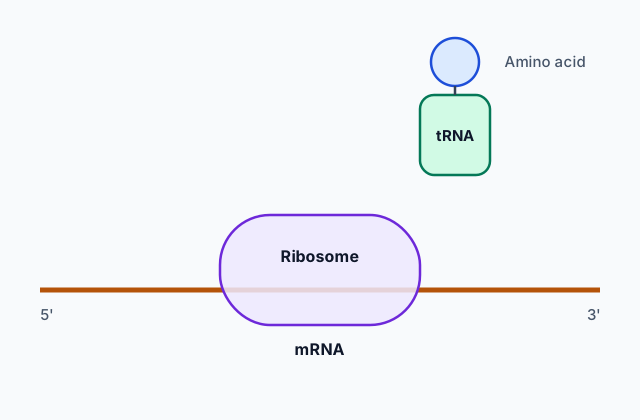
Translation of the mRNA to generate a polypeptide occurs on ribosomes. Ribosomes are present in the cytoplasm of both prokaryotic and eukaryotic cells, and on the cytoplasmic surface of the rough ER of eukaryotic cells.
The two kinds of cell differ in timing. A eukaryotic mRNA is made and processed in the nucleus, and only then reaches ribosomes in the cytoplasm. A prokaryote has no nucleus, so in prokaryotic organisms translation of the mRNA occurs while it is being transcribed: ribosomes start reading one end of an mRNA while RNA polymerase is still making the rest.
Quick check · Sort it
Each card describes translation in a cell. Tap a card, then the cells it describes.
Prokaryotic cells only
Eukaryotic cells only
Both kinds of cell
2b. Reading codons
Translation involves many sequential steps, including initiation, elongation and termination.
It is initiated when the rRNA in the ribosome interacts with the mRNA at the start codon, AUG, which codes for the amino acid methionine. From there the sequence of nucleotides on the mRNA is read in triplets, called codons.
Each codon encodes a specific amino acid, which you can find with a genetic code chart. Many amino acids are encoded by more than one codon: AAA and AAG, for example, both encode lysine. A few codons are stop codons, such as UAA, UAG and UGA, which encode no amino acid.
Quick check · Fill the statement
An mRNA reads 5'-AUG UUU GGC UAA-3'. In the genetic code, AUG encodes methionine, UUU phenylalanine and GGC glycine, and UAA is a stop codon. Complete the description of its translation.
Translation begins at . The polypeptide is methionine, then , then , and translation ends at .
2c. Building the chain
At each codon, tRNA brings the correct amino acid to the place the codon specifies: a tRNA whose anticodon pairs with that codon carries the matching amino acid.
The amino acid is transferred to the growing polypeptide chain, and the ribosome moves on to the next codon. This elongation continues along the mRNA until a stop codon is reached.
Translation then terminates with the release of the newly synthesized protein. Its sequence of amino acids was set codon by codon by the mRNA, and through the mRNA by the gene: that is how a genotype comes to determine a phenotype.
Quick check · Put it in order
Put the events of translation in the order they happen.
2d. One code for nearly all life, and an exception
Nearly all living organisms use the same genetic code: a codon encodes the same amino acid in a bacterium, a fungus, a plant or a person. That shared code is evidence for the common ancestry of all living organisms.
The usual flow of genetic information is from DNA to RNA to protein. Retroviruses are a special case with an alternate flow: from RNA to DNA. Their enzyme reverse transcriptase copies the viral RNA genome into DNA. This DNA integrates into the host genome, and is transcribed and translated by the host cell to assemble new viral progeny.
Quick check · Multiple choice
A drug blocks reverse transcriptase. A retrovirus enters a host cell treated with the drug. What is the most likely result?
Part 3 Watch it done How long is the polypeptide?
Predict first, then watch each step, then finish the reasoning yourself.
An mRNA reads 5'-AUG AAA GGA AAG UGA-3'. In the genetic code, AUG encodes methionine, AAA and AAG both encode lysine, GGA encodes glycine, and UGA is a stop codon. How many amino acids long is the polypeptide?
Predict first
Before you open the first step, predict: will the polypeptide have as many amino acids as the mRNA has codons?
Step 1 · Find the start
Translation is initiated at the start codon, AUG, which is the first codon here. It encodes methionine.
Step 2 · Read the codons
AAA is lysine, GGA is glycine and AAG is lysine again: two different codons, one amino acid.
Why this step?
Why does the last codon, UGA, add nothing to the chain?
UGA is a stop codon. It encodes no amino acid; reaching it ends translation and releases the polypeptide.
Step 3 · Count
Count the amino acids from the start codon up to the stop codon.
Your step · Calculate
An mRNA reads 5'-AUG AAA GGA AAG UGA-3'. AUG encodes methionine, AAA and AAG both encode lysine, GGA encodes glycine, and UGA is a stop codon. How many amino acids long is the polypeptide?
amino acids
Four amino acids from five codons: the stop codon adds none, and two different codons gave lysine. The chart, not the letters, decides what each codon means.
Part 4 Try it Finding the start
Two new questions. First, an mRNA whose start codon is not at its first base: 5'-GCAUGUUUCCUUAGC-3'. In the genetic code, AUG encodes methionine, UUU phenylalanine and CCU proline, and UAG is a stop codon. Second, an intron-free DNA copy of a human gene is put into bacteria, and the bacteria make a protein with the same amino acid sequence as the human protein.
Try it · Calculate
An mRNA reads 5'-GCAUGUUUCCUUAGC-3'. AUG encodes methionine, UUU phenylalanine and CCU proline, and UAG is a stop codon. How many amino acids long is the polypeptide it codes for?
Try it · Decide and justify
An intron-free DNA copy of a human gene is put into bacteria, and the bacteria make a protein with the same amino acid sequence as the human protein. Does this support the claim that humans and bacteria share a common ancestor?
Which statement supports your decision?
Part 5 Explain it A model of a ribosome at work
On the exam this is handwritten, so answer on paper first. Nothing you type here leaves this page. Then check your answer against the model and each scoring point.
Free response is 50% of the exam score. This one is shaped like Question 5, Analyze Model or Visual Representation of a Biological Concept or Process.
Free-response practice · Question 5 style
A model shows a ribosome on part of an mRNA that reads 5'-CCAUGGCUUGGUAAG-3'. In the genetic code, AUG encodes methionine, GCU alanine and UGG tryptophan, and UAA is a stop codon. A tRNA carrying alanine is shown arriving at the ribosome.
(a) Identify the codon at which translation begins.
(b) Identify the sequence of amino acids in the polypeptide.
(c) Describe how the tRNA carrying alanine is matched to the right place on the mRNA.
(d) A change in the mRNA turns the UAA into a codon for an amino acid. Predict how the polypeptide would differ, and justify your prediction.
Model answer
(a) AUG, the start codon, at bases 3 to 5.
(b) Methionine, alanine, tryptophan. Reading from AUG: AUG, GCU, UGG, then UAA, a stop codon.
(c) The tRNA's anticodon base pairs with the mRNA codon GCU, so it brings its alanine to the place that codon specifies.
(d) The polypeptide would be at least one amino acid longer. Translation continues along the mRNA until a stop codon is reached; without UAA, amino acids would keep being added until the ribosome reached a later stop codon.
Score your own answer. This is a self-check, not a grade. Tick each point your answer makes.
Part 6 Check yourself A retrovirus and two drugs
All three case questions use the table.
Researchers infect cultured cells with a retrovirus. Some cells get no drug, some get drug R, which blocks reverse transcriptase, and some get drug T, which blocks the host cell's ribosomes. Two days later they measure the copies of viral DNA integrated in each cell's genome and the virus particles released. These numbers are a teaching example.
| Treatment | Viral DNA copies in the host genome (per cell) | New virus particles released (relative) |
|---|---|---|
| None | 40 | 1,000 |
| Drug R | 0.4 | 10 |
| Drug T | 40 | 0 |
Case question 1 · Calculate
Using the table: by what percentage did drug R reduce the number of new virus particles released?
Case question 2 · Multiple choice
Using the table: why is almost no viral DNA found in the host genome with drug R?
Case question 3 · Multiple choice
Using the table: with drug T, viral DNA is in the host genome but no new virus particles are released. Which best explains this?
The rest stand on their own and do not use the case.
Check yourself · Spot the error
A student compares translation in a bacterium and in a plant cell. Tap the line with the mistake.
Check yourself · Match
Match each part of the genetic code to what it does in translation.
Part 7 Keep it Bring back earlier ideas
Translation reads the mRNA that transcription made, on the ribosomes met in Unit 2. Pulling back what each RNA does, and what ribosomes are, sets up how a protein is built.
From 6.3 Transcription and RNA Processing · Match
Match each molecule or part to what it does in making a protein.
From 2.1 Cell Structure and Function · Spot the error
A student describes ribosomes. Tap the line with the mistake.
In three lines
- Translation occurs on ribosomes in the cytoplasm and on the rough ER; in prokaryotes it occurs while the mRNA is being transcribed.
- It begins at AUG, reads codons of three bases as tRNAs bring amino acids, and ends at a stop codon; many amino acids have several codons.
- Nearly all organisms share one genetic code, evidence of common ancestry; retroviruses copy RNA into DNA with reverse transcriptase.
Exam strategy for this topic
- Section I, Multiple Choice: 60 questions in 90 minutes.
- Section II, Free Response: 6 questions in 90 minutes.
- This lesson's Explain it is shaped like free-response question 5, Analyze Model or Visual Representation of a Biological Concept or Process.
- A four-function, scientific, or graphing calculator is allowed on both sections of the exam.
To translate an mRNA, find the first AUG, mark off codons of three from it, look each up in the chart, and stop at the first stop codon, which adds nothing. Give the amino acids in order.
Questions students ask
Where does translation happen?
On ribosomes, which are present in the cytoplasm of both prokaryotic and eukaryotic cells, and on the cytoplasmic surface of the rough ER of eukaryotic cells.
How does translation start and stop?
It is initiated when the rRNA in the ribosome interacts with the mRNA at the start codon, AUG, which codes for methionine. It continues until a stop codon is reached, then terminates with the release of the new protein.
Why is the genetic code evidence for common ancestry?
Nearly all living organisms use the same genetic code, which is evidence for the common ancestry of all living organisms.
How do retroviruses differ from cells in the flow of genetic information?
Their information flows from RNA to DNA: reverse transcriptase copies the viral RNA genome into DNA, which integrates into the host genome and is transcribed and translated to assemble new viral progeny.
Course alignment, for teachers
AP Biology topic 6.4, Unit 6: Gene Expression and Regulation.
- Skill 2.D: Represent relationships within biological models, including mathematical models, diagrams, flowcharts, and systems.
- Skill 6.E: Predict the causes or effects of a change in, or disruption to, one or more components in a biological system.
This lesson maps all 4 essential knowledge statements of the topic to the part that teaches each one: 4 are checked by a scored question. The map is in the lesson file.