Unit 6 · Topic 6.5 · about 30 minutes · 7 parts · 12 scored checks, 3 of them multiple choice, plus 2 from earlier lessons
AP Biology 6.5: Regulation of Gene Expression
Unit 6: 12 to 16% of the multiple-choice section
What you'll be able to do
- Describe the kinds of interactions, between DNA, proteins and chemical changes to DNA or histones, that regulate gene expression.
- Explain how where a regulatory sequence sits relative to the genes it controls relates to what it does.
Key vocabulary
| Term | What it means | The exam trap |
|---|---|---|
| Regulatory sequence | A stretch of DNA that interacts with regulatory proteins to control transcription. | Ask which genes a regulatory sequence controls before saying what binding to it does. |
| Operon | A group of prokaryotic genes, lined up together, that are transcribed together. | Check that the organism is a prokaryote before describing a group of its genes as an operon. |
| Cell differentiation | The process by which a cell becomes specialized, with the features of a particular kind of cell. | Compare which genes two cells express before claiming their genes differ. |
| Gene product | The RNA or protein made when a gene is expressed. | Consider both how much of a gene product a cell makes and what it does. |
 Tap to open the picture full size
Part 1 Think first A sugar arrives
Commit to a guess first. Being wrong now makes the right idea stick better.
Predict first
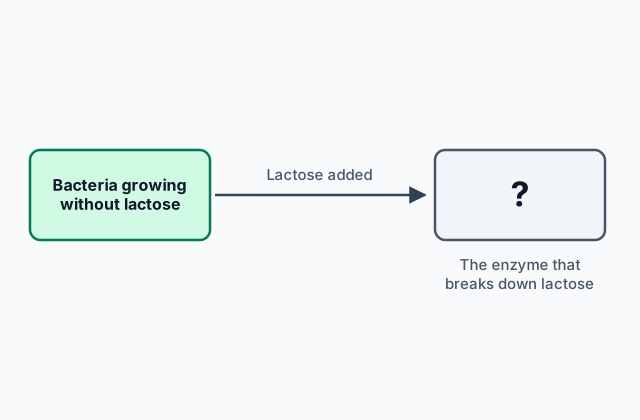
The bacterium E. coli can break down the sugar lactose with an enzyme, and its genes for that enzyme are always present. Bacteria are grown for many generations with no lactose, then lactose is added. Before the lactose is added, how much of the enzyme are the bacteria most likely making?
In short. Regulatory sequences are stretches of DNA that interact with regulatory proteins to control transcription, so a cell expresses some genes all the time and others only when induced.
- Prokaryotes regulate groups of genes as operons, in an inducible or a repressible system; in eukaryotes, groups of genes may be influenced by the same transcription factors.
- The phenotype of a cell or organism is determined by which genes are expressed and at what levels, which is how cells differentiate.
- Epigenetic changes can affect gene expression through reversible modifications of DNA or histones.
Part 2 Learn it Switching genes on and off
2a. Regulatory sequences and proteins
A cell's genes are typically present all the time, but not every gene is transcribed all the time. Regulatory sequences are stretches of DNA that interact with regulatory proteins to control transcription: a protein binding the sequence can switch transcription of nearby genes down or up.
- Some genes are constitutively expressed: transcribed all the time, at a fairly steady level, such as genes for proteins every cell needs.
- Others are inducible: transcribed at a low level until something, such as a nutrient or a signal, switches them on.
Quick check · Sort it
Each card describes how a gene is transcribed. Tap a card, then the kind of gene it describes.
Constitutively expressed
Inducible
2b. Operons in prokaryotes
Both prokaryotes and eukaryotes have groups of genes that are coordinately regulated, switched on and off together.
In prokaryotes the group is often an operon: genes lined up one after another on the DNA, transcribed together from one start, with a regulatory sequence just before the first gene. Because the sequence sits where transcription of the whole group begins, a repressor protein bound there blocks RNA polymerase from transcribing every gene in the operon at once.
Prokaryotes regulate operons in an inducible or a repressible system.
- Inducible: usually off. The repressor is bound until an inducer (lactose, in E. coli's lactose operon) removes it, and the genes are transcribed.
- Repressible: usually on. When a molecule builds up, often the operon's own end product, it helps the repressor bind, and transcription stops.
Quick check · Multiple choice
A bacterial operon has three genes in a row. A repressor protein, bound to the operon's regulatory sequence, keeps all three from being transcribed. Where does that regulatory sequence most likely lie?
2c. Transcription factors and specialized cells
In eukaryotes, groups of genes may be influenced by the same transcription factors, proteins that bind regulatory sequences, to coordinately regulate their expression.
The phenotype of a cell or an organism is determined by the combination of genes that are expressed and the levels at which they are expressed.
- Observable cell differentiation results from the expression of genes for tissue-specific proteins: a muscle cell and a liver cell carry the same genes but express different ones.
- Induction of transcription factors during development results in sequential gene expression: one transcription factor switches on the gene for the next, which switches on another set, in order.
- The function and amount of gene products determine the phenotype of organisms.
Quick check · Put it in order
During development, a signal starts a cell on its way to becoming a muscle cell. Put the events in order.
2d. Epigenetic changes
Gene expression can also change without any change to the base sequence. Epigenetic changes can affect gene expression through reversible modifications of DNA or histones.
For example, chemical groups such as methyl groups can be added to DNA, and chemical groups can be added to or removed from histones. Such changes can affect how tightly DNA is packed and whether regulatory proteins can reach a gene, and so whether it is transcribed. Because they are modifications, not changes to the bases, they can be removed again: the effect on expression is reversible.
Quick check · Fill the statement
Complete the description of epigenetic changes.
Adding chemical groups to DNA or to can change whether a gene is . The base sequence stays the , and the change is .
Part 3 Watch it done How much does lactose switch on?
Predict first, then watch each step, then finish the reasoning yourself.
Researchers measure the lactose-digesting enzyme in E. coli cells. With no lactose, the cells have 5 units of the enzyme; an hour after lactose is added, they have 1,500 units. These numbers are a teaching example. The enzyme level with lactose is how many times the level without it?
Predict first
Before you open the first step, predict: what does the change say about the gene?
Step 1 · Compare the conditions
The same cells, with the same genes, make 5 units without lactose and 1,500 units with it. Only the lactose differs.
Step 2 · Name the regulation
A gene transcribed far more when a nutrient is present is inducible; lactose is the inducer.
Why this step?
Why do the cells make any enzyme at all without lactose?
An inducible gene is switched down, not removed. A little transcription still slips through, so the level is low rather than zero.
Step 3 · Set up the ratio
"How many times" means divide the level with lactose by the level without it.
Your step · Calculate
E. coli cells have 5 units of the lactose-digesting enzyme without lactose and 1,500 units an hour after lactose is added. The level with lactose is how many times the level without it?
A 300-fold rise, with the genes unchanged. The lactose operon is inducible: lactose removes the repressor, and RNA polymerase transcribes the genes.
Part 4 Try it An operon that switches off
A new operon. Its genes code for the enzymes a bacterium uses to make the amino acid tryptophan. Researchers grow the bacteria with no tryptophan in the medium, then with plenty, and measure the enzymes: 100 units without tryptophan and 4 units with it. These numbers are a teaching example.
Try it · Calculate
Bacteria make 100 units of the enzymes for building tryptophan when the medium has none, and 4 units when it has plenty. By what percentage does the enzyme level fall?
Try it · Decide and justify
An operon's enzymes build tryptophan. The bacteria make 100 units of them with no tryptophan in the medium and 4 units with plenty. Is this operon regulated as an inducible or a repressible system?
Which evidence supports your decision?
Part 5 Explain it A drug that wakes a silent gene
On the exam this is handwritten, so answer on paper first. Nothing you type here leaves this page. Then check your answer against the model and each scoring point.
Free response is 50% of the exam score. This one is shaped like Question 1, Interpreting and Evaluating Experimental Results.
Free-response practice · Question 1 style
In a line of cultured cells, gene G is not transcribed, and its DNA carries many methyl groups. Researchers treat some of the cells with a drug that blocks the addition of methyl groups to new DNA, and leave others untreated. After five cell divisions they measure G's mRNA: 2 units in untreated cells and 60 units in treated cells. They then stop the drug, and after twenty more divisions the treated cells have 3 units. Sequencing shows G's base sequence is the same in every group. These numbers are a teaching example.
(a) Identify the independent variable and the dependent variable in the first part of the experiment.
(b) Describe how G's expression changed when the drug was given and after it was stopped.
(c) Explain how the drug changed G's expression although its base sequence did not change.
(d) Justify the claim that the change in G's expression was an epigenetic change rather than a mutation.
Model answer
(a) The independent variable is whether the cells were treated with the drug. The dependent variable is the amount of G's mRNA.
(b) G's mRNA rose from 2 units in untreated cells to 60 units in treated cells, then fell back to 3 units after the drug was stopped.
(c) Methyl groups on G's DNA were keeping it from being transcribed. The drug blocked new methyl groups, so as the cells divided, G's DNA carried fewer of them, and the gene could be transcribed. The modification of the DNA, not its sequence, controlled expression.
(d) G's base sequence was unchanged, so there was no mutation, and the effect reversed once the drug was stopped. Epigenetic changes are reversible modifications of DNA or histones that affect gene expression.
Score your own answer. This is a self-check, not a grade. Tick each point your answer makes.
Part 6 Check yourself One animal, two tissues
All three case questions use the table.
Researchers measure the mRNA of four genes in liver cells and muscle cells of one animal, and in muscle cells from an animal of the same species that lacks a working transcription factor M. These numbers are a teaching example.
| Gene | Liver cells | Muscle cells | Muscle cells lacking factor M |
|---|---|---|---|
| A | 100 | 100 | 100 |
| B | 90 | 0 | 0 |
| C | 0 | 80 | 4 |
| D | 0 | 60 | 3 |
Case question 1 · Calculate
Using the table: in muscle cells lacking factor M, gene C's mRNA is what percentage of its level in normal muscle cells?
Case question 2 · Multiple choice
Using the table: which gene is most likely constitutively expressed?
Case question 3 · Multiple choice
Using the table: genes C and D both fall to about 5% of their normal level in muscle cells lacking factor M. Which conclusion do the data best support?
The rest stand on their own and do not use the case.
Check yourself · Spot the error
A student explains how a gene in a cell was silenced and then switched back on. Tap the line with the mistake.
Check yourself · Match
Match each molecule to what it does in gene regulation.
Part 7 Keep it Bring back earlier ideas
Regulation decides whether a gene is transcribed and translated, and the environment is one thing that can change that. Pulling back the steps of translation and how the environment changes gene expression sets up how genes are switched.
From 6.4 Translation · Put it in order
Put the events of translation in the order they happen.
From 5.5 Environmental Effects on Phenotype · Put it in order
Put the events in order as a change in the environment leads to a different phenotype, and back again.
In three lines
- Regulatory sequences interact with regulatory proteins to control transcription; some genes are constitutively expressed and others inducible.
- Operons in prokaryotes are inducible or repressible, and eukaryotic transcription factors can regulate groups of genes, as in cell differentiation.
- Epigenetic changes can affect gene expression through reversible modifications of DNA or histones.
Exam strategy for this topic
- Section I, Multiple Choice: 60 questions in 90 minutes.
- Section II, Free Response: 6 questions in 90 minutes.
- This lesson's Explain it is shaped like free-response question 1, Interpreting and Evaluating Experimental Results.
- A four-function, scientific, or graphing calculator is allowed on both sections of the exam.
To explain different gene expression in two cells of one organism, say they carry the same genes and name what differs: a regulatory protein or transcription factor, an inducer or repressor, or an epigenetic modification. Do not say a cell lost a gene unless the data show it.
Questions students ask
What is a regulatory sequence?
A stretch of DNA that interacts with regulatory proteins to control transcription.
What is the difference between constitutive and inducible genes?
A constitutively expressed gene is transcribed all the time. An inducible gene is transcribed at a low level until something, such as a nutrient or signal, switches it on.
What is the difference between an inducible and a repressible operon?
An inducible operon is usually off and is switched on when an inducer removes its repressor. A repressible operon is usually on and is switched off when a molecule, often its end product, builds up and helps the repressor bind.
How do cells of one organism become different?
The phenotype of a cell is determined by the combination of genes expressed and the levels at which they are expressed. Cell differentiation results from the expression of genes for tissue-specific proteins.
What are epigenetic changes?
Reversible modifications of DNA or histones that can affect gene expression without changing the base sequence.
Course alignment, for teachers
AP Biology topic 6.5, Unit 6: Gene Expression and Regulation.
This lesson maps all 4 essential knowledge statements of the topic to the part that teaches each one: 4 are checked by a scored question. The map is in the lesson file.