Unit 6 · Topic 6.6 · about 30 minutes · 7 parts · 12 scored checks, 3 of them multiple choice, plus 2 from earlier lessons
AP Biology 6.6: Gene Expression and Cell Specialization
Unit 6: 12 to 16% of the multiple-choice section
What you'll be able to do
- Explain how transcription factors binding to the DNA sequences that start transcription affect a gene's expression and the organism's phenotype.
- Explain how differences in the regulation of gene expression lead to differences between cells and between organisms.
Key vocabulary
| Term | What it means | The exam trap |
|---|---|---|
| Transcription start site | The base in a gene where RNA polymerase begins making RNA. | Measure upstream and downstream from the start site, not from either end of the DNA. |
| Upstream and downstream | Before and after a point on a gene, in the direction transcription runs. | Fix the direction transcription runs before calling a sequence upstream or downstream. |
| Transcription factor | A protein that binds DNA and takes part in starting transcription. | Ask which cells have a given factor before predicting which genes they express. |
| Small RNA | A short RNA molecule that is not translated into protein. | Ask which molecule a small RNA acts on before predicting what it changes. |
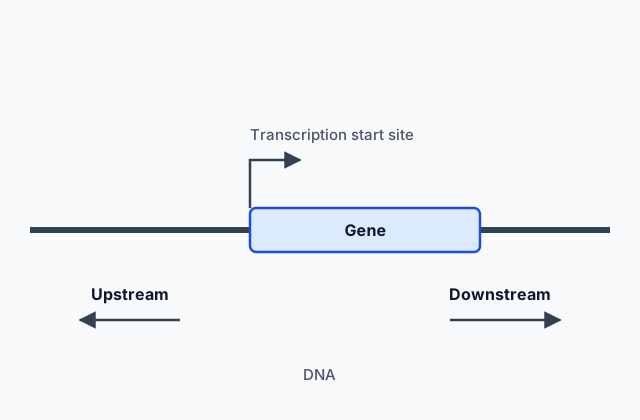 Tap to open the picture full size
Part 1 Think first DNA after the end of a gene
Commit to a guess first. Being wrong now makes the right idea stick better.
Predict first
Researchers remove a stretch of DNA that lies thousands of bases past the end of a gene. The part of the gene that is transcribed is untouched. Could the gene's transcription change?
In short. RNA polymerase and transcription factors bind to promoter or enhancer DNA sequences to initiate transcription, so which factors a cell has shapes which genes it expresses.
- Promoter and enhancer sequences can be upstream or downstream of the transcription start site.
- Negative regulatory molecules inhibit gene expression by binding to DNA and blocking transcription, and certain small RNA molecules also regulate gene expression.
- Gene regulation results in differential gene expression, which influences the products a cell makes and the functions it carries out.
Part 2 Learn it What starts and stops a gene
2a. Promoters and enhancers
Transcription does not start on its own. RNA polymerase and transcription factors bind to promoter or enhancer DNA sequences to initiate transcription.
- A promoter is next to the transcription start site, where RNA polymerase begins.
- An enhancer can be farther away. Transcription factors bound to an enhancer help RNA polymerase start at the promoter, for example when the DNA bends so the enhancer's proteins reach it.
These sequences can be upstream or downstream of the transcription start site: before it, or after it in the direction transcription runs. So DNA well outside the part of a gene that is transcribed can still control it.
Quick check · Decide and justify
A DNA sequence that transcription factors bind lies 3,000 bases downstream of a gene's transcription start site. Can binding at that sequence help initiate the gene's transcription?
Which statement supports your decision?
2b. Negative regulation
Regulation can also hold a gene back. Negative regulatory molecules inhibit gene expression by binding to DNA and blocking transcription. Bound at or near the promoter, such a molecule can keep RNA polymerase from starting, or from moving along the gene.
Whether a gene is transcribed in a cell can therefore depend on a balance: transcription factors that help start it, and negative regulators that block it. Remove a negative regulator, or the DNA site where it binds, and the gene can be transcribed more.
Quick check · Fill the statement
Complete the description of a negative regulatory molecule.
A negative regulatory molecule gene expression. It binds to and blocks .
2c. One genome, many kinds of cell
A liver cell and a nerve cell of one person typically carry the same genes. They differ because gene regulation results in differential gene expression: each kind of cell has its own set of transcription factors and negative regulators, so each transcribes its own set of genes.
Different genes expressed means different gene products, and gene products influence cell products and functions. A cell expressing the genes for an enzyme that makes a hormone secretes that hormone; a cell expressing genes for proteins that conduct signals carries nerve impulses. The same idea scales up: organisms can differ because they regulate the same genes differently.
Quick check · Sort it
Compare a liver cell and a nerve cell from one person. Tap each card, then whether it is typically the same in both cells or differs between them.
Typically the same
Differs between them
2d. Small RNAs
Proteins are not the only regulators. Certain small RNA molecules have roles in regulating gene expression.
Small RNAs like these are not translated into protein. Instead, a small RNA can base pair with a complementary stretch of a particular mRNA, and that can lead to the mRNA being broken down or keep it from being translated. Either way, less of the gene's protein is made, even though the gene itself, and its transcription, may be unchanged.
Quick check · Multiple choice
A small RNA is complementary to part of the mRNA of gene X. A cell starts making much more of this small RNA. What is the most likely effect?
Part 3 Watch it done An enhancer moved around
Predict first, then watch each step, then finish the reasoning yourself.
Researchers join a gene's enhancer to a test gene in three ways and measure the test gene's mRNA: with no enhancer, 10 units; with the enhancer placed upstream of the start site, 400 units; with it placed downstream, 380 units. These numbers are a teaching example. With the enhancer downstream, the mRNA level is how many times the level with no enhancer?
Predict first
Before you open the first step, predict: what will the downstream enhancer turn out to do?
Step 1 · Find the baseline
With no enhancer, the test gene gives 10 units: its promoter alone starts a little transcription.
Step 2 · Compare the two positions
Upstream, 400 units; downstream, 380. Both are far above 10, and close to each other.
Why this step?
Why does the enhancer still work when it is moved downstream?
Enhancer sequences can be upstream or downstream of the transcription start site. Transcription factors bound to the enhancer help RNA polymerase start at the promoter from either side.
Step 3 · Set up the ratio
Divide the level with the enhancer downstream by the level with no enhancer.
Your step · Calculate
A test gene gives 10 units of mRNA with no enhancer and 380 units with an enhancer placed downstream of its transcription start site. The level with the enhancer is how many times the level without it?
38 times, against 40 times upstream. Where an enhancer sits matters far less than whether transcription factors can bind it.
Part 4 Try it A protein that holds a gene back
A new gene. Researchers suspect that protein R holds back gene H by binding a site in the DNA near H's promoter. They measure H's mRNA in three kinds of cell: normal cells, 6 units; cells lacking protein R, 120 units; cells with protein R but with its binding site in the DNA changed so R cannot bind, 118 units. These numbers are a teaching example.
Try it · Calculate
Gene H gives 6 units of mRNA in normal cells and 120 units in cells lacking protein R. The level in normal cells is what percentage of the level in cells lacking R?
Try it · Decide and justify
Gene H gives 6 units of mRNA in normal cells, 120 units in cells lacking protein R, and 118 units in cells that have R but whose binding site for R in the DNA is changed. Do the data support the claim that R inhibits H by binding to DNA?
Which evidence supports your decision?
Part 5 Explain it Testing a small RNA
On the exam this is handwritten, so answer on paper first. Nothing you type here leaves this page. Then check your answer against the model and each scoring point.
Free response is 50% of the exam score. This one is shaped like Question 3, Scientific Investigation.
Free-response practice · Question 3 style
A researcher finds a small RNA in plant cells that is complementary to part of the mRNA of gene Y. She hypothesizes that the small RNA lowers the amount of Y protein the cells make.
(a) Identify an appropriate control group for an experiment that tests the hypothesis.
(b) Identify the independent variable and the dependent variable in the experiment.
(c) Predict the results that would support the hypothesis.
(d) The researcher also finds that gene Y is transcribed at the same rate with and without the small RNA. Explain how the small RNA could still lower the amount of Y protein.
Model answer
(a) Cells of the same plant line that do not make the small RNA, grown in the same conditions.
(b) The independent variable is whether the cells make the small RNA. The dependent variable is the amount of Y protein.
(c) Cells that make the small RNA would have less Y protein than the control cells.
(d) The small RNA can base pair with the complementary stretch of Y's mRNA after it is made. That can lead to the mRNA being broken down or block its translation, so less Y protein is made even though transcription is unchanged.
Score your own answer. This is a self-check, not a grade. Tick each point your answer makes.
Part 6 Check yourself Two transcription factors
All three case questions use the table.
Lens cells of the eye make a clear protein encoded by gene 1; skin cells make a tough protein encoded by gene 2. Researchers record which of two transcription factors, P and Q, each cell has, and measure the two genes' mRNA. They also give skin cells a working gene for factor P. These numbers are a teaching example.
| Cells | Factor P | Factor Q | Gene 1 mRNA | Gene 2 mRNA |
|---|---|---|---|---|
| Lens cells | Present | Absent | 500 | 0 |
| Skin cells | Absent | Present | 0 | 300 |
| Skin cells given factor P | Present | Present | 450 | 290 |
Case question 1 · Calculate
Using the table: in skin cells given factor P, gene 1's mRNA is what percentage of its level in lens cells?
Case question 2 · Multiple choice
Using the table: which best explains why ordinary skin cells make no gene 1 mRNA?
Case question 3 · Multiple choice
Using the table: which conclusion do the data best support?
The rest stand on their own and do not use the case.
Check yourself · Put it in order
A cell begins to make a new protein that changes what the cell does. Put the events in order.
Check yourself · Spot the error
A student explains two ways a cell can make less of a protein. Tap the line with the mistake.
Part 7 Keep it Bring back earlier ideas
This topic zooms in on regulation, which the last topic introduced, and on transcription itself. Pulling back constitutive and inducible genes, and how RNA polymerase uses its template, sets up how transcription is started and stopped.
From 6.5 Regulation of Gene Expression · Sort it
Each card describes how a gene is transcribed. Tap a card, then the kind of gene it describes.
Constitutively expressed
Inducible
From 6.3 Transcription and RNA Processing · Spot the error
A student describes transcription. Tap the line with the mistake.
In three lines
- RNA polymerase and transcription factors bind promoter or enhancer sequences, upstream or downstream of the start site, to initiate transcription.
- Negative regulatory molecules bind DNA and block transcription, and certain small RNAs also regulate gene expression.
- Gene regulation results in differential gene expression, which influences each cell's products and functions.
Exam strategy for this topic
- Section I, Multiple Choice: 60 questions in 90 minutes.
- Section II, Free Response: 6 questions in 90 minutes.
- This lesson's Explain it is shaped like free-response question 3, Scientific Investigation.
- A four-function, scientific, or graphing calculator is allowed on both sections of the exam.
When cells or organisms with the same genes differ, explain it through regulation: name the transcription factor, negative regulator or small RNA that differs, say whether it acts on DNA (transcription) or on mRNA, and connect the changed gene product to the phenotype.
Questions students ask
What do promoters and enhancers do?
RNA polymerase and transcription factors bind to promoter or enhancer DNA sequences to initiate transcription. These sequences can be upstream or downstream of the transcription start site.
What is a negative regulatory molecule?
A molecule that inhibits gene expression by binding to DNA and blocking transcription.
Why are cells of one organism different if they have the same DNA?
Gene regulation results in differential gene expression: each kind of cell expresses its own set of genes, which influences its products and functions.
How can small RNAs regulate genes?
Certain small RNA molecules have roles in regulating gene expression. Some, for example, pair with a particular mRNA, which can lead to its breakdown or block its translation.
Course alignment, for teachers
AP Biology topic 6.6, Unit 6: Gene Expression and Regulation.
- Skill 6.B: Support a claim with evidence from biological principles, concepts, processes, and data.
This lesson maps all 4 essential knowledge statements of the topic to the part that teaches each one: 4 are checked by a scored question. The map is in the lesson file.