Unit 6 · Topic 6.7 · about 30 minutes · 7 parts · 12 scored checks, 3 of them multiple choice, plus 2 from earlier lessons
AP Biology 6.7: Mutations
Unit 6: 12 to 16% of the multiple-choice section
What you'll be able to do
- Describe the different kinds of mutation, from a single changed base to a change in a whole chromosome.
- Explain how a change in an organism's genotype may lead to a change in its phenotype.
- Explain how changes in DNA sequences add to the genetic variation that natural selection can act on.
Key vocabulary
| Term | What it means | The exam trap |
|---|---|---|
| Reading frame | The way an mRNA is divided into codons, three bases at a time, starting from the start codon. | Start the frame at the start codon, not at the first base of the mRNA. |
| Genetic variation | Differences in DNA sequence among the individuals of a population. | Separate where variation comes from and what selection then does with it. |
| Nondisjunction | Chromosomes, or chromatids, failing to separate when a cell divides. | Say which division failed before predicting the gametes. |
| Point mutation | A mutation in which one nucleotide is substituted for a different one. | Follow a substituted base to its codon, and look the codon up, before judging the mutation's effect. |
 Tap to open the picture full size
Part 1 Think first Resistance without the drug
Commit to a guess first. Being wrong now makes the right idea stick better.
Predict first
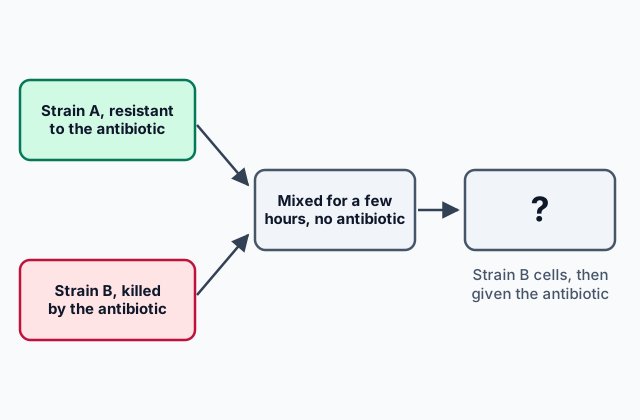
A lab mixes two strains of a bacterium: strain A survives an antibiotic, and strain B is killed by it. They grow together for a few hours with no antibiotic present. When the antibiotic is then added, some strain B cells survive it. What most likely happened?
In short. Mutations are alterations in a DNA sequence that can change the type or amount of a protein, and so the phenotype; they are a source of genetic variation that natural selection can act on.
- Point mutations substitute one nucleotide, and can be silent or nonsense; insertions or deletions can shift the reading frame.
- Errors in replication or repair, radiation and reactive chemicals can cause random mutations, whose effect, beneficial, detrimental or neutral, depends on the environment.
- Errors in mitosis or meiosis can change chromosome number or structure, and prokaryotes also gain variation by transformation, transduction, conjugation and transposition.
Part 2 Learn it How DNA changes
2a. Kinds of mutation
Alterations in a DNA sequence are mutations. They can cause changes in the type or amount of the protein produced, and so in the phenotype. A mutation can be beneficial, detrimental or neutral, depending on the effect, or lack of effect, it has on the nucleic acid or protein and the phenotypes the protein confers.
- Point mutation: one nucleotide is substituted for a different one.
- Silent mutation: the change in the nucleotide sequence has no effect on the amino acid sequence, because the new codon encodes the same amino acid.
- Nonsense mutation: a point mutation that causes a premature stop codon, so the polypeptide is cut short.
- Frameshift mutation: one or more nucleotides are inserted or deleted, shifting the reading frame, so every codon after the change is read differently, unless the number added or removed is a multiple of three.
Quick check · Sort it
Each card describes a change in a gene. Tap a card, then the kind of mutation it is.
Silent
Nonsense
Frameshift
2b. Causes, and whether a mutation helps
Errors in DNA replication or in DNA repair mechanisms, as well as external factors including radiation and reactive chemicals, can cause random mutations in the DNA. A mutation does not arise because an organism needs it; it arises by chance, and then has whatever effect it has.
Whether a mutation is beneficial, detrimental or neutral depends on the environmental context. A mutation that darkens a moth's wings may help it hide on dark tree bark and make it easier to spot on pale bark.
Mutations are a source of genetic variation: new alleles that did not exist before.
Quick check · Multiple choice
A mutation gives a moth darker wings. In a forest with dark tree bark, dark moths are eaten less by birds; in a forest with pale bark, they are eaten more. How is this mutation best described?
2c. Errors with whole chromosomes
Errors in mitosis or meiosis can also result in changes in phenotype.
- Changes in chromosome number resulting from nondisjunction, chromosomes failing to separate, often result in new phenotypes, for example in an organism with an extra copy of one chromosome (aneuploidy).
- Changes in chromosome number often result in disorders with developmental limitations.
- Alterations in chromosome structure, such as a piece of a chromosome deleted, duplicated or moved, lead to genetic disorders.
These are changes in genotype on a large scale: many genes at once gain or lose a copy, or are moved.
Quick check · Fill the statement
Complete the description of changes to whole chromosomes.
Nondisjunction during can leave an offspring with an extra or missing chromosome, a condition called . Changes in chromosome number often result in disorders with limitations, and alterations in chromosome also lead to genetic disorders.
2d. New variation and natural selection
Changes in genotype may affect phenotypes that are subject to natural selection. Genetic changes that enhance survival and reproduction can be selected for by environmental conditions.
Prokaryotes gain genetic variation not only by mutation but by horizontal acquisition of genetic information:
- Transformation: uptake of DNA from the surroundings.
- Transduction: viral transmission of genetic information from one cell to another.
- Conjugation: cell-to-cell transfer of DNA.
- Transposition: movement of DNA segments within and between DNA molecules.
Related viruses can recombine genetic information if they infect the same host cell. And reproductive processes that increase genetic variation, such as those of meiosis and fertilization, are evolutionarily conserved and shared by many organisms.
Quick check · Match
Match each way genetic variation arises in bacteria to what happens.
Part 3 Watch it done A stop codon too early
Predict first, then watch each step, then finish the reasoning yourself.
A gene's mRNA reads 5'-AUG GCU AAA GGC UUU UGA-3', coding for methionine, alanine, lysine, glycine and phenylalanine, then a stop. A point mutation changes the third codon, AAA, to UAA, which is a stop codon. How many amino acids long is the mutant polypeptide?
Predict first
Before you open the first step, predict: how will the mutant polypeptide compare with the normal one?
Step 1 · Read the normal mRNA
AUG, GCU, AAA, GGC, UUU, then UGA, a stop: 5 amino acids.
Step 2 · Name the mutation
One nucleotide is substituted, turning AAA into UAA, a stop codon. A point mutation that causes a premature stop is a nonsense mutation.
Why this step?
Why does the rest of the mRNA, GGC UUU, add nothing?
Translation terminates at the first stop codon it reaches. The ribosome releases the polypeptide at UAA and never reads the codons after it.
Step 3 · Read the mutant mRNA
Read from AUG up to the new stop codon, and count the amino acids.
Your step · Calculate
A gene's mRNA reads 5'-AUG GCU AAA GGC UUU UGA-3', coding for methionine, alanine, lysine, glycine and phenylalanine, then a stop. A point mutation changes AAA to UAA, a stop codon. How many amino acids long is the mutant polypeptide?
amino acids
2 amino acids instead of 5. One substituted base made a premature stop codon, a nonsense mutation, and the protein is cut short.
Part 4 Try it Insertions, deletions and the reading frame
A new gene. Its mRNA's coding region, from the AUG start codon through its stop codon, is 303 nucleotides long. This gene is a teaching example.
Try it · Calculate
Before a mutation, a gene's coding region, from the AUG start codon through the stop codon, is 303 nucleotides. The mutation deletes 3 nucleotides that make up one whole codon in the middle, creating no stop codon. How many amino acids long is the mutant polypeptide?
Try it · Decide and justify
In the same gene, compare a mutation that deletes a single nucleotide near the start with one that substitutes a single nucleotide at the same place. Which is more likely to change most of the protein's amino acid sequence?
Which statement supports your decision?
Part 5 Explain it A resistance gene spreads
On the exam this is handwritten, so answer on paper first. Nothing you type here leaves this page. Then check your answer against the model and each scoring point.
Free response is 50% of the exam score. This one is shaped like Question 4, Conceptual Analysis.
Free-response practice · Question 4 style
In a hospital, a gene that lets bacteria survive an antibiotic is found on a plasmid. Over several months, more and more of the bacteria in the hospital carry it.
(a) Describe one way the plasmid could pass from one bacterial cell to another that is not its offspring.
(b) Explain how using the antibiotic could make the bacteria carrying the gene more common.
(c) The gene first arose by a random mutation. Explain why the same mutation might not be beneficial in an environment with no antibiotic.
(d) Identify one way, other than the one you described in (a), that bacteria gain new genetic variation.
Model answer
(a) By conjugation: a cell carrying the plasmid passes a copy of its DNA directly to another cell it is in contact with. (Transformation, uptake of plasmid DNA released by another cell, also earns the point.)
(b) The antibiotic kills bacteria without the gene, while those with it survive and reproduce. A genetic change that enhances survival and reproduction is selected for by that environmental condition, so the carriers become a larger share of the population.
(c) Whether a mutation is beneficial, detrimental or neutral depends on the environmental context. With no antibiotic, the gene gives no survival advantage, so it would be neutral, or detrimental if making its product costs the cell resources.
(d) Mutation from errors in DNA replication, or transduction, transformation or transposition.
Score your own answer. This is a self-check, not a grade. Tick each point your answer makes.
Part 6 Check yourself Ultraviolet light and mutations
All three case questions use the table.
Researchers expose dishes of yeast cells to different doses of ultraviolet (UV) light, a form of radiation, then count the cells with a mutation in one test gene, per million cells. These numbers are a teaching example.
| UV dose (relative) | Mutant cells per million |
|---|---|
| 0 | 3 |
| 10 | 24 |
| 20 | 45 |
| 40 | 93 |
Case question 1 · Calculate
Using the table: the number of mutant cells per million at a UV dose of 40 is how many times the number at a dose of 0?
Case question 2 · Multiple choice
Using the table: with no UV light at all, there were still 3 mutant cells per million. Which best explains this?
Case question 3 · Multiple choice
Using the table: which conclusion do the data best support?
The rest stand on their own and do not use the case.
Check yourself · Rank it
Three mutations occur in the same gene, which codes for a protein 200 amino acids long. Rank them by how many of the protein's amino acids they change or remove.
Most amino acids changed or removed first
Give each one a place, 1 for first. Give two the same place if they are equal.
Your ranking: none yet
Check yourself · Spot the error
A student explains how a population of insects became resistant to an insecticide. Tap the line with the mistake.
Part 7 Keep it Bring back earlier ideas
A mutation changes the DNA itself, unlike the regulation of the last topics, and chromosome errors build on meiosis. Pulling back how transcription is controlled, and what nondisjunction does, sets mutations beside them.
From 6.6 Gene Expression and Cell Specialization · Fill the statement
Complete the description of a negative regulatory molecule.
A negative regulatory molecule gene expression. It binds to and blocks .
From 5.2 Meiosis and Genetic Diversity · Multiple choice
In a species with 2n = 12, the homologous chromosomes of one pair fail to separate in meiosis I, and meiosis II goes normally. Which describes the four gametes?
In three lines
- Mutations change a DNA sequence and can change the type or amount of a protein: point, silent, nonsense and frameshift.
- Replication or repair errors, radiation and reactive chemicals cause random mutations; whether one helps depends on the environment.
- Chromosome errors, horizontal gene transfer and viral recombination also add variation that natural selection can act on.
Exam strategy for this topic
- Section I, Multiple Choice: 60 questions in 90 minutes.
- Section II, Free Response: 6 questions in 90 minutes.
- This lesson's Explain it is shaped like free-response question 4, Conceptual Analysis.
- A four-function, scientific, or graphing calculator is allowed on both sections of the exam.
Name the kind of mutation and follow it to the protein and the phenotype: silent (no change), a substitution (one amino acid), nonsense (cut short) or frameshift (every later codon). Then say whether it is beneficial, detrimental or neutral in the environment given.
Questions students ask
What are the main kinds of mutation?
Point mutations substitute one nucleotide for another; a silent mutation has no effect on the amino acid sequence, and a nonsense mutation causes a premature stop. Frameshift mutations insert or delete nucleotides and shift the reading frame.
What causes mutations?
Errors in DNA replication or DNA repair mechanisms, as well as external factors including radiation and reactive chemicals, can cause random mutations in the DNA.
Are mutations harmful?
They can be beneficial, detrimental or neutral. Which one depends on the effect the mutation has on the protein and the phenotype, and on the environmental context.
How do bacteria gain genetic variation without sexual reproduction?
By mutation, and by horizontal acquisition of genetic information: transformation (uptake of DNA), transduction (viral transmission), conjugation (cell-to-cell transfer) and transposition (movement of DNA segments within and between DNA molecules).
How do errors in cell division change phenotypes?
Nondisjunction in mitosis or meiosis can change chromosome number, which often results in new phenotypes and in disorders with developmental limitations. Alterations in chromosome structure lead to genetic disorders.
Beyond the AP Exam
College Board sets these limits on what the AP Exam asks about this topic. Anything past them is not on the exam.
Knowledge of specific mutations and their effects is beyond the scope of the AP Exam.
Knowledge of specific disorders related to changes in chromosome number is beyond the scope of the AP Exam.
Course alignment, for teachers
AP Biology topic 6.7, Unit 6: Gene Expression and Regulation.
- Skill 2.C: Explain how biological models relate to larger principles, concepts, processes, systems, or theories.
This lesson maps all 4 essential knowledge statements of the topic to the part that teaches each one: 4 are checked by a scored question. The map is in the lesson file.