Unit 6 · Topic 6.8 · about 30 minutes · 7 parts · 12 scored checks, 4 of them multiple choice, plus 2 from earlier lessons
AP Biology 6.8: Biotechnology
Unit 6: 12 to 16% of the multiple-choice section
What you'll be able to do
- Explain how genetic engineering techniques are used to analyze DNA and to manipulate it.
Key vocabulary
| Term | What it means | The exam trap |
|---|---|---|
| Base pair (bp) | One pair of bases across a DNA double helix, used as the unit of a fragment's length. | Check whether a number gives a fragment's size in base pairs or its position on the gel. |
| Primer | A short single strand of nucleic acid that pairs with a template and gives DNA polymerase a start. | Ask which strands are single at each step before placing the primers. |
| Foreign DNA | DNA from a different organism or source than the cell it is put into. | Ask which cells actually took up the DNA before predicting what they make. |
| DNA fingerprint | A pattern of DNA fragments or sequences that typically differs from one individual to another. | Read a band's position as a fragment's size, not its sequence. |
 Tap to open the picture full size
Part 1 Think first A few cells on a hair
Commit to a guess first. Being wrong now makes the right idea stick better.
Predict first
Investigators find a single hair with a few cells at its root. There is far too little DNA in those cells to analyze directly. What is the most practical way to get enough DNA?
In short. Genetic engineering techniques can be used to analyze and manipulate DNA and RNA, and typically produce a DNA fingerprint that lets DNA from different samples be compared.
- Gel electrophoresis separates DNA fragments by size and charge; PCR amplifies DNA by denaturing it, annealing primers and extending new strands.
- Bacterial transformation introduces foreign DNA into bacterial cells.
- DNA sequencing determines the order of nucleotides in a DNA molecule.
Part 2 Learn it Tools for DNA
2a. Gel electrophoresis
Gel electrophoresis is a process that separates DNA fragments by size and charge.
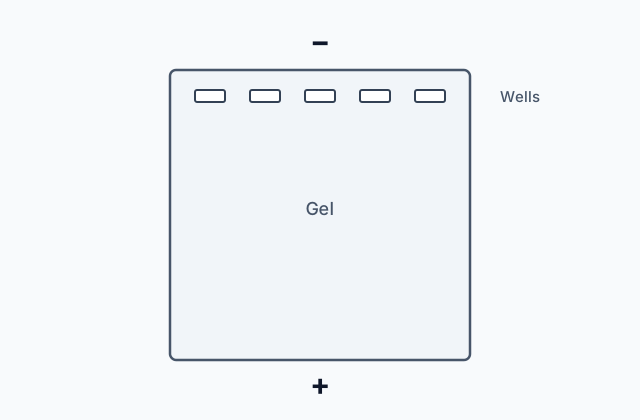
DNA samples are placed in wells at one end of a gel, and an electric current runs through it. DNA's phosphate groups give it a negative charge, so the fragments move toward the positive end. The gel is a mesh, and it slows larger fragments more than smaller ones, so in the same time smaller fragments move farther from the wells.
Each group of same-sized fragments ends up as a band. Fragment sizes are measured in base pairs (bp).
Quick check · Rank it
Three DNA fragments, of 300, 1,200 and 600 base pairs, are run side by side on a gel. Rank them from the one that ends up farthest from the wells to the one that ends up closest to them.
Farthest from the wells first
Give each one a place, 1 for first. Give two the same place if they are equal.
Your ranking: none yet
2b. The polymerase chain reaction
During polymerase chain reaction (PCR), DNA fragments are amplified, copied many times, in three steps that repeat as a cycle.
- Denaturing: the DNA is heated so its two strands separate.
- Annealing: short primers pair with each single strand, at the two ends of the stretch to be copied.
- Extending: DNA polymerase builds a new strand from each primer, along the original strand.
Each cycle doubles the number of copies of the target stretch, so the number grows fast: 1 copy becomes 2, then 4, then 8.
Quick check · Put it in order
Put the events of one cycle of PCR in order, ending with the start of the next cycle.
2c. Bacterial transformation
Bacterial transformation introduces foreign DNA into bacterial cells. The foreign DNA is often carried on a plasmid, a small circle of DNA that the bacteria copy as they divide.
Because nearly all organisms share the genetic code, bacteria can express a gene from another organism: bacteria given an intron-free DNA copy of the human insulin gene, for example, can make human insulin.
Not every cell takes up the plasmid. So the plasmid often also carries a gene for resistance to an antibiotic. Grown on a plate with that antibiotic, only the cells that took up the plasmid survive to form colonies.
Quick check · Multiple choice
Bacteria are given a plasmid that carries a gene for antibiotic resistance and a gene for a glowing protein, and only some of the cells take it up. They are then spread on a plate containing the antibiotic. Which colonies grow on the plate?
2d. Sequencing and DNA fingerprints
DNA sequencing technology determines the order of nucleotides in a DNA molecule, its exact sequence of bases, which a fragment's length alone does not show.
Typically, these techniques result in a DNA fingerprint, a pattern that allows the comparison of DNA sequences from various samples. Two samples with the same pattern of bands, or the same sequence, at several stretches of DNA very likely come from the same source; differences point to different sources. Comparisons like these are used to identify people, to test relatedness and to tell species apart.
Quick check · Multiple choice
Two DNA fragments give bands in exactly the same place on a gel. Which technique could best show whether their base sequences differ?
Part 3 Watch it done Ten cycles of PCR
Predict first, then watch each step, then finish the reasoning yourself.
A sample contains 5 copies of a stretch of DNA. It goes through 10 cycles of PCR, and every cycle doubles the number of copies. These numbers are a teaching example. How many copies are there after 10 cycles?
Predict first
Before you open the first step, predict: roughly how many copies will there be?
Step 1 · One cycle
Each copy is separated, primed and extended into two: 5 copies become 10.
Step 2 · Several cycles
Doubling again: 20 after 2 cycles, 40 after 3, 80 after 4. Each cycle multiplies by 2.
Why this step?
Why does the count grow so much faster than adding a few copies each cycle?
Every new copy is itself a template in the next cycle, so the number of templates doubles too. After n cycles the starting number is multiplied by 2 to the power n.
Step 3 · Ten cycles
Multiply the 5 starting copies by 2 ten times, that is, by 2 to the 10th power, which is 1,024.
Your step · Calculate
A sample with 5 copies of a stretch of DNA goes through 10 cycles of PCR, and each cycle doubles the number of copies. How many copies are there after the 10 cycles?
copies
5,120 copies from 5, in 10 cycles. A few more cycles reach millions, which is why PCR can work from a few cells.
Part 4 Try it How many cycles, and which band
Two new questions. First, a lab needs more than 1,000 copies of a stretch of DNA and starts from a single copy. Second, a student runs two fragments, X and Y, on a gel: after the run, X is 6 cm from the wells and Y is 3 cm from the wells.
Try it · Calculate
PCR starts from a single copy of a stretch of DNA, and each cycle doubles the number of copies. What is the fewest number of cycles that gives more than 1,000 copies?
Try it · Decide and justify
On a gel, fragment X ended 6 cm from the wells and fragment Y ended 3 cm from the wells. A student says X is the larger fragment. Is the student right?
Which statement supports your decision?
Part 5 Explain it Glowing colonies
On the exam this is handwritten, so answer on paper first. Nothing you type here leaves this page. Then check your answer against the model and each scoring point.
Free response is 50% of the exam score. This one is shaped like Question 6, Analyze Data.
Free-response practice · Question 6 style
Students try to transform bacteria with a plasmid that carries a gene for antibiotic resistance and a gene for a protein that glows green. They spread the bacteria on four plates and count the colonies the next day. These numbers are a teaching example.
- Plate 1, no plasmid, no antibiotic: a solid layer of growth, none glowing
- Plate 2, no plasmid, with antibiotic: 0 colonies
- Plate 3, with plasmid, with antibiotic: 120 colonies, all glowing
- Plate 4, with plasmid, no antibiotic: a solid layer of growth, with a few glowing patches
(a) Describe the difference between the results on plates 2 and 3.
(b) Explain why colonies grew on plate 3 but not on plate 2.
(c) Explain why the bacteria on plate 3 can make the glowing protein, even though the gene came from another organism.
(d) Explain why plate 4 is mostly not glowing.
Model answer
(a) Plate 2 has no colonies, while plate 3 has 120 colonies, all of which glow.
(b) Bacterial transformation introduced the plasmid into some cells on plate 3. Those cells carry its resistance gene and survive the antibiotic. The cells on plate 2 never got the plasmid, so the antibiotic killed them all.
(c) Nearly all organisms use the same genetic code, so the bacteria transcribe and translate the foreign gene into the same protein.
(d) Only a few cells take up the plasmid. With no antibiotic on plate 4, the many cells without it grow too, so most of the growth does not glow.
Score your own answer. This is a self-check, not a grade. Tick each point your answer makes.
Part 6 Check yourself A DNA fingerprint
All three case questions use the table.
Investigators use PCR to copy three stretches of DNA from a sample found at a crime scene and from three suspects, then run the copies on a gel. The table gives the size of the fragment each person has at each of the three stretches. These numbers are a teaching example.
| Sample | Stretch 1 | Stretch 2 | Stretch 3 |
|---|---|---|---|
| Crime scene | 1,200 | 850 | 400 |
| Suspect 1 | 1,200 | 900 | 400 |
| Suspect 2 | 1,200 | 850 | 400 |
| Suspect 3 | 1,000 | 850 | 300 |
Case question 1 · Calculate
Using the table: at how many of the three stretches does suspect 1's fragment match the crime scene sample's?
Case question 2 · Multiple choice
Using the table: whose DNA fingerprint matches the crime scene sample at all three stretches?
Case question 3 · Multiple choice
Using the table: on the gel, which of the crime scene sample's fragments ends up farthest from the wells?
The rest stand on their own and do not use the case.
Check yourself · Match
Match each technique to what it gives a biologist.
Check yourself · Spot the error
A student describes one cycle of PCR. Tap the line with the mistake.
Part 7 Keep it Bring back earlier ideas
Biotechnology puts the unit's ideas to work: plasmids, primers and DNA polymerase, and the ways bacteria gain DNA. Pulling back horizontal gene transfer and plasmids sets up the tools.
From 6.7 Mutations · Match
Match each way genetic variation arises in bacteria to what happens.
From 6.1 DNA and RNA Structure · Decide and justify
A yeast cell has a nucleus with linear chromosomes. A researcher also finds a small circular DNA molecule in it, separate from those chromosomes. Can this molecule be a plasmid?
Which statement supports your decision?
In three lines
- Gel electrophoresis separates DNA fragments by size and charge, and smaller fragments move farther.
- PCR amplifies DNA by denaturing, annealing primers and extending; bacterial transformation introduces foreign DNA into bacteria.
- DNA sequencing determines the order of nucleotides; these techniques typically give a DNA fingerprint for comparing samples.
Exam strategy for this topic
- Section I, Multiple Choice: 60 questions in 90 minutes.
- Section II, Free Response: 6 questions in 90 minutes.
- This lesson's Explain it is shaped like free-response question 6, Analyze Data.
- A four-function, scientific, or graphing calculator is allowed on both sections of the exam.
For a gel, read distance from the wells as size: smaller fragments move farther. For PCR, multiply by 2 each cycle. For transformation, use the antibiotic plate to find the cells that took up the plasmid. Then say what the comparison shows.
Questions students ask
How does gel electrophoresis separate DNA?
It separates DNA fragments by size and charge. DNA is negatively charged and moves toward the positive end, and smaller fragments move farther through the gel.
What are the steps of PCR?
DNA fragments are amplified by denaturing the DNA, annealing primers to the original strands, and extending the new DNA molecules. Each cycle doubles the number of copies.
What is bacterial transformation used for?
Bacterial transformation introduces foreign DNA into bacterial cells, for example so that the bacteria make a protein encoded by a gene from another organism.
What is a DNA fingerprint?
A pattern of DNA fragments or sequences that allows DNA from various samples to be compared. Gel electrophoresis, PCR and DNA sequencing typically result in one.
Beyond the AP Exam
College Board sets this limit on what the AP Exam asks about this topic. Anything past it is not on the exam.
Knowledge of the details of each of these genetic engineering techniques is beyond the scope of the AP Exam.
Course alignment, for teachers
AP Biology topic 6.8, Unit 6: Gene Expression and Regulation.
- Skill 6.D: Explain the relationship between experimental results and larger biological concepts, processes, or theories.
This lesson maps the one essential knowledge statement of the topic to the part that teaches each one: 1 is checked by a scored question. The map is in the lesson file.