Unit 7 · Topic 7.1 · about 30 minutes · 7 parts · 11 scored checks, 4 of them multiple choice, plus 2 from earlier lessons
AP Biology 7.1: Introduction to Natural Selection
Unit 7: 13 to 20% of the multiple-choice section
What you'll be able to do
- Describe what causes natural selection in a population.
- Explain how natural selection affects a population over generations.
Key vocabulary
| Term | What it means | The exam trap |
|---|---|---|
| Evolution | Change in the inherited characteristics of a population over generations. | Name the generations you are comparing before saying a population evolved. |
| Population | A group of individuals of one species living in the same area that can breed with one another. | Say which generation you mean when you describe a change. |
| Phenotype | An organism's observable characteristics, such as its color, size or behavior. | Describe a trait in terms you could measure, such as length or color. |
| Natural selection | A process that changes a population over generations as some inherited variations are passed on more than others. | Name what the environment acts on before naming the cause of a change. |
 Tap to open the picture full size
Part 1 Think first A long life or many offspring
Commit to a guess first. Being wrong now makes the right idea stick better.
Predict first
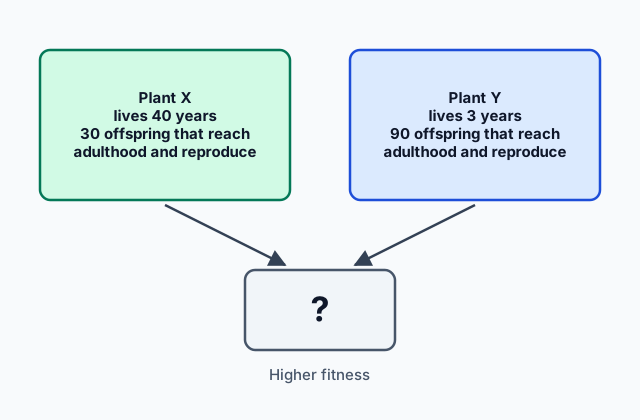
Two plants of the same species grow in one meadow. Plant X lives 40 years, and 30 of its offspring reach adulthood and reproduce. Plant Y lives 3 years, and 90 of its offspring reach adulthood and reproduce. Which plant has the higher evolutionary fitness?
In short. Natural selection is a major mechanism of evolution: competition for limited resources results in differential survival, and individuals with more favorable phenotypes are more likely to survive and produce more offspring.
- Individuals with more favorable phenotypes are more likely to survive and produce more offspring, passing those traits to later generations.
- Evolutionary fitness is measured by reproductive success, not by size, strength or length of life.
- Biotic and abiotic environments can fluctuate, so different genetic variations can be selected in each generation.
Part 2 Learn it How natural selection works
2a. Competition and differential survival
Natural selection is a major mechanism of evolution. It is not the only one; later topics add random processes.
According to Darwin's theory of natural selection, competition for limited resources results in differential survival: food, water, mates or space are too scarce for every individual, and some survive better than others. Individuals with more favorable phenotypes are more likely to survive and produce more offspring, thus passing on those favorable traits to subsequent generations.
For a trait to be passed on this way it has to be inherited. Over many generations, the favorable phenotypes tend to become more common in the population.
Quick check · Put it in order
A population of seed-eating mice lives in a field where the seeds run short each winter. Put these events in the order they happen as natural selection acts on the population, ending with the population that results.
2b. Fitness is reproductive success
Evolutionary fitness is measured by reproductive success: how many offspring an individual leaves that survive and go on to reproduce themselves.
Fitness is not the same as being the biggest, the strongest or the longest-lived. Those count only as far as they lead to more reproducing offspring. An individual that lives a long time but leaves few offspring passes on fewer of its alleles than one that lives briefly and leaves many.
So when you compare fitness, count offspring that reach adulthood and reproduce, not eggs laid or seeds made.
Quick check · Multiple choice
Four birds of one species nest in the same forest. Bird A lays 12 eggs, and 2 of its chicks survive to breed. Bird B lays 6 eggs, and 5 survive to breed. Bird C lays 8 eggs, and 3 survive to breed. Bird D lays 4 eggs, and all 4 survive to breed. Which bird has the highest evolutionary fitness?
2c. A changing environment
What counts as a favorable phenotype depends on the environment, and the environment does not stay still.
- The biotic environment is the living part: predators, prey, parasites, competitors and mates.
- The abiotic environment is the nonliving part: temperature, rainfall, light, soil and water chemistry.
Biotic and abiotic environments can fluctuate, affecting the rate and direction of evolution. Different genetic variations can be selected in each generation. A phenotype favored in a dry year may be at a disadvantage in a wet one, so selection can push a trait one way and then back.
Quick check · Sort it
Each card describes a change in the environment of a population of lizards. Tap a card, then the part of the environment that changed.
Biotic
Abiotic
Part 3 Watch it done Beetles on dark soil
Predict first, then watch each step, then finish the reasoning yourself.
A population of beetles has 100 green and 100 brown individuals, and color is inherited. On dark brown soil, birds eat 60% of the green beetles and 20% of the brown ones before they breed. Every surviving beetle leaves the same number of offspring, each the color of its parent. What percent of the next generation is brown, to the nearest whole percent? These numbers are a teaching example.
Predict first
Before you open the first step, predict: how will the brown share of the next generation compare with the brown share now?
Step 1 · Count the green survivors
Birds eat 60% of 100 green beetles, so 40 survive.
Step 2 · Count the brown survivors
Birds eat 20% of 100 brown beetles, so 80 survive.
Why this step?
Why can you work from the survivors instead of counting offspring?
Every survivor leaves the same number of offspring, each the color of its parent, so the colors appear in the next generation in the same proportions as among the survivors.
Step 3 · Find the brown share
Divide the brown survivors by all the survivors, then turn it into a percent.
Your step · Calculate
A beetle population has 100 green and 100 brown individuals, and color is inherited. Birds eat 60% of the green beetles and 20% of the brown ones before they breed. Every survivor leaves the same number of offspring, each the color of its parent. What percent of the next generation is brown, to the nearest whole percent?
%
About 67% brown, up from 50%. The birds did not change any beetle's color; they changed which beetles lived to breed, so the favorable phenotype became more common in one generation.
Part 4 Try it Wet years and dry years
A population of seed-eating birds lives on an island where rain varies from year to year. In dry years most seeds left are large and hard, and birds with deeper beaks crack them more easily. In wet years small, soft seeds are plentiful, and birds with shallower beaks handle them more easily. Beak depth is inherited. This island is a teaching example. The first question asks whether selection will push beaks one way every generation, and the second how the average beak depth most likely changes over years of alternating rain.
Try it · Decide and justify
On an island, birds with deeper beaks survive better in dry years, when most seeds are large and hard, and birds with shallower beaks survive better in wet years, when small, soft seeds are plentiful. Beak depth is inherited. After one dry year, a student says selection will now push the birds' beaks deeper in every generation that follows. Is the student right?
Which statement supports your decision?
Try it · Multiple choice
On an island, birds with deeper beaks survive better in dry years and birds with shallower beaks survive better in wet years. Beak depth is inherited. Over ten years, dry and wet years alternate. How does the average beak depth in the population most likely change over those years?
Part 5 Explain it White fur and shrinking snow
On the exam this is handwritten, so answer on paper first. Nothing you type here leaves this page. Then check your answer against the model and each scoring point.
Free response is 50% of the exam score. This one is shaped like Question 4, Conceptual Analysis.
Free-response practice · Question 4 style
A population of hares lives where snow covers the ground for most of the winter. Fur color is inherited: some hares turn white in winter, and some stay brown. Foxes hunt the hares by sight, and food is scarce in winter.
(a) Describe how competition for limited resources and predation could lead to differential survival in this population.
(b) Explain why white winter fur could become more common in the population over many generations.
(c) Identify the measure biologists use to compare the evolutionary fitness of white and brown hares.
(d) Over several decades, the snow comes later and melts earlier each year. Predict how this could change which fur color is favored, and explain your prediction.
Model answer
(a) Food is too scarce in winter for every hare, so hares compete for it, and foxes catch the hares they can see most easily. Hares whose fur matches the snow are more likely to escape foxes and survive the winter.
(b) Hares with white winter fur are more likely to survive and produce more offspring, which inherit the white fur. Over many generations, the favorable trait is passed on more often than brown fur, so it becomes more common.
(c) Reproductive success: the number of offspring each hare leaves that survive and reproduce.
(d) With less time under snow, white hares stand out against bare brown ground for more of the year, so brown fur could become the favorable phenotype in more seasons. The abiotic environment has changed, which can change the direction of selection.
Score your own answer. This is a self-check, not a grade. Tick each point your answer makes.
Part 6 Check yourself Lizard legs after a storm
All three case questions use the table.
On an island, lizards with long legs run fast on broad tree trunks, and lizards with short legs grip thin branches well. A storm strips the island's large trees, leaving mostly thin shrubs. Researchers count the offspring that survive to breed per adult lizard in a year before the storm and the year after it. These numbers are a teaching example.
| Leg length | Year before the storm (broad trees) | Year after the storm (thin shrubs) |
|---|---|---|
| Short | 1.2 | 1.8 |
| Long | 2.4 | 1.2 |
Case question 1 · Calculate
Using the table: in the year after the storm, short-legged lizards left how many times as many offspring surviving to breed, per adult, as long-legged lizards did?
Case question 2 · Multiple choice
Using the table: which conclusion do the data best support?
Case question 3 · Multiple choice
Using the table: why do the researchers count offspring that survive to breed, rather than how long each adult lives, to compare the two leg lengths?
The rest stand on their own and do not use the case.
Check yourself · Spot the error
A student explains how thick fur became common in a population of hares in a cold region. Tap the line with the mistake.
Check yourself · Match
Match each part of natural selection to an example of it in a population of frogs in a pond.
Part 7 Keep it Bring back earlier ideas
Natural selection acts on the variation the last unit produced. Pulling back how an antibiotic leaves only the cells with a resistance gene, and how resistance to an insecticide spreads, sets up selection in whole populations.
From 6.8 Biotechnology · Multiple choice
Bacteria are given a plasmid that carries a gene for antibiotic resistance and a gene for a glowing protein, and only some of the cells take it up. They are then spread on a plate containing the antibiotic. Which colonies grow on the plate?
From 6.7 Mutations · Spot the error
A student explains how a population of insects became resistant to an insecticide. Tap the line with the mistake.
In three lines
- Natural selection is a major mechanism of evolution: competition for limited resources results in differential survival.
- Individuals with more favorable phenotypes are more likely to survive and produce more offspring; fitness is reproductive success.
- Biotic and abiotic environments can fluctuate, so different genetic variations can be selected in each generation.
Exam strategy for this topic
- Section I, Multiple Choice: 60 questions in 90 minutes.
- Section II, Free Response: 6 questions in 90 minutes.
- This lesson's Explain it is shaped like free-response question 4, Conceptual Analysis.
- A four-function, scientific, or graphing calculator is allowed on both sections of the exam.
Tell the story in order: limited resources, competition, differential survival, more offspring for the favorable phenotype, and a change in the next generation. Measure fitness as reproductive success, and say which environment you are judging in.
Questions students ask
What causes natural selection?
Competition for limited resources results in differential survival. Individuals with more favorable phenotypes are more likely to survive and produce more offspring, passing on those favorable traits to later generations.
How is evolutionary fitness measured?
By reproductive success: the offspring an individual leaves that survive and go on to reproduce. Size, strength and length of life matter only as far as they lead to more such offspring.
Is natural selection the only way populations evolve?
No. Natural selection is a major mechanism of evolution, but evolution is also driven by random occurrences, such as mutation and genetic drift, taught in later topics.
Can selection change direction?
Yes. Biotic and abiotic environments can fluctuate, affecting the rate and direction of evolution, and different genetic variations can be selected in each generation.
Does an individual evolve?
No. A population evolves over generations as the share of individuals with inherited traits changes. Natural selection changes which individuals survive and reproduce.
Course alignment, for teachers
AP Biology topic 7.1, Unit 7: Natural Selection.
- Skill 2.A: Describe characteristics of visual representations of biological concepts and processes.
This lesson maps all 4 essential knowledge statements of the topic to the part that teaches each one: 4 are checked by a scored question. The map is in the lesson file.