Unit 7 · Topic 7.2 · about 30 minutes · 7 parts · 11 scored checks, 2 of them multiple choice, plus 2 from earlier lessons
AP Biology 7.2: Natural Selection
Unit 7: 13 to 20% of the multiple-choice section
What you'll be able to do
- Describe why phenotypic variation in a population matters.
- Explain how variation in the molecules within cells connects to an organism's fitness.
Key vocabulary
| Term | What it means | The exam trap |
|---|---|---|
| Phenotypic variation | Differences among the individuals of a population in their observable characteristics. | Ask whether a difference is inherited before using it to predict the next generation. |
| Selective pressure | A feature of the environment, such as a predator, a climate or a disease, that affects which individuals survive and reproduce. | Name the pressure before deciding which phenotype it acts on. |
| Enzyme form | One version of an enzyme; versions can differ in their amino acids and in how they perform. | Compare each form under the same stated conditions. |
| Transport protein | A membrane protein that moves a particular substance into or out of a cell. | Keep the kind of protein and the number of copies a cell makes as two separate questions. |
 Tap to open the picture full size
Part 1 Think first A lake that changes with the seasons
Commit to a guess first. Being wrong now makes the right idea stick better.
Predict first
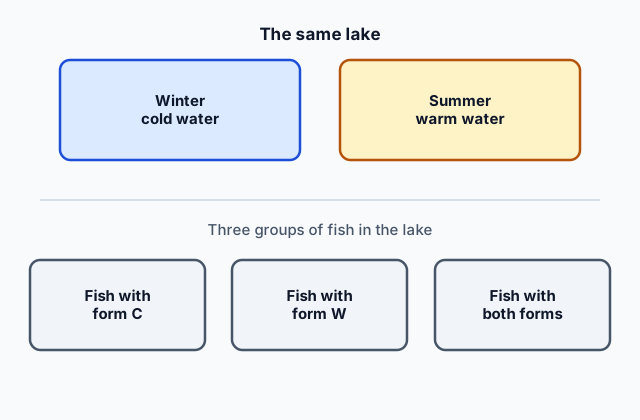
A species of fish lives in a lake that is cold in winter and warm in summer. The fish digest food with an enzyme that comes in two forms: form C works best in cold water and form W works best in warm water. Some fish make only form C, some only form W, and some make both. Which fish are most likely to grow and reproduce well across the whole year?
In short. Natural selection acts on phenotypic variations in populations; some variations can increase or decrease fitness in particular environments, and variation in the number and types of molecules within cells can help a population survive and reproduce in different environments.
- Without differences among individuals in a trait, selection has nothing in that trait to act on.
- Environments change and apply selective pressures, so a variation's effect on fitness depends on the environment.
- Variation in the number and types of molecules within cells, such as different forms of an enzyme, can give a population a greater ability to survive and reproduce in different environments.
Part 2 Learn it Variation and selective pressure
2a. Selection acts on variation
Natural selection acts on phenotypic variations in populations: the differences among individuals in their observable traits.
Selection works by sorting among those differences. Individuals whose phenotypes suit the environment better are more likely to survive and reproduce. If every individual in a population has the same phenotype for a trait, and the same alleles for it, there are no differences in that trait for the environment to sort, so selection cannot change it, however harsh the conditions.
That is why phenotypic variation matters: it is the raw material that selection works on.
Quick check · Decide and justify
In a field population of a plant, every plant has leaves of the same shape, coded by the same alleles. A drought arrives that favors plants losing less water through their leaves. A student predicts that leaf shape in the population will evolve by natural selection over the next generations because of the drought. Is the student right?
Which statement supports your decision?
2b. Selective pressures and fitness
Environments change and apply selective pressures to populations: a new predator, a hotter summer, a disease, a shortage of one food.
Some phenotypic variations can increase or decrease the fitness of an organism in particular environments. The same variation can do both, in different places or times. Dark fur hides a mouse on dark rock and makes it stand out on pale sand. A thick coat helps in a cold winter and can be a burden in heat.
So do not call a variation good or bad on its own. Name the environment, then ask whether the variation helps survival and reproduction there.
Quick check · Sort it
Each card names a variation and the environment an organism lives in. Tap a card, then whether the variation is more likely to raise or lower fitness in that environment.
More likely to raise fitness
More likely to lower fitness
2c. Variation in molecules
Variation does not stop at the visible traits. Variation in the number and types of molecules within cells can provide populations a greater ability to survive and reproduce in different environments.
- Types of molecules. An enzyme can come in more than one form. Two forms that differ in a few amino acids can have different optimal temperatures, so one works better in cold conditions and the other in warm.
- Number of molecules. Cells that make more copies of a membrane transport protein can take in a scarce nutrient faster than cells that make fewer.
When a population holds several molecular variants, some individuals are more likely to do well whichever conditions arrive.
Quick check · Match
Match each environment to the molecular variation most likely to help an organism survive and reproduce there.
Part 3 Watch it done More transport proteins in low sugar
Predict first, then watch each step, then finish the reasoning yourself.
A yeast population has two variants. Cells of variant H make many copies of a sugar transport protein, and cells of variant L make few. In a broth low in sugar, variant H cells double in number every 2 hours and variant L cells every 4 hours. A flask starts with 100 cells of each. After 8 hours, what percent of the cells are variant H? These numbers are a teaching example.
Predict first
Before you open the first step, predict: after 8 hours, what share of the cells will be variant H?
Step 1 · Count the doublings
In 8 hours, variant H doubles 8 ÷ 2 = 4 times, and variant L doubles 8 ÷ 4 = 2 times.
Step 2 · Find each count
Variant H: 100 × 2 × 2 × 2 × 2 = 1,600 cells. Variant L: 100 × 2 × 2 = 400 cells.
Why this step?
Why does variant H reproduce faster in this broth?
Sugar is scarce, and more copies of the transport protein let a cell take in sugar faster, so it has the energy and building blocks to divide more often.
Step 3 · Find variant H's share
Divide variant H's count by the total, then turn it into a percent.
Your step · Calculate
A flask of low-sugar broth starts with 100 cells of yeast variant H, which makes many copies of a sugar transport protein, and 100 cells of variant L, which makes few. Variant H cells double every 2 hours and variant L cells every 4 hours. After 8 hours, what percent of the cells are variant H?
%
80% variant H, up from 50% in 8 hours. A difference in the number of one kind of molecule changed how fast each variant reproduced in this environment.
Part 4 Try it Toxins and temperatures
Two new populations, both teaching examples. In the first question, beetles differ in how many copies of a toxin-breaking enzyme their cells make, and they are moved to a field where the only food plant carries that toxin. In the second, fish differ in which of three forms of a digestive enzyme they carry, and you rank the forms for a lake held warm all year.
Try it · Multiple choice
In a population of beetles, some individuals' cells make many copies of an enzyme that breaks down a toxin found in one plant, and others make few copies. The difference is inherited. The beetles are moved to a field where that plant is their only food. Which change is most likely over the next generations?
Try it · Rank it
Fish in a population each carry one of three forms of a digestive enzyme, with optimal temperatures of 10 °C, 18 °C and 26 °C. The forms are otherwise alike. The fish live in a lake held near 25 °C all year. Rank the forms from the one most likely to help a fish grow and reproduce in this lake to the one least likely.
Most likely to help first
Give each one a place, 1 for first. Give two the same place if they are equal.
Your ranking: none yet
Part 5 Explain it Testing an enzyme form
On the exam this is handwritten, so answer on paper first. Nothing you type here leaves this page. Then check your answer against the model and each scoring point.
Free response is 50% of the exam score. This one is shaped like Question 3, Scientific Investigation.
Free-response practice · Question 3 style
Researchers have two lines of fruit flies that are alike except in one enzyme. Line C carries a form of the enzyme that works best at low temperatures, and line W carries a form that works best at high temperatures. They plan to keep both lines at 15 °C and at 28 °C and compare them.
(a) Identify a dependent variable the researchers could measure to compare the fitness of the two lines.
(b) Identify the independent variables in this plan.
(c) Predict the result at 15 °C if the enzyme form affects fitness.
(d) A wild population carries both forms. Explain how having both forms could help the population persist in a habitat that is cold in some seasons and hot in others.
Model answer
(a) The number of offspring each line produces that survive to adulthood and reproduce (reproductive success).
(b) The enzyme form (line C or line W) and the temperature (15 °C or 28 °C).
(c) At 15 °C, line C would leave more surviving offspring than line W, because its enzyme form works better at low temperatures.
(d) Variation in the types of molecules within cells can give a population a greater ability to survive and reproduce in different environments. In cold seasons, flies with the cold form are more likely to do well, and in hot seasons flies with the hot form, so some individuals are likely to survive and reproduce whichever conditions come.
Score your own answer. This is a self-check, not a grade. Tick each point your answer makes.
Part 6 Check yourself Plants on mine soil
All three case questions use the table.
Near an old copper mine, the soil holds much more copper than ordinary soil. In one species of grass, type T plants make a protein that binds copper inside their cells, and type N plants do not. The difference is inherited. Researchers grow both types on mine soil and on ordinary soil and count the offspring of each plant that survive to reproduce. These numbers are a teaching example.
| Plant type | Mine soil | Ordinary soil |
|---|---|---|
| Type T (makes the protein) | 120 | 80 |
| Type N (does not) | 15 | 100 |
Case question 1 · Calculate
Using the table: on mine soil, type T plants made how many times as many surviving offspring per plant as type N plants?
Case question 2 · Multiple choice
Using the table: which claim do the data best support?
Case question 3 · Decide and justify
Using the table: a student claims that on ordinary soil, type N plants have the higher fitness of the two types. Do the data support the claim?
Which statement supports your decision?
The rest stand on their own and do not use the case.
Check yourself · Spot the error
A student explains how a fish population kept reproducing as its lake warmed over many years. Each fish carries alleles for a cold-adapted form or a warm-adapted form of an enzyme. Tap the line with the mistake.
Check yourself · Fill the statement
Complete the description of how environments shape fitness.
When an environment , it can place new on which individuals survive and reproduce. A variation that raises fitness in one environment can it in another.
Part 7 Keep it Bring back earlier ideas
Different forms of an enzyme matter because enzymes depend on temperature, and selection sorts the variation a population holds. Pulling back the steps of natural selection, and what heat far past its working range does to an enzyme, sets both beside molecular variation.
From 7.1 Introduction to Natural Selection · Put it in order
A population of seed-eating mice lives in a field where the seeds run short each winter. Put these events in the order they happen as natural selection acts on the population, ending with the population that results.
From 3.2 Environmental Impacts on Enzyme Function · Fill the statement
Complete the explanation of what happens to an enzyme that is heated far past its working range.
Heating disrupts the enzyme's folded , so the loses the shape that fits the substrate, and the enzyme can no longer the reaction.
In three lines
- Natural selection acts on phenotypic variations; with no differences in a trait, selection cannot change it.
- Environments change and apply selective pressures, and a variation can raise fitness in one environment and lower it in another.
- Variation in the number and types of molecules within cells can help a population survive and reproduce in different environments.
Exam strategy for this topic
- Section I, Multiple Choice: 60 questions in 90 minutes.
- Section II, Free Response: 6 questions in 90 minutes.
- This lesson's Explain it is shaped like free-response question 3, Scientific Investigation.
- A four-function, scientific, or graphing calculator is allowed on both sections of the exam.
When a question gives variation, name the environment and say which variant it favors and why, in terms of survival and reproduction. Remember that variation includes molecules inside cells, such as enzyme forms and transport proteins.
Questions students ask
Why does phenotypic variation matter?
Natural selection acts on phenotypic variations in populations. Without differences among individuals in a trait, the environment has nothing in that trait to favor.
What is a selective pressure?
A feature of the environment, such as a predator, a change in climate or a disease, that affects which individuals survive and reproduce. Environments change and apply selective pressures to populations.
Can the same trait be helpful and harmful?
Yes. Some phenotypic variations can increase or decrease the fitness of an organism in particular environments, so the same trait can help in one place or time and hurt in another.
How do molecules inside cells affect fitness?
Variation in the number and types of molecules within cells, such as different forms of an enzyme or more copies of a transport protein, can provide populations a greater ability to survive and reproduce in different environments.
Course alignment, for teachers
AP Biology topic 7.2, Unit 7: Natural Selection.
- Skill 1.B: Explain biological concepts and processes.
This lesson maps all 4 essential knowledge statements of the topic to the part that teaches each one: 4 are checked by a scored question. The map is in the lesson file.