Unit 7 · Topic 7.10 · about 30 minutes · 7 parts · 12 scored checks, 2 of them multiple choice, plus 2 from earlier lessons
AP Biology 7.10: Speciation
Unit 7: 13 to 20% of the multiple-choice section
What you'll be able to do
- Describe the conditions under which new species may arise.
- Describe how fast evolution and speciation run under different ecological conditions.
- Explain the processes and mechanisms that drive the formation of new species.
Key vocabulary
| Term | What it means | The exam trap |
|---|---|---|
| Gene flow | The addition or removal of alleles from a population, as individuals or their gametes move in or out. | Say which population gains or loses alleles, and by what movement, before predicting a change. |
| Hybrid | An offspring whose parents come from two different populations or species. | Name both parent groups before drawing a conclusion from a hybrid. |
| Stasis | A long period in which a lineage's traits change little. | Name which trait stayed the same before calling a stretch of the record stasis. |
| Lineage | A line of descent, from an ancestor through its descendants. | Draw a lineage as a branch with its ancestor at the base before comparing it with another. |
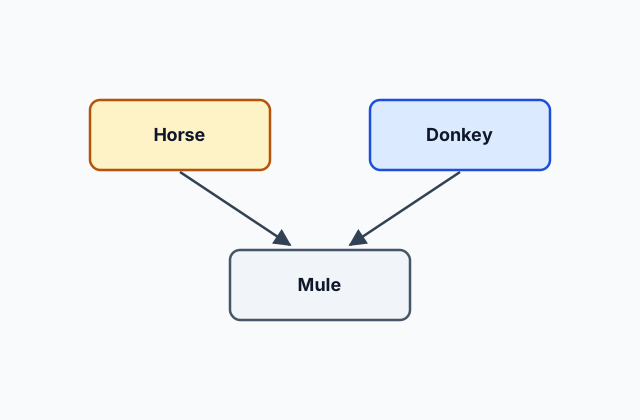 Tap to open the picture full size
Part 1 Think first Horses, donkeys and mules
Commit to a guess first. Being wrong now makes the right idea stick better.
Predict first
A horse and a donkey can mate, and their offspring, a mule, is typically healthy and strong. But mules are typically sterile: they almost never have offspring of their own. Are horses and donkeys one species?
In short. Speciation occurs when two populations become reproductively isolated from each other, so they no longer interbreed and exchange genetic information.
- The biological species concept, commonly used for sexually reproducing organisms, defines a species as a group capable of interbreeding to produce viable, fertile offspring.
- Various pre-zygotic and post-zygotic mechanisms can keep populations isolated; speciation can be allopatric (geographically isolated) or sympatric (with geographic overlap).
- Evolution can run in bursts after long stasis or slowly over long spans; speciation can be especially rapid during adaptive radiation, and convergent evolution gives distantly related groups similar adaptations.
Part 2 Learn it How new species form
2a. What makes a species
Speciation occurs when two populations become reproductively isolated from each other: members of one no longer interbreed with members of the other.
The biological species concept provides a commonly used definition of a species for sexually reproducing organisms. It states that species can be defined as a group capable of interbreeding and exchanging genetic information to produce viable, fertile offspring.
So the test of a species is not how its members look. Two populations can look quite different and still be one species, or look alike and be two.
Quick check · Multiple choice
Two populations of a sexually reproducing fish live in separate lakes. Under the biological species concept, which finding would show that they are separate species?
2b. What keeps species apart
Various pre-zygotic and post-zygotic mechanisms can maintain reproductive isolation and prevent gene flow between populations. A zygote is the cell formed when a sperm fertilizes an egg.
- Pre-zygotic mechanisms act before a zygote can form: for example, two populations that live in different habitats and rarely meet, or whose reproductive parts do not fit together.
- Post-zygotic mechanisms act after a zygote forms: for example, a hybrid that dies young, or one that survives but is infertile.
Either kind stops alleles from passing from one population into the other.
Quick check · Sort it
Each card describes a barrier between two populations of an animal. Tap a card, then the kind of mechanism it is.
Pre-zygotic
Post-zygotic
2c. With or without a barrier
Where the populations live shapes how speciation starts.
- Allopatric speciation occurs in populations that are geographically isolated, such as two groups cut off from each other by a new river or a stretch of sea. With no gene flow between them, mutation, selection and chance can make the groups more and more different.
- Sympatric speciation occurs in populations with geographic overlap. Something other than distance, such as a change in when or how individuals mate, cuts gene flow while the groups share one place.
Quick check · Fill the statement
Complete the description of two ways new species can form.
When a mountain range rises across a population's range and splits it in two, speciation between the two groups is . When one population becomes two species while its members still share the same , the speciation is .
2d. How fast, and in what pattern
Evolution does not always run at the same pace.
- Punctuated equilibrium is when evolution occurs rapidly after a long period of stasis.
- Gradualism is when evolution occurs slowly over hundreds of thousands or millions of years.
The pattern varies too.
- Divergent evolution occurs when adaptation to new habitats results in phenotypic diversification. Speciation rates can be especially rapid during times of adaptive radiation, as new habitats become available.
- Convergent evolution occurs when similar selective pressures result in similar phenotypic adaptations in different populations or species. Cacti in the Americas and some spurges in Africa both store water in thick, spiny stems, though they are not closely related.
Quick check · Match
Match each pattern of evolution to what it looks like.
Part 3 Watch it done A burst after a long wait
Predict first, then watch each step, then finish the reasoning yourself.
A teaching example. Fossils of a snail lineage in one region show its shell height staying about the same for 3,000,000 years. Then, within the next 40,000 years, shell height changes sharply, and after that it stays about the same again. Which pattern does this record fit, and how many times as long as the burst is the stretch of little change?
Predict first
Before you open the first step, predict: which pattern does the snail record fit?
Step 1 · Read the record
3,000,000 years with little change in shell height, then a sharp change within 40,000 years, then little change again.
Step 2 · Name the pattern
Evolution that occurs rapidly after a long period of stasis is punctuated equilibrium. Gradualism would show slow change spread across the whole record.
Why this step?
Why compare the two lengths of time, rather than only how much the shell changed?
Both patterns can end with the same total change. What tells them apart is how the change is spread over time: across the whole record, or in a short burst after a long stasis.
Step 3 · Compare the times
Divide the length of the stasis by the length of the burst.
Your step · Calculate
A teaching example: a snail lineage's shell height stays about the same for 3,000,000 years, then changes sharply within 40,000 years. The stretch of little change is how many times as long as the burst?
75 times as long. A long stasis broken by a short burst of change is the pattern of punctuated equilibrium; under gradualism the change would be spread across the whole 3,040,000 years.
Part 4 Try it Splitting with and without a barrier
Two new situations. First, a river changes course and splits a population of beetles in two: put the events that follow in order. Second, plants in one meadow split into two groups that flower at different times: decide which kind of speciation that is. Both are teaching examples.
Try it · Put it in order
A river changes course and splits a beetle population in two. Put the events in order, from the split to two separate species.
Try it · Decide and justify
In one meadow, a plant population comes to include some plants that flower in early spring and others that flower in late summer. Pollen moves only between plants in flower at the same time. After many generations, the two groups can no longer interbreed, though they still grow side by side. Which kind of speciation is this?
Which statement supports your decision?
Part 5 Explain it Many finches from one
On the exam this is handwritten, so answer on paper first. Nothing you type here leaves this page. Then check your answer against the model and each scoring point.
Free response is 50% of the exam score. This one is shaped like Question 4, Conceptual Analysis.
Free-response practice · Question 4 style
A single species of finch reached a chain of newly formed volcanic islands. Over a long time, the islands came to hold several finch species, with beaks of different shapes suited to the different foods on each island.
(a) Describe the condition that must be met for one population to become a separate species.
(b) Explain why speciation rates can be especially rapid when new habitats like these become available.
(c) Identify whether the variety of beaks is an example of divergent or convergent evolution, and explain your answer.
(d) Describe one pre-zygotic mechanism that could keep two of the finch species from interbreeding where they now share an island.
Model answer
(a) The two populations must become reproductively isolated from each other, so they no longer interbreed and exchange genetic information to produce viable, fertile offspring.
(b) New habitats offer many open ways of living. Adaptation to each new habitat results in phenotypic diversification, so speciation rates can be especially rapid during this adaptive radiation.
(c) Divergent evolution: one ancestral species adapted to different foods and habitats, and its descendants became phenotypically different from one another.
(d) If birds of one species respond only to the songs or courtship displays of their own species, they do not mate with the other species, so no zygote forms. (Breeding at different times of year also earns the point.)
Score your own answer. This is a self-check, not a grade. Tick each point your answer makes.
Part 6 Check yourself Flies raised on different foods
All three case questions use the table.
Researchers split one population of fruit flies into two groups and raise one group on starch food and the other on maltose food for many generations. Then they put flies from both groups together and record which pairs mate. These numbers are a teaching example.
| Female raised on | Male raised on | Matings observed |
|---|---|---|
| Starch | Starch | 26 |
| Starch | Maltose | 6 |
| Maltose | Maltose | 22 |
| Maltose | Starch | 6 |
Case question 1 · Calculate
Using the table: what percentage of all the observed matings were between flies raised on the same food?
Case question 2 · Multiple choice
Using the table: which best describes the barrier the data show beginning to form between the two groups?
Case question 3 · Decide and justify
Using the table: by the biological species concept, do the data show that the two groups of flies are now separate species?
Which statement supports your decision?
The rest stand on their own and do not use the case.
Check yourself · Spot the error
A student explains why sharks and dolphins both have a streamlined body shape. Tap the line with the mistake.
Check yourself · Sort it
Each card describes how a group of species came to be as it is. Tap a card, then the pattern of evolution it shows.
Divergent evolution
Convergent evolution
Part 7 Keep it Bring back earlier ideas
New species form when populations stop exchanging genes and are shaped by selection. Pulling back what a node on a cladogram stands for, and how selection spreads a resistance allele, sets speciation beside them.
From 7.9 Phylogeny · Multiple choice
On a cladogram, lineages K and L branch apart at the same node. What does that node represent?
From 6.7 Mutations · Spot the error
A student explains how a population of insects became resistant to an insecticide. Tap the line with the mistake.
In three lines
- Speciation occurs when populations become reproductively isolated; a species is commonly defined as a group that can produce viable, fertile offspring.
- Pre-zygotic and post-zygotic mechanisms keep species apart; speciation is allopatric with a geographic barrier, sympatric with overlap.
- Punctuated equilibrium and gradualism describe pace; divergent evolution and adaptive radiation diversify groups, and convergent evolution makes distantly related groups alike.
Exam strategy for this topic
- Section I, Multiple Choice: 60 questions in 90 minutes.
- Section II, Free Response: 6 questions in 90 minutes.
- This lesson's Explain it is shaped like free-response question 4, Conceptual Analysis.
- A four-function, scientific, or graphing calculator is allowed on both sections of the exam.
When a question asks whether two populations are separate species, look for evidence about interbreeding and offspring, then name what keeps the groups apart and whether it acts before or after a zygote forms.
Questions students ask
What is the biological species concept?
A commonly used definition of a species for sexually reproducing organisms: a group capable of interbreeding and exchanging genetic information to produce viable, fertile offspring.
When does speciation occur?
Speciation occurs when two populations become reproductively isolated from each other, so they no longer interbreed and exchange genetic information.
What is the difference between allopatric and sympatric speciation?
Allopatric speciation occurs in populations that are geographically isolated. Sympatric speciation occurs in populations with geographic overlap.
What is the difference between punctuated equilibrium and gradualism?
Punctuated equilibrium is when evolution occurs rapidly after a long period of stasis. Gradualism is when evolution occurs slowly over hundreds of thousands or millions of years.
How are divergent and convergent evolution different?
Divergent evolution occurs when adaptation to new habitats results in phenotypic diversification, and it can be especially rapid during adaptive radiation. Convergent evolution occurs when similar selective pressures result in similar phenotypic adaptations in different populations or species.
Course alignment, for teachers
AP Biology topic 7.10, Unit 7: Natural Selection.
- Skill 2.B: Explain relationships between characteristics of biological models in both theoretical and applied contexts.
- Skill 6.E: Predict the causes or effects of a change in, or disruption to, one or more components in a biological system.
This lesson maps all 7 essential knowledge statements of the topic to the part that teaches each one: 7 are checked by a scored question. The map is in the lesson file.