Unit 7 · Topic 7.11 · about 30 minutes · 7 parts · 11 scored checks, 4 of them multiple choice, plus 2 from earlier lessons
AP Biology 7.11: Variations in Populations
Unit 7: 13 to 20% of the multiple-choice section
What you'll be able to do
- Explain how the genetic diversity of a species or population affects its ability to withstand environmental pressures.
Key vocabulary
| Term | What it means | The exam trap |
|---|---|---|
| Genetic diversity | The variety of alleles, and of combinations of them, carried by the members of a population or species. | Say which genes the variation is in before comparing two populations. |
| Environmental perturbation | A disturbance or change in an organism's surroundings, such as a drought, a new disease or a change in temperature. | Name the pressure the change brings before predicting which individuals survive it. |
| Population dynamics | How the size and makeup of a population change over time. | Say which way a population is changing, and over what span of time, before explaining why. |
| Allele | One of the different versions of a gene. | Name the gene an allele belongs to before describing what the allele does. |
 Tap to open the picture full size
Part 1 Think first One kind of potato
Commit to a guess first. Being wrong now makes the right idea stick better.
Predict first
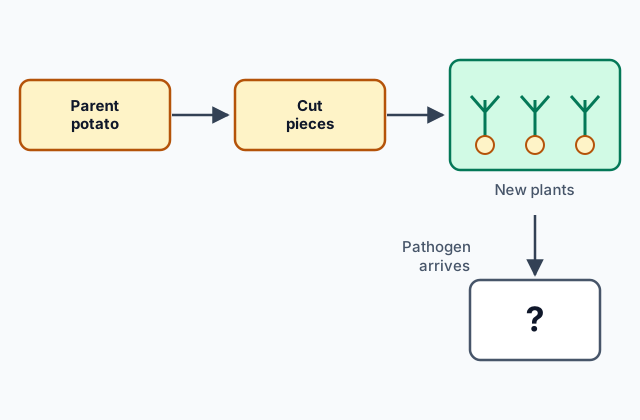
In the 1840s, many farms in Ireland grew mostly one variety of potato. Each new plant was grown from a piece cut from a potato of that variety, not from a seed. When a new plant pathogen arrived, it destroyed most of the crop across the country. Why was the crop hit so hard?
In short. The level of variation in a population affects its population dynamics: genetic diversity influences how well a population can respond to changes in its environment.
- Species and populations with little genetic diversity are at risk of decline or extinction.
- Genetically diverse populations hold up better under environmental perturbation, because they are more likely to include individuals that can withstand the pressure.
- Alleles that are adaptive in one environmental condition may be deleterious in another, because of different selective pressures.
Part 2 Learn it Diversity and survival
2a. Little diversity, more risk
The level of variation in a population affects population dynamics. The ability of a population to respond to changes in the environment is influenced by its genetic diversity: how many different alleles, and combinations of them, its members carry.
Species and populations with little genetic diversity are at risk of decline or extinction. If nearly every individual carries the same alleles, a change that harms one individual is likely to harm almost all of them, and natural selection has little variation to act on.
Quick check · Multiple choice
Two populations of the same species of tree are the same size. In population X, the trees carry many different alleles at most genes; in population Y, nearly all the trees carry the same alleles. Which population is more at risk of decline from a change in its environment, and why?
2b. Diversity and resilience
Genetically diverse populations are more resilient to environmental perturbation, a disturbance such as a drought, a new disease or a rise in temperature. They are more likely to contain individuals that can withstand the environmental pressure.
Those individuals survive and reproduce, so the population can persist, and the alleles that helped them become more common in later generations. Diversity does not protect every individual; it raises the chance that some individuals already carry a way through.
Quick check · Fill the statement
Complete the description of why a varied population copes better with a disturbance.
When a new disease reaches a population with many different alleles, the population is more likely to some individuals that can survive it. Those individuals and pass on their alleles, so the population is more than one whose members are nearly identical.
2c. Helpful here, harmful there
Alleles that are adaptive in one environmental condition may be deleterious in another, because of different selective pressures.
For example, an allele for a dark coat may hide a mouse on dark lava rock but make it easy for hawks to spot on pale sand. The allele itself does not change; the selective pressure does.
So a population that holds a range of alleles is more likely to persist when the environment changes: some alleles that mattered little before may now help.
Quick check · Sort it
Each card names an allele and the environment it is in. Tap a card, then whether the allele is likely to help or harm survival there.
Adaptive
Deleterious
Part 3 Watch it done Who withstands a new herbicide
Predict first, then watch each step, then finish the reasoning yourself.
A teaching example. Two populations of a weed, X and Y, each have 500 plants. Population X has many alleles at the gene a new herbicide affects, and 12% of its plants carry an allele that lets them survive the herbicide. In population Y, nearly every plant has the same allele at that gene, and only 0.4% carry the surviving allele. The herbicide is sprayed on both. How many plants in each population can withstand it?
Predict first
Before you open the first step, predict: how will the number of surviving plants in the two populations compare?
Step 1 · Population X
12% of 500 plants: 0.12 × 500 = 60 plants can withstand the herbicide.
Why this step?
Why does the share carrying the allele matter more here than the number of plants?
Both populations have 500 plants, so size cannot explain a difference. What differs is how many plants already carry an allele that lets them withstand the pressure, which depends on the population's genetic diversity.
Step 2 · Population Y
Turn 0.4% into a decimal, then multiply by the 500 plants.
Your step · Calculate
A teaching example: a weed population has 500 plants, nearly every plant has the same allele at the gene a new herbicide affects, and only 0.4% of its plants carry an allele that lets them survive the herbicide. How many plants in this population can withstand it?
plants
2 plants against 60 in population X. With the same number of plants, the more genetically diverse population is far more likely to contain individuals that can withstand the herbicide, so it is more resilient; population Y is at risk of decline.
Part 4 Try it When the beach changes color
A teaching example. A population of 400 snails lives on a beach of dark rocks: 300 have dark shells and 100 have light shells. A storm covers the beach with pale sand. Over the next season, birds find dark snails easily on the sand, and 60 dark snails and 90 light snails survive. First, work out what share of the survivors have dark shells; then decide what the change shows about the shell-color alleles.
Try it · Calculate
A teaching example: a population of 400 snails on dark rocks has 300 dark-shelled and 100 light-shelled snails. After a storm covers the beach with pale sand, 60 dark snails and 90 light snails survive the season. What percentage of the surviving snails have dark shells?
Try it · Multiple choice
A snail population on dark rocks was 75% dark-shelled. After a storm covered the beach with pale sand and birds hunted the snails for a season, 40% of the survivors were dark-shelled. What does this change best show?
Part 5 Explain it A small, uniform population
On the exam this is handwritten, so answer on paper first. Nothing you type here leaves this page. Then check your answer against the model and each scoring point.
Free response is 50% of the exam score. This one is shaped like Question 4, Conceptual Analysis.
Free-response practice · Question 4 style
A small population of a wild cat lives in one region. Nearly all the cats carry the same alleles at most of their genes.
(a) Describe why this population is at greater risk of decline or extinction than a genetically diverse population of the same species.
(b) Explain how the arrival of a new disease could affect this population differently from a genetically diverse population.
(c) Conservation workers bring in a few cats from a distant population of the same species, which carry different alleles. Explain how this could change the population's ability to respond to changes in its environment.
(d) An allele common in the cats helps them keep warm in the region's cold winters. Explain why the same allele might not be adaptive if the region's climate became much warmer.
Model answer
(a) The ability of a population to respond to changes in the environment is influenced by genetic diversity. With nearly identical alleles, the cats would all respond to a change in much the same way, so populations with little genetic diversity are at risk of decline or extinction.
(b) In a diverse population, some cats are more likely to carry alleles that let them withstand the disease; they survive and reproduce. In this population, a disease that harms one cat is likely to harm nearly all of them, so the population could decline sharply.
(c) The new cats add alleles, raising genetic diversity. The population is then more likely to contain individuals that can withstand a future environmental pressure, so it is more resilient.
(d) Alleles that are adaptive in one environmental condition may be deleterious in another, because of different selective pressures. In a warmer climate, keeping warm no longer helps survival and could make it harder for the cats to stay cool.
Score your own answer. This is a self-check, not a grade. Tick each point your answer makes.
Part 6 Check yourself Three wildflower populations and a fungus
All three case questions use the table.
Researchers count the number of different alleles found at five genes in three populations of the same wildflower. Then they expose 200 plants from each population to a new fungus and record the percentage that survive. These numbers are a teaching example.
| Population | Different alleles at five genes | Plants surviving the fungus (%) |
|---|---|---|
| P | 18 | 44 |
| Q | 10 | 18 |
| R | 5 | 2 |
Case question 1 · Calculate
Using the table: the percentage of plants surviving in population P is how many times the percentage surviving in population R?
Case question 2 · Multiple choice
Using the table: which conclusion do the data best support?
Case question 3 · Multiple choice
Using the table: researchers plant seedlings from population P among population R, and the two interbreed for several generations. What is the most likely effect on population R's survival of the fungus?
The rest stand on their own and do not use the case.
Check yourself · Spot the error
A student explains how a population of lake fish came through a summer when the water's oxygen level fell. Tap the line with the mistake.
Check yourself · Rank it
Three populations of the same grass species have the same number of plants. A new disease reaches all three. Rank them from the population most likely to contain plants that can withstand the disease to the one least likely.
Most likely to contain plants that withstand it first
Give each one a place, 1 for first. Give two the same place if they are equal.
Your ranking: none yet
Part 7 Keep it Bring back earlier ideas
Genetic diversity is what speciation and selection work with, and much of it comes from sexual reproduction. Pulling back what shows two populations are separate species, and why offspring of the same parents differ, sets diversity beside them.
From 7.10 Speciation · Multiple choice
Two populations of a sexually reproducing fish live in separate lakes. Under the biological species concept, which finding would show that they are separate species?
From 5.2 Meiosis and Genetic Diversity · Spot the error
A student explains why offspring of the same two parents differ. Tap the line with the mistake.
In three lines
- Genetic diversity influences how well a population can respond to changes in its environment.
- Populations with little diversity are at risk of decline or extinction; diverse ones are more likely to contain individuals that withstand a pressure.
- An allele adaptive in one environmental condition may be deleterious in another, because the selective pressures differ.
Exam strategy for this topic
- Section I, Multiple Choice: 60 questions in 90 minutes.
- Section II, Free Response: 6 questions in 90 minutes.
- This lesson's Explain it is shaped like free-response question 4, Conceptual Analysis.
- A four-function, scientific, or graphing calculator is allowed on both sections of the exam.
When a question compares populations facing a change, compare their genetic diversity, say which is more likely to contain individuals that can withstand the pressure, and name the environment before calling any allele helpful or harmful.
Questions students ask
Why does genetic diversity matter to a population?
The ability of a population to respond to changes in the environment is influenced by genetic diversity. Species and populations with little genetic diversity are at risk of decline or extinction.
Why are diverse populations more resilient?
Genetically diverse populations are more likely to contain individuals that can withstand an environmental pressure, so some survive and reproduce when the environment is disturbed.
Can an allele be helpful in one place and harmful in another?
Yes. Alleles that are adaptive in one environmental condition may be deleterious in another, because of different selective pressures.
Does a pressure like a new disease create resistant individuals?
No. A diverse population is more likely to already contain individuals that can withstand the pressure; those individuals survive and reproduce, and their alleles become more common.
Course alignment, for teachers
AP Biology topic 7.11, Unit 7: Natural Selection.
- Skill 6.C: Provide reasoning to justify a claim by connecting evidence to biological theories.
This lesson maps the one essential knowledge statement of the topic to the part that teaches each one: 1 is checked by a scored question. The map is in the lesson file.