Unit 7 · Topic 7.12 · about 30 minutes · 7 parts · 11 scored checks, 3 of them multiple choice, plus 2 from earlier lessons
AP Biology 7.12: Origins of Life on Earth
Unit 7: 13 to 20% of the multiple-choice section
What you'll be able to do
- Describe the scientific evidence that supports models of how life on Earth began.
Key vocabulary
| Term | What it means | The exam trap |
|---|---|---|
| Catalyst | A substance that speeds up a chemical reaction without being used up by it. | Say which reaction a catalyst speeds up before naming the catalyst. |
| Genetic continuity | Genetic information passing on from one generation to the next. | Name the molecule passed on, and how it is copied, before describing continuity. |
| Model | A simplified explanation of how something happened or works, which evidence can test. | List the evidence a model rests on before judging how well it holds up. |
| Replication | The copying of a nucleic acid to make a new molecule that carries the same information. | Name the strand being copied before describing the new one. |
 Tap to open the picture full size
Part 1 Think first Which came first
Commit to a guess first. Being wrong now makes the right idea stick better.
Predict first
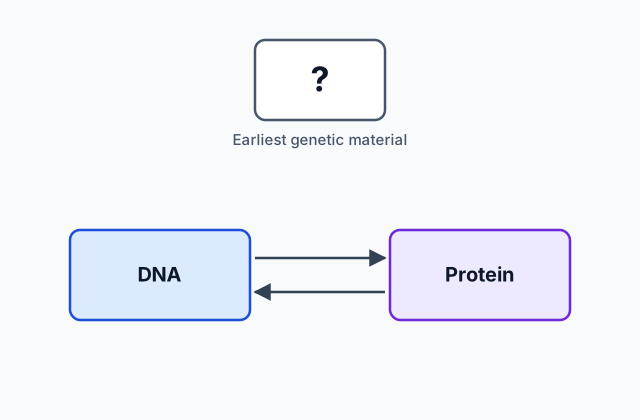
In cells today, DNA stores the genes, and proteins do most of the work of speeding up reactions, including copying DNA. But making proteins needs the information in DNA, and copying DNA needs proteins. Which kind of molecule could have been the earliest genetic material, before this partnership existed?
In short. The origin of life on Earth is supported by scientific evidence: geological evidence and fossils give a plausible range of dates, and the RNA world hypothesis proposes that RNA could have been the earliest genetic material.
- Earth formed approximately 4.6 billion years ago (bya); the environment was too hostile for life until about 3.9 bya, and the earliest fossil evidence for life dates to 3.5 bya.
- Taken together, these dates provide a plausible range for the origin of life, and geological evidence reinforces models of it.
- The RNA world hypothesis assumes that at some point in time RNA replication assured genetic continuity, that base-pairing is necessary for replication, and that genetically encoded proteins were not involved as catalysts.
Part 2 Learn it How and when life began
2a. Dating the first life
The origin of life on Earth is supported by scientific evidence, and geological evidence reinforces models of it.
- Earth formed approximately 4.6 billion years ago (bya).
- The environment was too hostile for life until about 3.9 bya.
- The earliest fossil evidence for life dates to 3.5 bya.
Taken together, this evidence provides a plausible range of dates for the origin of life: after the environment stopped being too hostile, and by the time of the earliest fossils.
Quick check · Match
Match each time to what the evidence places there.
2b. An RNA world
The RNA world hypothesis proposes that RNA could have been the earliest genetic material. It rests on three assumptions:
- At some point in time, genetic continuity was assured by the replication of RNA.
- Base-pairing is necessary for replication.
- Genetically encoded proteins were not involved as catalysts.
In other words, RNA would have carried information from one generation of molecules to the next, copied by pairing bases, with no enzymes made from genes doing the copying. DNA and proteins would have taken on their roles later.
Quick check · Sort it
Each card states a claim about early life. Tap a card, then whether it is one of the assumptions of the RNA world hypothesis.
An assumption
Not an assumption
2c. Testing the models
A model of the origin of life makes predictions that new evidence can test. A model that places the origin of life between about 3.9 and 3.5 bya predicts, for example, that no fossil of a living thing will turn up in rock from the time when the environment was too hostile for life. Each new rock or fossil that fits reinforces the model; one that does not would challenge it.
A test often starts from a null hypothesis: the statement that there is no effect or nothing to find, which the data can then support or reject. Finding something that the null hypothesis says is absent is evidence against it.
Quick check · Decide and justify
A team reports what appear to be fossil cells in rock dated to 4.2 billion years ago. If the find holds up, would it support or weaken the current range of dates for the origin of life?
Which statement supports your decision?
Part 3 Watch it done A range, not a moment
Predict first, then watch each step, then finish the reasoning yourself.
Earth's environment was too hostile for life until about 3.9 billion years ago, and the earliest fossil evidence for life dates to 3.5 billion years ago. How many million years long is the span between these two dates, the plausible range for the origin of life?
Predict first
Before you open the first step, predict: does the earliest fossil mark the moment life began?
Step 1 · List the dates
Earth formed approximately 4.6 bya; the environment was too hostile for life until about 3.9 bya; the earliest fossil evidence dates to 3.5 bya.
Step 2 · Pick the two ends
Life could not have begun while the environment was too hostile, so the range starts about 3.9 bya. Life existed by the time of the earliest fossils, so it ends by 3.5 bya.
Why this step?
Why does the range not start when Earth formed?
Earth formed approximately 4.6 bya, but its environment was too hostile for life until about 3.9 bya, so life could not have begun before then.
Step 3 · Find the span
Subtract the later date from the earlier one, then turn billions of years into millions.
Your step · Calculate
Earth's environment was too hostile for life until about 3.9 billion years ago, and the earliest fossil evidence for life dates to 3.5 billion years ago. How many million years long is the span between these two dates?
million years
About 400 million years, from about 3.9 to 3.5 billion years ago. The fossils show that life existed by 3.5 bya; together with the end of the hostile environment, they give a plausible range for the origin of life, not a single moment.
Part 4 Try it Testing an RNA world
Two new questions about the RNA world hypothesis. First, decide which finding would weaken it. Second, a teaching example: a short RNA strand is copied by base pairing, and you count one kind of base in the copy.
Try it · Multiple choice
Which finding would most weaken the RNA world hypothesis?
Try it · Calculate
A teaching example: a single RNA strand 24 nucleotides long has 6 A, 8 U, 5 G and 5 C. It is copied by base pairing into a complementary RNA strand. How many uracil (U) bases does the copy have?
Part 5 Explain it Copying RNA without proteins
On the exam this is handwritten, so answer on paper first. Nothing you type here leaves this page. Then check your answer against the model and each scoring point.
Free response is 50% of the exam score. This one is shaped like Question 3, Scientific Investigation.
Free-response practice · Question 3 style
Researchers want to test one assumption of the RNA world hypothesis: that RNA could be copied without genetically encoded proteins acting as catalysts. They set up tubes holding a short RNA template strand and loose RNA nucleotides, with no proteins, and measure how many complementary strands form in a day.
(a) Identify the null hypothesis for this investigation.
(b) Identify an appropriate control for this investigation, and justify your choice.
(c) Predict the result that would support the assumption being tested.
(d) Explain why base pairing is needed for the template to be copied.
Model answer
(a) Without proteins, no complementary RNA strands form from the template.
(b) A tube with the same loose nucleotides and conditions but no template strand. It shows whether any strands that form depend on the template rather than forming by chance.
(c) Complementary strands form in the tubes with the template and no proteins, more than in the control tube.
(d) Base-pairing is necessary for replication: each nucleotide joining the new strand pairs with a base of the template, A with U and G with C, so the new strand carries the template's information in complementary form.
Score your own answer. This is a self-check, not a grade. Tick each point your answer makes.
Part 6 Check yourself Dated rocks and the first life
All three case questions use the table.
Geologists examine rock samples of different ages from several sites and record what each sample holds. These samples are a teaching example; their ages fit the dates the evidence gives for early Earth.
| Sample | Age of rock (billion years) | What the rock holds |
|---|---|---|
| A | 4.4 | Mineral grains, no fossils |
| B | 3.8 | No fossils |
| C | 3.5 | Fossil traces of cells |
| D | 3.2 | Fossil traces of cells |
Case question 1 · Calculate
Using the table: how many million years older is sample A than the oldest sample that holds fossils?
Case question 2 · Multiple choice
Using the table: which statement do the samples best support?
Case question 3 · Multiple choice
Using the table: a team will test sample B for chemical traces of living things. Which is the null hypothesis for their test?
The rest stand on their own and do not use the case.
Check yourself · Spot the error
A student describes the RNA world hypothesis. Tap the line with the mistake.
Check yourself · Decide and justify
A student says the earliest fossil evidence for life, dated to 3.5 billion years ago, shows that life began exactly 3.5 billion years ago. Is the student right?
Which statement supports your decision?
Part 7 Keep it Bring back earlier ideas
The RNA world rests on base pairing, met in Unit 6, and the first life began the history of variation and selection this unit follows. Pulling back how bases pair, and why diverse populations cope better with change, links the origin of life to both.
From 7.11 Variations in Populations · Multiple choice
Two populations of the same species of tree are the same size. In population X, the trees carry many different alleles at most genes; in population Y, nearly all the trees carry the same alleles. Which population is more at risk of decline from a change in its environment, and why?
From 6.1 DNA and RNA Structure · Match
Match each base, in the molecule named, to the base it pairs with.
In three lines
- Earth formed approximately 4.6 bya; the environment was too hostile for life until about 3.9 bya; the earliest fossils date to 3.5 bya.
- Together these dates give a plausible range for the origin of life, and geological evidence reinforces the models.
- The RNA world hypothesis proposes RNA as the earliest genetic material, copied by base pairing without proteins encoded by genes.
Exam strategy for this topic
- Section I, Multiple Choice: 60 questions in 90 minutes.
- Section II, Free Response: 6 questions in 90 minutes.
- This lesson's Explain it is shaped like free-response question 3, Scientific Investigation.
- A four-function, scientific, or graphing calculator is allowed on both sections of the exam.
Keep each date with what it marks: Earth's formation at approximately 4.6 bya, the end of the hostile environment at about 3.9 bya, and the earliest fossils at 3.5 bya. Then name which assumption of the RNA world hypothesis a finding bears on.
Questions students ask
How old is Earth, and when did life begin?
Earth formed approximately 4.6 billion years ago. The environment was too hostile for life until about 3.9 bya, and the earliest fossil evidence for life dates to 3.5 bya. Together these give a plausible range of dates for the origin of life.
What evidence supports models of the origin of life?
The origin of life on Earth is supported by scientific evidence. Geological evidence reinforces the models, and the dates of Earth's formation, of its hostile early environment and of the earliest fossils give a plausible range.
What is the RNA world hypothesis?
It proposes that RNA could have been the earliest genetic material, with genetic continuity assured by the replication of RNA.
What are the assumptions of the RNA world hypothesis?
At some point in time, genetic continuity was assured by the replication of RNA; base-pairing is necessary for replication; and genetically encoded proteins were not involved as catalysts.
Course alignment, for teachers
AP Biology topic 7.12, Unit 7: Natural Selection.
- Skill 3.B: State the null hypothesis or predict the results of an experiment.
This lesson maps all 2 essential knowledge statements of the topic to the part that teaches each one: 2 are checked by a scored question. The map is in the lesson file.