Unit 8 · Topic 8.1 · about 30 minutes · 7 parts · 12 scored checks, 3 of them multiple choice, plus 2 from earlier lessons
AP Biology 8.1: Responses to the Environment
Unit 8: 10 to 15% of the multiple-choice section
What you'll be able to do
- Explain how the behavioral and physiological response of an organism is related to changes in internal or external environment.
- Explain how the behavioral responses of organisms affect their overall fitness and may contribute to the success of a population.
Key vocabulary
| Term | What it means | The exam trap |
|---|---|---|
| Signal | Something one organism gives off, such as a sound, a sight or a scent, that another organism can detect. | Name who sends the signal and who receives it before saying what it does. |
| Innate behavior | A behavior an organism performs without having to learn it from experience. | Check whether the behavior appears without practice before calling it innate. |
| Learned behavior | A behavior that develops or changes through an organism's experience. | Look at the behavior's effect on survival and reproduction before predicting how common it becomes. |
| Fitness | How well an individual survives and reproduces, measured by its offspring that survive to reproduce. | Count offspring that survive to reproduce, not food eaten or size, when comparing fitness. |
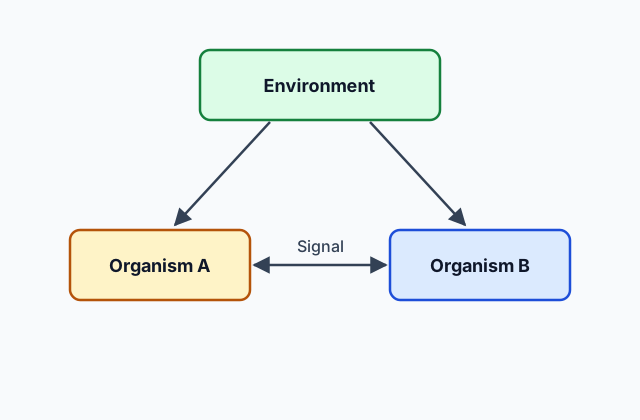 Tap to open the picture full size
Part 1 Think first A call that warns the flock
Commit to a guess first. Being wrong now makes the right idea stick better.
Predict first
When one bird in a feeding flock spots a hawk, it gives a sharp call, and the whole flock flies into cover. Calling may draw the hawk's attention to the caller. Why might a behavior like this persist in a bird population?
In short. Organisms respond to changes in their environment through behavioral and physiological mechanisms, and they exchange information with one another through signals that can change behavior.
- Organisms communicate through several kinds of signals, and signaling behaviors can change how other organisms behave.
- Signals that change the behavior of others can result in differential reproductive success.
- Fitness favors innate and learned behaviors that increase survival and reproductive success, and cooperative behavior tends to increase the fitness of the individual and the survival of the population.
Part 2 Learn it Responses, signals and fitness
2a. Responding to change
Organisms respond to changes in their environment through behavioral and physiological mechanisms.
- A behavioral response is a change in what the organism does: moving somewhere else, hiding, calling or traveling to a new area.
- A physiological response is a change in how its body works inside: its temperature, how fast its heart beats, how much water it loses or how it grows.
A hare that crouches under a bush when a storm starts is responding with behavior. A hare whose coat turns white as winter comes on is responding physiologically. You do not need the details of how any of these mechanisms work, only which kind of response each one is and what change set it off.
Quick check · Sort it
Each card describes how an organism responds to a change in its environment. Tap a card, then the kind of response it is.
Behavioral
Physiological
2b. Exchanging information
Organisms exchange information with one another in response to internal changes, such as hunger, and external cues, such as a predator coming near. The information can change how the receiver behaves.
Organisms communicate through various mechanisms:
- visual signals, which are seen;
- audible signals, which are heard;
- tactile signals, which are felt by touch;
- electrical signals, which some animals in water give off and sense;
- chemical signals, which are smelled or tasted.
A cat that fluffs its fur and arches its back sends a visual signal, and a cricket chirping at dusk sends an audible one. What matters here is the kind of signal and its effect on the receiver, not the details of how it is made or sensed.
Quick check · Match
Match each kind of signal to an example of it.
2c. What signals do
Organisms have a variety of signaling behaviors that produce changes in the behavior of other organisms. Animals use signals to:
- indicate dominance, which animal ranks above another in a group;
- find food, and lead others to it;
- establish territory, an area an animal claims and keeps others of its kind out of;
- ensure reproductive success, such as by attracting a mate.
Because signals change how others behave, they can result in differential reproductive success: some individuals leave more offspring that survive to reproduce than others do. A male frog whose call draws more females, for example, may father more offspring than a quieter male.
Quick check · Fill the statement
Complete the description of what two signals do.
A wolf that stands tall with its tail raised over a lower-ranking member of its pack is signaling . A songbird that sings from the edges of a stretch of woods and chases other males of its species out of it is establishing a .
2d. Behavior and natural selection
Responses to information and communication of information are vital to natural selection and evolution.
- Fitness favors innate and learned behaviors that increase survival and reproductive success. This holds whether an individual was born able to perform a behavior or learned it.
- Cooperative behavior tends to increase the fitness of the individual and the survival of the population. Animals that take turns watching for predators, or that hunt together, can each do better than they would alone.
Behavior is not separate from selection. It is one of the ways an individual's traits affect whether it survives and reproduces.
Quick check · Decide and justify
In a population of ground-nesting birds, chicks that learn to recognize the call of a predator and hide when they hear it survive to reproduce more often than chicks that do not. Over many generations, would natural selection tend to favor this learned response?
Which statement supports your decision?
Part 3 Watch it done Songs and surviving offspring
Predict first, then watch each step, then finish the reasoning yourself.
A teaching example. In a population of songbirds, males sing to claim and hold a territory. Over one season, 24 males that held a territory left 72 offspring that survived to reproduce, and 16 males without a territory left 8. How many times as many surviving offspring per male did the territory holders leave?
Predict first
Before you open the first step, predict: which males had the greater reproductive success per male?
Step 1 · Per male, territory holders
72 surviving offspring shared among 24 males is 72 / 24 = 3 per male.
Step 2 · Per male, no territory
8 surviving offspring shared among 16 males is 8 / 16 = 0.5 per male.
Why this step?
Why work out offspring per male before comparing, rather than comparing 72 with 8?
The two groups have different numbers of males. Reproductive success belongs to individuals, so the fair comparison is how many surviving offspring each male left on average.
Step 3 · Compare
Divide the territory holders' offspring per male by the other males' offspring per male.
Your step · Calculate
A teaching example: in a songbird population, 24 males that held a territory left 72 offspring that survived to reproduce, and 16 males without a territory left 8. Territory holders left how many times as many surviving offspring per male?
6 times as many. A signal that helps a male hold a territory goes with greater reproductive success, which is how signaling behavior can result in differential reproductive success.
Part 4 Try it Information passed along
Two new situations, both teaching examples. First, a worker ant finds food far from its nest: put the events that follow in order. Second, a hungry chick calls and its parent brings food: choose what kind of exchange that is.
Try it · Put it in order
A worker ant finds food away from its nest. Put the events in order, from the find to the food reaching the nest.
Try it · Multiple choice
A hungry chick calls loudly, and its parent responds by bringing it food. Which best describes this exchange?
Part 5 Explain it Do male moths follow a scent?
On the exam this is handwritten, so answer on paper first. Nothing you type here leaves this page. Then check your answer against the model and each scoring point.
Free response is 50% of the exam score. This one is shaped like Question 3, Scientific Investigation.
Free-response practice · Question 3 style
Researchers hypothesize that males of one moth species find females by detecting a chemical that the females release. They place 20 males, one at a time, at one end of a wind tunnel. At the other end they place either a filter paper treated with an extract from females or an untreated filter paper, and they record whether each male flies to the paper.
(a) Identify the independent variable and the dependent variable in this investigation.
(b) Explain why the researchers include the untreated filter paper.
(c) State the null hypothesis for this investigation.
(d) Predict the results if the researchers' hypothesis is correct, and explain how responding to this signal could affect a male's reproductive success.
Model answer
(a) The independent variable is whether the filter paper carries the extract from females. The dependent variable is whether each male flies to the paper (or how many males do).
(b) The untreated paper is the control. It shows how males behave toward a paper with no female extract, so any difference can be credited to the extract rather than to the paper or the tunnel.
(c) The extract from females has no effect on whether males fly to the paper.
(d) Far more males fly to the treated paper than to the untreated one. A male that detects the chemical and follows it is more likely to find a female and mate, so he is likely to leave more offspring.
Score your own answer. This is a self-check, not a grade. Tick each point your answer makes.
Part 6 Check yourself Groups with and without a lookout
All three case questions use the table.
Researchers follow 16 groups of a small desert mammal through one season. In 8 groups, one member at a time stands watch and gives an alarm call when a predator approaches. The other 8 groups have no lookout. These numbers are a teaching example.
| Groups | Members at start | Members alive at end |
|---|---|---|
| With a lookout | 80 | 68 |
| Without a lookout | 80 | 44 |
Case question 1 · Calculate
Using the table: what percentage of the members of groups with a lookout were alive at the end of the season?
Case question 2 · Multiple choice
Using the table: which conclusion do the data best support?
Case question 3 · Multiple choice
Researchers want to know whether the alarm calls, rather than some other difference between the groups, explain the gap in survival. Which added procedure would best test this?
The rest stand on their own and do not use the case.
Check yourself · Spot the error
A student predicts how song length will change in a population of songbirds. Tap the line with the mistake.
Check yourself · Decide and justify
In a teaching example, when caterpillars chew the leaves of one plant, it releases a chemical into the air. Nearby plants of the same species that were not chewed then begin making compounds that caterpillars avoid. Is this an example of organisms exchanging information?
Which statement supports your decision?
Part 7 Keep it Bring back earlier ideas
Organisms respond to signals from other organisms much as cells respond to signals from other cells, and all of it rests on a long history of life. Pulling back the kinds of response a cell makes, and the timeline of early Earth, keeps both in reach.
From 7.12 Origins of Life on Earth · Match
Match each time to what the evidence places there.
From 4.3 Signal Transduction Pathways · Sort it
Each card describes a cell's response to a signal. Tap a card, then the kind of response it is.
A change in gene expression
A change in the activity of proteins already present
Programmed cell death
In three lines
- Organisms respond to changes in their environment through behavioral and physiological mechanisms.
- They exchange information through visual, audible, tactile, electrical and chemical signals that change the behavior of others.
- Fitness favors innate and learned behaviors that increase survival and reproduction; cooperative behavior tends to help the individual and the population.
Exam strategy for this topic
- Section I, Multiple Choice: 60 questions in 90 minutes.
- Section II, Free Response: 6 questions in 90 minutes.
- This lesson's Explain it is shaped like free-response question 3, Scientific Investigation.
- A four-function, scientific, or graphing calculator is allowed on both sections of the exam.
When a question describes a behavior, name what changed in the environment or inside the organism, what the response or signal is, and how it affects survival and reproduction.
Questions students ask
What is the difference between a behavioral and a physiological response?
A behavioral response is a change in what an organism does, such as moving into shade. A physiological response is a change in how its body works inside, such as growing a thicker coat.
How do organisms communicate?
Organisms communicate through various mechanisms: visual, audible, tactile, electrical and chemical signals.
What do animals use signals for?
Animals use signals to indicate dominance, find food, establish territory and ensure reproductive success.
Does natural selection act on behavior?
Yes. Responses to information and communication of information are vital to natural selection and evolution, and fitness favors innate and learned behaviors that increase survival and reproductive success.
Why does cooperative behavior persist?
Cooperative behavior tends to increase the fitness of the individual and the survival of the population.
Beyond the AP Exam
College Board sets these limits on what the AP Exam asks about this topic. Anything past them is not on the exam.
Knowledge of specific behavioral or physiological mechanisms is beyond the scope of the AP Exam.
Knowledge of specific mechanisms of communication is beyond the scope of the AP Exam.
The details of the various communications and community behavioral systems are beyond the scope of the AP Exam.
Course alignment, for teachers
AP Biology topic 8.1, Unit 8: Ecology.
- Skill 3.C: Identify experimental procedures that align with the question, including:
This lesson maps all 4 essential knowledge statements of the topic to the part that teaches each one: 4 are checked by a scored question. The map is in the lesson file.