Unit 7 · Topic 7.3 · about 30 minutes · 7 parts · 11 scored checks, 4 of them multiple choice, plus 2 from earlier lessons
AP Biology 7.3: Artificial Selection
Unit 7: 13 to 20% of the multiple-choice section
What you'll be able to do
- Explain how humans can affect the diversity within a population of another species.
Key vocabulary
| Term | What it means | The exam trap |
|---|---|---|
| Inherited trait | A characteristic passed from parents to offspring through the alleles they carry. | Check whether the question says a trait is inherited, fully or only in part. |
| Breed | A population of a domestic species kept separate and bred for a set of traits. | Name the breed you mean when you compare traits. |
| Genetic variation | Differences in DNA sequence among the individuals of a population. | Say which population you are describing before judging its variation. |
| Mean | The average of a set of measurements: their sum divided by how many there are. | Read the units of every column before comparing numbers. |
 Tap to open the picture full size
Part 1 Think first Saving seed from the tallest plants
Commit to a guess first. Being wrong now makes the right idea stick better.
Predict first
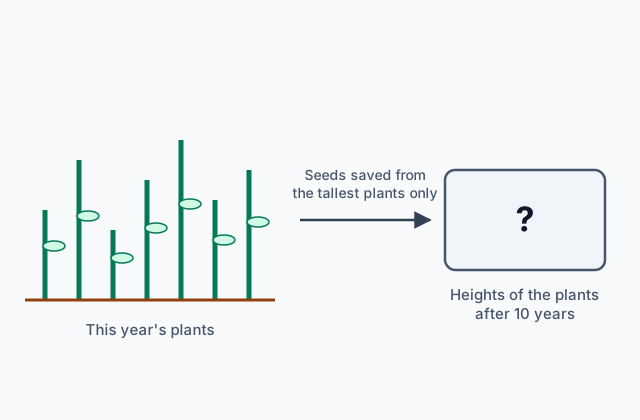
A farmer's corn plants vary in height. Each year for 10 years, the farmer saves seed only from the tallest plants and plants it the next spring. Height is partly inherited. After 10 years, how will the variety of plant heights in the field most likely compare with the first year?
In short. Through artificial selection, humans affect variation in other species: people choose which individuals breed, so inherited traits they favor can become more common over generations.
- In artificial selection, people decide which individuals reproduce, based on traits they want.
- Breeding toward one trait can narrow the variation within a population and leave it with fewer alleles.
- Breeding separate lines toward different traits can make populations of one species differ widely from one another.
Part 2 Learn it Humans as the selecting force
2a. People choose the parents
In natural selection, the environment determines which individuals survive and reproduce. In artificial selection, people do: a breeder or farmer picks the individuals with wanted traits and lets only those breed.
The chosen traits must be at least partly inherited. Offspring of the chosen parents tend to carry the wanted traits, and the breeder chooses again among them. Over generations, the wanted traits become more common and often more extreme.
Through artificial selection, humans affect variation in other species: the crops we grow and the animals we keep are populations shaped by human choices.
Quick check · Multiple choice
A horse breeder wants a calmer line of horses. Which plan is artificial selection?
2b. Less variation within a population
Choosing parents for one trait changes the variation within a population, often by reducing it.
- The trait narrows. If only the largest fruit are saved for seed, fruit size moves toward the large end and spreads over a narrower range.
- Alleles can be lost. When a few chosen parents supply every offspring, the alleles carried only by the individuals left out are not passed on. A crop grown from a few selected plants can hold much less genetic variation than a wild population of the same species.
A population with little genetic variation has fewer differences for any new pressure, such as a new disease, to act on.
Quick check · Decide and justify
A seed company grows a wheat variety whose seed all comes from a few plants chosen for large harvests. A student claims this field of wheat most likely holds less genetic variation than a wild population of the same species. Is the student right?
Which statement supports your decision?
2c. Different lines from one species
Artificial selection can also make populations of one species differ widely from one another.
Suppose breeders start from one population and keep separate lines. In one line they choose for long fur, and in another for short fur. Each line becomes more uniform inside, while the two lines grow further apart. Over many generations, lines bred toward different traits can look strikingly different, though they remain one species.
So artificial selection can narrow variation within each population and widen the differences between populations, both at once.
Quick check · Sort it
Each card describes what decides which individuals reproduce. Tap a card, then the kind of selection it describes.
Artificial selection
Natural selection
Part 3 Watch it done Heavier tomatoes
Predict first, then watch each step, then finish the reasoning yourself.
A gardener saves seed each year only from the plants with the heaviest tomatoes. In the starting generation, generation 0, the mean tomato mass is 40 grams. In generation 4, it is 72 grams. On average, how many grams did the mean rise per generation? These numbers are a teaching example.
Predict first
Before you open the first step, predict: how many steps from one generation to the next lie between generation 0 and generation 4?
Step 1 · Find the total rise
72 − 40 = 32 grams from generation 0 to generation 4.
Step 2 · Count the steps
Generation 0 to 1, 1 to 2, 2 to 3 and 3 to 4: four steps from one generation to the next.
Why this step?
Why did the mean rise at all?
The gardener chose only the plants with the heaviest tomatoes as parents. Tomato mass is partly inherited, so each generation's offspring carried more of the alleles for heavy fruit.
Step 3 · Find the rise per generation
Divide the total rise by the number of steps.
Your step · Calculate
A gardener saves seed each year only from the plants with the heaviest tomatoes. In generation 0 the mean tomato mass is 40 grams, and in generation 4 it is 72 grams. On average, by how many grams did the mean rise per generation?
grams
8 grams per generation. The gardener changed the population's tomatoes only by choosing which plants reproduced.
Part 4 Try it Two lines of rabbits
Breeders start with one population of rabbits whose fur length varies and is inherited. For 10 generations they keep two separate lines: in line A they breed only the longest-furred rabbits, and in line B only the shortest-furred. This is a teaching example. The first question asks how the two lines compare after 10 generations, and the second asks you to put the breeding steps for line A in order.
Try it · Multiple choice
Breeders start with one population of rabbits whose fur length varies and is inherited. For 10 generations, they breed line A from only the longest-furred rabbits and line B from only the shortest-furred. Compared with the starting population, how do the two lines most likely look after 10 generations, each within itself and against each other?
Try it · Put it in order
Put the steps for breeding a line of long-furred rabbits in order, from the first step to the result after many generations.
Part 5 Explain it Mice bred for running
On the exam this is handwritten, so answer on paper first. Nothing you type here leaves this page. Then check your answer against the model and each scoring point.
Free response is 50% of the exam score. This one is shaped like Question 6, Analyze Data.
Free-response practice · Question 6 style
Researchers start with one population of mice and keep two lines for 8 generations. In the selected line, only the mice that run the most on an exercise wheel are bred. In the control line, mice are bred at random. In both lines at the start, the mean is 5,000 wheel turns per day. In generation 8, it is 9,000 in the selected line and 5,100 in the control line. These numbers are a teaching example.
(a) Describe the difference between the two lines in generation 8.
(b) Explain the purpose of the control line.
(c) Explain how the breeding plan produced the change in the selected line.
(d) Predict how the variation in wheel running within the selected line compares with the control line in generation 8, and justify your prediction.
Model answer
(a) In generation 8 the selected line runs a mean of 9,000 turns per day, about 1.8 times the control line's 5,100.
(b) The control line is kept the same way except that its parents are chosen at random. It shows how much wheel running changes without selection, so the difference can be credited to the choice of parents.
(c) Only the mice that ran the most were allowed to breed. Running is at least partly inherited, so their offspring carried more of the alleles for high running, and choosing again each generation moved the mean up.
(d) The selected line most likely varies less. Its parents always came from the high end of the range, so alleles for low running were passed on less often, while the randomly bred control line keeps more of the starting variation.
Score your own answer. This is a self-check, not a grade. Tick each point your answer makes.
Part 6 Check yourself Ten generations of corn
All three case questions use the table.
Farmers grow a population of corn for 10 generations. Researchers measure the length of the ears in generations 0, 5 and 10, recording the mean and the shortest and longest ear. These numbers are a teaching example.
| Generation | Mean ear length (cm) | Shortest to longest ear (cm) |
|---|---|---|
| 0 | 15 | 8 to 22 |
| 5 | 19 | 14 to 24 |
| 10 | 23 | 21 to 26 |
Case question 1 · Calculate
Using the table: the spread of ear lengths is the longest ear minus the shortest. By how many centimeters did the spread shrink from generation 0 to generation 10?
Case question 2 · Multiple choice
Using the table: which description fits the data from generation 0 to generation 10?
Case question 3 · Multiple choice
Using the table: ear length is partly inherited. Which practice most likely explains the change across the 10 generations?
The rest stand on their own and do not use the case.
Check yourself · Spot the error
A student explains why a disease wiped out most of a crop variety. Tap the line with the mistake.
Check yourself · Fill the statement
Complete the description of breeding by people.
In artificial selection, decide which individuals , so the traits they favor become more common over .
Part 7 Keep it Bring back earlier ideas
Artificial selection is selection with people in the environment's place. Pulling back why selection needs variation, and how fitness is measured, sets the human choice beside the natural one.
From 7.2 Natural Selection · Decide and justify
In a field population of a plant, every plant has leaves of the same shape, coded by the same alleles. A drought arrives that favors plants losing less water through their leaves. A student predicts that leaf shape in the population will evolve by natural selection over the next generations because of the drought. Is the student right?
Which statement supports your decision?
From 7.1 Introduction to Natural Selection · Multiple choice
Four birds of one species nest in the same forest. Bird A lays 12 eggs, and 2 of its chicks survive to breed. Bird B lays 6 eggs, and 5 survive to breed. Bird C lays 8 eggs, and 3 survive to breed. Bird D lays 4 eggs, and all 4 survive to breed. Which bird has the highest evolutionary fitness?
In three lines
- Through artificial selection, humans affect variation in other species by choosing which individuals reproduce.
- Choosing parents for one trait can narrow the variation within a population and leave it with fewer alleles.
- Separate lines bred toward different traits can make populations of one species differ widely.
Exam strategy for this topic
- Section I, Multiple Choice: 60 questions in 90 minutes.
- Section II, Free Response: 6 questions in 90 minutes.
- This lesson's Explain it is shaped like free-response question 6, Analyze Data.
- A four-function, scientific, or graphing calculator is allowed on both sections of the exam.
When a question describes breeding, say who chooses the parents and which trait they choose, then describe both changes: the trait moves in the chosen direction, and the variation within the population often narrows.
Questions students ask
What is artificial selection?
Breeding in which people choose which individuals reproduce, based on traits they want. Through artificial selection, humans affect variation in other species.
How is artificial selection different from natural selection?
In natural selection the environment determines which individuals survive and reproduce. In artificial selection, people make that choice.
Does artificial selection increase or decrease variation?
Both, at different levels. Within one population, breeding for one trait often narrows the variation and can lose alleles. Between populations bred toward different traits, the differences can grow.
Why can a crop with little genetic variation be at risk?
A population with little genetic variation has few differences for a new pressure to act on. If a new disease arrives and few plants carry an allele that resists it, most of the crop can be lost.
Course alignment, for teachers
AP Biology topic 7.3, Unit 7: Natural Selection.
- Skill 4.B: Describe data from a table or graph, including:
This lesson maps the one essential knowledge statement of the topic to the part that teaches each one: 1 is checked by a scored question. The map is in the lesson file.