Unit 7 · Topic 7.4 · about 30 minutes · 7 parts · 12 scored checks, 3 of them multiple choice, plus 2 from earlier lessons
AP Biology 7.4: Population Genetics
Unit 7: 13 to 20% of the multiple-choice section
What you'll be able to do
- Explain how random occurrences affect the genetic makeup of a population.
- Describe the role of random processes in the evolution of particular populations.
- Describe how the genetic makeup of a population changes over time.
Key vocabulary
| Term | What it means | The exam trap |
|---|---|---|
| Population | A group of individuals of one species that live in the same area and can breed with one another. | Name which population you mean before judging a change in it. |
| Allele frequency | How common one allele is among all the copies of a gene in a population, written as a decimal or a percentage. | Say which population and which generation a frequency describes before comparing two of them. |
| Migration | The movement of individuals into or out of a population. | Say where the individuals moved from and to before judging the effect. |
 Tap to open the picture full size
Part 1 Think first A fire that picks no favorites
Commit to a guess first. Being wrong now makes the right idea stick better.
Predict first
Snails in a meadow have brown or yellow shells, set by one gene. A wildfire kills 95 of the 100 snails, and which ones die has nothing to do with shell color. Compared with before the fire, how are the alleles for shell color among the 5 survivors most likely to be?
In short. Evolution is driven not only by natural selection but also by random occurrences, which can change the allele frequencies of a population; those changes provide evidence that the population is evolving.
- Mutation is a random process that adds new genetic variation, and genetic drift is a change in allele frequencies from a nonselective process in small populations.
- The bottleneck and founder effects are kinds of genetic drift, and migration can cause gene flow, adding or removing alleles.
- Drift can allow a small population to diverge from others of its species, while gene flow between two populations prevents them from diverging into separate species.
Part 2 Learn it Random change in a population
2a. Mutation and genetic drift
Natural selection is not the only thing that changes a population. Evolution is also driven by random occurrences.
- Mutation is a random process that adds new genetic variation to a population. Mutations result in genetic variation, which provides the phenotypes on which natural selection acts.
- Genetic drift is a change in allele frequencies attributable to a nonselective process occurring in small populations. Which individuals happen to survive and reproduce, regardless of their traits, can shift the alleles passed on.
Drift matters most when a population is small. In a large population, chance gains and losses of an allele tend to even out; in a small one, a few chance events can move an allele's frequency a long way.
Quick check · Multiple choice
A meadow holds 30 wildflowers, some red and some white. One spring, a deer happens to trample and kill 12 of them, without regard to flower color. No plants, seeds or pollen arrive from other meadows. In the next generation, the share of the white allele has changed. Which process best accounts for the change?
2b. Bottlenecks and founders
Two kinds of genetic drift come up again and again.
- The bottleneck effect occurs when a population's size is reduced to a small number of individuals for at least one generation, for example after a flood or a fire. The survivors carry only some of the alleles the larger population had, in proportions set partly by chance.
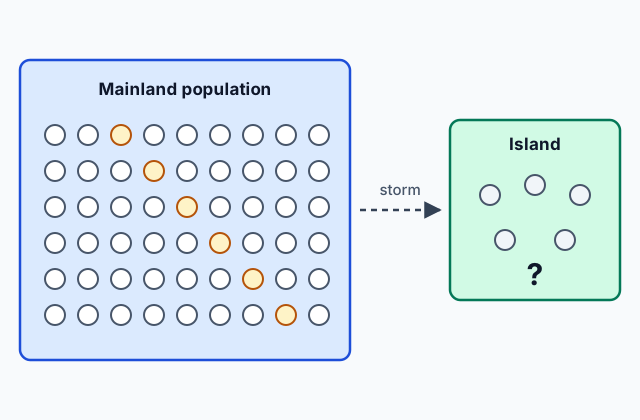
- The founder effect occurs when a group is separated from the other members of its population, for example a few birds carried to an island. The frequency of genes and traits will shift based on the genes in this new founder population.
In both, a small sample of a population becomes the whole gene source for the generations that follow.
Quick check · Decide and justify
Six lizards drift on a fallen tree from the mainland to an island where none of their species lived. They breed there, and over many generations a large island population grows from them. Is the island population's makeup an example of the bottleneck effect or the founder effect?
Which statement supports your decision?
2c. Gene flow, and staying one species
Migration can result in gene flow: the addition or removal of alleles from a population as individuals move into or out of it.
These random processes pull populations in opposite directions.
- Genetic drift can allow a small population to diverge from other populations of the same species, as its allele frequencies wander away from theirs.
- Gene flow between two populations prevents them from diverging into separate species, because alleles keep moving between them.
Quick check · Fill the statement
Complete the description of how random processes affect whether two populations of one species stay alike.
When individuals move between populations, alleles are carried with them, which is . Steady movement like this keeps two populations from into separate species. A small population cut off from the others may instead drift apart, because chance changes its allele .
2d. What counts as evolution
Changes in allele frequencies provide evidence for the occurrence of evolution in a population. If an allele that made up 30% of a population's copies of a gene makes up 50% ten generations later, the population has evolved, whatever the cause: selection, drift, gene flow or mutation.
Changes within one individual's life, such as growing larger with age, are not evolution of a population. Neither is a population simply getting bigger, if the share of each allele stays the same.
Quick check · Sort it
Each card describes a change in a population of fish. Tap a card, then whether it shows the population evolving.
Shows evolution
Does not show evolution
Part 3 Watch it done The alleles five founders carry
Predict first, then watch each step, then finish the reasoning yourself.
On a mainland, the allele a, for pale feathers, makes up 0.1 of a bird species' gene copies. A storm carries 5 of the birds to an empty island: 3 are AA, 1 is Aa and 1 is aa. What is the frequency of allele a among the founders? These birds are a teaching example.
Predict first
Before you open the first step, predict: how will the frequency of a among the founders compare with the mainland's 0.1?
Step 1 · Count all the gene copies
Each bird is diploid, so it carries two copies of the gene. 5 birds carry 10 copies.
Step 2 · Count the a copies in each genotype
AA birds carry no a. The Aa bird carries one a, and the aa bird carries two.
Why this step?
Why not just count the birds that have pale feathers?
An allele frequency is a share of gene copies, not of birds. The Aa bird carries an a allele too, and the aa bird carries two of them.
Step 3 · Divide
Add the a copies, then divide by all 10 copies.
Your step · Calculate
A storm carries 5 birds to an empty island: 3 have genotype AA, 1 has Aa and 1 has aa. On the mainland they came from, allele a makes up 0.1 of the gene copies. What is the frequency of allele a among the 5 founders? Give a decimal.
0.3 among the founders against 0.1 on the mainland. The island population that grows from these birds starts with frequencies based on their genes: the founder effect.
Part 4 Try it After a flood, and between two ponds
Two new situations, both teaching examples. In the first, a flood leaves only 10 beetles of a large population, and you work out how much one allele's frequency changed. In the second, you decide whether two frog populations linked by migration are likely to split into separate species.
Try it · Calculate
Before a flood, allele B makes up 0.5 of the gene copies in a large population of beetles. The flood kills beetles at random and leaves 10: 6 are BB, 3 are Bb and 1 is bb. By how much did the frequency of B change? Give a decimal.
Try it · Decide and justify
Two populations of one frog species live in ponds joined by a stream, and every year some frogs move from each pond to the other and breed there. Are the two populations likely to diverge into separate species?
Which statement supports your decision?
Part 5 Explain it Small and large fly populations
On the exam this is handwritten, so answer on paper first. Nothing you type here leaves this page. Then check your answer against the model and each scoring point.
Free response is 50% of the exam score. This one is shaped like Question 3, Scientific Investigation.
Free-response practice · Question 3 style
Researchers set up 10 small populations of fruit flies, with 10 flies each, and 10 large populations, with 1,000 flies each. In every population, allele E of one gene starts at a frequency of 0.5. The gene has no effect on survival or reproduction, and no flies move between populations. After 20 generations they measure the frequency of E in each population.
(a) State a null hypothesis for the effect of population size on the frequency of E.
(b) Predict which group of populations will show larger changes in the frequency of E, and explain your prediction.
(c) Explain why a change in the frequency of E in a population is evidence that the population evolved.
(d) The researchers then let a few flies move between the small populations every generation. Predict the effect on how different the small populations become from one another.
Model answer
(a) Population size has no effect on how much the frequency of E changes over 20 generations.
(b) The small populations. The gene does not affect survival, so any change is genetic drift, a change in allele frequencies from a nonselective process that occurs in small populations. With only 10 flies, chance in who reproduces can move the frequency a long way; in 1,000 flies, chance changes tend to even out.
(c) Changes in allele frequencies provide evidence for the occurrence of evolution in a population. A population whose frequency of E moved away from 0.5 has changed genetically over generations.
(d) The small populations would become less different from one another. Moving flies cause gene flow, which adds and removes alleles and keeps populations from diverging.
Score your own answer. This is a self-check, not a grade. Tick each point your answer makes.
Part 6 Check yourself One large population and one small
All three case questions use the table.
Researchers follow the frequency of allele R of one gene in two populations of the same plant species. Population X has about 5,000 plants and population Y has 20. The gene has no effect on survival or reproduction, and no plants or pollen move between the populations. These numbers are a teaching example.
| Generation | Population X (about 5,000 plants) | Population Y (20 plants) |
|---|---|---|
| 0 | 0.500 | 0.500 |
| 10 | 0.510 | 0.625 |
| 20 | 0.490 | 0.400 |
| 30 | 0.500 | 0.700 |
Case question 1 · Calculate
Using the table: by how much did the frequency of R in population Y change from generation 0 to generation 30? Give a decimal.
Case question 2 · Multiple choice
Using the table: the frequency of R swings widely in population Y but barely moves in population X. Which best explains the difference?
Case question 3 · Multiple choice
Using the table: which conclusion do the data best support?
The rest stand on their own and do not use the case.
Check yourself · Put it in order
Put the events of a founder effect in order, from first to last.
Check yourself · Spot the error
A student explains why fish in two lakes have stayed one species. Tap the line with the mistake.
Part 7 Keep it Bring back earlier ideas
Random processes change a population's alleles alongside the selection of the last topics, and new alleles come from mutation. Pulling back how breeders choose which animals reproduce, and what makes a mutation helpful or harmful, sets chance beside selection.
From 7.3 Artificial Selection · Multiple choice
A horse breeder wants a calmer line of horses. Which plan is artificial selection?
From 6.7 Mutations · Multiple choice
A mutation gives a moth darker wings. In a forest with dark tree bark, dark moths are eaten less by birds; in a forest with pale bark, they are eaten more. How is this mutation best described?
In three lines
- Evolution is also driven by random occurrences: mutation adds variation, and genetic drift changes allele frequencies in small populations.
- The bottleneck and founder effects are kinds of drift; migration can result in gene flow, which prevents two populations from diverging.
- Changes in allele frequencies provide evidence that a population is evolving, whatever the cause.
Exam strategy for this topic
- Section I, Multiple Choice: 60 questions in 90 minutes.
- Section II, Free Response: 6 questions in 90 minutes.
- This lesson's Explain it is shaped like free-response question 3, Scientific Investigation.
- A four-function, scientific, or graphing calculator is allowed on both sections of the exam.
Name the process before you explain the change: selection (a trait affects survival), drift (chance, in a small population), the bottleneck or founder effect, gene flow (migration) or mutation (a new allele). Then say what it does to allele frequencies.
Questions students ask
What is genetic drift?
A change in allele frequencies attributable to a nonselective process occurring in small populations. Chance, not a trait, decides which alleles are passed on.
What is the difference between the bottleneck effect and the founder effect?
Both are kinds of genetic drift. A bottleneck occurs when a population's size is reduced to a small number of individuals for at least one generation; the founder effect occurs when a group is separated from the rest of its population and starts a new one.
What does gene flow do?
Migration can result in gene flow, the addition or removal of alleles from a population. Gene flow between two populations prevents them from diverging into separate species.
How do you know a population has evolved?
Changes in allele frequencies provide evidence for the occurrence of evolution in a population, whether they come from selection, drift, gene flow or mutation.
Is evolution only natural selection?
No. Evolution is also driven by random occurrences: mutation, genetic drift, including the bottleneck and founder effects, and gene flow from migration.
Course alignment, for teachers
AP Biology topic 7.4, Unit 7: Natural Selection.
- Skill 3.B: State the null hypothesis or predict the results of an experiment.
This lesson maps all 3 essential knowledge statements of the topic to the part that teaches each one: 3 are checked by a scored question. The map is in the lesson file.