Unit 7 · Topic 7.6 · about 30 minutes · 7 parts · 11 scored checks, 2 of them multiple choice, plus 2 from earlier lessons
AP Biology 7.6: Evidence of Evolution
Unit 7: 13 to 20% of the multiple-choice section
What you'll be able to do
- Describe the kinds of data that provide evidence for evolution.
- Explain how morphological, biochemical and geological data provide evidence that organisms have changed over time.
Key vocabulary
| Term | What it means | The exam trap |
|---|---|---|
| Fossil | The preserved remains or traces of an organism that lived in the past. | Say whether a fossil comes from an extinct species or a living one before comparing it with others. |
| Extant | Still living today, as a species; the opposite of extinct. | Check whether a comparison uses living species, fossils or both. |
| Isotope | A form of a chemical element with a different number of neutrons from other forms; some isotopes are unstable and break down over time. | Read which element and which form a measurement refers to. |
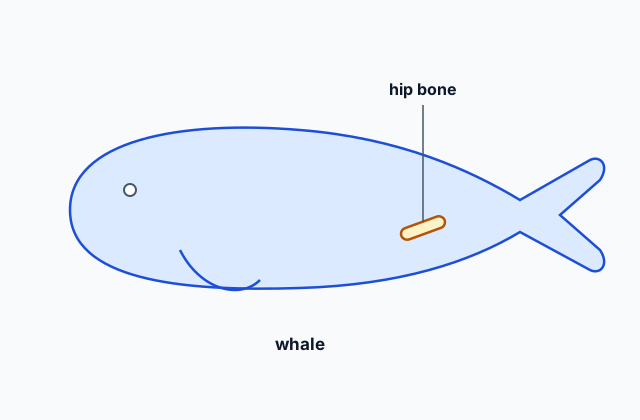 Tap to open the picture full size
Part 1 Think first Hip bones with no legs
Commit to a guess first. Being wrong now makes the right idea stick better.
Predict first
Whales have no hind legs, yet many whales have small hip bones buried in their bodies, attached to no leg. What do these bones most likely tell scientists about whales?
In short. Evolution is supported by scientific evidence from many disciplines, including geographical, geological, physical, biochemical and mathematical data, gathered from both living and extinct organisms.
- Fossils can be dated by the age of the rocks where they are found, by the rate of decay of isotopes including carbon-14, and by geographical data.
- Morphological homologies, including vestigial structures, provide evidence of common ancestry.
- A comparison of DNA nucleotide sequences and protein amino acid sequences provides evidence for evolution and common ancestry.
Part 2 Learn it Evidence that organisms change
2a. Evidence from many fields
Evolution is supported by scientific evidence from many disciplines: geographical, geological, physical, biochemical and mathematical data.
Molecular, morphological and genetic evidence from extant organisms, those alive today, and from extinct ones adds to our understanding of evolution.
- Geological evidence: rocks and the fossils in them, and how old they are.
- Morphological evidence: the form and structure of organisms, living and fossil.
- Biochemical evidence: molecules such as DNA and proteins, and how their sequences compare.
Each kind can be checked against the others, which is why evidence from many fields carries weight.
Quick check · Sort it
Each card describes a piece of evidence for evolution. Tap a card, then the kind of data it is.
Geological
Biochemical
Morphological
2b. Dating fossils
Fossils show organisms that lived in the past, many of them extinct. To use them as evidence of change over time, scientists need their ages. Fossils can be dated by a variety of methods, including:
- the age of the rocks where a fossil is found;
- the rate of decay of isotopes, including carbon-14;
- geographical data.
An isotope that decays does so at a steady rate. A living organism keeps taking in carbon, carbon-14 included, from its surroundings or its food. After it dies, it takes in no more, and the carbon-14 it holds decays, so the less that is left, the longer ago it died. Carbon-14 is used for relatively recent remains; much older fossils are dated from other isotopes in the rocks around them.
Quick check · Multiple choice
A fossil bone holds much less carbon-14 than the bones of living animals. A living animal keeps taking in carbon-14 from its food, and after death the carbon-14 it holds decays at a steady rate. What does the low carbon-14 in the fossil most likely show?
2c. Shared structures
Morphological homologies, including vestigial structures, provide evidence of common ancestry.
- A homology is a likeness in structure that species share because they inherited it from a common ancestor. The forelimbs of a human, a bat and a whale are built from the same set of bones in the same arrangement, though they are used to grasp, to fly and to swim.
- A vestigial structure is a reduced structure with little or no function in a species, but which matches a working structure in related species. It is hard to explain except as something kept from an ancestor.
The point is the shared arrangement, not the use: very different uses built on one body plan point to a shared origin.
Quick check · Fill the statement
Complete the description of evidence from body structures.
The arm of a human and the wing of a bat are built from the same set of bones in the same arrangement, which makes them morphological . A small, reduced body part with little or no function that matches a working part in related species is called a structure. Both kinds of evidence point to common .
2d. Comparing sequences
A comparison of DNA nucleotide sequences and protein amino acid sequences provides evidence for evolution and common ancestry.
To compare, line up the same gene, or the same protein, from two species and count the positions where they differ. Differences build up as lineages change over time. In general, the fewer differences two species have, the more recently they are likely to have shared a common ancestor; the more differences, the longer ago their lineages split.
Molecular data like these can be compared across species that look nothing alike, and across living and extinct ones where DNA survives.
Quick check · Rank it
A protein is compared between a lizard and three other species. Species A's version differs from the lizard's at 12 positions, species B's at 20 and species C's at 1. Rank the species by how closely related to the lizard the comparison suggests they are, from most closely related to least.
Most closely related first
Give each one a place, 1 for first. Give two the same place if they are equal.
Your ranking: none yet
Part 3 Watch it done Counting differences in a gene
Predict first, then watch each step, then finish the reasoning yourself.
The same 12-base stretch of a gene is read in three species. These sequences are a teaching example.
- Species X: ATGGCTAAGTTC
- Species Y: ATGGCAAAGTTT
- Species Z: ACGGCAAATTTG
At how many positions do X and Z differ?
Predict first
Before you open the first step, predict: which species do you expect X to differ from more, Y or Z?
Step 1 · Line the sequences up
Write the stretches one above the other so that position 1 sits over position 1, and so on to position 12.
Step 2 · Compare X and Y
They match everywhere except position 6 (T in X, A in Y) and position 12 (C in X, T in Y): 2 differences.
Why this step?
Why must the stretches come from the same gene?
Only the same gene in two species descends from one gene in their common ancestor, so its differences track change since they split. Two different genes would differ for reasons that have nothing to do with ancestry.
Step 3 · Compare X and Z
Go through all 12 positions and count every one where the bases are not the same.
Your step · Calculate
The same 12-base stretch of a gene reads ATGGCTAAGTTC in species X, ATGGCAAAGTTT in species Y and ACGGCAAATTTG in species Z. At how many positions do the stretches from X and Z differ?
positions
X differs from Y at 2 positions and from Z at 4. On this stretch alone, X and Y look more closely related; a real comparison uses far longer sequences, and many genes, before drawing a conclusion.
Part 4 Try it A protein, and a fish without sight
Two new cases. In the first, a protein compared between two species is turned into the percentage of positions that match; the numbers are a teaching example. In the second, you decide whether the reduced eyes of fish that live in dark caves are evidence that they share an ancestor with fish that live in open water.
Try it · Calculate
The same protein is 104 amino acids long in two species, and the two versions differ at 13 positions. What percentage of the positions are identical?
Try it · Decide and justify
A species of fish that lives in dark caves has small eyes, covered by skin, that do not work. A closely related species that lives in open water has eyes that work. Are the cave fish's eyes evidence that the two species share a common ancestor?
Which statement supports your decision?
Part 5 Explain it From land mammals to whales
On the exam this is handwritten, so answer on paper first. Nothing you type here leaves this page. Then check your answer against the model and each scoring point.
Free response is 50% of the exam score. This one is shaped like Question 4, Conceptual Analysis.
Free-response practice · Question 4 style
Fossils of an extinct mammal have a long body, a whale-like skull and small hind legs. Living whales have no hind legs, but many have small hip bones attached to no leg.
(a) Describe two methods that could be used to estimate the age of the fossils.
(b) Explain how the hip bones of living whales provide evidence that whales share a common ancestor with land mammals.
(c) Researchers read the same gene in whales and in several land mammals. Explain how they could use the sequences to judge which land mammal is most closely related to whales.
(d) Identify one other discipline, besides geology and the study of body structure, that provides evidence for evolution.
Model answer
(a) Find the age of the rocks the fossils were found in, and measure how much of a decaying isotope is left, since isotopes decay at a known, steady rate: carbon-14 for relatively recent remains, and other isotopes in the surrounding rock for much older fossils such as these. (Geographical data also earns the point.)
(b) The hip bones are vestigial structures: reduced, with no leg attached and no role in walking, but matching the hip bones that support hind legs in land mammals. Such morphological homologies provide evidence of common ancestry with mammals that had working hind legs.
(c) Line up the gene from whales and each land mammal and count the positions that differ. A comparison of DNA sequences provides evidence of common ancestry; the land mammal whose sequence has the fewest differences from the whale's is likely the closest relative.
(d) Biochemical, mathematical, physical or geographical data.
Score your own answer. This is a self-check, not a grade. Tick each point your answer makes.
Part 6 Check yourself One protein in five species
Both case questions use the table.
Researchers compare the amino acid sequence of one protein, 120 amino acids long, between species W and four other species. These numbers are a teaching example.
| Species | Differences from species W |
|---|---|
| P | 3 |
| Q | 12 |
| R | 24 |
| S | 36 |
Case question 1 · Calculate
Using the table: species S's protein has how many times as many differences from species W's as species Q's does?
Case question 2 · Multiple choice
Using the table: which conclusion do the data best support?
The rest stand on their own and do not use the case.
Check yourself · Spot the error
A student uses the bones of a python to argue about its ancestry. Tap the line with the mistake.
Check yourself · Match
Match each kind of evidence to what a scientist measures or compares to gather it.
Part 7 Keep it Bring back earlier ideas
Allele frequencies show evolution within one population; this topic shows it across species and long spans of time. Pulling back the conditions of a population that is not evolving, and how a gene's code becomes a protein, sets up comparing sequences.
From 7.5 Hardy–Weinberg Equilibrium · Sort it
Each card describes a population of frogs. Tap a card, then whether it meets the conditions of Hardy-Weinberg equilibrium or breaks one of them.
Meets the conditions
Breaks a condition
From 6.4 Translation · Match
Match each part of the genetic code to what it does in translation.
In three lines
- Evolution is supported by evidence from many disciplines: geographical, geological, physical, biochemical and mathematical.
- Fossils can be dated by rock age, isotope decay including carbon-14, and geographical data; homologies and vestigial structures show common ancestry.
- Comparing DNA and protein sequences provides evidence for evolution and common ancestry.
Exam strategy for this topic
- Section I, Multiple Choice: 60 questions in 90 minutes.
- Section II, Free Response: 6 questions in 90 minutes.
- This lesson's Explain it is shaped like free-response question 4, Conceptual Analysis.
- A four-function, scientific, or graphing calculator is allowed on both sections of the exam.
Name the kind of evidence first (fossil age, homology, vestigial structure, DNA or protein sequence), then say what it shows. For sequences, count the differences and put the pair with the fewest closest; for structures, compare the arrangement, not the use.
Questions students ask
What kinds of evidence support evolution?
Evidence from many disciplines: geographical, geological, physical, biochemical and mathematical data. Molecular, morphological and genetic evidence from living and extinct organisms adds to our understanding of evolution.
How are fossils dated?
By a variety of methods, including the age of the rocks where a fossil is found, the rate of decay of isotopes including carbon-14, and geographical data.
What is a vestigial structure?
A reduced structure with little or no function that matches a working structure in related species. Morphological homologies, including vestigial structures, provide evidence of common ancestry.
How do DNA and protein sequences show evolution?
A comparison of DNA nucleotide sequences and protein amino acid sequences provides evidence for evolution and common ancestry. In general, fewer differences suggest a more recent common ancestor.
Are homologous structures used for the same thing?
Not necessarily. A human arm, a bat wing and a whale flipper share one arrangement of bones but are used to grasp, fly and swim. The shared arrangement is the evidence.
Course alignment, for teachers
AP Biology topic 7.6, Unit 7: Natural Selection.
- Skill 4.B: Describe data from a table or graph, including:
This lesson maps all 3 essential knowledge statements of the topic to the part that teaches each one: 3 are checked by a scored question. The map is in the lesson file.