Unit 7 · Topic 7.7 · about 30 minutes · 7 parts · 11 scored checks, 2 of them multiple choice, plus 2 from earlier lessons
AP Biology 7.7: Common Ancestry
Unit 7: 13 to 20% of the multiple-choice section
What you'll be able to do
- Describe structural and functional evidence, at the cellular and molecular levels, that all eukaryotes share a common ancestor.
Key vocabulary
| Term | What it means | The exam trap |
|---|---|---|
| Membrane-bound organelle | A compartment inside a cell that is enclosed by its own membrane, such as the nucleus or a mitochondrion. | Name the organelle and its membrane before using it as evidence. |
| Linear chromosome | A chromosome whose DNA molecule has two free ends. | Check the shape of the DNA molecule, not the number of chromosomes, when describing it. |
| Intron | A stretch of a gene that is transcribed and then removed before the RNA is translated. | Keep introns and exons apart: say which one leaves the RNA and which one stays. |
| Common ancestor | An ancestral population from which two or more lineages descend. | Say which ancestor, of eukaryotes or of all life, a claim is about. |
 Tap to open the picture full size
Part 1 Think first A yeast and a person
Commit to a guess first. Being wrong now makes the right idea stick better.
Predict first
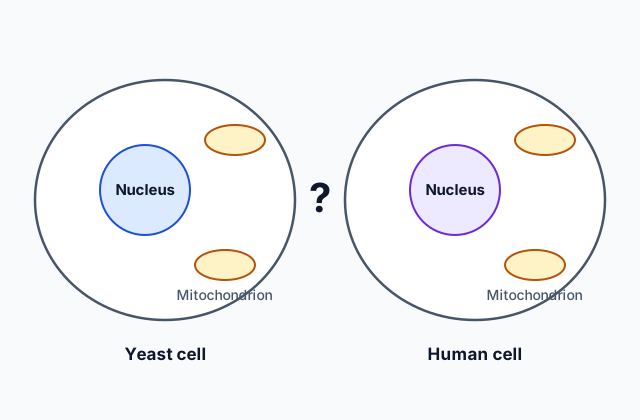
Baker's yeast is a single-celled fungus; a person is made of trillions of cells. Yet both keep their DNA in a nucleus inside membranes, both have mitochondria, and many of their genes are broken up by stretches that are cut out of the RNA. What best explains why two such different organisms share these features?
In short. Structural and functional evidence at the cellular and molecular levels indicates that all eukaryotes, from yeast to oak trees to people, share a common ancestor.
- All eukaryotes have membrane-bound organelles, such as a nucleus.
- Their chromosomes are linear, and many of their genes contain introns that are removed from the RNA.
- Prokaryotes typically have none of these features.
Part 2 Learn it What eukaryotes share
2a. Three shared features
Structural and functional evidence indicates common ancestry of all eukaryotes. The evidence includes:
- Membrane-bound organelles: compartments such as the nucleus, mitochondria and the endoplasmic reticulum, each enclosed by its own membrane.
- Linear chromosomes: each chromosome is a DNA molecule with two ends, and a cell typically has several of them.
- Genes that contain introns: stretches inside a gene that are transcribed and then removed before the RNA is translated.
Prokaryotes, by contrast, typically lack membrane-bound organelles, keep their DNA in a single circular chromosome, and have genes without introns.
Quick check · Sort it
Each card describes a feature of a cell. Tap a card, then the kind of cell it is typical of.
Eukaryotic cell
Prokaryotic cell
2b. Why shared features point to one ancestor
Fungi, plants, animals and single-celled eukaryotes look nothing alike, yet they share these features. The evidence is structural, in how the cell and its DNA are built, and functional, in how the parts work: the RNA of a fungus and of an animal has its introns removed, and their mitochondria do the same job.
A set of complex features found together across eukaryotes, and typically missing from prokaryotes, is best explained by inheritance: they arose once, in an ancestor of all eukaryotes, and were passed down to every lineage that descends from it. That shared ancestor is what common ancestry means here.
Quick check · Decide and justify
A biologist claims that fungi, plants and animals all descend from one common ancestor. Does the observation that all three have genes containing introns support the claim?
Which statement supports your decision?
2c. Using the evidence to predict
Because the three features were inherited together from the eukaryotes' common ancestor, finding one of them in a newly discovered cell lets a biologist predict the others. A cell with a nucleus will most likely also have linear chromosomes and genes with introns.
Not every shared feature points to eukaryotes in particular. Ribosomes, DNA as the genetic material and a plasma membrane are found in prokaryotes too, so they are evidence of the common ancestry of all known life, not of the eukaryotes' own ancestor. To support a claim about eukaryotes, use a feature that eukaryotes share and prokaryotes typically lack.
Quick check · Multiple choice
A newly described single-celled organism has a nucleus and mitochondria, each enclosed by a membrane. Which other feature would biologists most likely find in it?
Part 3 Watch it done Introns in the same places
Predict first, then watch each step, then finish the reasoning yourself.
The same gene is compared in a plant, a fungus and an animal, and the position of each intron is recorded by the codon it follows. In the plant, introns follow codons 12, 40, 77 and 103; in the fungus, codons 12 and 77; in the animal, codons 12, 40, 77 and 150. These positions are a teaching example. At how many positions do all three genes have an intron?
Predict first
Before you open the first step, predict: will the three genes have introns in the same places?
Step 1 · List the positions
Plant: 12, 40, 77, 103. Fungus: 12, 77. Animal: 12, 40, 77, 150.
Step 2 · Start from the shortest list
A position shared by all three must be in the fungus's list, which has only 12 and 77. So at most two positions can be shared by all three.
Why this step?
Why would an intron in the same place in a plant, a fungus and an animal be evidence of common ancestry?
An intron is far more likely to have sat at that spot in an ancestor of all three, and to have been inherited by each lineage, than to have appeared at the very same spot three separate times.
Step 3 · Check each position
Look for 12 and for 77 in the plant's list and the animal's list, and count the positions found in all three.
Your step · Calculate
The same gene is compared in three eukaryotes. In a plant, introns follow codons 12, 40, 77 and 103; in a fungus, codons 12 and 77; in an animal, codons 12, 40, 77 and 150. At how many positions do all three genes have an intron?
positions
Two positions, after codons 12 and 77, are shared by all three. Genes that contain introns, some of them in matching places in a plant, a fungus and an animal, are molecular evidence that all three descend from a common ancestor.
Part 4 Try it Weighing new evidence
Two new situations. In the first, a researcher compares the molecules that remove introns in human and yeast cells, a teaching example, and decides what it shows. In the second, a student writes an argument about fungi, plants and animals; find where it goes wrong.
Try it · Decide and justify
In a teaching example, a researcher finds that human cells and yeast cells remove introns from their RNA using very similar sets of molecules. Does this finding support the claim that humans and yeast share a common ancestor?
Which statement supports your decision?
Try it · Spot the error
A student explains what the cells of fungi, plants and animals show about their ancestry. Tap the line with the mistake.
Part 5 Explain it Placing a new organism
On the exam this is handwritten, so answer on paper first. Nothing you type here leaves this page. Then check your answer against the model and each scoring point.
Free response is 50% of the exam score. This one is shaped like Question 4, Conceptual Analysis.
Free-response practice · Question 4 style
Biologists find a new single-celled organism in a lake and want to know whether it shares a common ancestor with all eukaryotes.
(a) Describe two features, at the cellular or molecular level, that would indicate the organism is a eukaryote.
(b) Explain how features shared by fungi, plants and animals support the claim that all eukaryotes have a common ancestor.
(c) A student says that because the organism has ribosomes, it must share a common ancestor with eukaryotes in particular. Explain why ribosomes alone do not support that claim.
(d) The organism turns out to have a nucleus. Predict whether its genes are likely to contain introns, and justify the prediction.
Model answer
(a) Membrane-bound organelles, such as a nucleus or mitochondria; linear chromosomes; genes that contain introns. Any two earn the point.
(b) These features are found across eukaryotes, however different, and are typically missing from prokaryotes. They are best explained as inherited from one ancestor in which they arose, rather than arising separately in each group.
(c) Prokaryotes have ribosomes too, so ribosomes are evidence of the common ancestry of all known life, not of eukaryotes in particular.
(d) Yes, its genes most likely contain introns. A nucleus is a membrane-bound organelle, which marks the organism as a eukaryote, and eukaryotes inherited introns along with their organelles from their common ancestor.
Score your own answer. This is a self-check, not a grade. Tick each point your answer makes.
Part 6 Check yourself Five cells compared
All three case questions use the table.
A lab examines five single-celled organisms, V to Z, for three features. These organisms are a teaching example.
| Organism | Membrane-bound organelles | Chromosomes | Genes with introns |
|---|---|---|---|
| V | Yes | Linear | Yes |
| W | No | Circular | No |
| X | No | Linear | No |
| Y | Yes | Linear | Yes |
| Z | No | Circular | No |
Case question 1 · Multiple choice
Using the table: which organism, like organism V, has all three features shared by eukaryotes?
Case question 2 · Decide and justify
Using the table: a student says organism X is a eukaryote because its chromosomes are linear. Is the claim well supported?
Which statement supports your decision?
Case question 3 · Calculate
Using the table: what percentage of the five organisms have all three features shared by eukaryotes?
The rest stand on their own and do not use the case.
Check yourself · Fill the statement
Complete the description of the evidence for the ancestry of eukaryotes.
All eukaryotes have organelles, chromosomes that are rather than closed loops, and genes that contain . These shared features are evidence that all eukaryotes descend from a ancestor.
Check yourself · Sort it
Each card names a feature found in a fungus and in a plant. Tap a card, then the common ancestry it is evidence of.
Eukaryotes in particular
All known life
Part 7 Keep it Bring back earlier ideas
The features eukaryotes share are one more line of evidence for common ancestry, beside the kinds of evidence met in the last topic. Pulling back that evidence, and how prokaryotic and eukaryotic chromosomes differ, sets the eukaryotes' shared features beside them.
From 7.6 Evidence of Evolution · Sort it
Each card describes a piece of evidence for evolution. Tap a card, then the kind of data it is.
Geological
Biochemical
Morphological
From 6.1 DNA and RNA Structure · Sort it
Each card describes the chromosomes of a cell. Tap a card, then the kind of cell it typically describes.
Prokaryotic cell
Eukaryotic cell
In three lines
- All eukaryotes share membrane-bound organelles, linear chromosomes and genes that can contain introns.
- This structural and functional evidence indicates that all eukaryotes have a common ancestor.
- Features prokaryotes share too, such as ribosomes, point to the ancestry of all life instead.
Exam strategy for this topic
- Section I, Multiple Choice: 60 questions in 90 minutes.
- Section II, Free Response: 6 questions in 90 minutes.
- This lesson's Explain it is shaped like free-response question 4, Conceptual Analysis.
- A four-function, scientific, or graphing calculator is allowed on both sections of the exam.
When a question asks for evidence that eukaryotes share a common ancestor, name a feature all eukaryotes have and prokaryotes typically lack: membrane-bound organelles, linear chromosomes or genes with introns. Then say it was inherited from that ancestor.
Questions students ask
What evidence shows that all eukaryotes share a common ancestor?
Structural and functional evidence at the cellular and molecular levels: all eukaryotes have membrane-bound organelles, linear chromosomes and genes that can contain introns.
Why do shared features point to a common ancestor?
Complex features found together across eukaryotes, however different, are best explained by inheritance from one ancestor in which they arose, rather than by separate origins in each group.
Do prokaryotes have these features?
Typically not. Prokaryotes typically lack membrane-bound organelles, have a single circular chromosome and have genes without introns.
Are ribosomes evidence that eukaryotes share an ancestor?
Not of eukaryotes in particular. Prokaryotes have ribosomes too, so ribosomes are evidence of the common ancestry of all known life.
Course alignment, for teachers
AP Biology topic 7.7, Unit 7: Natural Selection.
- Skill 6.E: Predict the causes or effects of a change in, or disruption to, one or more components in a biological system.
This lesson maps the one essential knowledge statement of the topic to the part that teaches each one: 1 is checked by a scored question. The map is in the lesson file.