Unit 7 · Topic 7.8 · about 30 minutes · 7 parts · 11 scored checks, 2 of them multiple choice, plus 2 from earlier lessons
AP Biology 7.8: Continuing Evolution
Unit 7: 13 to 20% of the multiple-choice section
What you'll be able to do
- Explain how evolution is an ongoing process in all living organisms.
Key vocabulary
| Term | What it means | The exam trap |
|---|---|---|
| Resistance | The ability of some members of a population to survive a drug or chemical that kills others of their kind. | Say which population, and which drug or chemical, a claim about resistance is about. |
| Pathogen | A virus, bacterium or other agent that causes disease in a host. | Name which organism changed, the pathogen or its host, before explaining a new disease. |
| Generation | One round of reproduction, from parents to their offspring. | Count generations, not years, when judging how fast a population can change. |
| Genome | All of the genetic information in an organism or a species. | Say what kind of evidence, fossil or DNA, a claim about change rests on. |
 Tap to open the picture full size
Part 1 Think first Unchanged for millions of years?
Commit to a guess first. Being wrong now makes the right idea stick better.
Predict first
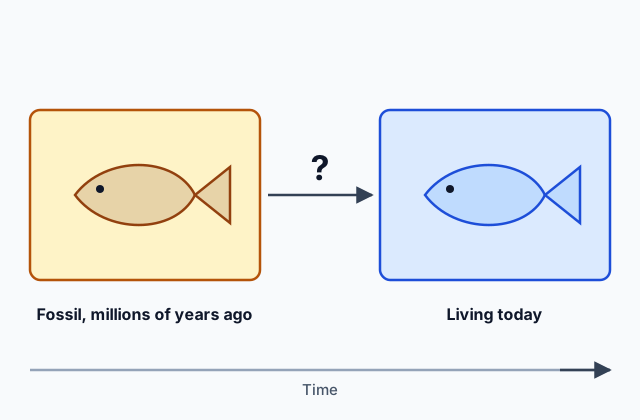
In a teaching example, fossils of a kind of fish from millions of years ago look almost exactly like the same kind of fish alive today. Has this lineage stopped evolving?
In short. All species have evolved and continue to evolve; the evidence includes changes in genomes over time, continuous change in the fossil record, resistance to drugs and pesticides, and pathogens that cause emergent diseases.
- Genomes keep changing over time, and the fossil record shows lineages changing continuously.
- Populations evolve resistance to antibiotics, pesticides, herbicides and chemotherapy drugs.
- Pathogens evolve, and new variants can cause emergent diseases.
Part 2 Learn it Evolution has not stopped
2a. Genomes and fossils keep changing
All species have evolved and continue to evolve. Two kinds of evidence show it over long spans of time:
- Genomic changes over time. Mutations keep adding new variation, so the DNA of a species changes from generation to generation, and populations of one species come to differ in their DNA.
- Continuous change in the fossil record. Fossils from older and younger rock layers show a lineage changing step by step.
A species that is well suited to its environment still evolves. Environments keep changing, and new variation keeps arising.
Quick check · Multiple choice
Fossils of a clam lineage show its shell shape changing step by step through rock layers spanning several million years, and DNA from one living population of the clams, sampled 30 years apart, differs in sequence. What do the two observations together best show?
2b. Resistance evolves
Evolution can be fast enough to watch. Populations evolve resistance to antibiotics, pesticides, herbicides and chemotherapy drugs.
A population varies. If a few individuals carry a variant that lets them survive a drug or a chemical, then using it kills many of the others, and the survivors reproduce and pass the variant on. Over generations the variant becomes more common, and the drug or chemical works less well. The variant was not caused by the drug; the drug selected among variants that were already there or that arose by chance.
Cancer cells in a tumor vary too, so a tumor can evolve resistance to a chemotherapy drug in the same way.
Quick check · Put it in order
A bacterial infection is treated with one antibiotic for many weeks, and the population of bacteria evolves resistance. Put the events in the order they happen.
2c. Pathogens and emergent diseases
Pathogens, the viruses, bacteria and other agents that cause disease, evolve too. A virus that copies its genome many times gains mutations, and related viruses can recombine their genetic information when they infect the same host cell. A new variant may infect a new host species, spread more easily, or escape a host's defenses.
Pathogens evolving in these ways can cause emergent diseases, diseases that appear in a population for the first time or spread rapidly in a new way.
Quick check · Match
Match each example of ongoing evolution to what is observed.
Part 3 Watch it done One course of an antibiotic
Predict first, then watch each step, then finish the reasoning yourself.
A population of 1,010 bacteria includes 10 cells carrying a resistance allele; the other 1,000 lack it. An antibiotic kills 99% of the cells without the allele and none of the cells with it. These numbers are a teaching example. What percentage of the surviving cells carry the allele?
Predict first
Before you open the first step, predict: how will the share of resistant cells after the antibiotic compare with the share before it?
Step 1 · Find the share before
10 of 1,010 cells carry the allele, just under 1% of the population.
Step 2 · Count the survivors without the allele
The antibiotic kills 99% of the 1,000 cells without the allele, so 1% of them survive: 10 cells.
Why this step?
Why does the allele's share change even though no cell gained the allele?
The antibiotic removes cells without the allele far more than cells with it. The resistant cells are not new; they make up a larger part of the smaller population that is left, and they pass the allele on when they divide.
Step 3 · Find the share after
Add the survivors of both kinds, then divide the resistant survivors by that total.
Your step · Calculate
A population of 1,010 bacteria includes 10 cells carrying a resistance allele and 1,000 that lack it. An antibiotic kills 99% of the cells without the allele and none of the cells with it. What percentage of the surviving cells carry the allele?
%
From under 1% to 50% in one treatment. When the survivors divide, the next population starts with far more resistant cells, and repeated treatment pushes the share higher still. That is resistance evolving.
Part 4 Try it A weed killer stops working
A farm sprays the same herbicide, a weed killer, on its fields every year. These numbers are a teaching example. First, compare how many weeds survive the spray early and late. Second, pick the investigation that tests whether the survival is inherited.
Try it · Calculate
A farm sprays the same herbicide every year. In year 1, 2 of every 400 weeds survive the spray; in year 6, 150 of every 400 survive. The share surviving in year 6 is how many times the share in year 1?
Try it · Decide and justify
On a farm that sprays the same herbicide every year, more weeds survive each year. A researcher wants to test whether the weeds' survival is inherited, rather than caused by a weaker spray in later years. Which investigation is the better test?
Which statement supports your decision?
Part 5 Explain it A cancer drug loses its effect
On the exam this is handwritten, so answer on paper first. Nothing you type here leaves this page. Then check your answer against the model and each scoring point.
Free response is 50% of the exam score. This one is shaped like Question 3, Scientific Investigation.
Free-response practice · Question 3 style
A chemotherapy drug shrinks a patient's tumor at first, but after several months of treatment the tumor grows again even though the drug is still given.
(a) Describe how the population of cells in the tumor could have evolved resistance to the drug.
(b) Researchers grow cells from the regrown tumor in dishes. Propose an investigation, with a control, to test whether the regrown tumor's cells are more resistant to the drug than the original tumor's cells.
(c) Identify the independent variable in your investigation.
(d) Predict the result of your investigation if the tumor has evolved resistance.
Model answer
(a) The tumor's cells varied. A few cells could survive the drug; the drug killed most of the others, and the survivors kept dividing and passed the resistance on to the cells they produced, so the tumor became mostly resistant cells.
(b) Grow equal numbers of cells from the original tumor (saved before treatment) and from the regrown tumor in separate dishes, give each dish the same dose of the drug, and count the cells that survive. Dishes of each kind with no drug are the control.
(c) The source of the cells: the original tumor or the regrown tumor. (The presence of the drug, compared with the no-drug control, also earns the point.)
(d) A larger share of the regrown tumor's cells would survive the drug than of the original tumor's cells.
Score your own answer. This is a self-check, not a grade. Tick each point your answer makes.
Part 6 Check yourself Mosquitoes and an insecticide
All three case questions use the table.
Researchers test mosquitoes from two regions with the same dose of an insecticide, a kind of pesticide, every two years. One region was sprayed with the insecticide every year; the other was never sprayed. The numbers are a teaching example.
| Year | Sprayed region (%) | Unsprayed region (%) |
|---|---|---|
| 0 | 3 | 3 |
| 2 | 9 | 4 |
| 4 | 24 | 3 |
| 6 | 51 | 4 |
| 8 | 81 | 3 |
Case question 1 · Multiple choice
Using the table: which conclusion do the data best support?
Case question 2 · Calculate
Using the table: by how many percentage points did survival in the sprayed region rise from year 0 to year 8?
Case question 3 · Decide and justify
Using the table: a student suggests the rise in the sprayed region was caused by a change in weather over the eight years that affected both regions alike. Do the data support the student's idea?
Which statement supports your decision?
The rest stand on their own and do not use the case.
Check yourself · Spot the error
A student explains what fossils and DNA show about a lineage of snails. Tap the line with the mistake.
Check yourself · Fill the statement
Complete the description of how a virus can come to cause a new disease.
A virus that copies its genome many times gains , and related viruses that infect the same host cell can their genetic information. A new variant that can infect a new host species may cause an disease.
Part 7 Keep it Bring back earlier ideas
Ongoing evolution follows from the shared ancestry of the last topic: lineages that split from one ancestor keep changing. Pulling back what all eukaryotes share, and how a resistance allele spreads, sets ongoing change beside them.
From 7.7 Common Ancestry · Sort it
Each card describes a feature of a cell. Tap a card, then the kind of cell it is typical of.
Eukaryotic cell
Prokaryotic cell
From 6.7 Mutations · Spot the error
A student explains how a population of insects became resistant to an insecticide. Tap the line with the mistake.
In three lines
- All species have evolved and continue to evolve, in their genomes and in the fossil record.
- Populations evolve resistance to antibiotics, pesticides, herbicides and chemotherapy drugs by selection.
- Pathogens evolve, and new variants can cause emergent diseases.
Exam strategy for this topic
- Section I, Multiple Choice: 60 questions in 90 minutes.
- Section II, Free Response: 6 questions in 90 minutes.
- This lesson's Explain it is shaped like free-response question 3, Scientific Investigation.
- A four-function, scientific, or graphing calculator is allowed on both sections of the exam.
When a question says a drug, pesticide or herbicide stopped working, describe variation already in the population, the drug killing the others, and the survivors reproducing. Do not say the drug caused the resistance it selected for.
Questions students ask
Are species still evolving?
Yes. All species have evolved and continue to evolve. Genomes change over time, and the fossil record shows lineages changing continuously.
How does antibiotic resistance evolve?
Some bacteria carry a variant that lets them survive the antibiotic. The drug kills most of the others, the survivors reproduce and pass the variant on, and over generations it becomes common.
What else can populations evolve resistance to?
Pesticides, herbicides and chemotherapy drugs, as well as antibiotics.
What is an emergent disease?
A disease that appears in a population for the first time or spreads rapidly in a new way. Pathogens evolving, for example a virus variant that can infect a new host, can cause emergent diseases.
If a species looks the same in old fossils and today, has it stopped evolving?
No. Its genome and traits that leave no fossil can keep changing; all species continue to evolve.
Course alignment, for teachers
AP Biology topic 7.8, Unit 7: Natural Selection.
- Skill 3.D: Propose a new investigation based on an evaluation of the experimental design or evidence.
This lesson maps the one essential knowledge statement of the topic to the part that teaches each one: 1 is checked by a scored question. The map is in the lesson file.