Unit 8 · Topic 8.2 · about 30 minutes · 7 parts · 12 scored checks, 2 of them multiple choice, plus 2 from earlier lessons
AP Biology 8.2: Energy Flow Through Ecosystems
Unit 8: 10 to 15% of the multiple-choice section
What you'll be able to do
- Describe the strategies organisms use to acquire and use energy.
- Explain how energy flows and matter cycles through trophic levels.
- Explain how changes in energy availability affect populations, communities, and ecosystems.
- Explain how the activities of autotrophs and heterotrophs enable the flow of energy within an ecosystem.
Key vocabulary
| Term | What it means | The exam trap |
|---|---|---|
| Trophic level | A feeding level in an ecosystem: producers, primary to quaternary consumers, or decomposers. | Name what each organism eats before placing it on a level. |
| Biomass | The total mass of living matter, such as at one trophic level in an area. | Check the units and the area before comparing two biomass figures. |
| Reservoir | A place where matter, such as carbon or water, is stored for a time in a cycle. | Name the element being stored before tracing where it moves next. |
| Primary productivity | The capture of energy by producers and its storage in organic matter. | Ask what the producers' energy source is before describing how they capture it. |
 Tap to open the picture full size
Part 1 Think first A snake and a mouse at mealtime
Commit to a guess first. Being wrong now makes the right idea stick better.
Predict first
A corn snake and a mouse of about the same mass are kept as pets in the same warm room. The mouse needs to eat every day, but the snake does fine on one meal every week or two. What best explains the difference?
In short. Organisms use energy to organize, grow, reproduce and maintain homeostasis; autotrophs capture energy that heterotrophs then consume, and matter and nutrients move between the environment and organisms through biogeochemical cycles.
- Endotherms use thermal energy generated by metabolism to maintain body temperature; ectotherms may regulate their temperature behaviorally.
- The water, carbon, nitrogen and phosphorus cycles move matter between abiotic and biotic reservoirs, and each demonstrates the conservation of matter.
- A change in energy resources such as sunlight, or in the biomass of producers, can affect the number and size of the other trophic levels.
Part 2 Learn it Energy and matter in ecosystems
2a. How organisms use energy
Organisms use energy to organize, grow, reproduce and maintain homeostasis. They use different strategies to regulate body temperature and metabolism.
- Endotherms use thermal energy generated by metabolism to maintain homeostatic body temperatures.
- Ectotherms lack efficient internal mechanisms for maintaining body temperature, although they may regulate their temperature behaviorally by moving into the sun or shade or by aggregating with other individuals.
What an organism can do depends on its energy budget. A net gain in energy results in energy storage, the growth of the organism and increased reproductive output. A net loss of energy results in loss of mass, a decrease in reproductive output and, eventually, death.
Different organisms use various reproductive strategies in response to energy availability. Some organisms alternate between asexual and sexual reproduction in response to energy availability.
Quick check · Sort it
Each card describes a change in an animal over one season. Tap a card, then whether that change is what a net gain or a net loss of energy results in.
Net gain of energy
Net loss of energy
2b. Levels, flow and cycles
Ecological levels of organization include populations, communities, ecosystems and biomes. A population is the members of one species in an area, and a community is all the populations of different species there. An ecosystem is a community together with the nonliving things it interacts with, such as water, soil and air. A biome is a large region of similar climate and similar kinds of ecosystems, such as all the world's deserts.
Energy flows through ecosystems, while matter and nutrients cycle between the environment and organisms via biogeochemical cycles. Energy moves one way through the organisms; the same atoms of carbon, nitrogen and phosphorus are used again and again. The cycles are essential for life, each cycle demonstrates the conservation of matter, and the cycles are interdependent.
Each cycle has abiotic reservoirs, nonliving places where matter is stored such as the atmosphere, oceans and rocks, and biotic reservoirs, the living organisms. Processes move matter between reservoirs.
Quick check · Sort it
Each card names a place where carbon is stored. Tap a card, then whether it is an abiotic or a biotic reservoir.
Abiotic reservoir
Biotic reservoir
2c. Four cycles
- Water (hydrologic) cycle. Water moves and is stored within the hydrosphere. Reservoirs include oceans, surface water, the atmosphere and living organisms. Processes include evaporation, condensation, precipitation and transpiration, the loss of water vapor from plants.
- Carbon cycle. Carbon atoms recycle into organisms as carbohydrates and back into the atmosphere as carbon dioxide (CO₂). At the highest levels of organization it can be simplified into four parts: photosynthesis, cellular respiration, decomposition and combustion.
- Nitrogen cycle. Its steps include nitrogen fixation, assimilation, ammonification, nitrification and denitrification, performed by microorganisms in the soil. The largest reservoir of nitrogen is the atmosphere. In nitrogen fixation, nitrogen gas (N₂) is fixed into ammonia (NH₃), which ionizes to ammonium (NH₄⁺) by acquiring hydrogen ions from the soil solution.
- Phosphorus cycle. Weathering of rocks releases phosphate (PO₄³⁻) into soil and groundwater. Producers take in phosphate and build it into biological molecules; consumers eat producers and take it in. Phosphorus returns to the soil by decomposition of biomass or by excretion.
Quick check · Match
Match each process to what happens during it.
2d. Autotrophs, heterotrophs and trophic levels
Autotrophs capture energy from physical or chemical sources in the environment.
- Photosynthetic organisms capture energy present in sunlight, contributing to primary productivity.
- Chemosynthetic organisms capture energy from small inorganic molecules present in their environment, which can occur in the absence of oxygen.
Heterotrophs, which include carnivores, herbivores, omnivores, decomposers and scavengers, metabolize carbohydrates, lipids and proteins as sources of energy. They capture the energy in carbon compounds by consuming organic matter derived from autotrophs, incorporating matter into their tissues.
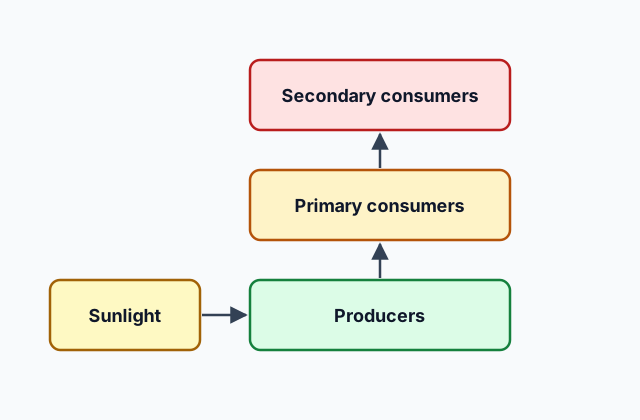
These feeding relationships form trophic levels: producers; primary, secondary, tertiary and quaternary consumers; and decomposers. Changes in energy availability can result in changes in population size and disruptions to an ecosystem. A change in energy resources such as sunlight, or in the biomass or number of producers in an area, can affect the number and size of the other trophic levels.
Quick check · Fill the statement
Complete the description of a food chain at a deep-sea vent.
Bacteria living around a deep-sea vent, far from any sunlight, capture energy from small inorganic molecules, so they are autotrophs. A crab that eats the living bacteria is a , which takes in energy by consuming organic matter.
Part 3 Watch it done Energy up a meadow food chain
Predict first, then watch each step, then finish the reasoning yourself.
A teaching example. In a meadow, the producers capture 15,000 kJ of energy in a year. Primary consumers take in 1,800 kJ by eating producers, and secondary consumers take in 135 kJ by eating primary consumers. What percentage of the energy taken in by the primary consumers is taken in by the secondary consumers?
Predict first
Before you open the first step, predict: about what share of the primary consumers' energy is taken in by the secondary consumers?
Step 1 · Read the levels
Producers 15,000 kJ, primary consumers 1,800 kJ, secondary consumers 135 kJ.
Step 2 · Pick the pair
The question compares the secondary consumers with the primary consumers they eat. So 135 kJ is the part and 1,800 kJ is the whole. The producers' 15,000 kJ is not part of this comparison.
Why this step?
Why does the comparison run only upward, from one level to the level that eats it?
Energy flows through an ecosystem one way, from autotrophs to the heterotrophs that consume them. It is not cycled back to the producers the way matter is.
Step 3 · Divide
Divide the secondary consumers' energy by the primary consumers' energy, and give it as a percentage.
Your step · Calculate
A teaching example: in a meadow, producers capture 15,000 kJ of energy in a year, primary consumers take in 1,800 kJ, and secondary consumers take in 135 kJ. What percentage of the primary consumers' energy is taken in by the secondary consumers?
%
7.5%. In this example each level takes in far less energy than the level it eats, and none of it returns to the producers. That is why a change in the producers can affect the number and size of every level above them.
Part 4 Try it Less light, and a change of strategy
Two new situations, both teaching examples. First, ash from a volcano dims the sunlight over a grassland for two years: predict the effect on the hawks that live there. Second, aphids change how they reproduce as the seasons change: choose what that pattern shows.
Try it · Decide and justify
In a teaching example, ash from a volcanic eruption dims the sunlight reaching a grassland for two years. Hawks in the grassland eat snakes, snakes eat mice, and mice eat the seeds of grasses. Predict the effect on the number of hawks the grassland supports.
Which statement supports your decision?
Try it · Multiple choice
In a teaching example, an aphid species produces offspring asexually while its host plants are plentiful, then reproduces sexually as the plants die back in fall. Which best describes this pattern?
Part 5 Explain it Energy in a pond
On the exam this is handwritten, so answer on paper first. Nothing you type here leaves this page. Then check your answer against the model and each scoring point.
Free response is 50% of the exam score. This one is shaped like Question 4, Conceptual Analysis.
Free-response practice · Question 4 style
In a pond, algae are eaten by water fleas, and water fleas are eaten by small fish. Water fleas are ectotherms.
(a) Describe how the algae capture the energy that enters this food chain.
(b) Describe one way an ectotherm such as a water flea may regulate its body temperature.
(c) Explain how energy captured by the algae comes to be used by the small fish.
(d) A summer of cloudy weather reduces the algae in the pond. Explain how this change in energy availability could affect the size of the water flea population.
Model answer
(a) Algae are photosynthetic autotrophs. They capture energy present in sunlight and store it in carbon compounds, contributing to primary productivity.
(b) An ectotherm lacks efficient internal mechanisms for keeping its temperature steady, but it may regulate it behaviorally, such as by moving between warmer and cooler water or by aggregating with other individuals.
(c) Water fleas are heterotrophs: they eat the algae and metabolize their carbohydrates, lipids and proteins for energy, incorporating matter into their own tissues. The fish eat the water fleas and capture the energy in those carbon compounds the same way.
(d) Less algae means less energy available to the water fleas. A net loss of energy leads to loss of mass and lower reproductive output, so the water flea population can shrink.
Score your own answer. This is a self-check, not a grade. Tick each point your answer makes.
Part 6 Check yourself A grassland in a drought
All three case questions use the table.
Researchers measure the biomass, the mass of living matter, at three trophic levels of a grassland in two years. A drought in Year 2 slows the growth of the grasses. Biomass is given in kilograms per hectare. These numbers are a teaching example.
| Trophic level | Year 1 | Year 2 |
|---|---|---|
| Producers | 2,000 | 1,200 |
| Primary consumers | 200 | 110 |
| Secondary consumers | 20 | 9 |
Case question 1 · Calculate
Using the table: by what percentage did the biomass of producers decrease from Year 1 to Year 2?
Case question 2 · Multiple choice
Using the table: which best explains the drop in the biomass of secondary consumers from Year 1 to Year 2?
Case question 3 · Decide and justify
Using the table: a population of rabbits in this grassland feeds on the grasses. Predict whether the rabbit population is more likely to grow or to shrink during Year 2.
Which statement supports your decision?
The rest stand on their own and do not use the case.
Check yourself · Put it in order
Put these levels of ecological organization in order, from the narrowest to the broadest.
Check yourself · Spot the error
A student follows a rabbit that eats grass. Tap the line with the mistake.
Part 7 Keep it Bring back earlier ideas
Organisms spend energy on everything they do, including how they respond to their surroundings, and they can only keep going with a steady input of energy. Pulling back the kinds of response organisms make, and why living things need energy to stay ordered, sets energy flow beside them.
From 8.1 Responses to the Environment · Sort it
Each card describes how an organism responds to a change in its environment. Tap a card, then the kind of response it is.
Behavioral
Physiological
From 3.3 Cellular Energy · Fill the statement
Complete the description of how a living system stays alive.
To stay highly , a living system needs an energy that is greater than its energy .
In three lines
- Organisms use energy to grow, reproduce and maintain homeostasis; endotherms make body heat by metabolism, and ectotherms may regulate temperature by behavior.
- Energy flows through ecosystems, while water, carbon, nitrogen and phosphorus cycle between abiotic and biotic reservoirs.
- Autotrophs capture energy from sunlight or inorganic molecules; heterotrophs eat organic matter, and a change in producers can affect every trophic level.
Exam strategy for this topic
- Section I, Multiple Choice: 60 questions in 90 minutes.
- Section II, Free Response: 6 questions in 90 minutes.
- This lesson's Explain it is shaped like free-response question 4, Conceptual Analysis.
- A four-function, scientific, or graphing calculator is allowed on both sections of the exam.
When a question changes the energy reaching an ecosystem, start at the producers and follow the change up one trophic level at a time, saying at each step how much energy is available to the next.
Questions students ask
What is the difference between an endotherm and an ectotherm?
Endotherms use thermal energy generated by metabolism to maintain homeostatic body temperatures. Ectotherms lack efficient internal mechanisms for maintaining body temperature, although they may regulate it behaviorally by moving into the sun or shade or by aggregating with other individuals.
Does energy cycle through an ecosystem?
No. Energy flows through ecosystems, while matter and nutrients cycle between the environment and organisms via biogeochemical cycles.
What are the four parts of the carbon cycle?
At the highest levels of organization, the carbon cycle can be simplified into four parts: photosynthesis, cellular respiration, decomposition and combustion.
What is the largest reservoir of nitrogen?
The atmosphere. Microorganisms in the soil fix nitrogen gas into ammonia, which ionizes to ammonium.
How do autotrophs and heterotrophs differ?
Autotrophs capture energy from sunlight (photosynthesis) or from small inorganic molecules (chemosynthesis). Heterotrophs capture energy by consuming organic matter derived from autotrophs.
Course alignment, for teachers
AP Biology topic 8.2, Unit 8: Ecology.
- Skill 6.D: Explain the relationship between experimental results and larger biological concepts, processes, or theories.
This lesson maps all 13 essential knowledge statements of the topic to the part that teaches each one: 13 are checked by a scored question. The map is in the lesson file.