Unit 1 · Topic 1.14 · about 30 minutes · 7 parts · 12 scored checks, 3 of them multiple choice
AP Calculus AB 1.14: Connecting Infinite Limits and Vertical Asymptotes
Unit 1: 10 to 15% of the multiple-choice section
What you'll be able to do
- Use limits involving infinity to describe and explain how a function behaves near an input where its values grow without bound, including at a vertical asymptote.
Key vocabulary
| Term | What it means | The exam trap |
|---|---|---|
| Infinite limit | A limit statement such as or , which says the values of increase or decrease without bound as approaches . | Read both halves of the statement: the arrow names the input approaches, and the right side says what the values of do. |
| Unbounded | A function is unbounded near when, for inputs close enough to , its values pass any number you name in size. | Unbounded describes the outputs of the function; the inputs stay close to one number. |
| One-sided limit | What approaches as approaches from one side only, written from the left and from the right. | The or in or names the side the input comes from, not the sign of the answer. |
| Vertical asymptote | A line for which at least one one-sided limit of at is or . | Decide with a limit at that input, not with a glance at the formula or a calculator graph, which can hide behavior near . |
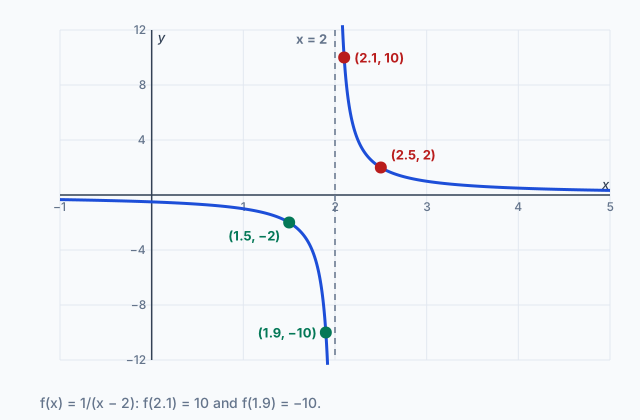 Tap to open the picture full size
Part 1 Think first Where does the image land?
Guess before you learn. A wrong guess still makes the answer stick.
Predict first
A camera lens has a focal length of 10 centimeters. When an object is centimeters in front of it, with , the sharp image forms centimeters behind the lens. With the object 11 centimeters away, the image is 110 centimeters behind the lens. The object is moved in to 10.1 centimeters. About how far behind the lens is the image now?
In short. An infinite limit, such as , says the values of grow without bound as approaches , and the line is a vertical asymptote when at least one one-sided limit there is or .
- is not a real number, so a limit written as or does not exist, and the symbol says how it fails: the function is unbounded.
- When a numerator approaches a number that is not 0 and the denominator approaches 0, the signs of the two parts on each side give the sign of the infinite limit.
- A zero of the denominator is only a candidate: a limit that is a real number there means a hole in the graph, not an asymptote.
Part 2 Learn it Three short ideas, each checked as you go
14a. When the values grow without bound
Some functions have no limit at an input because their values never settle: they grow without bound. Take near 0. At and at it is 100. At and at it is 10,000. Closer inputs give larger outputs, with no ceiling.
Calculus extends limit notation to say this. We write
to mean that can be made larger than any number you name by taking close enough to 0, but not equal to 0. This is an infinite limit. Writing instead means the values decrease without bound.
Two things to keep straight. First, is not a real number. The statement says the limit does not exist, and it says how the limit fails: the function is unbounded near 0.
Second, an infinite limit can be one-sided. On the graph at the top, climbs past 10 just right of 2 and falls past just left of it, so
The two sides disagree, so the two-sided limit at 2 does not exist, and it is neither nor .
Quick check · Multiple choice
No calculator. A function has . What does this statement say about ?
14b. Finding the sign from the formula
A few values suggest an infinite limit; the formula settles it. When the numerator of a quotient approaches a number that is not 0 and the denominator approaches 0, the quotient is unbounded. Its sign on each side comes from the signs of the two parts.
Take . The numerator approaches 4. The denominator approaches 0, and because it is positive. A number near 4 divided by a small positive number is a large positive number, so the limit is . (At the quotient is 401.)
From the left, makes negative, so
(At the quotient is .)
A squared factor such as is positive on both sides of 3, so it never flips the sign. With in the denominator and a numerator near 4, the quotient is large and positive on both sides, and the two-sided limit is .
That is the rule for a two-sided infinite limit: it is only when both one-sided limits are , and only when both are .
Quick check · Sort it
No calculator. Tap a card, then tap the bin that says what the limit on it is.
The limit is
The limit is
The two sides disagree
14c. Vertical asymptotes, explained with limits
The line is a vertical asymptote of the graph of when at least one one-sided limit at is or . One side is enough. Near the line the graph runs alongside it, unbounded.
For a quotient, the zeros of the denominator are where to look, but a zero of the denominator is not yet an asymptote. Take
The denominator is 0 at and at .
At the numerator is 0 too. For , , so . That limit is a real number, so stays bounded near 2, and the graph has a hole there, not an asymptote.
At the numerator approaches 1 and the denominator approaches 0, through positive values from the right. So , and the graph has a vertical asymptote at .
The limit is the explanation. An asymptote is a claim about unbounded behavior, and an infinite one-sided limit is the evidence for it.
Quick check · Decide and justify
No calculator. Let . A classmate says the graph of has a vertical asymptote at , because the denominator is 0 there. Is the classmate right?
Which reason supports your answer?
Part 3 Watch it done Every vertical asymptote of a quotient
Watch each step, then do the last one yourself.
Let . Find every vertical asymptote of the graph of , and justify each answer with a limit.
Step 1 · Factor and list the candidates
. The denominator is 0 at and , so those are the only inputs where an asymptote can be.
Step 2 · Test $x = 1$
For , , so . The limit is a real number, so is not a vertical asymptote. The graph has a hole at .
Why this step?
Why does a limit of at rule out an asymptote there?
A vertical asymptote at needs the values of to grow without bound as approaches 1 from at least one side. Values that approach from both sides stay bounded near 1, so neither one-sided limit is infinite.
Step 3 · Test $x = 3$ from the right
As , the numerator approaches 6 and the denominator approaches 0 through positive values. So , and that one side is enough: the graph of has a vertical asymptote at .
Your step · Fill the statement
No calculator. Finish it. Tap a blank, then tap an answer.
For near 3, as approaches 3 from the left the numerator approaches and the denominator approaches 0 through values. So .
Part 4 Try it A new quotient and a new context
Try it · Calculate
No calculator. How many vertical asymptotes does the graph of have?
Try it · Multiple choice
No calculator. A model for a small lamp gives the brightness meters from it as lux, for . Which statement interprets in this context?
Part 5 Explain it Write it the way the exam asks
On the exam free response is handwritten, so work on paper first. Nothing you type here leaves this page. Then compare with the model answer and score each point.
Free response is 50% of the exam score. This one is shaped like Question 6, from free-response Part B (calculator not permitted).
Free-response practice · Question 6 style
No calculator. A tank holds 600 liters of water when full. While it is being filled, water leaks out at a constant rate of 20 liters per hour. A pump that delivers liters per hour, with , fills the empty tank in hours.
(a) Find . Using correct units, interpret the meaning of in the context of the problem.
(b) Find . Using correct units, explain what this limit says about filling the tank.
(c) The leak rate can change. With a pump that delivers 50 liters per hour and a leak of liters per hour, the empty tank fills in hours, for . Find . Using correct units, explain what this limit says about filling the tank.
Model answer
(a) . A pump that delivers 50 liters per hour fills the empty tank in 20 hours.
(b) As , the numerator stays 600 and the denominator approaches 0 through positive values, so . As the pump's rate decreases toward the leak rate of 20 liters per hour, the time needed to fill the tank increases without bound.
(c) As , the numerator stays 600 and the denominator approaches 0 through positive values, because . So . As the leak rate increases toward the pump's 50 liters per hour, the time needed to fill the tank increases without bound.
Score your own answer. This is a self-check, not a grade. Tick each point your answer makes.
Part 6 Check yourself One quotient, two suspects
The two case questions use the same function and table. Answer them from it.
Let . Its denominator is 0 at and at , so is not defined at either input. The table gives some values of near them.
| 0.9 | |
|---|---|
| 0.99 | |
| 1.01 | 402 |
| 1.1 | 42 |
| 1.9 | 6.444 |
| 1.99 | 6.040 |
| 2.01 | 5.960 |
| 2.1 | 5.636 |
Case question 1 · Match
No calculator. Use the formula for , with the table as a guide. Tap a limit, then what it is.
Case question 2 · Multiple choice
No calculator. Where does the graph of have a vertical asymptote?
The rest stand on their own and do not use the case.
Check yourself · Spot the error
No calculator. A student looks for the vertical asymptotes of . Tap the first line with a mistake.
Check yourself · Calculate
No calculator. Let , where is a constant. For what value of does the graph of have a vertical asymptote at but not at ?
Part 7 Keep it Bring back earlier ideas
Two earlier ideas this lesson leans on. Pulling them back up is what makes them last.
Bring it back · Calculate
No calculator. Let for and for , where is a constant. For what value of is continuous at ?
Bring it back · Match
No calculator. Tap a limit, then what is true of it.
In three lines
- An infinite limit, written with or , says the values of a function grow without bound, and that the limit does not exist.
- Near a zero of a denominator, the signs of the numerator and the denominator on each side give the sign of each one-sided infinite limit.
- The line is a vertical asymptote when at least one one-sided limit at is infinite; a real-number limit there means a hole.
Exam strategy for this topic
- Section I Part A, Multiple Choice (calculator not permitted): 29 questions in 62 minutes.
- Section I Part B, Multiple Choice (graphing calculator required): 13 questions in 38 minutes.
- Section II Part A, Free Response (graphing calculator required): 2 questions in 30 minutes.
- Section II Part B, Free Response (calculator not permitted): 4 questions in 60 minutes.
To justify a vertical asymptote at , write one one-sided limit at that is or , with its reason: the numerator approaches a number that is not 0 while the denominator approaches 0 from a known side. To rule an asymptote out, show that the limit at is a real number.
Questions students ask
Is a limit that exists?
No. A limit exists only when it is a real number, and is not one. Writing is still useful: it says the limit fails to exist because the values grow without bound, rather than because they oscillate or the two sides disagree.
What if the numerator and the denominator are both 0 at ?
Then tells you nothing yet. Factor and cancel, and find the limit again. A real number means a hole; a number that is not 0 over a denominator approaching 0 means an asymptote. gives at 2 and still has an asymptote there.
Can I find vertical asymptotes from a calculator graph?
A graph can suggest one, but a window can hide behavior near an input, and a steep stretch can look like an asymptote that is not there. Confirm each one with a limit from the formula.
Can a graph touch its vertical asymptote?
At most at one point, because a function has at most one output at ; a function defined in pieces can give a value. What the graph cannot do is stay bounded near on the side where the limit is infinite.
Do only rational functions have vertical asymptotes?
No. , so is a vertical asymptote of , and has one at every odd multiple of . The same one-sided limit test applies.
Course alignment, for teachers
AP Calculus AB topic 1.14, Unit 1: Limits and Continuity.
- Skill 3.D: Apply an appropriate mathematical definition, theorem, or test.
This lesson maps all 2 essential knowledge statements of the topic to the part that teaches each one: 2 are checked by a scored question. The map is in the lesson file.