Unit 1 · Topic 1.5 · about 30 minutes · 7 parts · 12 scored checks, 3 of them multiple choice
AP Calculus AB 1.5: Determining Limits Using Algebraic Properties of Limits
Unit 1: 10 to 15% of the multiple-choice section
What you'll be able to do
- Find limits of sums, differences, products, quotients and composite functions with the limit theorems, and find one-sided limits from a formula or a graph.
Key vocabulary
| Term | What it means | The exam trap |
|---|---|---|
| One-sided limit | A limit that uses inputs on one side only: from the left, with , and from the right, with . | The minus sign in means from the left of ; it does not make a negative number. |
| Limit theorems | Rules that find the limit of a sum, difference, product, quotient or composite of functions from the limits of the functions it is built from. | Write each separate limit down, in parentheses, before you combine them; a negative limit is where signs slip. |
| Composite function | A function such as , in which the output of the inside function becomes the input of the outside function . | Read from the inside out: the inside function is the one that receives . |
 Tap to open the picture full size
Part 1 Think first What does the price close in on?
Commit to an answer first. A guess made before the lesson, even a wrong one, helps the idea stay.
Predict first
A courier prices packages by weight , in kilograms. A package under 2 kilograms costs dollars, and a package of 2 kilograms or more costs dollars. Picture packages that stay under 2 kilograms but get closer and closer to 2. What price do their prices close in on?
In short. When the limits of the parts exist, the limit theorems build the limit of a sum, difference, product, quotient or composite from them, and a one-sided limit comes from the formula, or the stretch of graph, on that side alone.
- The limit of a sum, difference, product or constant multiple is that same combination of the separate limits, provided each one exists.
- A quotient's limit is the quotient of the limits only when the denominator's limit is not 0; a composite's limit puts the inner limit into the outer function when the outer function's limit there equals its value.
- A one-sided limit uses inputs on one side only, so it reads the piece of a formula, or the part of a graph, that holds on that side.
Part 2 Learn it Limits from one side, then limits of combinations
2a. One-sided limits from a formula or a graph
A one-sided limit uses inputs from one side only. is the limit from the left, using , and is the limit from the right, using . Neither one looks at .
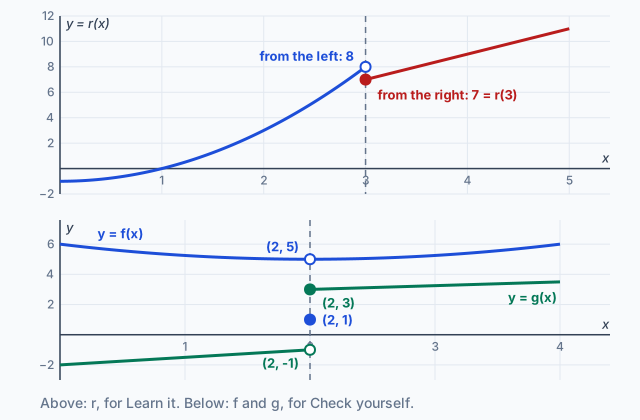
From a formula. A function defined in pieces says which formula holds on each side. The upper graph at the top of the lesson is
Just left of 3, , so . Just right of 3, , so . Each piece is a polynomial, and the next chunk shows why a polynomial's limit is its value.
From a graph. Trace the graph toward from each side and read the height it heads for. The left branch heads for the open circle at height 8, and the right branch for the filled dot at height 7. An open circle means that one point is missing from the graph, not that the limit is missing.
The two-sided limit exists only when the two one-sided limits are equal. Here they are 8 and 7, so it does not exist.
Quick check · Match
No calculator. Let . Tap each one-sided limit, then its value.
2b. Sums, differences, products and constant multiples
Suppose and , and both limits exist. The limit theorems say a combination's limit is the same combination of and :
- and ;
- for any constant ;
- .
So if and , then
Write each separate limit in parentheses before you combine them. A negative limit is where signs get lost.
The same theorems explain polynomials. Since and a constant's limit is itself, products and sums build any polynomial: , which is the polynomial's value at 2.
The theorems work the same way for one-sided limits, as long as every limit in the combination comes from the same side. If a limit you need does not exist, the theorem cannot be used, and the combined limit needs another look.
Quick check · Calculate
No calculator. Suppose and . Find .
2c. Quotients and composite functions
Quotients. With and ,
If and , the limit of the quotient is 3. If , the theorem gives no answer at all. It does not say the limit is 0, and it does not say the limit fails to exist. Check the denominator's limit before you divide.
Composite functions. In , the inside function acts first. If and , then
For example, if , then , because the square root's limit at 16 is its value there. Find the inner limit first, then put it into the outer function, never the other way around.
Powers are a special case: by the product theorem, .
Quick check · Multiple choice
No calculator. Suppose and . What is ?
Part 3 Watch it done A quotient whose top is defined in pieces
Open each step in turn, then finish the last one yourself.
Let . Find .
Step 1 · Limit from the left
For , , so .
Step 2 · Limit from the right
For , , so .
Step 3 · Two-sided limit of the top
The one-sided limits are equal, so . The value plays no part.
Step 4 · Limit of the bottom
, which is not 0. So the quotient theorem applies: .
Why this step?
Why find both one-sided limits of , and the bottom's limit, before dividing?
The quotient theorem has two conditions: the limits of the top and the bottom must exist, and the bottom's limit must not be 0. The equal one-sided limits show the top's limit exists, and the bottom's limit of 4 shows it is not 0. Only then may the theorem be used.
Your step · Calculate
No calculator. Finish it. For the function above, and . What is ?
Part 4 Try it New functions, the same theorems
Try it · Calculate
No calculator. Let , and suppose . Find .
Try it · Decide and justify
No calculator. Suppose and . A classmate argues that does not exist, because the quotient theorem would give . Does the quotient theorem show that the limit does not exist?
Which reason supports your answer?
Part 5 Explain it Answer it as a free-response question
Free response is written by hand on the exam, so answer on paper first. Nothing you type on this page is sent anywhere. Then open the model answer and score yourself point by point.
Free response is 50% of the exam score. This one is shaped like Question 6, from free-response Part B (calculator not permitted).
Free-response practice · Question 6 style
No calculator. A delivery drone's battery charge is percent of a full charge, minutes after the drone first takes off, for . At the drone lands, its battery is swapped for another one, and it takes off again. Treating the swap as instant,
(a) Find and . Using correct units, interpret in the context of the problem.
(b) Does exist? Justify your answer.
(c) The drone uses 5 percent of a full charge each minute, so its controller estimates the flight time left as minutes. Use the properties of limits to find . Show the work that leads to your answer.
Model answer
(a) For , , so . For , , so . As the time approaches 10 minutes from before the swap, the battery charge approaches 50 percent of a full charge.
(b) No. The limit from the left is 50 and the limit from the right is 90. They are not equal, so does not exist.
(c) exists, and the denominator is the constant 5, which is not 0. So by the quotient property, minutes. Just after the swap, the controller's estimate of flight time left approaches 18 minutes.
Score your own answer. This is a self-check, not a grade. Tick each point your answer makes.
Part 6 Check yourself Two functions near x = 2
Both case questions use the lower graph at the top of the lesson. Read every limit you need from it.
The picture at the top of the lesson has two plots. The lower plot, shown again here, graphs two functions near : is the curve, and is the pair of line pieces. Each open circle marks a point missing from a graph, and each filled dot marks a function's value at .
Tap to open the picture full sizeCase question 1 · Calculate
No calculator. Use the graphs of and to find .
Case question 2 · Multiple choice
No calculator. Using the graphs of and , what is ?
The rest stand on their own and do not use the case.
Check yourself · Spot the error
No calculator. Let . A student works out . Tap the first line with a mistake.
Check yourself · Fill the statement
No calculator. Tap a blank, then tap an answer.
If and , then provided . If and , then equals .
Part 7 Keep it Bring back earlier ideas
Two ideas from earlier in Unit 1 that this lesson leans on. Recalling them now is what keeps them.
Bring it back · Multiple choice
No calculator. The table gives values of a function near , and .
What is the best estimate of from the table?
Bring it back · Decide and justify
No calculator. A function has . A classmate says this means . Is the classmate right?
Which reason supports your answer?
In three lines
- A one-sided limit uses only inputs on its side: the piece of the formula, or the part of the graph, that holds there.
- When the separate limits exist, the limit of a sum, difference, product or constant multiple is that combination of the limits.
- A quotient's limit needs a nonzero denominator limit, and a composite's limit puts the inner limit into the outer function.
Exam strategy for this topic
- Section I Part A, Multiple Choice (calculator not permitted): 29 questions in 62 minutes.
- Section I Part B, Multiple Choice (graphing calculator required): 13 questions in 38 minutes.
- Section II Part A, Free Response (graphing calculator required): 2 questions in 30 minutes.
- Section II Part B, Free Response (calculator not permitted): 4 questions in 60 minutes.
When a free-response part asks for the limit of a combination, write each separate limit first, then say why the theorem applies (each limit exists, and a denominator's limit is not 0), and only then combine them. For a function in pieces, name the piece you use on each side.
Questions students ask
Do I have to name the limit theorem I use?
Not by name. A teacher's advice: write each separate limit, then the combination, so a reader can see which theorem you used. For a quotient, write that the denominator's limit is not 0.
Why is the limit of a polynomial just its value?
A polynomial is built from and constants by sums, products and constant multiples. Since and a constant's limit is itself, the limit theorems put those pieces back together and give the polynomial's value at .
What if one of the separate limits does not exist?
Then the theorem cannot be used on that combination. That alone does not prove the combined limit fails to exist; it means you need another way to find it.
Is a limit at a negative number?
No. The minus sign means the inputs approach 2 from the left, through values such as 1.9 and 1.99. The number being approached is still 2.
Can I use the limit theorems on one-sided limits?
Yes, as long as every limit in the combination comes from the same side. A limit from the right of a sum is the sum of the limits from the right.
Course alignment, for teachers
AP Calculus AB topic 1.5, Unit 1: Limits and Continuity.
- Skill 1.E: Apply appropriate mathematical rules or procedures, with and without technology.
This lesson maps all 2 essential knowledge statements of the topic to the part that teaches each one: 2 are checked by a scored question. The map is in the lesson file.