Unit 1 · Topic 1.6 · about 30 minutes · 7 parts · 12 scored checks, 3 of them multiple choice
AP Calculus AB 1.6: Determining Limits Using Algebraic Manipulation
Unit 1: 10 to 15% of the multiple-choice section
What you'll be able to do
- Determine a limit by rewriting the function as an equivalent expression, by factoring, by multiplying by a conjugate or by using a trigonometric identity, when substitution gives .
Key vocabulary
| Term | What it means | The exam trap |
|---|---|---|
| Equivalent expressions | Two expressions that give the same output at every input in a set, such as and at every . | Each time you replace one form with the other, write the inputs where they agree, such as , so no step claims more than the algebra gives. |
| Common factor | A factor of the whole numerator and of the whole denominator, such as in , which can be divided out. | Factor completely before you divide anything out; a piece that is added to other terms is not a factor. |
| Conjugate | For a sum or difference with a square root, such as , the same two terms with the opposite sign between them, . | The conjugate changes the sign between the terms, not the sign in front of the square root. |
| Alternate form of a trigonometric function | The same trigonometric expression written another way by an identity, such as for , or for . | Choose the form that makes a factor appear in both the numerator and the denominator. A form that exposes no common factor leaves the where it was. |
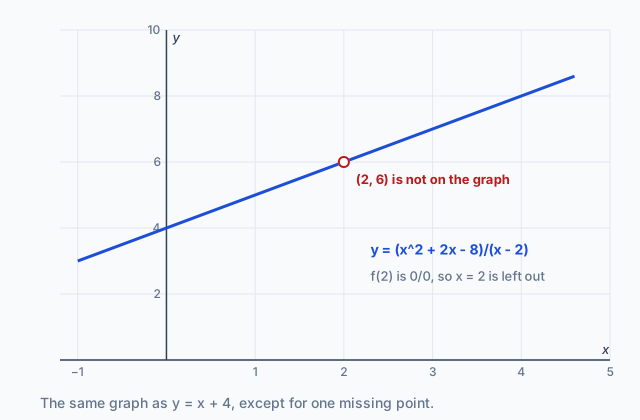 Tap to open the picture full size
Part 1 Think first A cell the spreadsheet cannot fill
Guess before you learn. A wrong guess still makes the answer stick.
Predict first
Priya fills a spreadsheet column with . Every cell works except the one for , which shows a divide-by-zero error, because there the formula is . As gets closer and closer to 3, what value does approach?
In short. When substituting into a limit gives , rewrite the function as an equivalent expression that agrees with it near the input, and find the limit of that expression instead.
- from substitution is not a value. It says the expression has to be rewritten before the limit can be found.
- Factoring and dividing out a common factor, multiplying by a conjugate, and switching to another form of a trigonometric function each give an equivalent expression.
- An expression that equals the function for every input near , other than itself, has the same limit as .
Part 2 Learn it Three ways to rewrite, each checked as you go
2a. When substitution gives 0/0, factor
In 1.5 the limit theorems let you find many limits by substituting. Try that on , the function graphed at the top, and you get . That is not an answer, and it does not mean the limit fails to exist. It means the top and the bottom share a factor that is 0 at , and your job is to find it.
Factor, then divide out the common factor:
The two expressions are equivalent for every except 2. A limit as looks only at inputs near 2, never at 2 itself, so the two have the same limit:
The graph shows it: the quotient is the line with an open circle at .
Two cautions. Divide out only a factor of the whole top and the whole bottom, never one term of a sum. And if substitution gives a number, such as , you are already done. Only calls for a rewrite.
Quick check · Calculate
No calculator. Find .
2b. Square roots: multiply by the conjugate
A square root in a sum or difference hides its common factor. Take . Substitution gives , and nothing factors in sight.
The conjugate of is : the same two terms with the sign between them changed. Their product has no square root in it, because :
Multiply the top and the bottom by the conjugate. That is multiplying by , which is 1, so the expression stays equivalent:
for . Now substitution works, and the limit is .
On the side without the square root, leave the conjugate as a factor in parentheses. Expanding it there gains nothing, and the factor you divide out comes from the other side.
Quick check · Multiple choice
No calculator. What is ?
2c. Trigonometric limits: switch to another form
With sines and cosines, the rewrite is an identity you already know:
- , so and ;
- ;
- .
Pick the form that makes one factor appear in both the top and the bottom. For , substitution gives . Rewrite the top with the Pythagorean identity, and it factors as a difference of squares:
for every near 0 other than 0. So the limit is .
The identity did not find the limit by itself. It exposed a common factor, and from there the work is the same as in a rational function. As everywhere in calculus, the angles are in radians.
Quick check · Calculate
No calculator. Find .
Part 3 Watch it done A conjugate in the denominator
Watch each step, then do the last one yourself.
Find .
Step 1 · Try substitution
The top is and the bottom is , so substitution gives . The square root is in the bottom, so its conjugate, , is the tool.
Step 2 · Multiply by the conjugate over itself
Why this step?
Why does multiplying by leave the limit the same?
For every near 5 that fraction is a positive number over itself, which is 1. Multiplying by 1 gives an equivalent expression, so its limit is the same. The conjugate is chosen because has no square root left.
Step 3 · Factor and divide out
, so for the expression is .
Your step · Calculate
No calculator. Finish it. For , . What is ?
Part 4 Try it A claim to judge, and a fraction inside a fraction
Try it · Decide and justify
No calculator. Let . A classmate says does not exist, because is and has no value. Is the classmate right?
Which reason supports your answer?
Try it · Calculate
No calculator. Find . Give an exact decimal.
Part 5 Explain it Write it the way the exam asks
On the exam free response is handwritten, so work on paper first. Nothing you type here leaves this page. Then compare with the model answer and score each point.
Free response is 50% of the exam score. This one is shaped like Question 3, from free-response Part B (calculator not permitted).
Free-response practice · Question 3 style
No calculator. Water drains from a tank. The depth of the water, in centimeters, minutes after a valve is opened is for . For , let .
(a) Explain why cannot be found by substituting into .
(b) Find . Show the work that leads to your answer.
(c) In part (b), the limit of was found from a different expression, one that has a value at . is not defined. Explain why the two expressions must have the same limit as .
Model answer
(a) . At the numerator of is and the denominator is , so substitution gives , which is not a value. has to be rewritten first.
(b) For , . Multiply the numerator and the denominator by :
So centimeters per minute.
(c) For every in , the work in (b) shows . A limit as uses only the values at inputs near 4, never the value at 4 itself, so two expressions that agree at every near 4 other than 4 have the same limit there. That is not defined does not change the limit.
Score your own answer. This is a self-check, not a grade. Tick each point your answer makes.
Part 6 Check yourself One function, two inputs
The two case questions use the same function. Answer them from its definition.
A function is defined by one formula for every except 3 and a separate value at 3, as the table shows.
| Input | |
|---|---|
Case question 1 · Calculate
No calculator. Find .
Case question 2 · Multiple choice
No calculator. What is ?
The rest stand on their own and do not use the case.
Check yourself · Sort it
No calculator. Substitute first, and rewrite only when substitution gives . Tap a card, then tap what that rule says to do for its limit.
Factor polynomials and divide out a common factor
Multiply by the conjugate
Rewrite with a trigonometric identity
Substitute; no rewrite is needed
Check yourself · Spot the error
No calculator. A student finds . Tap the first line with a mistake.
Part 7 Keep it Bring back earlier ideas
This lesson stands on two earlier ideas: the limit theorems, and what a limit statement means. Pulling them back up is what makes them last.
Bring it back · Calculate
No calculator. Suppose and . Find .
Bring it back · Multiple choice
No calculator. Which statement says what means?
In three lines
- Substitution that gives is a signal to rewrite, not an answer.
- Factor and divide out, multiply by a conjugate, or use a trigonometric identity to reach an equivalent expression.
- The rewritten expression agrees with the function near the input, so its limit there is the function's limit.
Exam strategy for this topic
- Section I Part A, Multiple Choice (calculator not permitted): 29 questions in 62 minutes.
- Section I Part B, Multiple Choice (graphing calculator required): 13 questions in 38 minutes.
- Section II Part A, Free Response (graphing calculator required): 2 questions in 30 minutes.
- Section II Part B, Free Response (calculator not permitted): 4 questions in 60 minutes.
On a no-calculator question, write the substitution first and say what it gives. If it is , show the rewrite itself: the factoring, the conjugate or the identity. Keep in front of every line until you substitute, because a line without it says the expression equals the number, which is not true.
Questions students ask
Does mean the limit does not exist?
No. It means substitution has told you nothing yet. The limit may be any number, or it may fail to exist; rewriting the expression is how you find out.
Why may I divide out a factor that is 0 at the input?
Because the limit never uses the input itself. At every near other than , the factor is not 0, so dividing it out is allowed there, and those are the only inputs the limit looks at.
What if substitution gives a nonzero number over 0?
Then rewriting will not help. Near that input the quotient is unbounded, so the limit does not exist as a real number. Topic 1.14 shows how to describe that behavior with and . The rewrites in this lesson are for .
How do I know which rewrite to use?
Read the expression. Polynomials on the top and the bottom: factor. A square root in a sum or difference: use the conjugate. Sines, cosines and tangents: look for an identity that exposes a common factor.
Can't I just use a table of values instead?
A table gives an estimate, as in 1.4, and it can mislead. The algebra gives the limit exactly, and when a question asks you to find a limit without a calculator, the algebra is the work to show.
Course alignment, for teachers
AP Calculus AB topic 1.6, Unit 1: Limits and Continuity.
- Skill 1.C: Identify an appropriate mathematical rule or procedure based on the classification of a given expression (e.g., Use the chain rule to find the derivative of a composite function).
This lesson maps the one essential knowledge statement of the topic to the part that teaches each one: 1 is checked by a scored question. The map is in the lesson file.