Unit 1 · Topic 1.7 · about 30 minutes · 7 parts · 12 scored checks, 3 of them multiple choice
AP Calculus AB 1.7: Selecting Procedures for Determining Limits
Unit 1: 10 to 15% of the multiple-choice section
Key vocabulary
| Term | What it means | The exam trap |
|---|---|---|
| Limit | A real number is if can be made arbitrarily close to by taking sufficiently close to , but not equal to . | Keep writing on every line until you substitute; without it, a line states a value, not a limit. |
| One-sided limit | The value approaches as approaches from one side only: from the left and from the right. | The minus sign in means from the left of , not a negative number. |
| Limit theorems | Rules that give the limit of a sum, difference, product, quotient or composite function from the limits of its parts. | Each theorem needs the limits of the parts to exist, so say what they are before you combine them. |
| Equivalent form | An expression equal to the original at every input near other than itself, such as a quotient after a common factor is canceled. | A canceled form can differ from the original at itself, so use it for the limit, not for the value at . |
| Conjugate | For a sum or difference with a square root, such as , the same two terms joined by the opposite sign, . | Multiply the top and the bottom by the conjugate, never only one of them, or the value changes. |
 Tap to open the picture full size
Part 1 Think first Is an error message the answer?
Guess before you learn. A wrong guess still makes the answer stick.
Predict first
Jordan is checking his homework. To find , he types into his calculator and gets an error, because the top and the bottom are both 0 there. What does that tell him about the limit?
In short. Selecting a procedure for a limit means reading what you are given, a graph, a table or a formula, and what substitution gives, and letting that choose the method.
- Given only a graph or a table, estimate the limit from outputs at inputs near on both sides, not from the output at .
- Given a formula, substitute first; the kind of result you get decides the next step.
- Where the rule changes at , as in a piecewise function or an absolute value, find each one-sided limit and compare them.
Part 2 Learn it Three short ideas, each checked as you go
7a. Start from what you are given
A limit question hands you a graph, a table or a formula, and that decides your first move.
With a graph or a table there is nothing to compute. Read the outputs at inputs closer and closer to from both sides, and say what they approach. The output at itself plays no part: depends only on inputs near , never on .
With a formula, substitute first. For polynomials, and for sums, products, quotients and composites built from them, the limit theorems come down to substitution, as long as no denominator approaches 0. Roots, sine and cosine also work by substitution at any input inside their domain, a fact you will confirm when you study continuity. What you get tells you what to do next.
- A number. That number is the limit. A top of 0 is fine: .
- A nonzero number over 0. The top stays near that number while the bottom shrinks toward 0, so the size of the quotient grows without bound, positive or negative. The function is unbounded near , and the limit does not exist.
- 0 over 0. The quotient theorem needs a bottom whose limit is not 0, so it cannot be used, and is not a value. Rewrite the expression in an equivalent form, then substitute again.
Quick check · Sort it
No calculator. Substitute the input into each expression. Tap a card, then tap what the substitution tells you about the limit.
Substitution gives the limit
0 over 0: rewrite first
Nonzero over 0: no limit
7b. Zero over zero: let the form choose the rewrite
When substitution gives , the top and the bottom both approach 0, and the quotient could approach any number, or none. To find out, replace the expression with an equivalent form: one equal to it at every input near other than itself. The two have the same limit, because a limit never looks at .
Which rewrite to use depends on what the expression is made of.
- Polynomials on top and bottom. Both are 0 at , so both have the factor . Factor, cancel it, and substitute again.
- A square root in a sum or difference, such as . Multiply the top and the bottom by the conjugate, . The product has no root left.
- Some trigonometric quotients. When the top and the bottom are built from , and , a Pythagorean identity such as reaches a form that factors.
- A fraction inside a fraction. Combine the small fractions over a common denominator, then cancel.
After the rewrite, read the new substitution the same way as before. If it is still , rewrite again.
Quick check · Match
No calculator. Each limit gives when you substitute. Tap a limit, then the rewrite that suits it.
7c. Two rules at one input
Some functions change their rule at . A piecewise function can switch formulas there, and an absolute value such as is for but for . No single formula then describes both sides, so find the two one-sided limits, each from the rule on its own side:
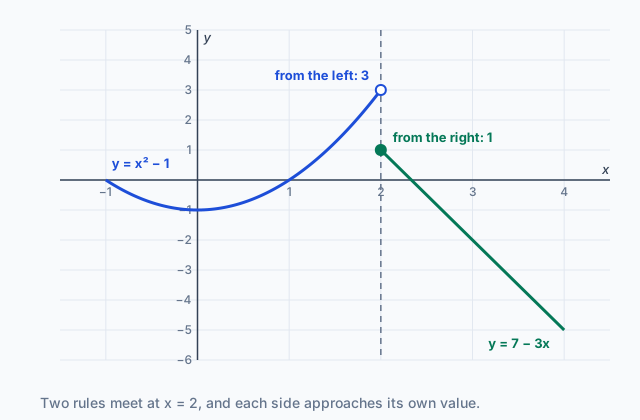
If they are the same number, the limit is that number. If they differ, the limit does not exist. A change of rule alone settles nothing. The graph at the top changes rule at and its sides approach 3 and 1, but two other rules could meet at one value.
Here are three ways a limit can fail to exist, and each shows on a graph or in a table:
- the function is unbounded near ;
- it oscillates near , as swings between and 1 again and again as ;
- the limit from the left and the limit from the right are different numbers.
Quick check · Decide and justify
No calculator. A function is defined by for and for . A classmate says does not exist, because uses one formula to the left of 2 and another to the right. Is the classmate right?
Which reason supports your answer?
Part 3 Watch it done Choosing the rewrite, step by step
Watch each step, then do the last one yourself.
Find .
Step 1 · Substitute first
At the top is and the bottom is . That is , so the quotient theorem cannot be used yet.
Step 2 · Let the form choose
Both parts are polynomials, and both are 0 at , so both have the factor . The top is a sum of cubes, , and the bottom is .
Why this step?
Why must be a factor of both polynomials?
A polynomial that is 0 at has , which is , as a factor. So from two polynomials tells you exactly which factor to look for.
Step 3 · Cancel, then substitute again
For , . At the new bottom is , not 0, so substitution now gives the limit.
Your step · Calculate
No calculator. Finish it. For , . What is ?
Part 4 Try it Two new limits
Try it · Calculate
No calculator. Find .
Try it · Multiple choice
No calculator. What is ?
Part 5 Explain it Write it the way the exam asks
On the exam free response is handwritten, so work on paper first. Nothing you type here leaves this page. Then compare with the model answer and score each point.
Free response is 50% of the exam score. This one is shaped like Question 4, from free-response Part B (calculator not permitted).
Free-response practice · Question 4 style
No calculator. A cyclist rides away from a trailhead along a straight path. Her distance from the trailhead, in meters, seconds after she starts is
For , the function gives her average velocity, in meters per second, between time 4 and time .
(a) Find . Show the work that leads to your answer.
(b) Find . Show the work that leads to your answer.
(c) Does exist? Justify your answer. If it exists, interpret its value in the context of the problem, using correct units.
Model answer
(a) . For , , which gives at . Since , for . So .
(b) For , for . So .
(c) Yes. The left-hand and right-hand limits of at are both 5, so . As the time interval on either side of shrinks, her average velocity approaches 5 meters per second, so at the instant seconds the cyclist is moving away from the trailhead at 5 meters per second.
Score your own answer. This is a self-check, not a grade. Tick each point your answer makes.
Part 6 Check yourself A function known only from a table
The two case questions use the same table. Answer them from it.
A function is defined for all real numbers. Its formula is not given, but , and the table shows at inputs close to 2.
| 1.9 | 11.41 |
|---|---|
| 1.99 | 11.9401 |
| 1.999 | 11.994001 |
| 2.001 | 12.006001 |
| 2.01 | 12.0601 |
| 2.1 | 12.61 |
Case question 1 · Calculate
No calculator. Use the table to estimate .
Case question 2 · Multiple choice
No calculator. Which statement about near do the table and the value support?
The rest stand on their own and do not use the case.
Check yourself · Spot the error
No calculator. A student finds . Tap the first line with a mistake.
Check yourself · Fill the statement
No calculator. Tap a blank, then tap an answer.
As , has no limit because it . As , has no limit because it . As , has no limit because it .
Part 7 Keep it Bring back earlier ideas
Two earlier ideas that every procedure here relies on. Pulling them back up is what makes them last.
Bring it back · Calculate
No calculator. Suppose and . Find .
Bring it back · Multiple choice
No calculator. A runner's distance from the start line is known at every time . How does calculus use limits to define the runner's speed at the instant ?
In three lines
- Read what you are given first: a graph or a table means estimate, and a formula means substitute.
- A number from substitution is the limit, a nonzero number over 0 means no limit, and 0 over 0 means rewrite in an equivalent form.
- Where the rule changes at the input, find both one-sided limits and compare them.
Exam strategy for this topic
- Section I Part A, Multiple Choice (calculator not permitted): 29 questions in 62 minutes.
- Section I Part B, Multiple Choice (graphing calculator required): 13 questions in 38 minutes.
- Section II Part A, Free Response (graphing calculator required): 2 questions in 30 minutes.
- Section II Part B, Free Response (calculator not permitted): 4 questions in 60 minutes.
On a free-response limit, show the substitution that gives , then the rewrite, and keep on every line until the final substitution. Where a function changes rule at the input, write both one-sided limits and say whether they agree before you state the limit.
Questions students ask
Is ever the answer to a limit?
No. It is not a number. It says the quotient theorem cannot be used yet, and the limit could turn out to be any number or fail to exist. Rewrite and substitute again.
If substitution gives a number, do I still need to rewrite?
No. When no denominator approaches 0 and the input is inside the domain of every part, the number you get is the limit. Rewriting is for .
How do I know which rewrite to use?
Read what the expression is made of. Polynomials factor, a square root in a difference takes its conjugate, a quotient built from and takes a Pythagorean identity, and a fraction inside a fraction takes a common denominator.
Can a limit exist where the function has no value?
Yes. The limit uses only inputs near . has no value at 1, but for it equals , so its limit there is 2.
Why use one-sided limits for an absolute value?
Because follows one rule for and another for . Each one-sided limit uses one rule, and the two-sided limit exists only if they agree.
Course alignment, for teachers
AP Calculus AB topic 1.7, Unit 1: Limits and Continuity.
- Skill 1.C: Identify an appropriate mathematical rule or procedure based on the classification of a given expression (e.g., Use the chain rule to find the derivative of a composite function).
This lesson maps the topic's 0 learning objectives, since the course framework gives it no essential knowledge statements, to the part that teaches each one: 0 are checked by a scored question. The map is in the lesson file.